

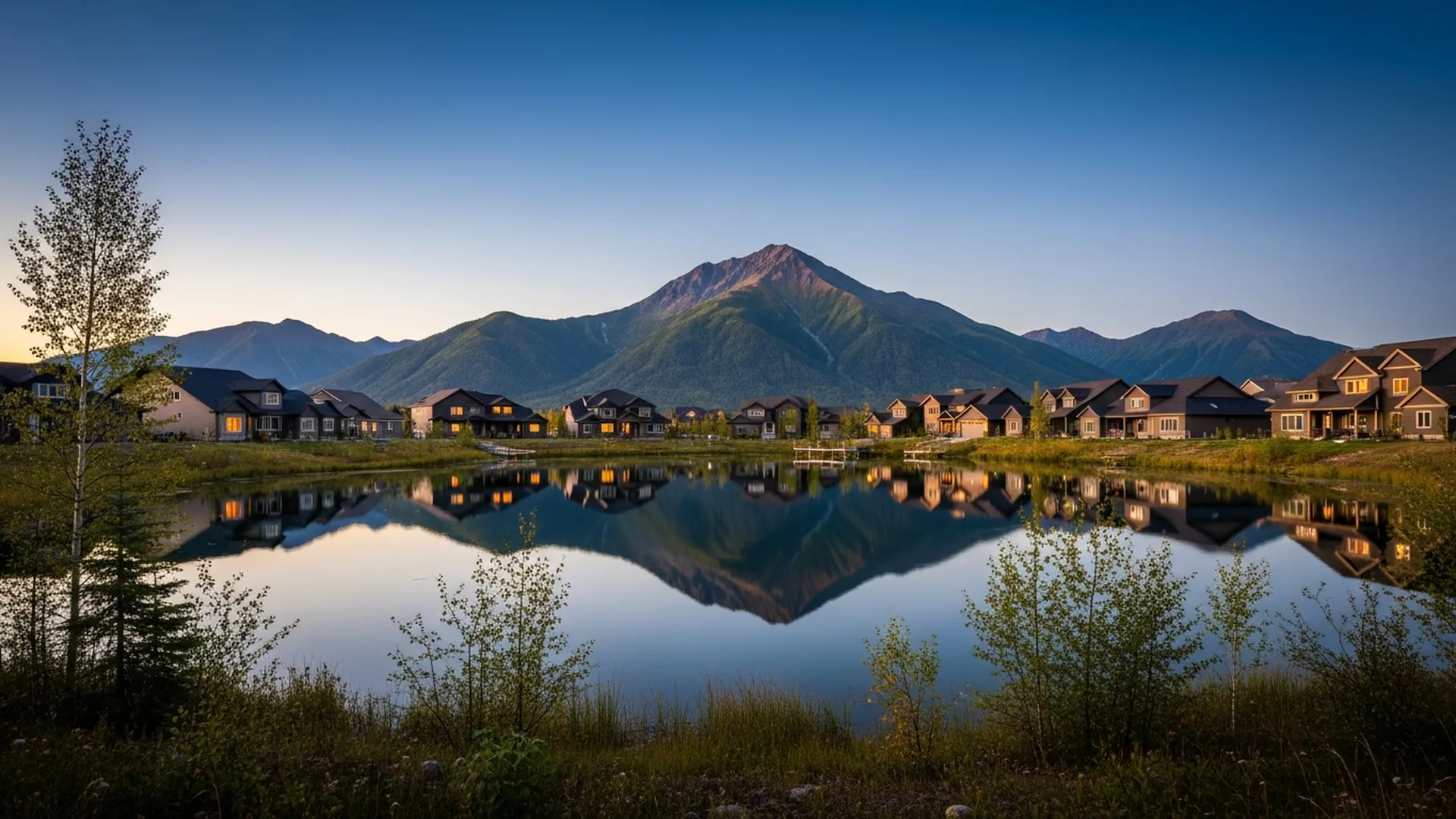
Snowgoose Pond is an acreage subdivision north of downtown Palmer in the Matanuska-Susitna Borough, reached off Palmer-Fishhook and Trunk Roads and framed by Chugach and Talkeetna mountain views. Homes here sit on larger lots — commonly one to three-plus acres, some marketed as horse property — and are served by private well and on-site septic rather than public utilities. The neighborhood trades the Anchorage Bowl’s smaller lots for space and mountain scenery, roughly 42 miles up the Glenn Highway from Anchorage. Because the Mat-Su Borough does not enforce residential building codes the way the Municipality of Anchorage does, verifying the well, septic, any recorded covenants, and past construction is central to a sound purchase here.
When buyers tell me they want acreage, a real view, and room for a shop or horses — but still an achievable drive to Anchorage — Snowgoose Pond is one of the Palmer neighborhoods that consistently comes up. It sits north of Palmer’s historic downtown in the Matanuska-Susitna Borough, and listings there routinely read the way Valley buyers hope: multi-acre parcels, custom finishes, three-car garages, greenhouses, and mountain backdrops. Homes.com describes Snowgoose Pond as one of Palmer’s premier neighborhoods, and that reputation shows up in the caliber of what gets built there.
What I try to do on a page like this is separate the postcard from the paperwork. The views and the acreage are real and worth chasing. But the reason a knowledgeable local earns their keep in the Valley is the second layer — the borough rules, the well-and-septic realities, and the covenant details that behave very differently here than they do 42 miles south in the Anchorage Bowl.
- Snowgoose Pond is an acreage subdivision north of downtown Palmer, reached off Palmer-Fishhook and Trunk Roads via Snowgoose Road, in the Matanuska-Susitna Borough.
- Lots are large — commonly around one to three-plus acres, with some parcels bigger and several marketed as horse property.
- Homes rely on private wells and on-site septic; new installs, replacements, and major septic repairs require a Mat-Su Borough permit plus a site evaluation, coordinated with Alaska DEC.
- Palmer is roughly 42–43 miles northeast of Anchorage on the Glenn Highway — often cited near a 45–50 minute drive in good conditions, longer in winter and traffic.
- The Mat-Su Borough historically does not enforce residential building codes for homes, unlike the Municipality of Anchorage’s active code program — making independent inspection and verification essential.
- At least part of Snowgoose Pond is covenant-restricted with an HOA; recorded CCRs and any HOA documents should be reviewed per parcel.
- Alaska sellers must deliver a written property disclosure (AS 34.70) before a buyer’s written offer, with up to triple damages for a willful violation.
Where Is Snowgoose Pond, and What Makes It a Premier Palmer Address?
Snowgoose Pond sits north of Palmer’s historic downtown, off Palmer-Fishhook Road and Trunk Road, with Snowgoose Road running into the subdivision. Palmer itself is the borough seat of the Matanuska-Susitna Borough, and, per Wikipedia’s geographic summary, it lies in a wide valley between the Talkeetna Mountains to the north and the Chugach Mountains to the south and east, with Pioneer Peak rising more than 6,000 feet just a few miles south of town. That framing — open Valley farmland floor, big peaks on nearly every horizon — is exactly what gives Snowgoose Pond its views.
The neighborhood’s appeal is the combination that’s genuinely hard to find in the Anchorage Bowl: real acreage, custom homes, and mountain scenery within an easy reach of Palmer’s services. Recent listings in and around the subdivision have featured multi-acre parcels with creeks, hilltop settings backing to a pond, horse setups, and high-end interior work — quartz counters, butler’s pantries, in-floor heat, and 10-foot ceilings among them. Unlike an in-town lot, the draw here is that the land does as much work as the house.
| Factor | Snowgoose Pond (Palmer) |
|---|---|
| Location | North of downtown Palmer, off Trunk / Palmer-Fishhook via Snowgoose Rd |
| Typical lot size | ~1 to 3+ acres; some larger; some horse property |
| Water & sewer | Private well and on-site septic (not public utilities) |
| Drive to Anchorage | ~42–43 miles / commonly 45–50 min in good conditions |
| Jurisdiction | Matanuska-Susitna Borough (no residential building-code enforcement) |
| Views | Chugach (S/E), Talkeetna (N), Pioneer Peak area |
What Should You Check on a Well-and-Septic Property in Snowgoose Pond?
This is the single most important thing about buying an acreage home in the Valley, and it’s where a Bowl buyer’s habits don’t transfer. Snowgoose Pond homes are served by private wells and on-site septic systems, not public water and sewer. Per how septic permitting works in the Matanuska-Susitna Borough, any new installation, major repair, or system alteration typically requires a borough permit and a site evaluation — including a soil percolation or profile test — and inspections at multiple stages of installation, all coordinated with Alaska DEC on-site wastewater standards.
Two practical points I raise with buyers here. First, at the point of sale, lenders and buyers commonly request a septic inspection, and some transactions require an as-built drawing to be on file with the borough — so confirm whether one exists for your parcel early, not the week of closing. Second, Alaska’s long winters are a real variable: ground frost can affect tank access and drain-field performance, and systems that aren’t properly insulated or regularly used can be vulnerable to freezing, while spring thaw can temporarily saturate soils and reduce drain-field efficiency. Newer subdivisions platted under more recent borough rules are more likely to carry engineered designs — pump-up or pressure-distribution systems — that have mechanical components needing periodic maintenance.
Well & septic done right
- As-built on file with the borough
- Recent septic inspection and pump record (guideline: every 3–5 years)
- Well flow/potability test results reviewed
- Understanding of system type (gravity vs. engineered/pump)
Where buyers get surprised
- No as-built or permit history located
- Testing scheduled in deep winter when ground is frozen
- Assuming a Bowl-style municipal record exists
- Overlooking insulation/use history on a seasonal system
How Is Buying in the Mat-Su Borough Different from the Municipality of Anchorage?
This is the “borough vs. municipality” distinction that trips up buyers moving up from town, and it’s worth stating plainly. The Municipality of Anchorage runs the state’s most active residential building-code enforcement program, applying the International Building and Residential Codes with local seismic and climate amendments inside the Anchorage Bowl. The Matanuska-Susitna Borough — which includes Palmer and Wasilla — has historically not enforced residential building codes for one-to-three-unit homes. Alaska is, in fact, the only state where residential buildings of three units or fewer aren’t covered by any state-level building code, leaving it to local governments to adopt their own.
Why does that matter to a Snowgoose Pond buyer? Because it changes where your assurance comes from. In much of the borough, there’s no municipal plan review or inspection standing behind a house — so a qualified independent home inspection, a look at the well and septic records, and verification of any additions or finished space carry the weight that a code department would carry in town. The 2018 magnitude-7.1 earthquake made this concrete: a University of Alaska Anchorage study found buildings in Anchorage areas without code enforcement suffered damage at many times the rate of code-enforced areas. None of this makes the Valley a poor place to buy — a huge share of excellent Alaska homes are here — it just means the due diligence is on you and your team, not a city inspector.
Palmer and the Central Mat-Su fire service area have carried more code activity than the borough at large, and rules evolve. Confirm current permitting and enforcement for a specific parcel with the Mat-Su Borough Permit Center rather than assuming borough-wide “no code” means “no requirements.”
How Long Is the Commute from Snowgoose Pond to Anchorage?
Palmer is about 42–43 road miles northeast of Anchorage on the Glenn Highway. Common references put the drive around 45 to 50 minutes in free-flowing conditions; Wikipedia notes many Palmer residents commute about 45 minutes to work in Anchorage. Because Snowgoose Pond sits north of downtown Palmer, add a few minutes on top of the town-center figure. The honest caveat: those are good-condition numbers. Winter weather, snow, and peak-hour congestion on the Glenn regularly stretch the real commute, so if you’ll drive it daily to Anchorage or JBER, plan around the bad-day trip, not the best-day one.
Are There Covenants or an HOA in Snowgoose Pond?
Mat-Su parcels run the full spectrum — from completely unrestricted rural land to platted subdivisions with recorded covenants (CCRs) and a homeowners association. Snowgoose Pond falls on the more structured end: it’s a named, covenant-restricted subdivision, and listings there have referenced covenants/restrictions and a home owners association. That’s often a positive for a luxury buyer — covenants can protect the look and value of the neighborhood — but the terms differ by phase and lot. Before you write an offer, read the recorded covenants and any HOA documents for the exact parcel so you know what’s allowed (outbuildings, animals, RV parking, short-term rental) and what dues or architectural rules apply.
Thinking of Selling in Snowgoose Pond? What Drives Value Here
Sellers in an acreage neighborhood win on the things a photo can’t fully capture: a clean, documented well and septic; a real, cleared sightline to the mountains; usable, well-drained land; and finishes that read as quality up close. Because I pair a background in design with the real-estate side, I pay close attention to how a home’s finishes and light present in listing photos and in person — small staging and sightline decisions move the number more than most sellers expect on higher-end Valley homes.
On the paperwork side, Alaska law is specific. Under AS 34.70.010–34.70.200, a seller must deliver a completed written Residential Real Property Transfer Disclosure Statement before the buyer makes a written offer, disclosing known defects and conditions in the property and its systems. Get this right: a seller who negligently violates the duty is liable for the buyer’s actual damages, and a willful violation can expose the seller to up to three times the actual damages plus potential costs and attorney fees. For an acreage home, that means accurate disclosure of the well, septic, and any past repairs isn’t just good practice — it’s your legal protection. If you’re weighing a sale, the next step is a real number: get your Palmer-area home value.
This page is general and educational, not legal advice. Alaska’s disclosure statute and borough permitting rules can change and vary by parcel — consult a licensed attorney or the Mat-Su Borough for your specific situation.
- Matanuska-Susitna Borough — Permit Center, Planning/Development Services, and myProperty & Maps (permitting, parcels, road maintenance status). matsugov.us
- Mat-Su Borough septic permitting & site-evaluation practice, coordinated with Alaska DEC on-site wastewater rules (permits, as-builts, winter/thaw considerations).
- Alaska Statutes AS 34.70.010–34.70.200 — Residential Real Property Transfer Disclosure (delivery before written offer; up to triple damages for willful violation). State of Alaska / codes.findlaw.com / law.justia.com.
- Building-code enforcement contrast: Municipality of Anchorage code program vs. Mat-Su Borough; Alaska’s lack of a state residential code; 2018 earthquake damage study (UAA). ADN / permitsguide.com.
- Commute & geography: Palmer ~42–43 mi from Anchorage on the Glenn Highway; Chugach/Talkeetna framing; Pioneer Peak. Wikipedia (Palmer, Alaska); The MILEPOST; alaska.org.
- Snowgoose Pond as a premier Palmer acreage subdivision with covenants/HOA and multi-acre lots. Homes.com; AK MLS IDX listing content (deemed reliable, independently verify).
Considering a Snowgoose Pond home?
Let’s look at the land, the well and septic, and the covenants together — before you fall for the finishes.
Frequently Asked Questions
Snowgoose Pond is an acreage subdivision north of downtown Palmer in the Matanuska-Susitna Borough, reached off Palmer-Fishhook Road and Trunk Road via Snowgoose Road. Palmer sits about 42 miles northeast of Anchorage on the Glenn Highway, and the neighborhood is framed by the Chugach Mountains to the south and east and the Talkeetna Mountains to the north.
Snowgoose Pond is an acreage neighborhood. Listings in and around the subdivision commonly sit on roughly one to three-plus acres, with some parcels larger, and several are marketed as horse property. Larger, privacy-oriented lots are the defining trait, in contrast to the smaller lots typical of in-town Palmer and the Anchorage Bowl.
Yes. Like most acreage neighborhoods in the Mat-Su Borough, Snowgoose Pond homes are typically served by private wells and on-site septic systems rather than public water and sewer. New installations, replacements, and major septic repairs require a Mat-Su Borough permit and a site evaluation, coordinated with Alaska DEC on-site wastewater rules. Buyers should verify the well, septic, and any as-built on file before closing.
Palmer is roughly 42 to 43 road miles northeast of Anchorage on the Glenn Highway, a drive commonly cited around 45 to 50 minutes in free-flowing conditions. Snowgoose Pond sits north of downtown Palmer, so it adds a few minutes to that. Real-world commute times to Anchorage or JBER during winter weather and peak traffic run longer, which is worth building into your plan.
No. The Matanuska-Susitna Borough has historically not enforced residential building codes for one-to-three-unit homes, unlike the Municipality of Anchorage, which runs the state’s most active residential code-enforcement program in the Anchorage Bowl. That means much of the borough has no municipal plan review or inspection for houses, so an independent inspection and careful verification of any past work matter even more here.
At least part of Snowgoose Pond is a covenant-restricted subdivision, and some listings reference covenants/restrictions and a homeowners association. Because Mat-Su parcels range from fully unrestricted rural land to platted subdivisions with recorded CCRs, the specifics vary by phase and lot. Always review the recorded covenants and any HOA documents for the exact parcel before you write an offer.
Alaska law (AS 34.70.010 through 34.70.200) requires a seller to deliver a completed written Residential Real Property Transfer Disclosure Statement before the buyer makes a written offer. It covers known defects and conditions in systems such as the roof, foundation, well, and septic. A seller who willfully violates the disclosure duty can be liable for up to three times the buyer’s actual damages, so accurate disclosure of your well, septic, and any past repairs is essential.