

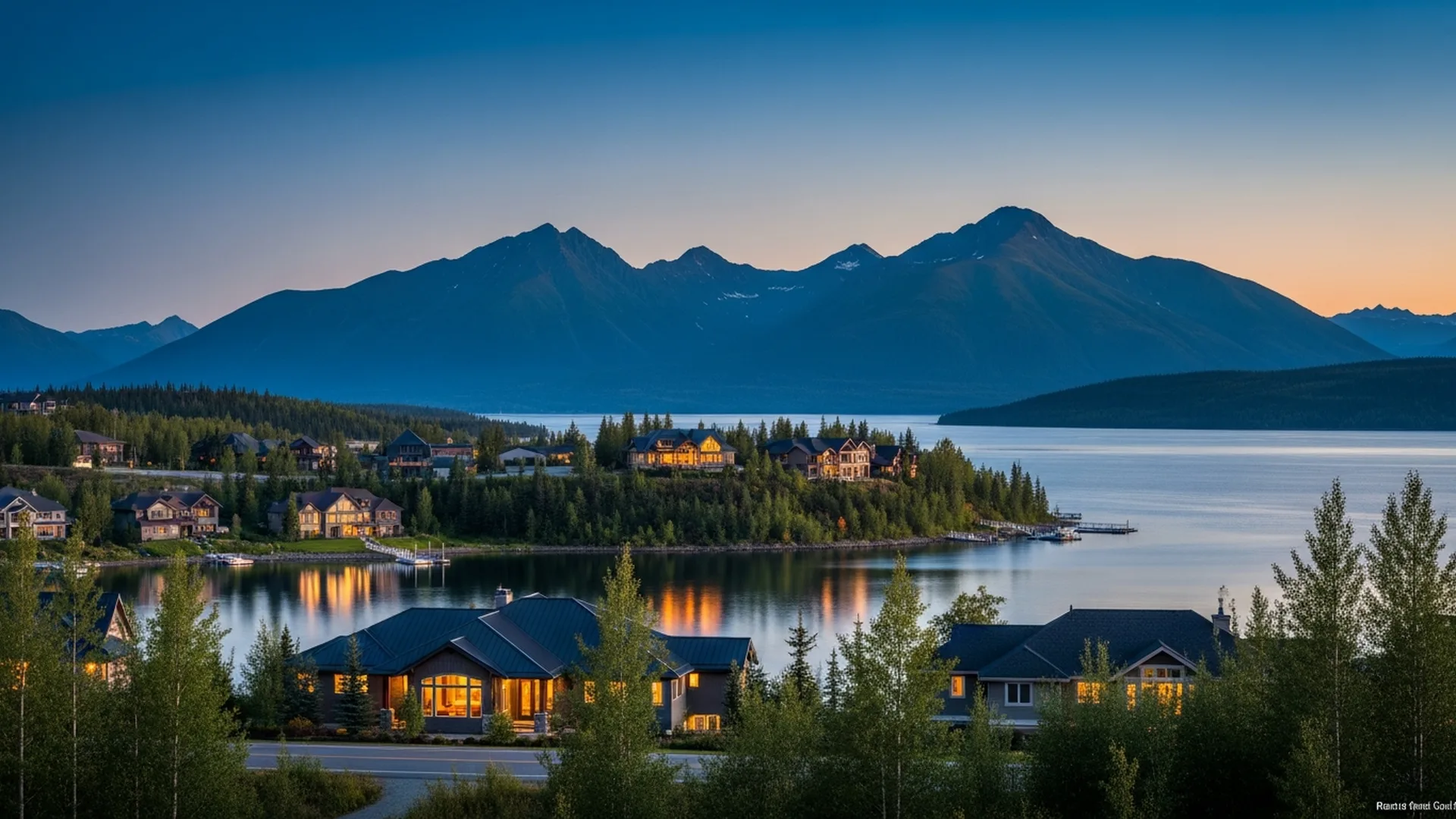
Rocky Point is a covenanted bluff-top subdivision on the north side of the Matanuska River just outside downtown Palmer, in Alaska’s Matanuska-Susitna Borough. Its draw is large lots with open mountain and river-valley views, paved roads, private resident river access, and a community park — on private well and on-site septic, as is standard in the Valley. Palmer sits 42 miles northeast of Anchorage on the Glenn Highway, roughly a 45- to 50-minute drive, so Rocky Point trades a longer commute than the Hillside for more land and a quieter valley setting. Because the borough does not enforce residential building codes outside the cities, the real due diligence here is the well log, the septic as-built, the recorded covenants, and the flood/erosion picture for the specific lot.
The buyers I see gravitate to Rocky Point are usually trading Anchorage square footage for Matanuska Valley land and a view they can’t get inside the bowl. Rocky Point earns its name honestly — it sits on a long bluff above the Matanuska River, and the parcel was homesteaded well before the famous 1935 Matanuska Colony, with an Ahtna place-name meaning “box point” recorded for the bluff. That history matters less than what it tells you about the land: it is a prominent, elevated bench above the river, and elevation plus orientation is what decides which lots actually capture the peaks.
- Rocky Point is a bluff-top subdivision on the north side of the Matanuska River, minutes from downtown Palmer with quick Glenn Highway access.
- Palmer is 42 miles northeast of Anchorage on the Glenn Highway — a road distance of about 43 miles and roughly a 45- to 50-minute drive.
- Homes are on private well and on-site septic; the developer reports subdivision wells typically running about 80–100 feet deep, with well logs and soils reports published for the lots.
- Unlike much of the unrestricted Mat-Su Borough, Rocky Point is a covenanted community with a homeowners association, construction requirements, common areas, and a community park.
- Outside Palmer, Wasilla, and Houston, the Matanuska-Susitna Borough does not enforce residential building codes — only land-use, septic, floodplain, and driveway rules apply, so private inspection matters more.
- Palmer is anchored by Pioneer Peak (over 6,000 feet just south of town), Lazy Mountain, and Matanuska Peak, so lot orientation strongly affects the view.
- The site sits along the Matanuska River, so confirming the FEMA flood zone and any borough floodplain permit for the exact lot is essential.
Where Is Rocky Point, and What Makes This Palmer Bluff Different?
Rocky Point occupies a bench above the Matanuska River on the outskirts of Palmer, the borough seat of the Matanuska-Susitna Borough. Palmer itself lies on the north shore of the Matanuska River in a wide valley between the Talkeetna Mountains to the north and the Chugach Mountains to the south and east, with Pioneer Peak rising over 6,000 feet just a few miles south of town and Lazy Mountain and Matanuska Peak standing to the east. That bowl of peaks is why so much of Palmer’s luxury value is a view story rather than a lot-size-only story — and on a river bluff like Rocky Point, the two combine.
The subdivision was developed as a planned community with paved roads, a community park with a picnic pavilion and walking trail, pedestrian/ATV trails, and private resident access to the Matanuska River flood plain for recreation. It sits close to downtown Palmer, the Palmer Golf Course, and the Palmer airport. That amenity package — paved streets, common areas, an HOA — is what separates Rocky Point from the large unplatted acreage that defines much of the Valley.
How Long Is the Commute From Rocky Point to Anchorage?
This is the single most important trade-off for a Rocky Point buyer, so price it honestly. Palmer is 42 miles northeast of downtown Anchorage on the Glenn Highway; measured door-to-door the road distance from Palmer runs about 43 miles and takes roughly 45 to 50 minutes in normal conditions. Many Palmer residents commute about 45 minutes to work in Anchorage. Rocky Point sits just outside downtown Palmer with quick access onto the Glenn, so add a few minutes to reach the highway.
The Glenn Highway is the backbone here. The freeway stretch from north Anchorage to Wasilla is the only road access to Anchorage for most of the state, which means it is also the region’s primary commuter corridor and can slow in peak hours and winter weather. For a buyer weighing the space-and-view lifestyle of the Valley against a shorter Hillside or Eagle River commute, that daily drive is the number that should drive the decision — not the finishes.
| Reference point | Direction / distance from Rocky Point |
|---|---|
| Downtown Palmer & golf course | Adjacent, roughly 5 minutes (per developer) |
| Anchorage (via Glenn Highway) | Southwest, ~42 mi / ~45–50 min |
| Pioneer Peak (6,000+ ft) | South of Palmer, a few miles |
| Lazy Mountain & Matanuska Peak | East |
| Matanuska River | Below the bluff; flows southwest toward Knik Arm |
What Should You Check on a Well-and-Septic Property in Rocky Point?
Almost every home in the Mat-Su Valley outside the city cores is on a private well and an on-site septic system, and Rocky Point is no exception. The well-and-septic surprise that catches buyers most often is not whether a system exists — it’s the paperwork behind it. Here, the developer’s own materials are unusually helpful: they publish well logs and soils reports, and they report that wells already drilled in the subdivision have typically run about 80 to 100 feet deep with abundant, good-tasting water, noting the water table has not been encountered above the bluff in their excavation. Some of the newer lots even have a pre-excavated septic area backfilled with gravel to support a system.
That’s a strong starting point, but it is the developer’s description of the subdivision — not a guarantee for your specific lot. Septic permitting in the borough falls under the Matanuska-Susitna Borough’s building/development services in coordination with the Alaska Department of Environmental Conservation, and a new installation or major repair typically requires a site evaluation (soil test), a permit, and staged inspections. At resale, lenders and buyers commonly request a septic inspection, and some transactions require an as-built drawing on file with the borough. My checklist for any Valley lot: pull the actual well log, confirm the septic permit and as-built, get a current septic inspection, and remember that Alaska’s long winters mean ground frost and spring thaw can affect drain-field performance — so timing an inspection when the ground is workable matters.
What tends to hold value here
- Elevated bluff lots with framed Pioneer Peak or river-valley views
- Documented well log with good depth and yield
- Paved roads, HOA common areas, and a community park
- Larger lots than comparable Anchorage inventory
What to verify before you offer
- The exact lot’s well log, septic as-built, and current inspection
- FEMA flood zone and any borough floodplain permit near the river
- Current recorded CCRs and HOA dues/construction requirements
- Commute tolerance for the ~45-minute Glenn Highway drive
How Do Mat-Su Borough Rules Differ From the Municipality of Anchorage?
This is the borough-versus-municipality distinction that trips up buyers moving out of Anchorage. Outside the cities of Palmer, Wasilla, and Houston, the Matanuska-Susitna Borough has historically taken a hands-off approach to land use: there is no comprehensive zoning map covering all borough land, and the borough openly states it does not have residential building codes — no structural, electrical, plumbing, or fire-safety code enforcement. Instead, the borough regulates land-use matters (lot lines, easements, rights-of-way, shorelines), septic in coordination with Alaska DEC, floodplain development, driveway/encroachment permits, and optional Special Land Use Districts that residents can create.
The practical consequence for a Rocky Point buyer is twofold. First, a thorough private home inspection carries more weight here than it does in Anchorage, because there is no municipal code-enforcement backstop on the structure. Second, Rocky Point’s private covenants do a lot of the work that municipal zoning would do elsewhere — the subdivision has recorded construction requirements, a New Construction Approval Form, an HOA, and common areas intended to be conveyed to the homeowners association. In other words, this is one of the Valley neighborhoods where the CCRs, not a city zoning code, protect your investment. Read them before you buy.
Palmer and Wasilla are the two old-town cores of the Mat-Su Valley, and the borough is one of Alaska’s fastest-growing areas — part of the Anchorage metropolitan statistical area. That growth is exactly why land-use questions (density, septic capacity, lot minimums) are actively debated at the borough level, and why a covenanted, planned subdivision like Rocky Point commands a premium over raw acreage.
Is the Rocky Point Bluff at Risk From the Matanuska River?
Any river-bluff property raises the flood-and-erosion question, and it deserves a straight answer. The Rocky Point developer states there is no imminent erosion risk along the bluff, citing bedrock at the upstream “point” that extends out and protects the bank, plus completed mitigation work using roughly fifty concrete blocks (each about 19 tons, spaced 50 feet apart) along the river alignment; much of the land is also built up to at least above the base flood elevation. That is a substantive, specific answer — more than most bluff sellers offer.
Here is where I disclose uncertainty honestly: that statement is the developer’s, and it doesn’t replace lot-specific verification. Because the subdivision sits along the Matanuska River, confirm the FEMA flood zone for the exact parcel and whether a Mat-Su Borough floodplain development permit applies to a build — the borough administers floodplain permitting to stay in good standing with the National Flood Insurance Program. If a lot is in or near a mapped flood hazard area, that affects both permitting and insurance, and it’s the kind of thing I want confirmed in writing before an offer, not discovered after.
Thinking of Selling in Rocky Point? What Drives Value Here
Sellers on view lots routinely underestimate how much the sightline moves the number. In Rocky Point, the value drivers are specific and defensible: an open, framed view of Pioneer Peak or the river valley; a documented, deep, high-yield well; a clean septic as-built and inspection; and finishes that read as intentional rather than builder-basic. My background is a designer’s eye — I hold a degree in Interior Design and spent years in furnishings and design — and that’s the lens I bring to prepping a Valley home: which finishes actually hold value through an Alaska winter, how to stage a great room to lead the eye to the peak, and where a modest update returns more than it costs. For a data-backed number on your specific home, start with a valuation for the Palmer market and let’s refine it from there.
- Matanuska-Susitna Borough — Development Services / Permit Center — land use, zoning, permitting, and floodplain development; Matanuska-Susitna Borough Code.
- Matanuska-Susitna Borough / Development Services & local reporting — the borough does not enforce residential building codes outside Palmer, Wasilla, and Houston; no comprehensive zoning map (borough statements; Anchorage Press; Frontiersman).
- Alaska Department of Environmental Conservation — On-Site Wastewater / Engineering Support & Plan Review — on-site wastewater (septic) standards, coordinated with borough permitting for site evaluation, permits, and inspections.
- Rocky Point subdivision developer materials — community description, well logs and soils reports (typical 80–100 ft wells), covenants and construction requirements, community park, and bluff-erosion mitigation; presented as developer statements, not lot-specific guarantees.
- The Milepost; Wikipedia (Palmer, Alaska); Glenn Highway — Palmer is 42 miles from Anchorage via the Glenn Highway; commute norms; Pioneer Peak, Lazy Mountain, and Matanuska Peak.
- FEMA / National Flood Insurance Program — Flood Map Service Center — flood-zone determination for parcels near the Matanuska River (verify per lot); Mat-Su Borough Floodplain Development for local flood-hazard determination and permitting.
Considering a Home in Rocky Point or the Palmer Area?
Let’s walk the bluff lots, read the covenants, and check the well-and-septic paperwork together. Call Bill at 907-560-4090.
Frequently Asked Questions
Rocky Point is a bluff-top subdivision on the north side of the Matanuska River just outside downtown Palmer, in the Matanuska-Susitna Borough. The developer describes it as roughly five minutes from downtown Palmer, close to the Glenn Highway, and about 45 minutes from Anchorage. Palmer itself sits 42 miles northeast of Anchorage on the Glenn Highway.
Yes. Rocky Point is on private well and on-site septic, which is the norm for Mat-Su Valley properties outside the city cores. The developer’s materials report that wells in the subdivision have typically run about 80 to 100 feet deep with good water, and that soils reports and well logs are published for the lots. Any buyer should still verify the specific well log, septic as-built, and a current inspection for the individual property.
Palmer is 42 miles northeast of downtown Anchorage via the Glenn Highway, and the road distance works out to roughly 43 miles with a drive of about 45 to 50 minutes in normal conditions. Rocky Point sits just outside downtown Palmer with quick access to the Glenn, so plan on a similar commute plus a few minutes to reach the highway.
Yes. Unlike much of the unrestricted Mat-Su Borough, Rocky Point is a covenanted subdivision with a homeowners association and recorded construction requirements, plus common areas including a community park. The developer publishes covenants, a New Construction Approval Form, and construction requirements, and the open space is intended to be owned by the homeowners association. Always read the current recorded CCRs and HOA documents before you buy.
Outside the cities of Palmer, Wasilla, and Houston, the Matanuska-Susitna Borough has historically taken a hands-off approach and does not enforce residential building codes for structure, electrical, plumbing, or fire safety. What does apply are borough land-use rules, septic permitting coordinated with Alaska DEC, floodplain and driveway permits, and, in a subdivision like Rocky Point, the private CCRs. That means a private home inspection and a qualified builder carry more weight here than a code-enforcement backstop.
Rocky Point sits on a long bluff above the Matanuska River, so many lots have open mountain and river-valley views across the wide Matanuska Valley. Palmer is flanked by Pioneer Peak, which rises over 6,000 feet just south of town, plus Lazy Mountain and Matanuska Peak to the east, so sightlines and lot orientation matter a great deal to which peaks and river views a given home actually captures.
The Rocky Point developer states there is no imminent bluff-erosion risk, citing bedrock at the upstream point that protects the bluff and roughly fifty large concrete armor blocks placed along the river alignment, with much of the land built up above the base flood elevation. Because the property sits along the Matanuska River, a buyer should still confirm the FEMA flood zone for the exact lot and whether a Mat-Su Borough floodplain development permit applies before building.