

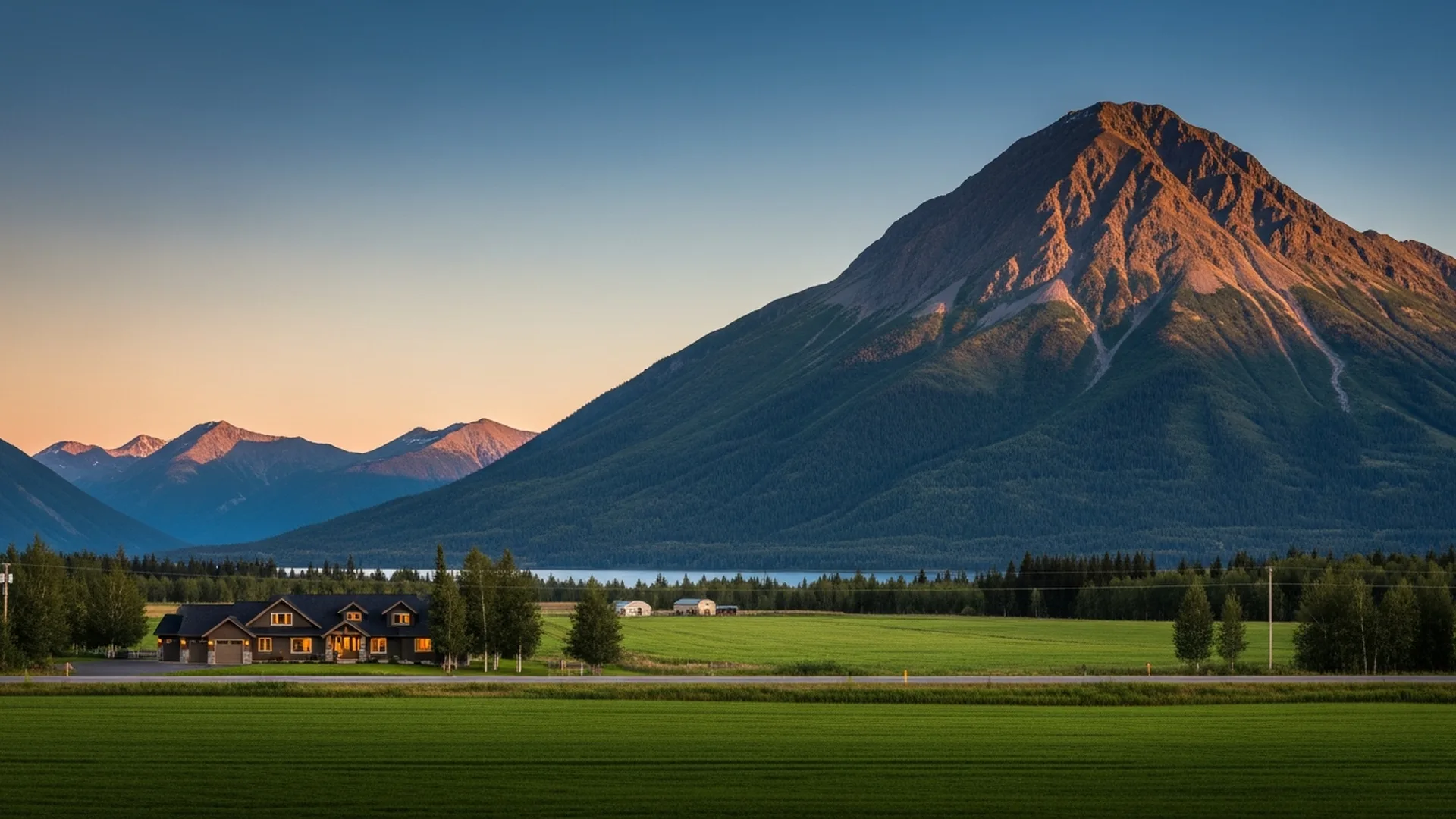
Palmer is the borough seat of the Matanuska-Susitna Borough, about 42 miles northeast of Anchorage on the Glenn Highway, and its luxury market centers on acreage, farm-quality soils, and open mountain-and-valley views rather than the Cook Inlet view lots of the Anchorage Hillside. Because Palmer sits in the Mat-Su Borough — not the Municipality of Anchorage — it has no COSA-style certificate required to transfer title, and on-site wells and septic systems are governed by Alaska DEC under 18 AAC 72. Many properties outside the city core rely on a private well and septic rather than public utilities. The town grew from the 1935 Matanuska Colony, which is why farmable 40-acre roots still shape today’s larger parcels. Buyers trade a roughly 45-minute-to-hour commute for more land and unobstructed sightlines to Pioneer Peak, Lazy Mountain, and the Talkeetna range.
Palmer is one of the more distinctive luxury submarkets in Southcentral Alaska, and it earns that character honestly. The town began as a New Deal farming experiment and never fully left its agricultural roots, so the land itself — not just the house on it — is what buyers are really pricing. In my four decades living in the Anchorage area, I’ve watched the Mat-Su Valley shift from a place people drove past on the way to Denali into a serious option for buyers who want acreage and views within commuting range of the city.
What follows is a working guide to how Palmer’s upper-tier market actually functions: what drives value, the well-and-septic and borough-rules realities that catch out-of-town buyers, the commute math, and what matters when you go to sell. Where a specific figure varies property to property, I’ll say so rather than paper over it — on rural acreage, the honest answer is usually “it depends on the parcel,” and knowing what to verify is the whole game.
- Palmer sits about 42 miles northeast of Anchorage on the Glenn Highway; many residents commute roughly 45 minutes to an hour into the city.
- It is the borough seat of the Matanuska-Susitna Borough — a borough, not a municipality — which changes the rules that apply versus a home inside Anchorage.
- Unlike the Municipality of Anchorage, the Mat-Su Borough does not run a COSA-style on-site systems certificate required to transfer title; on-site septic falls under Alaska DEC’s 18 AAC 72 regulations.
- Many Palmer-area properties outside the city core use a private well and on-site septic; DEC requires a private well to be at least 100 feet from a septic system or other contamination source (18 AAC 72.100).
- Value here is driven by acreage, farm-quality glacial silt-loam soils, and open views of Pioneer Peak, Lazy Mountain, and the Talkeetna Mountains.
- Palmer grew from the 1935 Matanuska Colony, which relocated 203 Midwest families onto 40-acre tracts — the reason larger, farmable parcels remain common today.
- Many borough parcels are unrestricted (no recorded covenants), so confirming zoning, access-road maintenance, and any CCRs is part of buyer due diligence.
What Makes Palmer a Distinct Luxury Market in the Mat-Su Valley?
Palmer is framed by the jagged spire of Pioneer Peak to the south, Lazy Mountain and Matanuska Peak to the east, and the Talkeetna Mountains to the north, on the north shore of the Matanuska River. That setting is the product. Unlike an Anchorage Hillside buyer chasing a Cook Inlet sightline, a Palmer luxury buyer is usually after land: an acreage parcel with room for a shop, a barn, horses, a large garden, or simply distance from neighbors, wrapped in a wide-open mountain view.
The agricultural history is not decorative trivia — it directly shapes the inventory. Palmer descended from the 1935 Matanuska Colony, in which 203 families from Minnesota, Wisconsin, and Michigan each drew a 40-acre tract to farm. Per the Palmer city history and the University of Alaska’s Matanuska Experiment Farm, the valley’s glacial silt-loam soils and roughly 19–20 hours of summer daylight made it Alaska’s agricultural heartland; it still produces much of the state’s fresh produce and hosts the Alaska State Fair each August. Those original 40-acre lots have subdivided over the decades, but the pattern left behind is a landscape of genuinely farmable, larger parcels — the raw material of Palmer’s land-first luxury market.
| Orientation fact | Detail |
|---|---|
| Distance from Anchorage | ~42 miles northeast via the Glenn Highway |
| Typical commute to Anchorage | ~45 minutes to 1 hour (weather-dependent) |
| Signature views south / east | Pioneer Peak (6,000+ ft), Lazy Mountain, Matanuska Peak |
| Views / recreation north | Talkeetna Mountains and Hatcher Pass via Palmer-Fishhook Road |
| Rivers bordering the valley floor | Matanuska River (north shore of which Palmer sits) and Knik River |
| Nearest larger city | Wasilla, ~10–12 miles west |
How Long Is the Commute From Palmer to Anchorage?
This is the single most important practical question for a Palmer buyer, and the honest answer is a range, not a number. Palmer is 42 miles northeast of Anchorage on the Glenn Highway, and per the town’s own description many residents commute about 45 minutes to work in Anchorage. In real life that means roughly 45 minutes to an hour door-to-door in ordinary conditions, and longer in hard winter weather or when the Glenn slows through the Eagle River and Eklutna corridor. It is a genuinely scenic drive along the Matanuska River, but it is a daily drive, and it should be weighed honestly against the extra land and views Palmer buys you.
The upside is what sits at the other end of Palmer’s road network. Palmer-Fishhook Road runs north out of town toward Hatcher Pass, a 300,000-acre state management area in the Talkeetna Mountains with year-round paved access as far as Independence Mine and the Skeetawk ski area — roughly 20–25 minutes from downtown Palmer. For a luxury buyer, that’s the trade in plain terms: a longer commute to the city, a much shorter one to alpine recreation.
What Palmer offers luxury buyers
- Acreage and farm-quality glacial silt-loam soils rare closer to Anchorage
- Wide, unobstructed mountain-and-valley views
- Fast access to Hatcher Pass recreation (~20–25 min)
- Many parcels unrestricted — more freedom to build shops, barns, or outbuildings
- Historic, walkable downtown and strong agricultural identity
Trade-offs to weigh
- ~45-minute-to-hour Anchorage commute, longer in winter
- Most rural properties on private well and septic, not public utilities
- Buyer carries the well/septic and access due diligence (no borough COSA)
- Wind funnels through the Matanuska and Knik valleys; verify site exposure
- Fewer high-end comparable sales than the Anchorage Hillside
What Should You Check on a Well-and-Septic Property Near Palmer?
Here is where being in a borough rather than the Municipality of Anchorage matters most, and where I see out-of-town buyers make assumptions that cost them. Inside Anchorage, the Municipality runs a Certificate of On-Site Systems Approval (COSA) program that effectively requires a well-and-septic sign-off before a title transfer. Palmer is in the Matanuska-Susitna Borough, which does not run that program — there is no borough-mandated on-site systems certificate you must obtain simply to sell. Alaska DEC even notes that the Municipality of Anchorage has additional requirements beyond the statewide rules, precisely because the borough does not.
What governs instead is Alaska DEC’s statewide wastewater code, 18 AAC 72 (updated effective October 1, 2023). On the water side, DEC sets minimum separation distances under 18 AAC 72.100: a private well must generally be at least 100 horizontal feet from a septic tank, soil absorption system, sewer line, or other contamination source, and at least 25 feet from a private sewer service line or sump. Systems and their design are tied to registered-engineer soil evaluation and DEC plan review or a permit-by-rule pathway. The practical takeaway: because no certificate is forced on the transaction, the responsibility to verify the well and septic falls squarely on you as the buyer.
On a Palmer acreage purchase, unlike a certificate-backed Anchorage sale, I treat the following as non-negotiable due diligence: pull the well log from the Alaska DNR Well Log Tracking System (WELTS), get a current water-quality test and a flow check, have the septic system inspected for condition and DEC compliance, confirm the parcel’s zoning or unrestricted status through the borough Permit Center, and verify the legal access and winter maintenance status of the road. None of this is exotic — it’s simply the work the Anchorage COSA would otherwise front-load for you.
Why Does Palmer Have So Much Acreage and Farmland?
Because it was literally designed to. In 1935, under President Roosevelt’s New Deal, the Federal Emergency Relief Administration created the Matanuska Colony and relocated 203 Depression-era families — chosen from Minnesota, Wisconsin, and Michigan for their cold-climate hardiness — onto individual 40-acre tracts in the Matanuska Valley. Most of the original colonists eventually left; by 1965 only about 20 of the first families were still farming. But the survivors established a lasting farm economy, and Palmer became, and remains, considered Alaska’s agricultural center.
For a modern luxury buyer, that history translates into three things worth understanding. First, larger, subdivided-from-40-acre parcels are common, so land is central to the value proposition. Second, the valley’s silt-loam soils are genuinely productive — the same soils that produce the state fair’s record cabbages — which matters if you want a working garden, hobby farm, or equestrian property. Third, the surviving Colony landscape (Bodenburg Loop, the Butte, and Farm Loop Road) gives many parcels open sightlines that newer, denser subdivisions closer to Anchorage simply can’t offer.
Because many Mat-Su Borough parcels are unrestricted (no recorded covenants or HOA), two neighboring Palmer properties can carry very different rights and obligations. That freedom is a feature for buyers who want a shop or outbuildings — and a reason to read any recorded covenants carefully, since some subdivisions do impose them. Verify the specifics parcel by parcel rather than assuming the “usual” applies.
Thinking of Selling in Palmer? What Drives Value Here
Selling a luxury or acreage property in Palmer is a different exercise than pricing a view condo on the Anchorage Hillside, because the buyer is underwriting land and lifestyle as much as square footage. In my experience the sellers who net the most are the ones who make the diligence easy: a clean, documented well log and recent water test, a serviced and inspected septic system, clear evidence of legal access and winter road maintenance, and any recorded covenants organized and disclosed up front. Since the borough won’t force a COSA, a seller who voluntarily supplies that paperwork removes the exact friction that makes buyers hesitate.
Presentation matters too, and this is where my design background is genuinely useful rather than a talking point. I hold a degree in Interior Design and spent years in furnishings and design before real estate, so when I walk a Palmer home I’m reading how the light works through a long Mat-Su winter, whether the finishes will read as current or dated to a discerning buyer, and how to frame those Pioneer Peak and Lazy Mountain views from inside the house. On acreage properties, staging the land — sightlines, cleared views, the approach up the driveway — often moves the number as much as staging the interior. When you’re ready, I’ll build you a specific, data-backed valuation for your parcel.
- Matanuska-Susitna Borough — Development Services / Permit Center (land use, zoning, and permitting; borough-level authority vs. municipality). matsu.gov
- Alaska Department of Environmental Conservation — 18 AAC 72 (Wastewater Treatment & Disposal) (effective 10/1/2023) and 18 AAC 72.100 private-well separation distances (100 ft to septic/contamination sources; 25 ft to private sewer line). dec.alaska.gov
- Alaska DEC — “Installing or Upgrading a Septic System” (notes the Municipality of Anchorage and City of Valdez impose additional requirements beyond the statewide rules). dec.alaska.gov
- City of Palmer — History of Palmer (1935 Matanuska Colony; 203 families; 40-acre tracts). palmerak.org
- University of Alaska Fairbanks / Visit Palmer — Matanuska Experiment Farm history and Matanuska Valley agriculture. visitpalmer.com
- Wikipedia (Palmer, Alaska) — 42 miles northeast of Anchorage; ~45-minute commute; Pioneer Peak, Lazy Mountain, Matanuska Peak; borough seat. en.wikipedia.org
- Alaska State Parks (DNR) — Hatcher Pass East Management Area (300,000 acres; ~20 minutes from Palmer; Palmer-Fishhook Road access). dnr.alaska.gov
Exploring Palmer luxury homes and acreage?
Work with a 40-year Anchorage-area local who knows the borough rules, the land, and the well-and-septic realities parcel by parcel.
Frequently Asked Questions
Palmer is about 42 miles northeast of Anchorage on the Glenn Highway, and many Palmer residents commute roughly 45 minutes to an hour into Anchorage. Travel time varies with weather and traffic; winter conditions and the stretch near the Eklutna and Eagle River corridors can lengthen it. The drive is straightforward and scenic, following the Matanuska River and the mountains.
No. Palmer sits in the Matanuska-Susitna Borough, which does not run the Municipality of Anchorage’s COSA program, so there is no borough-mandated on-site septic and well certificate required simply to transfer title. In the borough, on-site septic systems fall under Alaska DEC’s 18 AAC 72 regulations rather than a municipal certificate. Even without a mandated COSA, most buyers and lenders still order a private well and septic inspection, and I recommend one on any Palmer acreage purchase.
Palmer’s luxury inventory skews toward acreage, farmland, and mountain-and-valley views rather than the Cook Inlet view lots that define the Anchorage Hillside. Buyers here are usually trading a shorter commute for more land, agricultural soils, and open sightlines to Pioneer Peak, Lazy Mountain, and the Talkeetna range. The trade-off is the roughly 45-minute to hour drive to Anchorage.
Many Palmer-area properties outside the city core rely on a private well and an on-site septic system rather than public utilities. Alaska DEC sets minimum separation distances under 18 AAC 72.100 — for example, a private well must generally be at least 100 horizontal feet from a septic tank, soil absorption system, or other contamination source. Confirm the well log, water test, and septic condition during due diligence.
Palmer grew from the 1935 Matanuska Colony, a New Deal project that relocated 203 families from Minnesota, Wisconsin, and Michigan to farm 40-acre tracts in the Matanuska Valley. The valley’s glacial silt-loam soils and long summer daylight made it Alaska’s agricultural heartland, and it still produces much of the state’s fresh vegetables and hosts the Alaska State Fair. That heritage is why larger, farmable parcels remain common around Palmer today.
Palmer is one of the strongest acreage markets in the borough for buyers who want land, farm-quality soils, and mountain views within about an hour of Anchorage. Larger parcels commonly rely on wells and septic and may or may not carry recorded covenants, since many borough parcels are unrestricted. Verify zoning, access-road maintenance, well and septic, and any covenants before making an offer.
Check the private well (well log, flow, and water quality test), the septic system’s condition and DEC compliance under 18 AAC 72, the winter maintenance and legal status of the access road, whether the parcel is zoned or unrestricted, and any recorded covenants. Because the borough does not require a COSA, this due diligence falls to the buyer and their inspectors, so build enough time into the contract to complete it.