

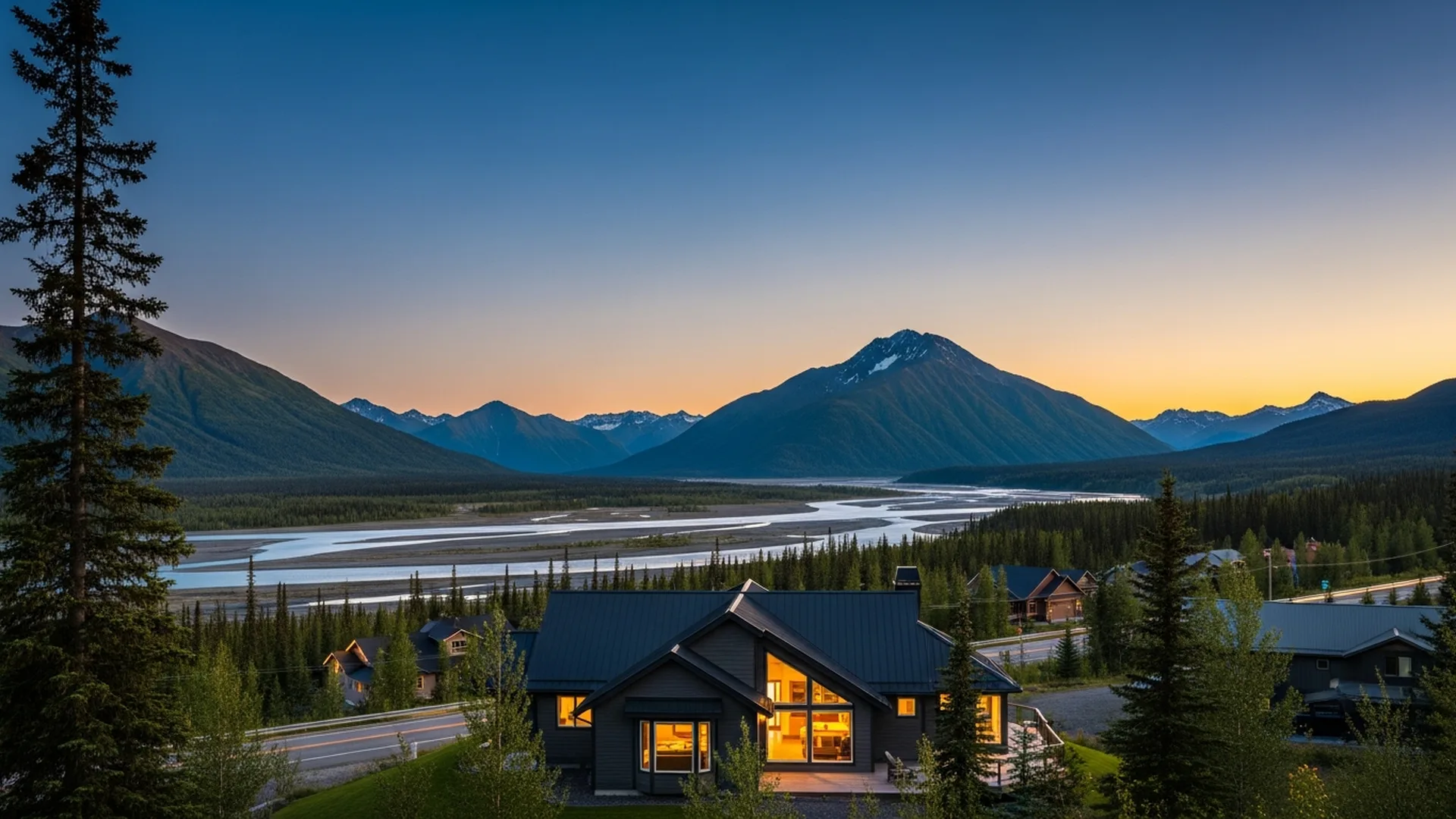
The Butte is a rural farming community in the Matanuska-Susitna Borough, sitting across the Matanuska River from Palmer along the Old Glenn Highway, about 40 to 45 minutes north of Anchorage. It takes its name from Bodenburg Butte, a roughly 880-foot rock landmark rising out of the surrounding valley farmland. Homes here are defined by acreage, open Pioneer Peak and Chugach views, and private well-and-septic systems rather than municipal utilities. Unlike Anchorage, the Mat-Su Borough enforces no residential building code and requires no Certificate of On-Site Systems Approval to sell, which makes independent well, septic, and title due diligence the buyer's responsibility. For buyers who value land, farm heritage, and views over in-town convenience, The Butte is one of the most distinctive addresses in the Palmer area.
When I take Anchorage buyers up to The Butte for the first time, the reaction is almost always the same: they crest the Old Glenn Highway, the farmland opens up, and Pioneer Peak fills the windshield. I've lived in Southcentral Alaska for forty years, and The Butte still reads as one of the most cinematic pieces of the Mat-Su Valley — a landscape of colony-era farms sitting under big mountains, with a single lone rock, the Butte itself, planted in the middle of it all.
But the view is the easy part. The harder, more valuable part of buying out here is understanding what makes a rural Mat-Su property different from an Anchorage one: the private systems, the borough rules that don't apply, the commute math, and how orientation on a wide-open parcel drives both livability and resale. This guide walks through all of it.
- The Butte sits in the Matanuska-Susitna Borough, across the Matanuska River from Palmer, spanning roughly milepost 9 to 16 of the Old Glenn Highway; it's about 40–45 miles from Anchorage.
- Its namesake, Bodenburg Butte, is a glacially-carved rock rising to roughly 874–881 feet, giving the area its signature 360-degree valley views of Pioneer Peak, the Knik and Matanuska rivers, and the Chugach and Talkeetna ranges.
- Homes rely on private wells and on-site septic systems regulated under Alaska DEC's 18 AAC 72 — there is no municipal water or sewer.
- The Mat-Su Borough does not enforce a residential building code and requires no Certificate of On-Site Systems Approval (COSA) to transfer title, unlike the Municipality of Anchorage — so buyer due diligence carries more weight.
- The area is rooted in the 1935 Matanuska Colony farming program; fertile soil and long summer daylight support genuine agricultural and hobby-farm use, some on original colony parcels.
- Butte Elementary School (Matanuska-Susitna Borough School District) is located in the community; middle and high school assignments should be verified with the district.
- Services — groceries, medical, dining — are in Palmer or Wasilla, not in The Butte itself, so the trade for space and views is a longer errand and commute radius.
Where Is The Butte, and What Defines It?
The Butte is a distinct community in the Matanuska-Susitna Borough, on the opposite side of the Matanuska River from downtown Palmer. Local reporting describes it as spanning roughly from milepost 9 to 16 on the Old Glenn Highway, historically the route anyone in the Valley had to drive to reach Anchorage before the newer Glenn Highway was built. The community sits on a broad alluvial plain near the convergence of the Matanuska and Knik river valleys, which is exactly why the views are so unusually open for a place that isn't up on a mountainside.
The organizing feature is Bodenburg Butte — a lone hill that hiking guides describe as a roche moutonnée, a rock scoured and rounded by past glaciers. Its summit sits at roughly 874 to 881 feet, and the popular West Butte Trail climbs about 1.5 miles (with a memorable stretch of stairs) to a summit that AllTrails describes as offering a wide panorama including "the Cook Inlet, the Knik and Matanuska rivers, and the Talkeetna Mountains." Unlike a neighborhood defined by a subdivision or an HOA, The Butte is defined by geography: farmland, river valleys, and that single rock.
| Orientation fact | Detail |
|---|---|
| Governing jurisdiction | Matanuska-Susitna Borough (not a city; borough seat is Palmer) |
| Distance to Anchorage | ~40–45 miles; ~45 min–1 hr via Glenn & Old Glenn Highway |
| Distance to downtown Palmer | Minutes; across the Matanuska River |
| Namesake landmark | Bodenburg Butte, summit ~874–881 ft |
| Key views | Pioneer Peak (S), Lazy Mtn/Matanuska Pk (NE), Knik Glacier, Chugach & Talkeetna ranges |
| Utilities | Private well & on-site septic (no municipal water/sewer) |
How Long Is the Commute From The Butte to Anchorage?
This is the first question I get from Anchorage buyers, and the honest answer is that the number on the map understates the reality. The Butte is roughly 40 to 45 miles from Anchorage, which reads as a tidy 45 minutes — but the entire Mat-Su Valley funnels into Anchorage on one road. The Glenn Highway is, apart from the Seward Highway toward the Kenai, effectively the only road access to Anchorage, and it's the shared commuter artery for both the Chugiak–Eagle River area and the whole Valley.
What that means in practice: a mid-day drive can be genuinely quick, but a weekday morning or a Friday afternoon behind a Valley-wide commute is a different experience, and winter weather on the Glenn compresses everyone's schedule. The Old Glenn Highway itself — the 19-mile country road The Butte sits on — is scenic and lightly traveled, cutting through the original Matanuska Colony farmland. Unlike a Hillside buyer whose commute is 20 minutes of city arterials, a Butte buyer is committing to a highway corridor. I always tell people to test-drive it at the hour they'll actually be driving it, not at noon on a Saturday.
What Should You Check on a Well-and-Septic Property in The Butte?
The single biggest difference between buying in Anchorage and buying in The Butte is that there is no municipal water or sewer — nearly every home runs on a private well and an on-site septic system. That's normal for rural Mat-Su, but it shifts real responsibility onto the buyer, because the borough won't do the checking for you.
Per Alaska's Department of Environmental Conservation, all septic systems in the state are governed by 18 AAC 72 (Chapter 72), which defines who may design and install a system and the process for it to be approved. In most cases an Alaska-registered professional engineer evaluates the soils, performs a percolation test where needed, designs the system, and certifies the completed installation. DEC also notes something important for buyers comparing markets: the Municipality of Anchorage has additional requirements beyond the state baseline — the Mat-Su does not. So a system that's fine under Alaska DEC rules in The Butte would face an extra layer of scrutiny across the river in Anchorage.
Here's the buyer checklist I run on a Butte property, and the reasoning behind each item:
What to verify before you offer
- Well log & water test — depth, flow rate, and a current potability/arsenic test.
- Septic design & as-built — the engineered design and the record of what was actually installed.
- Last pump & inspection dates — when the tank was last serviced and the drainfield evaluated.
- Soils/percolation history — valley soils vary; a strong perc on one parcel doesn't guarantee the neighbor's.
- Flood-hazard status — river-valley proximity means checking FEMA maps and any borough flood-hazard permit requirements.
Why it matters here specifically
- There's no COSA safety net forcing a system check at sale (see next section).
- A private lender or an out-of-area buyer will often still demand a septic inspection.
- Replacing or upgrading a failed system is a real, engineered expense — better priced before closing.
- Water quality and quantity, not city hookup, determine what the land can support.
Specific, current figures on median sale prices, days on market, or lot-size distribution for The Butte alone are not reliably published as a standalone dataset — the community is small and usually folded into broader Palmer-area statistics. Rather than quote a number I can't source, I pull live comparables for the exact area when a buyer or seller asks. Treat any single “Butte median” figure you see online with caution.
Does the Mat-Su Borough Require Permits or a COSA to Buy or Sell Here?
This surprises almost every buyer coming from Anchorage. The Matanuska-Susitna Borough does not enforce a residential building code, and it does not require a Certificate of On-Site Systems Approval (COSA) to transfer title. In Anchorage, a seller generally must produce a COSA — a municipal sign-off on the well and septic — before a sale closes. That requirement simply does not exist in the Mat-Su.
Independent permitting guides describe the contrast bluntly: a project that needs a permit in Anchorage may need no building permit at all just miles north in the borough. This cuts both ways. On the upside, it means genuine flexibility — owners can build, add outbuildings, and improve land with far less bureaucracy, which is part of the rural appeal. On the downside, it means a home may have been built or modified without code-based inspection, so the buyer inherits more of the verification burden. It's worth noting that even without a building code, other approvals can still apply: Alaska DEC septic and well rules, driveway permits, and flood-hazard development permits in designated flood areas near the rivers.
My rule for Butte buyers: treat the absence of a COSA not as a hurdle removed but as a reason to add your own private septic inspection and a thorough home inspection. The protection Anchorage builds into the transaction, you build in yourself here.
What Are the Views and the Land Really Like?
The Butte's identity is agricultural. The community sits in the heart of the original Matanuska Colony farmland — the 1935 New Deal program that relocated farm families, largely from Michigan, Wisconsin, and Minnesota, to homestead the Valley. Some original colony farms still operate today, and the area around Bodenburg Loop Road is dotted with working farms and U-pick operations. The Valley's reputation for record-setting giant vegetables comes from exactly this combination the Palmer area is known for: fertile glacial soil and a summer growing season with very long daylight hours.
For a homebuyer, that translates into land that can genuinely be used — hobby farms, gardens, animals, greenhouses — not just looked at. And because the community sits low and open on the plain with the mountains ringing it, the views are a defining asset: Pioneer Peak to the south, Lazy Mountain and Matanuska Peak to the northeast, and the river valleys spreading out below. Where a Hillside buyer in Anchorage pays a premium for a Cook Inlet sightline, a Butte buyer is buying a mountain-and-farmland panorama.
How Orientation and Daylight Drive Value Here
This is where my design background changes how I walk a Butte property. On an open parcel with no neighbors blocking anything, the decisions that matter most are which way the main living spaces face and how the home captures Alaska's dramatic seasonal light. A great room aimed at Pioneer Peak with south-facing glass will feel radically different in December than one that turns its back to the sun to chase a secondary view. On a wide-open Butte lot you have the rare luxury of choosing orientation almost freely — and the homes that hold value are the ones that used that freedom well: light, sightline, and shelter from prevailing wind all resolved together.
Thinking of Selling in The Butte? What Drives Value Here
If you already own in The Butte and are weighing a sale, the value levers are different from an in-town or Anchorage listing. Because there's no COSA requirement, buyers — and especially their lenders — will look to you to demonstrate the well and septic are sound; having a recent, clean septic inspection and a documented well log in hand removes the single biggest source of buyer hesitation and can protect your price. Second, the view and the land are the story: how a property frames Pioneer Peak, how usable the acreage is, and how the home sits to the light are what separate a memorable listing from an ordinary one.
This is where my interior-design training earns its keep on the listing side. Preparing a view-and-acreage home isn't about generic staging furniture — it's about making the sightlines and the daylight legible to a buyer walking through, so they feel what makes the parcel special. When you're ready, I'll build you a specific, current picture of what your Butte property is worth. Start with the home value tool, and I'll follow up with real local comparables.
- Alaska Department of Environmental Conservation — Installing or Upgrading a Septic System (18 AAC 72 / Chapter 72; qualified persons; Anchorage & Valdez additional requirements). dec.alaska.gov
- Matanuska-Susitna Borough — Permitting / Permit Center, Code Compliance, and Communities / Community Councils (borough governance; permit center; Palmer). matsu.gov / matsugov.us
- Statewide/borough building-code guidance — Mat-Su Borough Development Services — Mat-Su Borough does not enforce a general residential building code (contrast with Municipality of Anchorage Development Services). MOA COSA program provides the Anchorage-side well/septic regulatory contrast.
- Alaska DOT&PF / Glenn Highway — the ~38-mile freeway segment is the primary/only road corridor between Anchorage and the Mat-Su and Chugiak–Eagle River suburbs.
- The Milepost / community references — Palmer ~42 miles northeast of Anchorage via the Glenn Highway; The Butte spans ~MP 9–16 on the Old Glenn Highway.
- Alaska.org — Bodenburg Butte, AllTrails, and Mat-Su tourism — Bodenburg Butte summit ~874–881 ft, West Butte Trail, 360-degree views of Pioneer Peak, Knik/Matanuska rivers, Chugach & Talkeetna ranges.
- Matanuska Colony history — 1935 New Deal farm-colony program; fertile soil and long summer daylight; original colony farms near Bodenburg Loop.
- Matanuska-Susitna Borough School District — Butte Elementary School (PK–5), Palmer; Alaska Department of Education & Early Development. matsuk12.us / education.alaska.gov
Explore Homes in The Butte and the Mat-Su Valley
Want to see what's available on acreage near Palmer? I'll pull current listings and walk the well, septic, and view details with you.
Frequently Asked Questions
The Butte is a rural community in the Matanuska-Susitna Borough, sitting across the Matanuska River from downtown Palmer along the Old Glenn Highway. It is named for Bodenburg Butte, a roughly 880-foot rock landmark that rises out of the surrounding farmland. From Anchorage it is about a 40-to-45-minute drive north via the Glenn Highway and then the Old Glenn Highway.
The Butte is roughly 40 to 45 miles from Anchorage, generally a 45-minute to one-hour drive depending on traffic and season. The route runs up the Glenn Highway — the main and, apart from the Seward Highway to the Kenai, effectively only road link between Anchorage and the Mat-Su Valley — then onto the two-lane Old Glenn Highway toward Palmer. Test the drive at the hour you'd actually commute, since the whole Valley funnels onto that one corridor.
Yes. The Butte is a rural area without municipal water or sewer, so nearly every property relies on a private well and an on-site septic system. Septic systems in Alaska are regulated under 18 AAC 72, and a system generally must be designed and certified by an Alaska-registered professional engineer. Before you buy, confirm the well log, the septic design and as-built, and when the system was last inspected and pumped.
No. Unlike the Municipality of Anchorage, the Matanuska-Susitna Borough does not enforce a residential building code and does not require a Certificate of On-Site Systems Approval (COSA) to transfer title. Anchorage's COSA requirement does not apply in the Mat-Su. That said, septic and well permitting under Alaska DEC rules, driveway permits, and any flood-hazard requirements can still apply, and a private lender or buyer will often ask for a septic inspection anyway.
The Butte sits on a broad alluvial plain where the Matanuska and Knik river valleys meet, so open, unobstructed views are one of its defining features. Pioneer Peak dominates the skyline to the south, with Lazy Mountain, Matanuska Peak, and the Chugach and Talkeetna ranges around it, and glimpses of the Knik Glacier and Knik Arm from higher ground. A home's orientation and how much sky it faces matter enormously here.
For buyers who want space, agricultural or hobby-farm land, and big mountain views, The Butte is one of the more distinctive options in the Palmer area. It carries the legacy of the 1935 Matanuska Colony farms, has fertile valley soil and a long summer daylight growing season, and many parcels are large. The trade-offs are the private well and septic, a longer commute than in-town Palmer, and the fact that services like groceries and medical care are in Palmer or Wasilla rather than in the community itself.
The Butte is served by the Matanuska-Susitna Borough School District, and Butte Elementary School (grades PK–5) is located in the community. Families should verify current attendance-area boundaries and grade assignments for middle and high school directly with the district, since boundaries can change.