

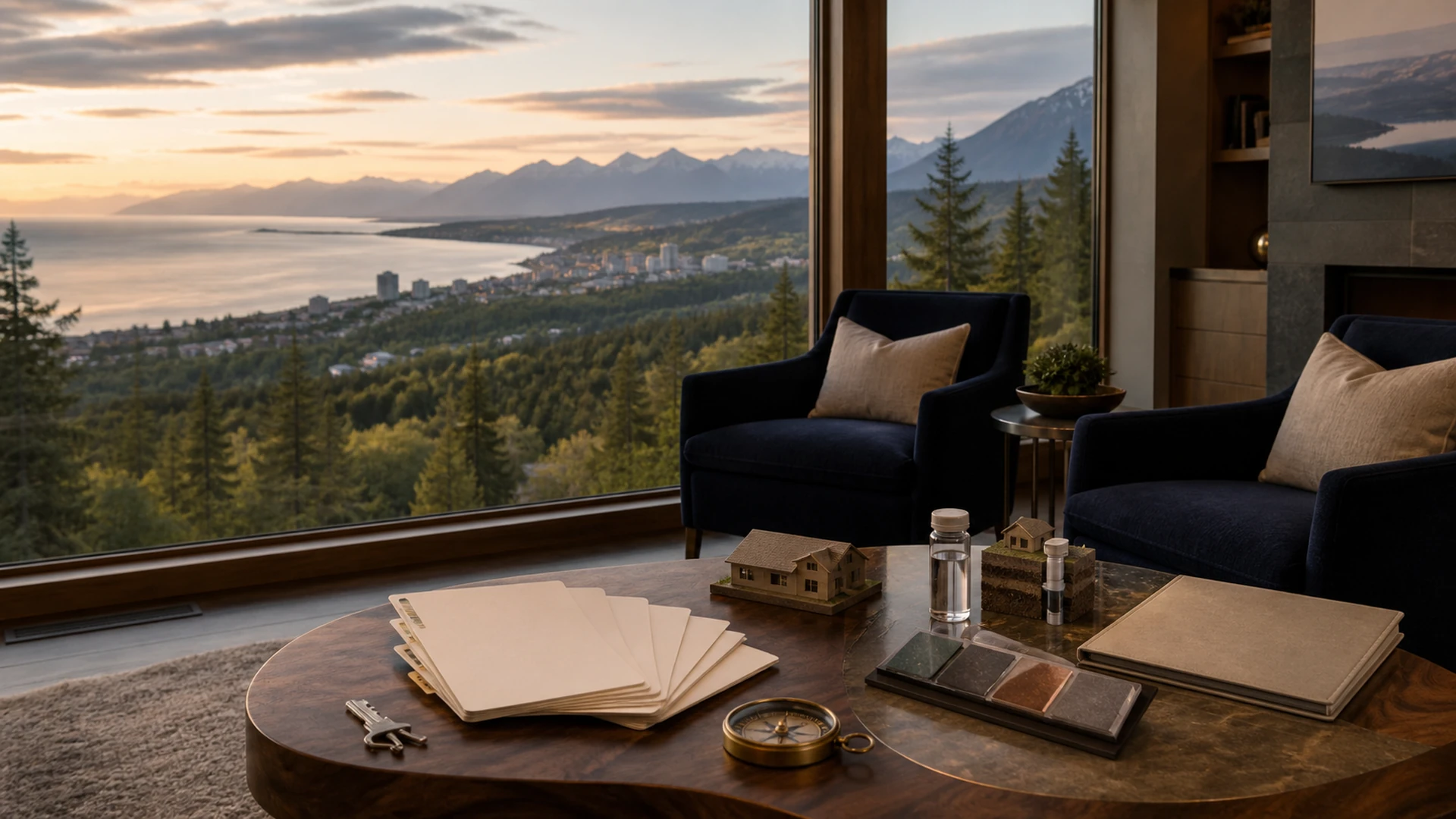
In Greater Anchorage, luxury generally begins around $1 million and is defined by attributes — view corridor, waterfront or lake access, acreage, custom construction — as much as by price. Because Alaska is a statutory high-cost area, its 2026 conforming loan limit is $1,249,125, so many luxury homes finance within conforming limits rather than as jumbo loans. The Hillside holds the municipality’s highest concentration of million-dollar homes, with West Anchorage, Girdwood, and Eagle River each forming distinct corridors. The most Alaska-specific piece of due diligence is well and septic: in Anchorage a COSA is required to transfer title on such properties. Sellers must deliver a written disclosure statement before a buyer’s written offer under AS 34.70. And view orientation — which way a lot faces toward Cook Inlet or the Chugach — is among the strongest value drivers in the market. The full questions are answered below.
After forty years in Anchorage, I’ve found that the questions luxury buyers and sellers ask here are different from anywhere else — and that the honest answers are what build trust. Below are the ones I hear most, grouped by buying, selling, and the local realities that catch newcomers off guard. Where an answer rests on a rule or a figure, I’ve cited the source; where a term deserves a fuller treatment, I’ve linked to it.
- Luxury in Anchorage generally starts around $1 million and is defined by attributes — view, water, acreage, custom build — as much as by price.
- Alaska’s 2026 conforming loan limit is $1,249,125, so many luxury purchases here are not jumbo loans.
- The most Alaska-specific due-diligence item is well & septic: a COSA is required to transfer title in Anchorage.
- Sellers must deliver a written disclosure (AS 34.70) before the buyer’s offer; a willful failure can mean up to three times the buyer’s actual damages.
- View orientation, not just “a view,” is one of the strongest value drivers — it sets both the sightline and the winter sun.
- The 2024 NAR practice changes mean a written buyer-broker agreement before touring, with compensation spelled out up front.
Buying a Luxury Home in Anchorage
There’s no official line, but in the Greater Anchorage market luxury generally begins around the $1 million mark and is defined as much by attributes as by price: a premium view corridor, waterfront or lake access, acreage, custom construction, or high-end finishes. Because Alaska’s 2026 conforming loan limit is $1,249,125, many homes people consider luxury here still finance within conforming limits rather than as jumbo loans. The Hillside holds the highest concentration of million-dollar homes in the municipality.
The Anchorage Hillside, on the western foothills of the Chugach Mountains in South Anchorage, has the highest concentration of luxury and million-dollar homes, with pockets like Prominence Pointe, Sahalee, Rabbit Creek, and Bear Valley. West Anchorage carries established coastal and lake prestige at Campbell Lake, Turnagain, and Bootlegger Cove; Girdwood and Alyeska anchor the ski and second-home market; and Eagle River offers larger-lot mountain living. Each is a distinct corridor with its own geography and utility norms.
Not necessarily. Because Alaska is a statutory high-cost area, its 2026 one-unit conforming loan limit is $1,249,125 — well above the national baseline of $832,750. Only a loan amount above that Alaska limit is a true jumbo loan, so a large share of Anchorage luxury purchases finance within conforming limits. Whether you need a jumbo product depends on your loan amount, not on whether the home is marketed as luxury.
Start with the Certificate of On-Site Systems Approval (COSA): in the Municipality of Anchorage, a COSA is required to transfer title on any property served by a well or septic system, and it confirms an engineer has inspected and tested the systems to MOA standards. Beyond that, check lot size and separation-distance rules, the age and condition of the well and septic, and timing — because testing needs unfrozen ground, a winter sale can hinge on the thaw. It’s the single most Alaska-specific piece of luxury due diligence.
Anchorage has a real seasonal rhythm driven by daylight and access rather than by fashion. Spring and summer bring the most listings, the longest daylight for touring, and unfrozen ground for well, septic, and COSA testing, which makes it the busiest window. Serious buyers still transact in winter, often with less competition, but on-site-system testing and some inspections can be constrained by frozen ground and snow cover. The right timing depends on whether you value selection or reduced competition.
View is one of the strongest value drivers in the Anchorage luxury market, but it’s really about orientation. On the Hillside, which rises on a west-facing slope, west and northwest lots capture Cook Inlet, Knik Arm, and Alaska Range views and better evening and winter sun, while east-facing lots look into the Chugach. Two lots a block apart can differ sharply in value based on sightline and exposure, so the view corridor — not just “a view” — is what matters.
Selling & Valuing a Luxury Home
Yes. Alaska law (AS 34.70) requires the seller of most residential real property to deliver a completed written Residential Real Property Transfer Disclosure Statement to the buyer before the buyer makes a written offer. A willful failure to comply can expose the seller to up to three times the buyer’s actual damages, plus possible costs and attorney fees. It’s a standard and important step in every Anchorage sale, luxury included.
Carefully, because the pool of genuinely comparable sales is thin. A credible valuation is a comparative market analysis that starts from real local sales and adjusts for view orientation, lot size, utilities (city versus well and septic), and finish quality — the factors that move value here. Automated online estimates tend to struggle with Anchorage luxury precisely because they can’t see view corridor or utility type. For a specific number, a local CMA beats an algorithm.
Yes. Under the National Association of REALTORS® practice changes effective August 17, 2024, a buyer now signs a written buyer-broker agreement before touring homes with an agent, and that agreement spells out how the buyer’s agent is compensated. Offers of buyer-agent compensation are also no longer published in the MLS. The practical effect for luxury buyers and sellers is that agent compensation is negotiated and documented more explicitly up front.
Alaska has no state income or capital-gains tax, so the tax question on a home sale is a federal one. Under the federal Section 121 exclusion, a qualifying primary-residence seller can generally exclude up to $250,000 of gain if single and $500,000 if married filing jointly, subject to ownership and use tests. This is general information, not tax advice — confirm your specific situation with a tax professional, especially on a high-value or non-primary-residence sale.
Anchorage Local Realities
Yes. Both Eagle River and Girdwood are part of the Municipality of Anchorage, even though each functions as its own community outside the Anchorage Bowl. Eagle River sits north along the Glenn Highway between Joint Base Elmendorf-Richardson and Chugach State Park; Girdwood sits about 40 miles south in a Chugach valley near the end of Turnagain Arm. The Mat-Su Valley, by contrast, is a separate borough with its own rules.
The magnitude 7.1 earthquake of November 30, 2018 made seismic construction a normal part of due diligence rather than an afterthought. Buyers of luxury and custom homes routinely ask about foundation type, any retrofits, and how a specific home performed in 2018. Modern Alaska construction is engineered for seismic activity, so this is about informed inspection, not alarm — it’s simply one more question a seasoned local buyer asks.
Ski-in/ski-out means a property with direct trail access to lifts or slopes. In Southcentral Alaska it centers on Alyeska Resort in Girdwood, about 40 miles south of Anchorage along Turnagain Arm. True ski-in/ski-out access is scarce and commands a premium in Girdwood’s second-home and short-term-rental market, so verifying the actual trail access of a specific property matters.
Look for genuine local depth in the specific corridor you’re targeting, because value factors here — view orientation, well and septic, winter access, cold-climate construction — differ block to block and can’t be faked. Ask how an agent evaluates a view corridor, what they check on a well-and-septic property, and how they build a comparative market analysis in a thin market. Bill Ure brings forty years of living in Anchorage and a design background to those exact questions, at 907-560-4090.
- FHFA — 2026 Conforming Loan Limit Values — the 2026 one-unit limit for Alaska ($1,249,125) versus the national baseline ($832,750).
- Municipality of Anchorage — Certificate of On-Site Systems Approval (COSA) — the requirement to obtain a COSA to transfer title on a well/septic property.
- Alaska Statutes AS 34.70.010 (Justia) — the seller’s disclosure statement must be delivered before the buyer’s written offer.
- Alaska Statutes AS 34.70.090 (FindLaw) — a willful violation exposes the seller to up to three times the buyer’s actual damages.
- National Association of REALTORS® — What the Settlement Means for Buyers and Sellers — the written buyer-agreement practice change effective August 17, 2024.
- USGS — M7.1 November 30, 2018 Anchorage Earthquake — the magnitude and date behind the seismic-construction answer.
- IRS Section 121 primary-residence capital-gains exclusion figures ($250,000 single / $500,000 married) and Alaska’s state tax status (no individual income tax, state capital gains tax, or real-estate transfer tax).
Still Have a Question About Your Move?
The best answers are the ones matched to your specific property and corridor. Let’s talk it through — or, if you’re selling, start with a real, data-backed value for your home.