

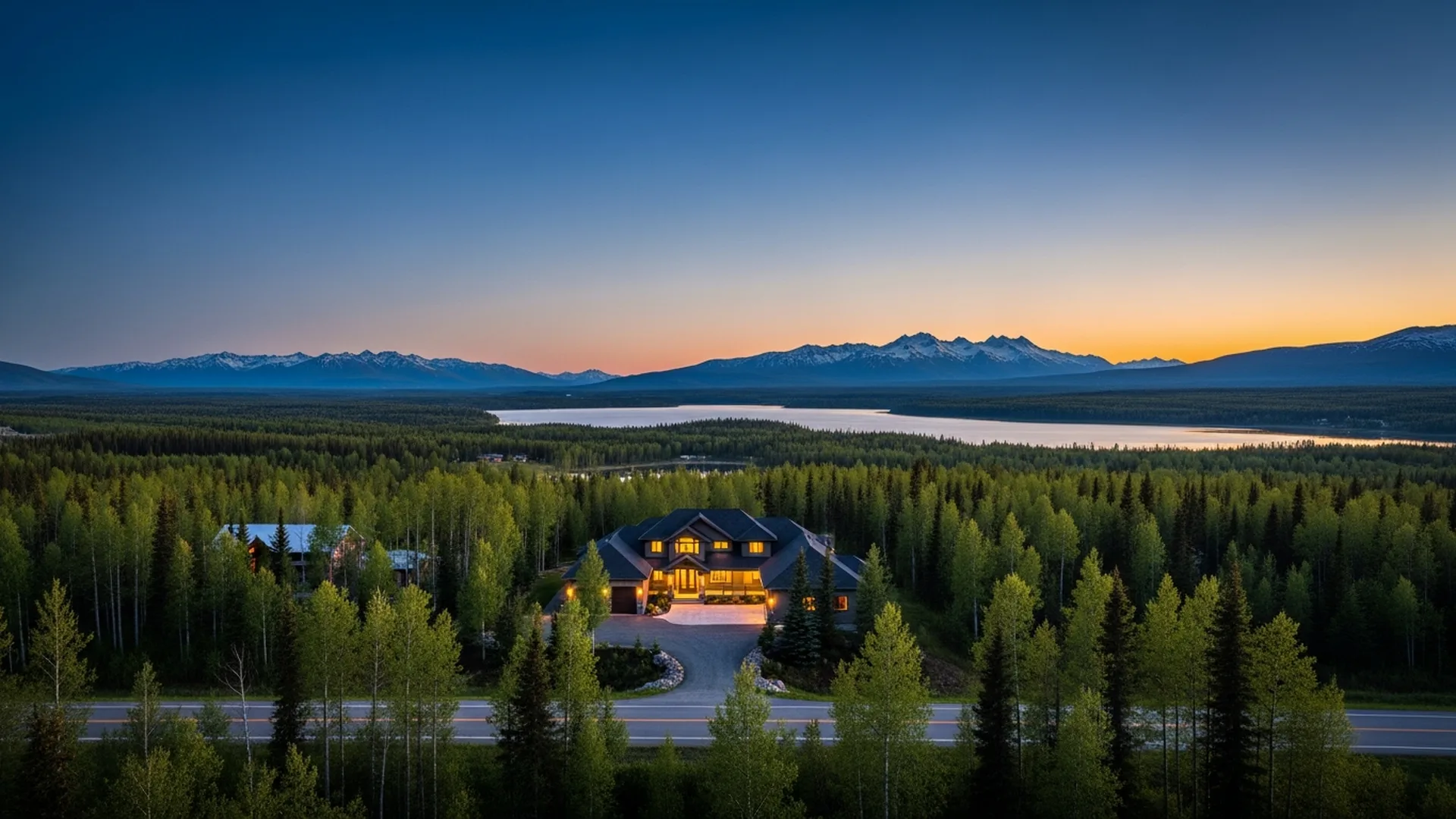
Wasilla is the commercial heart of Alaska's Mat-Su Valley, set among lakes roughly 43–45 road miles north of Anchorage, and its luxury inventory centers on lakefront estates and acreage parcels that are scarce closer to the city. The defining tradeoffs are a commute of about 45–60 minutes to Anchorage and a heavy reliance on private wells and septic systems rather than public utilities. Because most of the Matanuska-Susitna Borough outside the cities has no traditional zoning and no borough-wide residential building code, and because there is no Anchorage-style COSA certificate required at sale, due diligence falls more heavily on the buyer. For Wasilla specifically, that means confirming the septic bedroom rating, testing the well, and verifying shoreline setbacks and any Special Land Use District or subdivision covenants on the exact parcel.
I have watched the drive north from Anchorage change over four decades, and Wasilla has grown from a railroad-and-mining crossroads into the functional core of the state's fastest-growing region. For a luxury buyer, the appeal is straightforward: the Mat-Su Valley delivers waterfront, acreage, and flat, buildable ground at a value that is hard to find on the Anchorage Hillside. The catch is that the rules governing land, water, and roads out here are genuinely different from the Municipality of Anchorage — and the buyers who do best are the ones who understand those differences before they fall for a view.
This guide covers what actually matters on a high-end Wasilla purchase: the lake geography, the borough-versus-municipality distinction, well and septic due diligence, the commute, and what drives value if you are selling. Where a specific figure genuinely varies parcel to parcel, I say so rather than paper over it.
- Wasilla sits between Wasilla Lake and Lake Lucille in the Mat-Su Valley, roughly 43–45 road miles (about 30 air miles) north of Anchorage.
- The commute to Anchorage runs about 45–60 minutes in normal conditions; the City of Wasilla calls it roughly a 50-minute drive.
- Most valley homes use private wells and septic; Mat-Su Borough studies report about 93% of borough households are on private septic systems.
- Anchorage requires a COSA to transfer title on any well/septic property (a 1998 ordinance) — the Mat-Su Borough has no equivalent required certificate.
- Outside the cities of Wasilla, Palmer, and Houston, most of the borough has no traditional zoning and no borough-wide residential building code.
- Inside Wasilla city limits, Title 16 zoning applies, including a 75-foot setback from the ordinary high water mark of a lake, stream, or creek.
- Septic installs, replacements, and major repairs require a permit and soil test through the borough and Alaska DEC (18 AAC 72); routine pumping does not.
Where Is Wasilla, and What Does Its Luxury Inventory Look Like?
Wasilla anchors the cluster of communities — with Big Lake and Houston nearby — that serve as the Mat-Su Valley's commercial and residential core. The City of Wasilla describes itself as nestled between Wasilla Lake and Lake Lucille, sheltered from harsher weather by the Talkeetna Mountains, and located about 12 miles north of Knik Arm on Cook Inlet. The Dena'ina name for the area, Benteh, means “among the lakes” — which tells you exactly where the high-end demand concentrates.
Unlike the Anchorage Hillside, where value tracks Cook Inlet and Chugach view corridors, Wasilla's luxury tier is driven mostly by water frontage and land. The premium parcels are the ones on desirable lakes — Wasilla Lake, Lake Lucille, Finger Lake, and the many named lakes threaded through the area — along with larger acreage estates on the back roads where new subdivisions have grown. A recurring reality here: on lakes like Lucille, the majority of the shoreline is privately owned, so genuine private waterfront is finite and holds its scarcity value.
| Orientation fact | Detail |
|---|---|
| Distance to Anchorage | ~43–45 road miles south; ~30 air miles |
| Commute to Anchorage | ~45–60 minutes (City of Wasilla: ~50 min) |
| Distance to Palmer | ~15–20 min east via Palmer-Wasilla Hwy |
| Signature lakes | Wasilla Lake, Lake Lucille, Finger Lake |
| Key corridors | Parks Hwy, Knik-Goose Bay Rd, Wasilla-Fishhook Rd |
| Terrain shelter | Talkeetna Mountains to the north |
How Long Is the Commute From Wasilla to Anchorage?
This is the first question nearly every Wasilla buyer asks, and it deserves an honest answer. The road distance is roughly 43 to 45 miles via the Glenn and Parks Highways, and free-flowing drive times commonly land around 45 to 50 minutes; the City of Wasilla itself calls it a roughly 50-minute commute. But that number is a best case. The whole valley funnels toward Anchorage through a limited highway corridor, so morning and evening peaks — and Alaska winter conditions — regularly stretch the drive well past an hour.
Unlike the Anchorage Hillside, where a buyer might be 15 minutes from downtown, a Wasilla purchase is fundamentally a space-for-commute trade. Buyers who thrive here either work in the valley, work remotely, or have made peace with the drive in exchange for acreage and water they simply could not buy closer in. For anyone who commutes daily, I always suggest driving the route at your actual departure time before you commit — the map minutes and the Monday-at-7am minutes are two different numbers.
How Are Mat-Su Borough Rules Different From the Municipality of Anchorage?
This is the single most important thing an out-of-area luxury buyer needs to understand, and it is where a knowledgeable local earns their keep. Anchorage is a unified municipality with citywide zoning and code. The Mat-Su Borough works differently: the cities of Wasilla, Palmer, and Houston have traditional zoning, but across most of the borough outside those city limits, there is no traditional parcel-by-parcel zoning and no borough-wide residential building code. Local reporting on the valley has put it plainly — the Mat-Su Borough does not assign a zoning category to every parcel the way many communities do.
That doesn't mean anything goes. The borough uses Special Land Use Districts — recognizable examples include the Knik Sled Dog District and the Nancy Lake districts — each with its own rules, and many subdivisions carry their own single-family or large-lot designations and private covenants. Inside Wasilla city limits, Title 16 of the Wasilla Municipal Code governs setbacks, minimum lot sizes, and uses, and requires a 75-foot setback from the ordinary high water mark of any lake, stream, or creek. The practical takeaway: where the parcel sits determines which rulebook applies, and you verify that with the borough Permit Center or the City of Wasilla before you buy, never after.
What the Wasilla structure gives you
Larger acreage and lakefront parcels at valley pricing; flatter, more buildable ground than much of the Hillside; genuine flexibility on many out-of-city parcels where no traditional zoning restricts use; strong outdoor-recreation access (fishing, boating, sledding, Hatcher Pass).
What it asks of you
More buyer-side due diligence: no borough-wide building code outside the cities, no Anchorage-style COSA required at sale, and private well/septic/road responsibility. Special Land Use Districts and subdivision covenants can restrict use in ways a casual buyer won't spot without checking.
What Should You Check on a Well-and-Septic Home in Wasilla?
Nearly every luxury home outside the small utility-served pockets of Wasilla and Palmer runs on a private well and an on-site septic system. Mat-Su Borough wastewater studies have reported that roughly 93% of borough households are on private septic. That makes well-and-septic due diligence the core of any smart Wasilla purchase.
Here is the distinction that surprises Anchorage buyers most: the Mat-Su Borough does not require a COSA. The Certificate of On-Site Systems Approval is a Municipality of Anchorage requirement — since a 1998 ordinance, Anchorage requires a COSA (confirming the well and septic were tested by a professional engineer and meet municipal standards) to transfer title on any well/septic property. There is no borough-wide equivalent in Mat-Su. In practice, though, lenders and buyers in the valley routinely request a septic inspection and water test anyway, and some transactions require an as-built drawing on file with the borough — so testing usually still happens, just without a mandated certificate to enforce it.
For any Wasilla well-and-septic property, I make sure we confirm: the septic system's approved bedroom rating and current condition (an older home finished with extra bedrooms may exceed what the original system was designed to serve); a well flow and water-quality test for quantity, and for arsenic, nitrate, and coliform bacteria; and whether any new or replacement system work is needed. New installs, replacements, and major repairs require a permit and a soil/site evaluation through the borough in coordination with Alaska DEC under 18 AAC 72 — routine pumping does not. Because Alaska ground frost affects soil testing and drain-field access, sellers should plan any septic or soil work for the unfrozen months rather than mid-winter.
Seasonality here is logistics, not sentiment. Soil percolation tests, new septic installation, and drain-field work depend on unfrozen ground, so a well-and-septic transaction that surfaces a system issue in January can face a real timing problem. Verifying the system early — before listing, or early in the inspection window — is the single best way to keep a Wasilla deal on schedule.
Thinking of Selling in Wasilla? What Drives Value Here
If you are selling a high-end Wasilla home, the value levers are different from the Hillside. Buyers here are paying for land and water first — usable acreage, private and buildable lake frontage, and the quality of the improvements sitting on it. A cleared, genuinely usable shoreline and a documented, well-maintained septic and well package can move the number more than a comparable interior upgrade would.
My background pairs a career in furnishings and design with a degree in interior design, and I use that eye to help sellers stage and position finishes that read as intentional to a discerning valley buyer — the great room that frames the lake, the mudroom that respects Alaska reality, the finishes that hold up through a subarctic winter. Because there is no required COSA to force the issue, I also advise Wasilla sellers to get ahead of the well and septic story: a tested, documented system is a trust signal that keeps buyers and lenders comfortable and protects your closing timeline. When you are ready to put a number to it, the next step is a real, local valuation — not an algorithm's guess.
- City of Wasilla — “Dynamic Wasilla” (location between Wasilla Lake and Lake Lucille; Talkeetna Mountains shelter; ~30 air miles from Anchorage; ~50-minute commute).
- Matanuska-Susitna Borough — Utilities and Regional Wastewater & Septage Study (public utilities limited to Talkeetna and parts of Wasilla/Palmer; ~93% of borough households on private septic).
- Matanuska-Susitna Borough — Development Services / Zoning (Special Land Use Districts; traditional zoning inside Palmer, Wasilla, Houston; Permit Center, Palmer).
- City of Wasilla — Planning Department (Title 16 zoning; typical setbacks; 75-ft setback from ordinary high water mark, WMC 16.24.030).
- Alaska Department of Environmental Conservation — On-Site Wastewater program, 18 AAC 72 (septic permitting, site/soil evaluation).
- Municipality of Anchorage — On-Site Water & Wastewater, Certificate of On-Site Systems Approval (COSA) (COSA required for title transfer since 1998; well/septic testing standards) — cited for the Anchorage contrast.
- Road distance and drive-time references between Wasilla and Anchorage (~43–45 miles; ~45–50 min free-flowing), via City of Wasilla and Alaska.org.
Looking at Wasilla Luxury or Lakefront Homes?
Work with a 40-year Alaska local who knows the borough rules, the lakes, and the well-and-septic realities. Call Bill Ure at 907-560-4090.
Frequently Asked Questions
Wasilla is roughly 43 to 45 road miles north of Anchorage via the Glenn and Parks Highways, and about 30 air miles. In free-flowing conditions the drive is around 45 to 50 minutes, but rush-hour and winter weather regularly stretch it longer, since the corridor funnels through a limited number of routes. The City of Wasilla describes the commute as roughly 50 minutes.
Yes. Most homes in the Wasilla area rely on a private well and an on-site septic system rather than public utilities. Mat-Su Borough studies have reported that roughly 93 percent of borough households are on private septic systems. Only limited areas inside the cities of Wasilla and Palmer, plus the borough-owned Talkeetna system, offer public water and sewer.
No. The Certificate of On-Site Systems Approval (COSA) is a Municipality of Anchorage requirement — Anchorage has required a COSA to transfer title on any well or septic property since a 1998 ordinance. The Mat-Su Borough has no equivalent borough-wide certificate. In practice, lenders and buyers in Wasilla still commonly request a septic inspection and water test, so testing usually happens anyway, just without a mandated municipal certificate.
It depends on where the property sits. Inside the city limits of Wasilla there is traditional zoning under Title 16 of the Wasilla Municipal Code, with setbacks, minimum lot sizes, and use rules. Outside city limits, most of the Mat-Su Borough has no traditional zoning and no borough-wide residential building code, though Special Land Use Districts and subdivision covenants can still apply. Always verify the specific parcel with the borough before you buy.
Confirm the septic system's approved bedroom rating and condition, test the well for quantity and quality, and verify shoreline setbacks and any Special Land Use District or subdivision restrictions. Within Wasilla city limits, code requires a minimum 75-foot setback from the ordinary high water mark of a lake, stream, or creek. Also confirm road maintenance responsibility, since many valley subdivisions are on private or limited-service roads.
Wasilla buyers are usually trading commute for space, water frontage, and value. The Mat-Su Valley offers larger acreage parcels and genuine lakefront living that is scarce and expensive closer to Anchorage, plus flatter, more buildable ground. The tradeoff is the daily drive to Anchorage and a heavier reliance on private well, septic, and road maintenance. Hillside buyers prioritize Cook Inlet and Chugach views and a shorter commute instead.
Yes. New installations, replacements, and major repairs generally require a permit and a site evaluation with a soil test, handled through the Mat-Su Borough in coordination with the Alaska Department of Environmental Conservation under 18 AAC 72. Routine pumping does not require a permit. Because Alaska's winter ground frost affects testing, sellers should plan septic and soil work for the unfrozen months.