

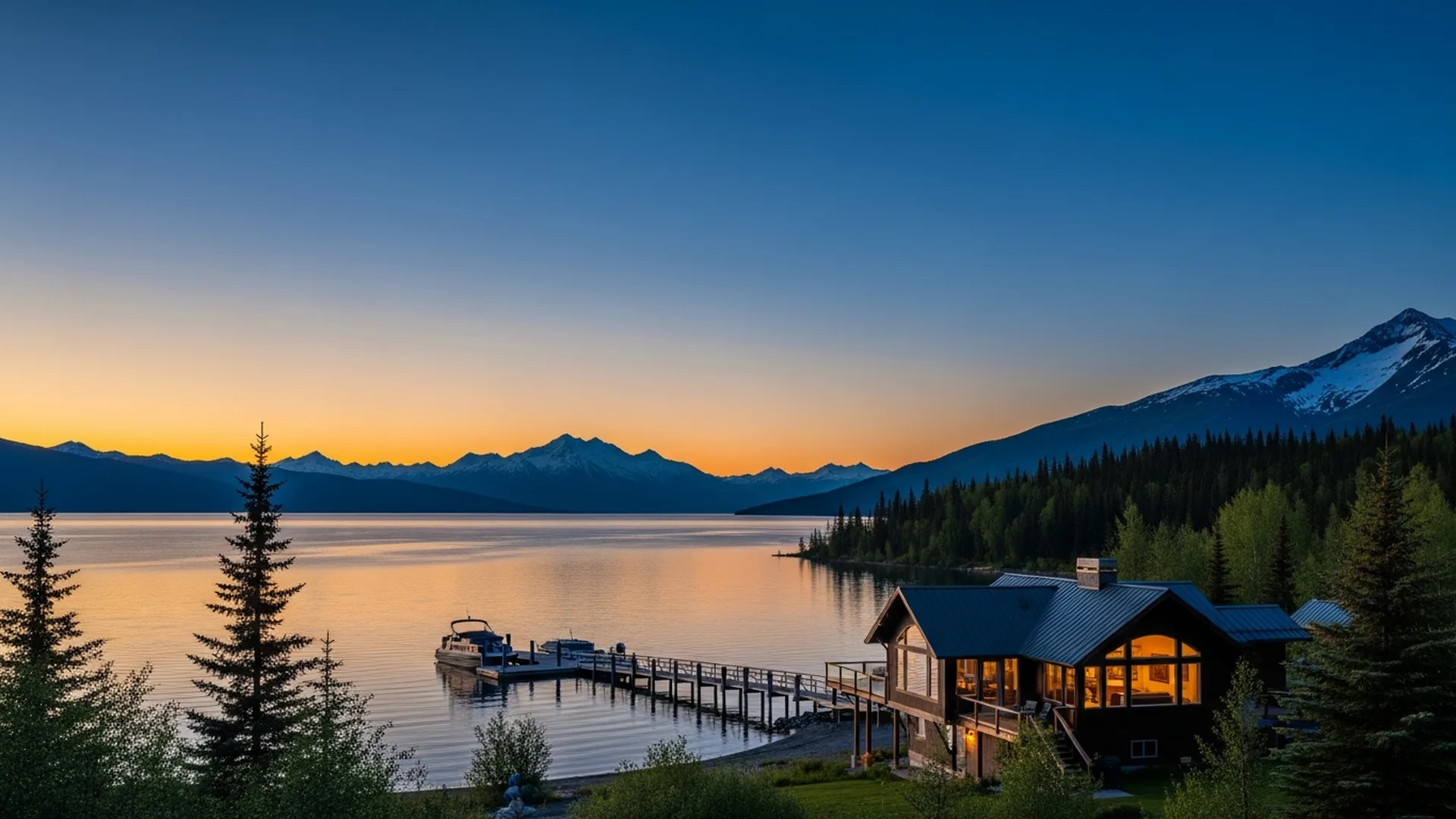
Big Lake is a recreation-centered lake community in the Matanuska-Susitna Borough, roughly 57–59 miles north of Anchorage — about an hour’s drive — built around a 3,000-acre lake with some 67 miles of shoreline and one of Alaska’s busiest float-plane bases. On Big Lake, water-access type drives value more than square footage: deeded waterfront (your lot touches the water) commands a clear premium over shared common-area access, which in turn beats a lot that is merely near the lake. Because Big Lake is rural, homes here typically run on private well and septic rather than city utilities, and there is no Anchorage-style point-of-sale COSA certificate, so a private well-and-septic inspection is standard due diligence. Buyers should also verify float-plane rights against the recorded subdivision documents and evaluate wildfire defensible space on wooded lots.
Of all the water in the Mat-Su Valley, Big Lake is the one Anchorage buyers know by name. It is the closest major recreation lake to the city, and on a summer weekend the float planes taking off and landing are entertainment in themselves. But the reason I steer buyers to read a Big Lake listing carefully is that the market here is really several markets stacked on top of each other — a seasonal cabin on a back cove, a deeded lot on the main lake, and a year-round home with a private dock and float-plane access each follow their own rules on price, financing, and what you legally own at the waterline.
This page walks through the questions that actually decide a Big Lake purchase: the three tiers of water access, whether you can operate a float plane, the well-and-septic realities that come with a rural Mat-Su Borough address, how far the commute really is, and the wildfire history no one likes to bring up but every wooded-lot buyer should understand.
- Big Lake sits about 57–59 miles north of Anchorage via the Glenn and Parks Highways — roughly a one-hour drive, and the closest major recreation lake to the city.
- The lake covers roughly 3,000 acres with about 67 miles of shoreline, and is one of Alaska’s busiest float-plane bases.
- Water access comes in three tiers — deeded waterfront, shared common-area access, and “near the lake” — and that tier drives price more than square footage.
- Big Lake is in the Matanuska-Susitna Borough, so homes typically run on private well and septic, and there is no Anchorage-style COSA certificate required at sale.
- Float-plane and motorized-boat use is allowed on most of the lake, but specific subdivisions or covenants can restrict it — verify against recorded documents.
- The Mat-Su is wildfire country: the 2015 Sockeye Fire near Willow burned about 7,220 acres and destroyed 55 homes, so defensible space and insurance belong in your due diligence.
- Many owners live at Big Lake full-time and commute or use the property as a second home; a “cabin” may not be winterized for year-round living.
Where Is Big Lake, and How Far Is the Commute to Anchorage?
Big Lake lies in the southern Matanuska-Susitna Borough, reached by driving north out of Anchorage on the Glenn Highway, continuing onto the Parks Highway, and turning onto Big Lake Road. Mapping services put the road distance at roughly 57 to 59 miles and the drive at about an hour in normal conditions, with Wasilla — and the nearest hospital, Mat-Su Regional Medical Center — about 14–15 miles east. It is genuinely the closest major recreation lake to Anchorage, which is exactly why it fills up on summer weekends and why so many owners treat it as either a commuter base or a second home.
The practical thing to understand is that the commute is a Parks Highway commute. Improvements at the Big Lake Road junction — a signal and widening to four lanes — have helped traffic flow, but this is still a single-corridor drive that stretches under summer weekend volume and winter weather. Unlike an in-town Anchorage neighborhood where you trade money for a shorter commute, at Big Lake you are trading commute time for lake frontage, acreage, and privacy you simply cannot buy inside the Municipality.
What’s the Difference Between Deeded Waterfront and “Lake Access” on Big Lake?
This is the single most important distinction on the lake, and it is the one the MLS does not always make clear. There are three common tiers:
- Deeded waterfront — your lot legally touches the water and you own a portion of shoreline. This is the clear premium tier, and it is what most people picture when they say “lakefront.”
- Common-area lake access — your subdivision shares a community waterfront lot, beach, or boat launch. You get water access, but you do not own frontage. Newer developments around the lake are frequently structured this way, sometimes with a community dock slip available.
- “Near the lake” — no legal water access at all, despite a Big Lake address.
The price gap between these tiers is significant, and it is the most expensive surprise a buyer can walk into here. A listing that reads “lake access” can mean a deeded beach or nothing legally enforceable, so the answer lives in the title report and the recorded subdivision plat — not the listing description. Verify it in writing before you make an offer.
| Access tier | What you own | Relative value |
|---|---|---|
| Deeded waterfront | Lot legally touches water; a stretch of shoreline is yours | Highest — clear premium |
| Common-area lake access | Shared subdivision waterfront lot, beach, or boat launch | Middle |
| “Near the lake” | No legal water access despite the address | Lowest |
Can You Land a Float Plane on Big Lake?
Yes — Big Lake is one of Alaska’s busiest float-plane bases, and most of the lake permits float planes and motorized boats. Some newer subdivisions are even designed around it, marketing hangar-style homesites with the ability to taxi a plane to the lake via a community launch. But two caveats matter. First, individual HOAs, covenants, or platted subdivision rules can restrict motorized or aviation use, so “most of the lake allows it” is not the same as “this lot allows it.” Second, the airport logistics are their own thing: a Mat-Su Borough aviation system study notes that at Big Lake a float plane has to be towed from the lake across a highway to reach the airport — a real-world quirk worth understanding if you plan to base an aircraft here.
If aviation access is a reason you’re buying, treat it exactly like water access: confirm it against the recorded subdivision documents and verify with the listing agent before you assume anything. I’ve seen buyers fall for the view and forget to check whether the covenants actually let them do what they came for.
Do Big Lake Homes Have Well and Septic — and Is There a COSA Like Anchorage?
Big Lake is a rural Matanuska-Susitna Borough community, so homes here commonly rely on private wells and on-site septic systems rather than municipal water and sewer. That difference is more than cosmetic. In the Mat-Su Borough, new septic installations, replacements, and major repairs generally require a permit and a site evaluation — including a soil percolation or profile test — coordinated with the Alaska Department of Environmental Conservation, and some transactions require an as-built drawing to be on file with the borough.
Here is the critical distinction Anchorage buyers get wrong: there is no COSA at Big Lake. The Municipality of Anchorage requires a Certificate of On-Site Systems Approval before it will transfer title on a well-and-septic property. That is a Municipality of Anchorage program — it does not exist in the Mat-Su Borough. So a Big Lake sale carries no borough-mandated point-of-sale certificate. In practice, that shifts the burden to you: lenders and buyers routinely require a private septic and well inspection anyway, and on a waterfront lot I consider it non-negotiable. High groundwater near a lakeshore, older gravity-fed systems on longtime homesteads, and Alaska’s freeze-thaw cycle all make the septic story worth confirming before you’re under contract.
A listing that calls a property a “cabin” may mean it is uninsulated, summer-only, or on a non-permitted septic; a “year-round home” is fully winterized with permitted utilities. The MLS does not always distinguish the two, and it changes both value and financing. Touring with a local agent — and reading the permit and as-built history — is the only reliable way to know which one you’re buying.
Is Big Lake at Risk From Wildfire?
The honest answer is that the Mat-Su Valley is wildfire country, and a wooded lakefront lot is exactly the kind of place that requires thinking about it. The 2015 Sockeye Fire near Willow — north of Big Lake — burned about 7,220 acres, destroyed 55 homes and damaged dozens more structures, closed the Parks Highway, and forced the evacuation of roughly 1,700 residences across the surrounding communities, with Big Lake among the areas affected by smoke and serving as a refuge for evacuated sled-dog kennels. Smaller fires have flared closer to the lake as well.
None of that should scare a buyer off — it should shape due diligence. Look at defensible space around the structure, confirm insurance availability and cost for the specific property, and understand the evacuation access, since Big Lake, like much of the valley, is a car-dependent community reliant on the Parks Highway corridor. These are ordinary, answerable questions; the mistake is not asking them.
What buyers love about Big Lake
- Closest major recreation lake to Anchorage — roughly an hour’s drive
- Year-round lifestyle: boating, fishing, and float planes in summer; snowmachining, ice fishing, and mushing in winter
- Larger, private, wooded lots — median lot size near an acre — and genuine waterfront ownership
- Denali and Talkeetna Mountain views on clear days
What to weigh carefully
- Water-access tier can swing value dramatically — verify deeded vs. shared vs. none
- Private well and septic; no Anchorage-style COSA, so inspect independently
- Wildfire exposure and single-corridor Parks Highway access
- “Cabin” vs. winterized year-round home affects financing and value
What Do Waterfront Homes Cost on Big Lake?
Big Lake prices vary more than most Mat-Su markets, and the reason ties back to everything above: water-access type, winterization, and lot character drive value more than raw square footage. Publicly listed inventory has spanned a very wide band — from a couple hundred thousand dollars for off-water cabins up through premium deeded-waterfront homes and large-acreage estates well into seven figures, with the strongest demand for anything with true deeded frontage. Because those ranges move with the season and the market, I won’t hang a single “median” number on this page as if it were fixed; the right figure is a current comparative market analysis pulled against the specific access tier you’re shopping. That’s the number that actually protects you at offer time.
Thinking of Selling on Big Lake? What Drives Value Here
If you’re selling, the value story on Big Lake is not the story most sellers tell. Square footage and finishes matter, but the first thing a serious buyer’s agent checks is what the title and plat say about water and aviation access — so a listing that documents deeded frontage, a recorded launch easement, or confirmed float-plane rights up front removes the exact uncertainty that makes buyers hesitate or discount. Clean, on-file septic and well records do the same work.
This is also where my background helps sellers. I hold a degree in interior design and spent a career in furnishings and design before real estate, and on a lake property that eye goes straight to the things that photograph and appraise well: how the main living space frames the water, how light moves through a high-latitude great room, and which finishes read as year-round quality rather than seasonal cabin. Presenting a Big Lake home as a winterized, documented, view-forward property — rather than leaving buyers to guess — is what moves the number. When you’re ready, I can pull a data-backed valuation for your specific lot and access tier.
- Matanuska-Susitna Borough (matsugov.us) — borough permitting/planning jurisdiction, Regional Aviation System Plan (float-plane tow-across-highway note), and Regional Wastewater & Septage Study (share of borough households on private septic).
- Alaska Department of Environmental Conservation (dec.alaska.gov) — on-site wastewater/engineering plan review; engineered/alternative septic systems in difficult-soil or high-groundwater conditions.
- Municipality of Anchorage (muni.org) — Certificate of On-Site Systems Approval (COSA) is a Municipality program, cited here to clarify it does not apply in the Mat-Su Borough.
- Alaska State Parks / Big Lake North State Recreation Area — lake size (~3,000 acres), ~67 miles of shoreline, float-plane base, and recreation profile.
- Travel Alaska (travelalaska.com) and mapping references — ~57–59 mile distance and ~1-hour commute from Anchorage; Wasilla ~14–15 miles east.
- Wikipedia, NASA Earth Observatory, Alaska Wildland Fire Information, and Anchorage Daily News — 2015 Sockeye Fire acreage (~7,220 acres), 55 homes destroyed, evacuations, and Parks Highway closure.
Explore Big Lake Waterfront With a 40-Year Alaska Local
I’ll match comps to the exact water-access tier, read the title and easements, and protect you on inspection contingencies. Call or text 907-560-4090.
Frequently Asked Questions
Yes. Big Lake is one of Alaska’s busiest float-plane bases, and most of the lake permits float planes and motorized boats. That said, individual subdivisions, HOAs, or platted covenants can restrict use, and access from a specific lot varies. Confirm float-plane rights against the recorded subdivision documents and the title report before you assume you can operate from a given property.
There are three common tiers. Deeded waterfront means your lot legally touches the water and you own a stretch of shoreline. Common-area lake access means your subdivision shares a community waterfront lot or boat launch, but you do not own frontage. “Near the lake” means no legal water access at all. The price difference between these is significant, and the MLS does not always spell it out, so it should be verified in the title report before you make an offer.
Big Lake sits roughly 57 to 59 miles north of Anchorage via the Glenn and Parks Highways, about a one-hour drive in normal conditions. It is the closest major recreation lake to Anchorage, which is why many owners commute or use their homes as second homes. Winter weather and summer weekend traffic on the Parks Highway can lengthen the trip.
Yes. Big Lake is a rural Mat-Su Borough community, and homes there commonly rely on private wells and on-site septic systems rather than municipal utilities. In the Matanuska-Susitna Borough, new septic installations, replacements, and major repairs generally require a permit and site evaluation coordinated with Alaska DEC. A septic and well inspection is standard buyer due diligence, especially on a waterfront lot.
No. The Municipality of Anchorage requires a Certificate of On-Site Systems Approval (COSA) at title transfer for well-and-septic properties, but that is a Municipality of Anchorage program and does not apply in the Matanuska-Susitna Borough. Big Lake sits in the Mat-Su Borough, so there is no equivalent borough-mandated point-of-sale certificate. In practice, buyers and lenders still routinely require a private septic and well inspection, and some transactions require an as-built to be on file with the borough.
Big Lake prices vary more than most Mat-Su markets because water-access type drives value more than square footage. Publicly listed inventory has ranged from a couple hundred thousand dollars for off-water cabins up to well past a million for premium deeded waterfront and large-acreage estates. Because ranges shift with the market and depend heavily on whether a home is winterized for year-round use, ask for a current comparative market analysis matched to the specific water-access type.
The Mat-Su Valley is wildfire country. The 2015 Sockeye Fire near Willow burned about 7,220 acres, destroyed 55 homes, and forced Parks Highway closures and large-scale evacuations in the surrounding communities. Big Lake was on the edge of that event and has seen smaller fires nearby. Buyers should evaluate defensible space, insurance availability, and evacuation access as part of due diligence on a wooded lakefront lot.