

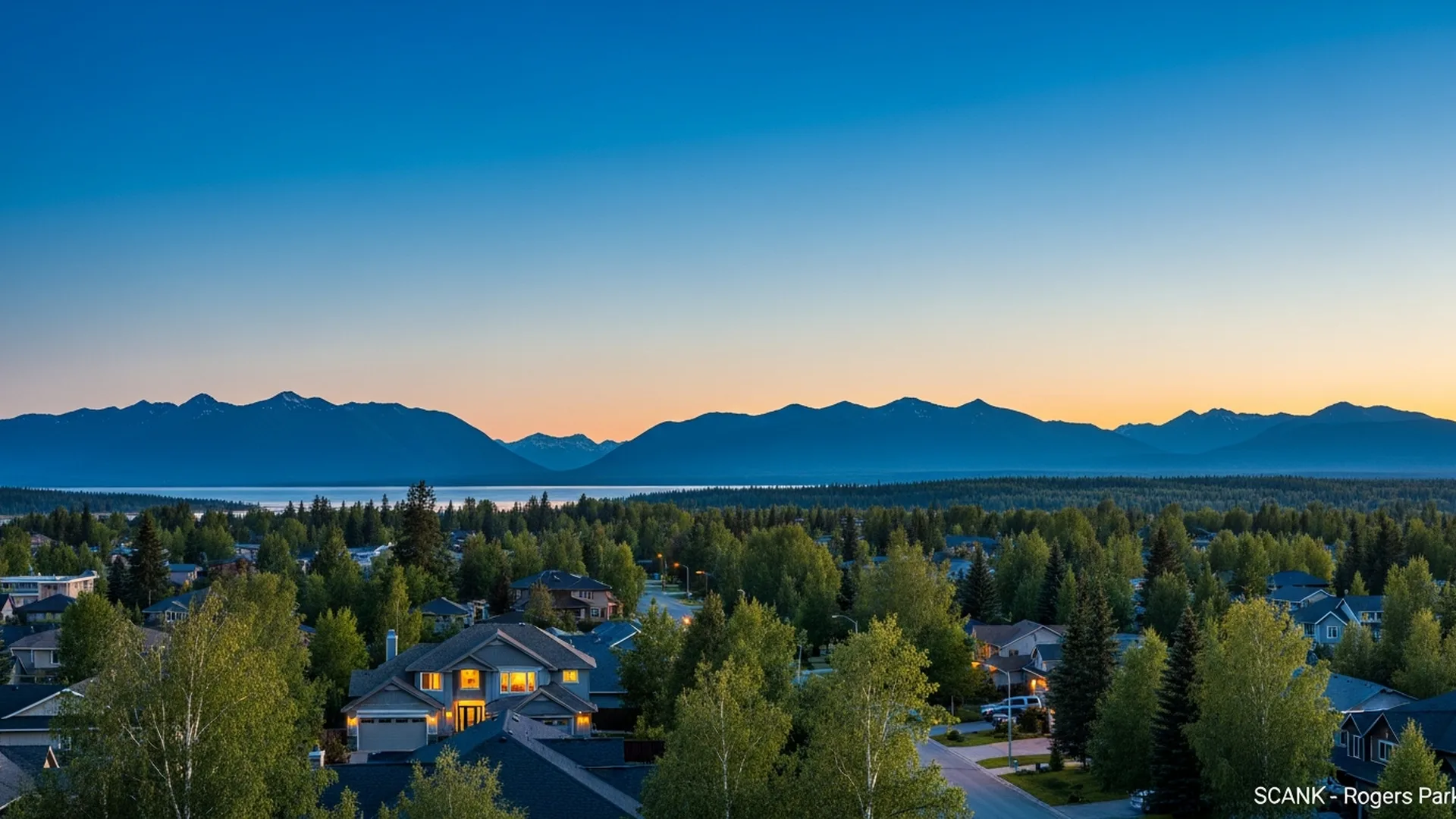
Rogers Park is one of the most centrally located established home neighborhoods in Anchorage, sitting along the Chester Creek Greenbelt roughly between the New Seward Highway and Lake Otis Parkway, about three miles from downtown. Its housing stock is largely 1950s and 1960s single-family homes on a walkable street-and-alley grid, many now extensively remodeled or expanded. Because it is a built-out, city-serviced subdivision, homes here connect to municipal water and sewer rather than the private wells and septic systems that trigger a Certificate of On-Site Systems Approval elsewhere in the municipality. For buyers, the neighborhood's appeal is location, mature character, and direct greenbelt trail access; for value, the deciding factor is almost always the depth and quality of a home's updates.
Ask most people to name Anchorage's prestige addresses and they reach for the Hillside view lots or the coastal streets near the water. Rogers Park earns its standing differently. It is a compact, historic subdivision in the geographic center of the city — the kind of neighborhood where the streets are lined with mature trees, every block has sidewalks and alleys, and a buyer is trading acreage and big views for walkability and a five-minute commute to almost everything. Over four decades living in Anchorage, I've watched central neighborhoods like this hold their appeal precisely because location can't be built anywhere else.
This guide covers what actually matters when you buy or sell here: where Rogers Park sits, how old the homes are and why that shapes value, what the Chester Creek greenbelt gives you, and how the property due-diligence picture differs from the well-and-septic neighborhoods on the city's edges.
- Rogers Park is a central Anchorage subdivision, described locally as bounded roughly by the Chester Creek Greenbelt, 36th Avenue, the New Seward Highway, and Lake Otis Parkway — about three miles from downtown.
- The subdivision was homesteaded in 1920 and subdivided in 1941; family-home construction ran mostly from the early 1950s into the mid-1960s, so most homes are mid-century and heavily remodeled.
- As a built-out, city-serviced neighborhood, homes typically use municipal water and sewer — so the Municipality's COSA (Certificate of On-Site Systems Approval) that governs many Hillside and Eagle River sales usually does not apply here.
- The Lanie Fleischer Chester Creek Trail runs along the neighborhood, connecting west to Westchester Lagoon and the Tony Knowles Coastal Trail and east toward Goose Lake and the university lakes.
- Rogers Park Elementary sits inside the neighborhood; local guides also list Wendler Middle School and Bettye Davis East Anchorage High — always verify boundaries with the Anchorage School District finder.
- Third-party portals report a broad price range from the mid-$300,000s into the upper-$700,000s and a recent median sale price near $475,000; the reliable number for a specific home comes from a current market analysis.
Where Is Rogers Park in Anchorage — and Why Does the Location Matter?
Rogers Park sits in central Anchorage. Local real-estate descriptions place the neighborhood between the Chester Creek Greenbelt to the north and 36th Avenue to the south, and between the New Seward Highway to the west and Lake Otis Parkway to the east. Practically, that means you are near the middle of the city: neighborhood guides put downtown Anchorage about three miles away and the Ted Stevens Anchorage International Airport within about five miles. One point worth flagging plainly for out-of-state buyers — some directories file Rogers Park under “Midtown” and others under “central” Anchorage; the neighborhood label matters less than the fact that it is genuinely central.
There's also a naming nuance a careful buyer should understand. The historic Rogers Park subdivision is small — an Anchorage Daily News commentary describes it as roughly a one-seventh-of-a-square-mile family residential neighborhood in the northeastern corner of the much larger Rogers Park Community Council District, which itself covers nearly a square mile and contains dozens of platted subdivisions and several zoning types. If you're comparing listings, confirm whether a home is in the original subdivision or simply within the broader council district, because character and zoning can differ block to block.
| Attribute | Rogers Park detail |
|---|---|
| Location | Central Anchorage; ~3 mi to downtown, ~5 mi to the airport |
| Rough boundaries | Chester Creek Greenbelt (N), 36th Ave (S), New Seward Hwy (W), Lake Otis Pkwy (E) |
| Housing stock | Mostly 1950s–1960s single-family homes, many remodeled/expanded |
| Utilities | Municipal water & sewer (COSA typically not applicable) |
| Trail access | Lanie Fleischer Chester Creek Trail → Westchester Lagoon & Coastal Trail |
| Assigned schools (verify) | Rogers Park Elementary, Wendler Middle, Bettye Davis East Anchorage High |
How Old Are Rogers Park Homes, and Why Does That Shape Value?
This is the single most important thing to understand before you buy or price here. Rogers Park is a mid-century neighborhood. As recounted in an Anchorage Daily News commentary by a longtime resident, the area was homesteaded in 1920, subdivided in 1941 on the street-and-alley grid you still see today, and built out with family homes mostly from the early 1950s through the mid-1960s. Longtime local real-estate write-ups add that the housing is dominated by 1950s and 1960s construction, with only a handful of newer infill homes, and that most of the original homes have since been remodeled and updated — some with additions, expanded bedroom counts, and heated attached garages.
What that means in practice: two houses on the same street can be priced very differently based entirely on the depth and quality of their renovations. Unlike a new-construction subdivision where homes are broadly comparable, in Rogers Park the “bones plus updates” equation drives everything — roof age, window replacement, mechanical systems, kitchen and bath finishes, and whether an addition was permitted and done well. The same Daily News account notes that recent years have brought more expansion remodels and accessory-dwelling-unit infill, nudging density up and open yard space down. For a buyer, reading those updates correctly is where you either find value or overpay.
Do Rogers Park Homes Have Well and Septic — or Is Due Diligence Simpler Here?
Here's where a central neighborhood is genuinely easier than the city's edges. Rogers Park is a built-out, city-serviced subdivision, which means homes are generally on municipal water and sewer rather than private wells and septic systems. That matters because of a specific municipal rule. Per the Municipality of Anchorage, an ordinance passed in August 1998 requires that to transfer title on any property served by a well or septic system, the seller must obtain a Certificate of On-Site Systems Approval (COSA) — a document, signed by a State of Alaska registered professional engineer, confirming the on-site well and/or septic system has been inspected, tested, and found compliant.
The COSA process is not trivial where it applies: the Municipality's guidance describes water testing for arsenic, nitrate, and coliform bacteria, septic-tank pumping and adequacy testing, and a field verification of separation distances — and industry accounts note real cost and timeline exposure, including the risk that a home's added bedrooms no longer match the size the original septic system was designed for. In Rogers Park, that whole layer usually falls away because there's no on-site system to certify. The honest caveat: if a specific older property does have a private well or septic system, a COSA would be required at title transfer — so confirm the utility connection on any home before you assume it's city-serviced. This is exactly the kind of local rule where knowing whether it applies saves a buyer both money and closing delays.
The float-plane, lakefront, and well-and-septic due-diligence topics that come up in Anchorage luxury searches belong mostly to the lake and edge neighborhoods, not to Rogers Park. If lakefront or float-plane access is your priority, see the Campbell Lake and Sand Lake pages linked below — those are where on-site systems, dock rights, and lake access genuinely drive the analysis.
What Do You Get for Living Along the Chester Creek Greenbelt?
The greenbelt is Rogers Park's signature amenity, and it's a real one. The Lanie Fleischer Chester Creek Trail runs along the neighborhood; per Visit Anchorage, this tree-lined, paved path connects Westchester Lagoon and the Tony Knowles Coastal Trail on the west to the University of Alaska Anchorage area on the east, stretching about four miles end to end on a flat surface. At its western terminus at Westchester Lagoon, the trail ties directly into the Coastal Trail, which follows the shoreline along Knik Arm and Cook Inlet — so from a Rogers Park doorstep you can reach the water's edge and downtown entirely on a car-free path.
The Rails-to-Trails Conservancy notes something that captures why this location is unusual: unlike most Anchorage trails that hug the coastline, the Chester Creek corridor is a transportation greenbelt that runs through the city, offering easy access to downtown. Its broader network connects to more than a dozen miles of routes and forms part of the 32-mile “Moose Loop” linking the Chester Creek, Coastal, Campbell Creek, and Ship Creek trails. Locally, homes here are also near green spaces such as Carlson Park, with Goose Lake Park about a mile away. For buyers who want a walkable, year-round-recreation address without leaving the center of town, that trail access is a durable value driver.
Rogers Park at a glance
What Should a Buyer Weigh Before Making an Offer in Rogers Park?
Because the appeal is location and character rather than newness, buyers touring Rogers Park consistently discover that the trade-offs are about the housing itself, not the setting. The setting is a strength; the home's condition is the variable.
Strengths
- Central location — short commutes across the city and easy downtown access
- Walkable street-and-alley grid with sidewalks; direct greenbelt trail access
- Municipal water and sewer — simpler transaction than well-and-septic areas
- Mature, established character with a recognized neighborhood identity
Things to check
- Mid-century stock — verify roof age, windows, mechanicals, and remodel quality
- Confirm any addition's bedroom count and that work was permitted
- Lot sizes are modest; this is not an acreage or big-view market
- Confirm whether a home is in the original subdivision vs. the broader council district
Thinking of Selling in Rogers Park? What Actually Drives Value Here
Sellers in mid-century neighborhoods routinely underestimate how much presentation and documented updates move the number. Because buyers are pricing your home against other 1950s–60s houses with wildly varying renovation levels, the winning strategy is to make the quality and permitting of your updates unmistakable — roof, windows, mechanicals, and any addition — and to stage the interior so mid-century square footage reads as light-filled and current rather than dated. This is where my interior-design background earns its keep: knowing which finishes read as timeless versus trendy, and how to present a compact floor plan so it lives larger than its footprint.
Pricing should lean on genuine, current comparables rather than portal medians. Third-party sites have reported a Rogers Park median sale price around $475,000 over a recent 12-month period, up modestly year over year, with homes reportedly selling faster than the national average — but those are aggregate portal figures, not a valuation of your specific home. When you're ready, I'll prepare a Rogers Park comparative market analysis grounded in what comparable, similarly-updated homes have actually sold for. You can start with the Anchorage home value tool.
- Municipality of Anchorage — On-Site Water & Wastewater / Certificate of On-Site Systems Approval (COSA): 1998 title-transfer ordinance, engineer inspection, and water-quality testing requirements.
- Municipality of Anchorage Development Services — AMC Chapter 15.65 (Wastewater Disposal) and 15.55 (Water Wells); COSA guidelines and On-Site records access.
- Anchorage Daily News — commentary on the Rogers Park subdivision history (homesteaded 1920, subdivided 1941, built out early 1950s–mid 1960s) and the subdivision vs. Community Council District distinction.
- Visit Anchorage & Rails-to-Trails Conservancy — Lanie Fleischer Chester Creek Trail length, greenbelt character, and connection to Westchester Lagoon and the Tony Knowles Coastal Trail.
- Anchorage School District — official school-boundary finder (assigned schools must be verified by address).
- Third-party real-estate portals (Homes.com, Zillow, Trulia) — reported Rogers Park price range and recent median sale price; used as market-context references only.
- HomeTownLocator — approximate Rogers Park coordinates within the Municipality of Anchorage.
Explore Rogers Park & Central Anchorage Homes
Get a local read on the neighborhood, the housing stock, and which updated homes are worth the number. Call Bill Ure at 907-560-4090.
Frequently Asked Questions
Rogers Park is an established residential neighborhood in central Anchorage. Local descriptions place it roughly between the Chester Creek Greenbelt to the north and 36th Avenue to the south, and between the New Seward Highway to the west and Lake Otis Parkway to the east. Downtown Anchorage is about three miles away, making it one of the most centrally located home markets in the city.
Most Rogers Park homes date to the 1950s and 1960s. Per an Anchorage Daily News account, the subdivision was homesteaded in 1920, subdivided in 1941, and family-home construction ran largely from the early 1950s through the mid-1960s. Because the stock is older, many homes have been extensively remodeled, so value here turns heavily on the quality and permitting of those updates.
Generally no. As a built-out central Anchorage subdivision, Rogers Park is served by municipal water and sewer rather than private wells and septic systems. That means the Municipality of Anchorage Certificate of On-Site Systems Approval (COSA) required at title transfer for well-and-septic properties usually does not apply here. If a specific property does have an on-site system, a COSA would be required, so confirm the utility connection before you write an offer.
The neighborhood sits along the Chester Creek Greenbelt. The paved Lanie Fleischer Chester Creek Trail runs roughly four miles from Westchester Lagoon — where it meets the Tony Knowles Coastal Trail — east toward Goose Lake, and its wider system connects to more than a dozen miles of routes. Nearby green spaces cited by local sources include Carlson Park and Goose Lake Park, about a mile away.
Rogers Park is served by the Anchorage School District, and Rogers Park Elementary School sits within the neighborhood. Local guides list Wendler Middle School and Bettye Davis East Anchorage High School among the assigned secondary schools. Attendance boundaries change, so always verify a specific address using the Anchorage School District's official school finder before you buy.
Rogers Park is a mixed-price neighborhood rather than a pure luxury enclave. Third-party portals have reported a range from roughly the mid-$300,000s into the upper-$700,000s and a median sale price around $475,000 over a recent 12-month window. Those are aggregate portal figures that move with the market, so the reliable number for your specific home comes from a current comparative market analysis.
Rogers Park pairs a central location with a walkable, tree-lined street grid and direct access to the Chester Creek Greenbelt. Downtown is about three miles away and the airport within about five miles. The Lanie Fleischer Chester Creek Trail runs along the neighborhood and connects west to Westchester Lagoon and the Tony Knowles Coastal Trail and east toward the university-area lakes.