

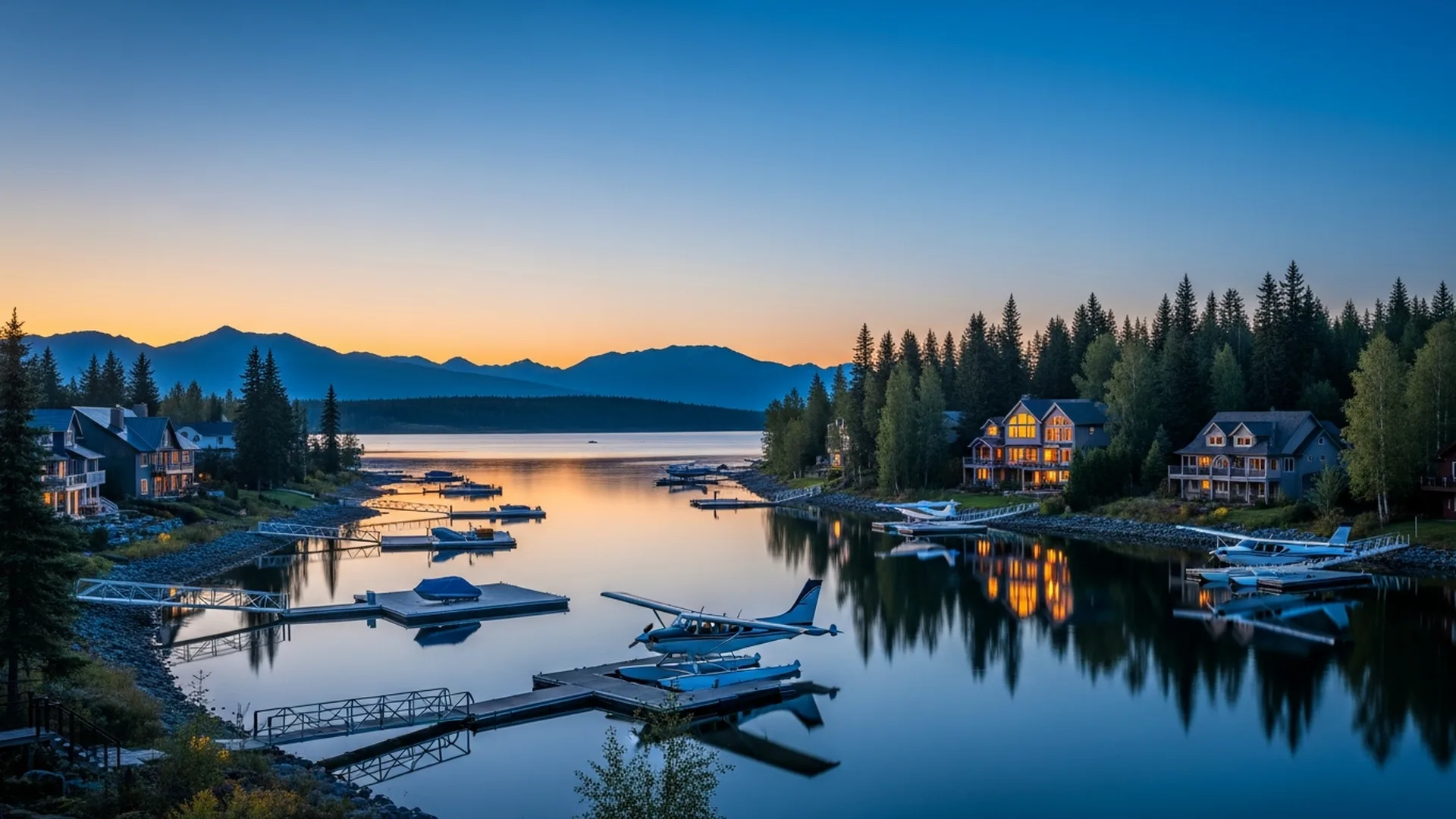
Campbell Lake is a dammed lake in the southwest corner of the Anchorage Bowl, ringed by luxury homes and serving as an FAA-designated seaplane base — one of the few Anchorage addresses where a homeowner can keep a floatplane or boat at a private dock in town. Most lakefront homes date to the late 1970s and early 1980s, with the last built around 2007, so this is an established, largely built-out lakefront rather than a new-construction market. Lots typically run about a quarter- to a half-acre, and homes range from roughly 1,500 to 6,000 square feet. Importantly, although the lake was long treated as private, a December 2019 State of Alaska and Municipality of Anchorage joint statement clarified it is a public water body, and the State filed a related access lawsuit in 2023 — facts any buyer should understand going in.
Ask most Anchorage residents about Campbell Lake and they’ll tell you it’s the “private lake” on the west side lined with big houses and floatplanes. That reputation is half the story — and the half that has changed matters a great deal to a buyer. What has not changed is the appeal: a genuine in-town lakefront where your dock can hold a boat or a floatplane, minutes from the airport and the edge of Kincaid Park. In four decades of watching this city, I’ve found very few Anchorage settings that combine water at the back door with that kind of proximity.
This guide covers what the Campbell Lake housing stock is really like, what drives value on the water here, how access and the floatplane base function, and the public-versus-private question that a careful buyer needs to walk into with eyes open. I’ll be direct about the trade-offs as well as the appeal — that’s the only way this page is worth your time.
- Campbell Lake was formed in 1958 when an earthen dam was built across Campbell Creek, flooding former intertidal wetlands to create the lake.
- The lake functions as a floatplane base; many lakefront homes have docks used for floatplanes and boats, and aircraft have the right of way on the water.
- Most lakefront homes were built in the late 1970s and early 1980s, with the last homes completed around 2007 — an established, essentially built-out lakefront.
- Lakefront lots generally run about a quarter- to a half-acre; waterfront homes commonly range from ~1,500 to 3,000 sq ft, with luxury homes up to ~6,000 sq ft.
- In December 2019 the State of Alaska and the Municipality of Anchorage jointly clarified that Campbell Lake is a public water body; the State filed a related access lawsuit in 2023.
- The dam is a State-regulated Class III (low) hazard dam that must be periodically inspected to hold a certificate to operate.
- Campbell Lake sits in southwest Anchorage near the Dimond corridor — about 7–9 miles from downtown and roughly 7.5 miles from Ted Stevens Anchorage International Airport.
What Makes Campbell Lake a Distinct Luxury Address in West Anchorage?
Campbell Lake is not a natural lake. It was created in 1958 when Anchorage residents David Alm and George McCullough built an earthen dam across the outflow of Campbell Creek, flooding a stretch of intertidal wetland to form what is now the largest lake in the Anchorage Bowl. That origin is more than trivia — it explains why the shoreline is entirely ringed by homes and why the lake has always been treated as an amenity tied to the surrounding parcels rather than a public park with a beach.
The result is one of the very few places in Anchorage where the luxury proposition is genuine in-town waterfront. Unlike a Hillside view lot, where the water is a distant Cook Inlet horizon, a Campbell Lake home puts the water at the dock. And unlike a remote lake cabin, this one is minutes from the Dimond shopping corridor, roughly 7.5 miles from Ted Stevens Anchorage International Airport, and a short drive from Kincaid Park. Buyers touring here consistently react to that combination — a working floatplane dock and a grocery run in the same afternoon is not something most markets can offer.
| Attribute | Campbell Lake, West Anchorage |
|---|---|
| Home vintage | Mostly late 1970s–early 1980s; final construction ~2007 |
| Typical lot size | ~1/4 acre to ~1/2 acre (lakefront) |
| Typical home size | ~1,500–3,000 sq ft; luxury homes up to ~6,000 sq ft |
| Water use | Floatplane base & boating; aircraft have right of way; no fishing on the lake |
| Water status | Public water body (2019 State/MOA joint statement); State access lawsuit filed 2023 |
| Location | SW Anchorage Bowl, near Dimond corridor; ~7–9 mi to downtown, ~7.5 mi to airport |
How Much Does the Campbell Lake Floatplane Dock Actually Matter?
For a certain buyer, the dock is the whole point. Anchorage’s Lake Hood is the busiest seaplane base in the world, with hundreds of slips — and a waitlist that pilots describe in terms of many years, not months. Campbell Lake is one of the local alternatives where a homeowner can moor a floatplane at their own shoreline. That scarcity is real value: you are not just buying a house on water, you are buying an in-town aviation asset that is difficult to replicate.
Two practical realities follow from the seaplane-base status. First, this is an active operational surface — watercraft yield to aircraft, and there is no fishing on the lake. Second, summer brings floatplane and, at times, helicopter activity overhead and on the water. Some residents treasure the sound of a float departure over morning coffee; others find peak-summer traffic wearing. That is exactly the kind of preference I’d rather a buyer test in person, on a busy July weekend, than discover after closing.
What Is the Campbell Lake Housing Stock Really Like?
This is not a new-construction neighborhood, and a buyer should set expectations accordingly. The bulk of the lakefront homes went up in the late 1970s and early 1980s, and the last homes on the lake were built around 2007. With the shoreline essentially built out, nearly every sale is an existing home. The upside is that many have been meaningfully updated over the decades — it is common to find extensively finished lower levels adding livable square footage below the original footprint.
Sizes vary widely. Waterfront homes commonly fall in the 1,500-to-3,000-square-foot range, while the larger luxury homes reach roughly 6,000 square feet, with floor plans running from three bedrooms up to five- and six-bedroom layouts, some placing the primary suite on the main level. Because the era and quality of updates differ so much house to house, two homes at similar list prices can be very different underneath. This is precisely where a trained design eye earns its keep: reading which renovations were done well and which are cosmetic is a large part of protecting your money on an older lakefront home.
What buyers love here
Genuine in-town lakefront; a dock that can hold a boat or floatplane; scarcity value versus Lake Hood; minutes from Dimond shopping, Kincaid Park, the Coastal Trail, and the airport; established, private-feeling setting.
Honest trade-offs
Older housing stock (mostly 40+ years) with variable updates; summer floatplane noise; ongoing public-access and easement questions; dam and dredging obligations shared among lakefront owners; little to no new construction available.
Is Campbell Lake Really Public or Private — and Why Does It Matter to a Buyer?
This is the single most important thing to understand before buying here, and I won’t soften it. For decades, the lake was treated as a private amenity of the surrounding homes. Beginning in 2019, investigative reporting and then the government caught up with the legal reality: in December 2019 the State of Alaska and the Municipality of Anchorage issued a joint statement clarifying that Campbell Lake is a public water body, open to the public for boating and permissible recreation, with lawful access by aircraft, via Campbell Creek, or through two surveyed public-access easements. In 2023 the State filed a lawsuit aimed at confirming a public right-of-way to the lake.
What this does not change: the lots, the shoreline uplands, and the docks remain private property. What it does mean is that the “exclusive private lake” framing a seller or an old listing might use is not accurate, and a diligent buyer should read the State/Municipality joint statement, understand where the public easements run relative to the parcel, and factor the unresolved litigation into their decision. In my experience, buyers who understand this up front are perfectly comfortable; the ones who feel misled are the ones who were sold a story instead of the facts.
Campbell Lake’s earthen dam is regulated by the State of Alaska as a Class III (low) hazard dam and must be periodically inspected to hold a certificate to operate. Lakefront owners have historically shared substantial costs for dredging and dam upkeep through the lake’s homeowners’ organization. Confirm current dam status and the schedule and amount of owner assessments during due diligence.
What Is the Setting Around Campbell Lake Like Year-Round?
Campbell Lake sits at the southwest edge of the Anchorage Bowl, just south of the Dimond Boulevard corridor and its shopping, and a short drive from Kincaid Park — a 1,400-plus-acre park on a former Cold War missile site, laced with world-class ski, bike, and hike trails and views of Denali and Cook Inlet. The park is also the southern terminus of the eleven-mile Tony Knowles Coastal Trail, which runs along the Cook Inlet coast to downtown. For a West Anchorage buyer who wants water at home and trails and coastline within minutes, that geography is hard to beat.
Winter changes the lake’s character entirely: the frozen surface becomes a place for skiing and skating, and the summer floatplane traffic gives way to quiet. High-latitude daylight swings are dramatic here as everywhere in Anchorage, and on a west-facing lakefront the long summer evenings over the water are a genuine amenity. As always in Alaska, I encourage buyers to see a property in more than one season before committing.
Thinking of Selling on Campbell Lake? What Drives Value Here
If you own on the lake, your two biggest value levers are the waterfront function and the condition of an older home. A sound, well-permitted dock capable of floatplane use is a differentiator few Anchorage listings can claim — make sure it’s documented and presented, not buried in the remarks. On the house itself, buyers here are comparing 40-year-old homes with wildly different updates; the sellers who win are the ones whose renovations read as intentional and well-executed. That’s an area where I lean on a background in interior design and furnishings to advise on staging and on which finishes actually move the number versus which simply cost money.
Just as important, price and market with the lake’s real facts — the public-water status and any easements — disclosed cleanly. Getting ahead of those questions builds buyer confidence and protects your negotiating position. For a specific figure on your home, start with a Campbell Lake home value estimate and we can refine it into a true custom analysis.
- State of Alaska (Dept. of Natural Resources) & Municipality of Anchorage — “Joint Statement: Campbell Lake within the Municipality of Anchorage: Ownership, Use and Access” (public-water status, lawful access methods, dam certification history).
- Wikipedia, “Campbell Lake (Anchorage, Alaska)” — lake formation (1958 dam), dam failures (1964, 1989), 2018 earthquake sewer-pipe repair and 2019 drainage, and 2019 joint statement summary.
- Alaska’s News Source / KTUU — reporting on the 2023 State of Alaska lawsuit to confirm public access to Campbell Lake.
- Neighborhood real-estate market descriptions of Campbell Lake housing stock (home vintage late 1970s–early 1980s, last built ~2007; lot sizes ~1/4–1/2 acre; home sizes ~1,500–6,000 sq ft; distances to downtown, airport, and shopping).
- Visit Anchorage & alaska.org — Kincaid Park (1,400+ acres) and Tony Knowles Coastal Trail (11 miles, downtown to Kincaid Park).
- Lake Hood Seaplane Base background (busiest seaplane base in the world; 500+ slips) as context for floatplane-dock scarcity.
Considering a Campbell Lake home?
Get a straight, local read on the lakefront market — and on any specific home’s dock, condition, and access.
Frequently Asked Questions
No. For decades Campbell Lake was widely assumed to be private, but in December 2019 the State of Alaska and the Municipality of Anchorage issued a joint statement clarifying that Campbell Lake is a public water body open for boating and permissible recreation. The lots and shoreline are privately owned, but the water itself is public. Any buyer should read that joint statement and note that the State also filed a related access lawsuit in 2023.
Yes. Campbell Lake functions as an FAA-designated seaplane base, and many lakefront homes have their own docks used for floatplanes and boats. Pilots value it as an alternative to Lake Hood, where the waitlist for a slip can run many years. Because the lake is an active seaplane base, aircraft have the right of way and there is no fishing on the lake.
Most Campbell Lake homes were originally built in the late 1970s and early 1980s, with the final round of lakefront construction completed around 2007. Because the shoreline is essentially built out, most transactions are established homes rather than new construction, and many have been extensively renovated or expanded with finished lower levels.
Lakefront lots generally run between about a quarter-acre and a half-acre. Waterfront homes commonly range from roughly 1,500 to 3,000 square feet, with the largest luxury homes reaching around 6,000 square feet. Layouts range from three-bedroom plans up to five- and six-bedroom homes, some with a main-floor primary suite.
Campbell Lake sits in the southwest corner of the Anchorage Bowl, in the West Anchorage area near the Dimond Boulevard corridor. It is about 7 to 9 miles from downtown Anchorage and roughly 7.5 miles from Ted Stevens Anchorage International Airport, with Kincaid Park and the Tony Knowles Coastal Trail nearby to the west.
Verify the lake’s public-water status and any easements crossing or near the parcel, confirm the condition and permitting of the dock, and review the Campbell Lake homeowners’ organization assessments, which have historically funded dredging and dam upkeep. Because the earthen dam is a State-regulated Class III hazard dam requiring periodic inspection, ask about its current status. As with any Anchorage purchase, confirm utility service and, for any non-sewered systems, on-site water and wastewater details.
For a buyer who wants genuine in-town lakefront and floatplane access, Campbell Lake is one of the rare Anchorage addresses that delivers it, minutes from the airport and Kincaid Park. The trade-offs are older housing stock, summer floatplane noise, and the ongoing public-access question. It suits a buyer prioritizing the water lifestyle over new construction; a design-minded eye helps separate the well-updated homes from those needing work.