

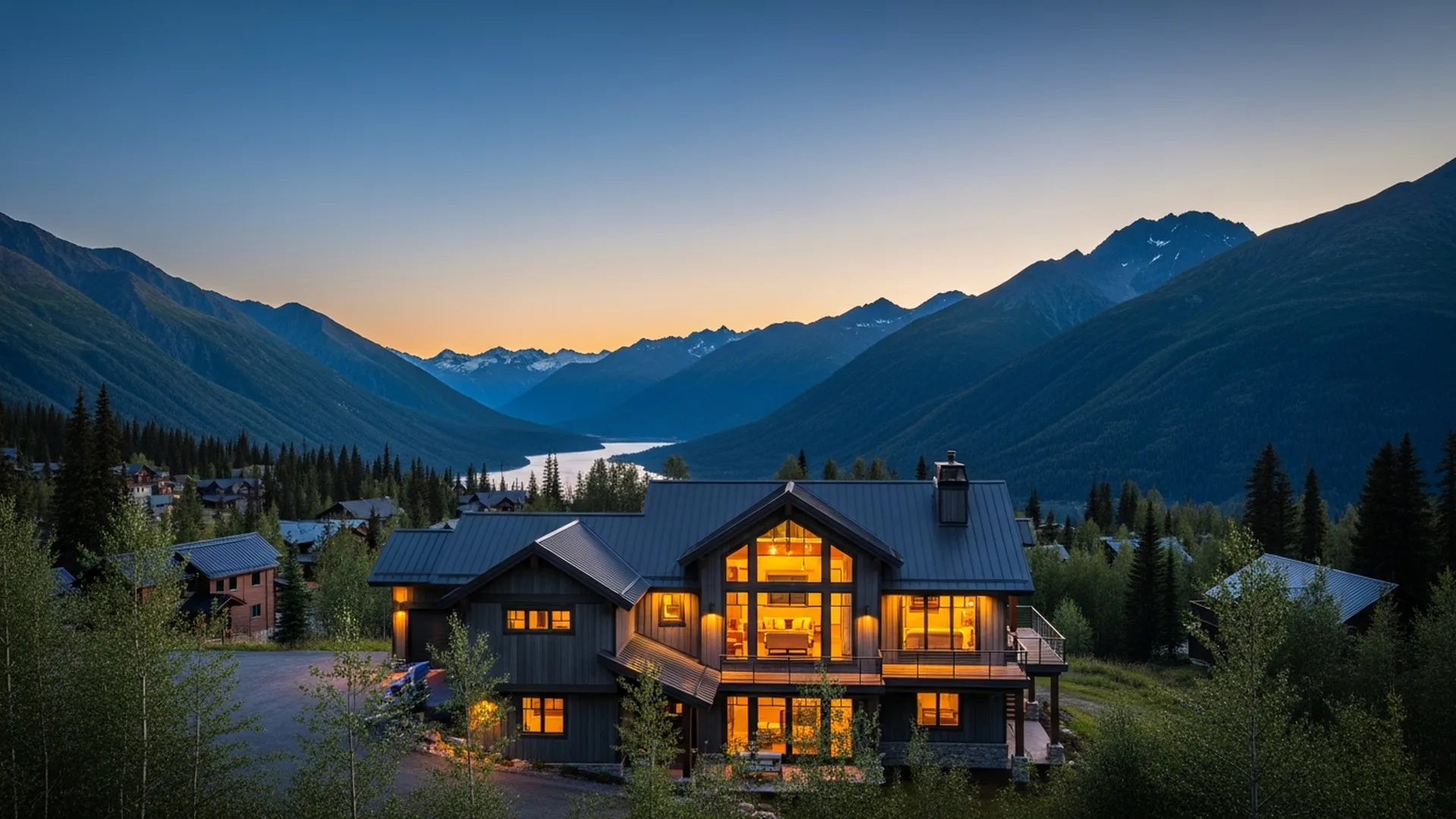
South Fork is the valley area of Eagle River reached by Hiland Road off the Glenn Highway, inside the Municipality of Anchorage about 13 miles north of downtown. Homes here sit in a broad, glacier-carved Chugach valley, and lots tend to be larger because many properties run on individual wells and on-site septic systems, which Alaska DEC rules require room to separate. The signature draw is direct Chugach State Park access at the South Fork Eagle River Trailhead, gateway to Eagle and Symphony Lakes. Because most of these properties use well and septic, a Municipality of Anchorage Certificate of On-Site Systems Approval (COSA) is required to transfer title. For any luxury buyer, view orientation, usable acreage, winter road access, and the condition of the well and septic are the factors that most affect value.
South Fork is one of those Eagle River addresses where the geography does most of the talking. Turn off the Glenn Highway at the Eagle River Loop exit around Mile 11.6, follow Hiland Road, and the terrain lifts you out of the town center and up into a broad valley that reaches deep into the Chugach Mountains. Buyers who tour it in person almost always feel the shift — the lots open up, the mountain walls close in, and the sense of being “in town but not of it” is immediate. It is a genuinely different product from a typical Anchorage Bowl subdivision, and understanding why is the key to buying or selling well here.
I’ve watched this corridor grow over forty years of living in Anchorage. The through-line in South Fork has always been the same: land, light, and access carry the value. The homes that hold their price are the ones that got the valley’s realities right — sun orientation, a well and septic system that will pass inspection, and a driveway that behaves in February. This guide lays out those realities with the actual rules that govern them, so you can read a South Fork property the way a seasoned local does.
- South Fork is accessed via Hiland Road from the Glenn Highway’s Eagle River Loop exit (about Mile 11.6), inside the Municipality of Anchorage roughly 13 miles north of downtown.
- Many South Fork homes use private wells and on-site septic; Alaska DEC’s 18 AAC 72 requires at least 100 feet of separation between a well and a septic system, which pushes lots larger.
- Alaska DEC also requires a drainfield to sit at least 100 feet from a lake, river, or stream and at least 50 feet from a slope steeper than 25 percent — both common valley conditions.
- The Municipality of Anchorage has required a Certificate of On-Site Systems Approval (COSA) to transfer title on well/septic properties since an August 1998 ordinance; well and septic testing is generally valid for two years.
- The South Fork Eagle River Trailhead in Chugach State Park leads into a glacier-carved valley, with the route to Eagle and Symphony Lakes running about 5.5 miles one way.
- Trailhead parking is documented as undersized for peak demand, so end-of-road neighborhoods can see summer congestion.
- The Glenn Highway is the single main corridor to Anchorage, so winter and incident delays are worth planning for when evaluating a commute.
Where Is South Fork in Eagle River, and How Do You Get There?
South Fork sits in the mouth of the Eagle River Valley, on the south side of the community, reached by heading up Hiland Road. Eagle River itself is an independent-minded valley community that sits inside the Municipality of Anchorage, tucked between Joint Base Elmendorf-Richardson and Chugach State Park. Most sources place it about 12 to 13 miles up the Glenn Highway from downtown, with the road distance to downtown typically cited around 15 miles.
For getting in and out, the practical detail matters: the Eagle River Loop exit at roughly Glenn Highway Mile 11.6 is the best access to both Eagle River and Hiland roads. From there, drive times to the Anchorage Bowl are commonly described in the 17-to-40-minute range depending on where you measure from, the time of day, and the weather. Unlike a Hillside address that has several ways down into midtown, South Fork funnels onto one main corridor — the Glenn Highway — so I always tell buyers to price in a buffer for storm mornings and the occasional highway incident rather than assuming a best-case drive.
| Location factor | South Fork, Eagle River detail |
|---|---|
| Jurisdiction | Municipality of Anchorage |
| Distance to downtown Anchorage | ~13 miles (road ~15 miles) |
| Main highway access | Glenn Highway, Eagle River Loop exit ~Mile 11.6 → Hiland Road |
| Typical drive to Anchorage Bowl | ~17–40 minutes (traffic/weather dependent) |
| Signature outdoor access | South Fork Eagle River Trailhead, Chugach State Park (Eagle & Symphony Lakes ~5.5 mi) |
| Common water/wastewater | Individual well & on-site septic on many valley lots |
Why Are South Fork Eagle River Lots So Much Larger Than In-Town Lots?
The honest answer is regulatory, not just aesthetic. Homes higher up the valley generally rely on a private well for water and an on-site septic system for wastewater, and Alaska’s wastewater rules under 18 AAC 72 require real physical space between those systems. Per Alaska DEC, a private drinking-water source must sit at least 100 horizontal feet from a septic tank, soil absorption field, or other wastewater system. On top of that, DEC requires the drainfield to be at least 100 feet from the high-water level of a lake, river, or stream, and at least 50 feet from any slope steeper than 25 percent with more than a 10-foot drop.
Now overlay those rules on a glacier-carved valley threaded by the South Fork of Eagle River and framed by steep Chugach slopes, and you can see why parcels here are sized generously: a lot has to hold the house, the well, the drainfield, reserve area for a future replacement field, and still respect the setbacks from water and steep ground. Unlike an in-town lot on city sewer, where a builder can pack more house onto less land, a South Fork lot is doing hydrological work. That is the un-fakeable reason the space, privacy, and elbow room exist — and it is exactly the kind of thing a buyer should confirm on the specific property, because setbacks are checked against the survey, not assumed.
What Well and Septic Due Diligence Should a South Fork Buyer Do?
This is the single most important body of knowledge for a valley purchase, and it’s where a local read pays off. Because most South Fork properties are on well and septic, the transaction runs through the Municipality of Anchorage’s Certificate of On-Site Systems Approval (COSA) process. Since an August 1998 Municipal Assembly ordinance, the MOA requires a COSA to transfer title on any property served by a well or septic system. A State-of-Alaska-registered civil or environmental engineer performs a field inspection, tests the systems, and verifies code separation distances; the On-Site Water and Wastewater Section then reviews the package and issues the certificate.
The practical timing details are what protect a deal. Per the Municipality’s guidance, well and septic test results are generally good for two years, while water samples are shorter-lived — nitrate and bacteria results only about 90 days, and arsenic about a year. The septic tank also needs a pumping receipt within the previous year. One valley-specific wrinkle the MOA itself flags: septic system pipes shown in municipal records must all be accounted for in the field, even pipes buried under snow — which is a real consideration for a winter closing. And if separation distances don’t meet code, the engineer has to file a waiver request, which adds time and cost. The recurring surprise I warn buyers about isn’t a dramatic system failure; it’s a home that added bedrooms over the years onto a septic system originally sized for fewer, because Anchorage code sizes the system by bedroom count.
Cost figures move over time and vary by property. Anchorage engineering firms currently cite a Municipality COSA review/issuance fee in the range of about $600, and the MOA/DEC charge separate permit and records-retrieval fees. Treat any single dollar figure as a starting estimate and confirm the current fee schedule with the MOA On-Site Water and Wastewater Section and a licensed engineer for your specific property.
How Does Winter Access Work Up Hiland Road?
Access is a two-part question in South Fork: the highway, and the driveway. The Glenn Highway is the main corridor between Eagle River and the Anchorage Bowl, and it’s well documented that collisions or severe weather can ripple delays and even occasional closures through that single route — so a South Fork commute deserves a weather buffer that a multi-route in-town address might not. The second part is hyper-local: the farther up the valley a home sits, the steeper and snowier the terrain, and the more the driveway grade and its winter maintenance matter.
The specific thing to confirm before you buy is who maintains the road to a given home. Some valley roads are municipally maintained; others rely on private or subdivision arrangements, which affects plowing reliability and cost. I always tell buyers to walk (or drive) the exact approach and ask that maintenance question directly, because two homes a half-mile apart in the same valley can have very different winter realities. This isn’t a reason to avoid South Fork — it’s simply the diligence that separates a confident valley purchase from a February regret.
What Makes South Fork Special for Outdoor Access?
This is South Fork’s strongest, most defensible asset. The neighborhood borders Chugach State Park — one of the largest state parks in the country — and the South Fork Eagle River Trailhead is right there. It ushers hikers into a broad, glacier-carved valley dotted with lakes; the marquee route to Eagle and Symphony Lakes runs roughly 5.5 miles from the upper trailhead, across alpine meadows and a rocky glacial moraine to bright, glacier-fed water. For a certain buyer, having that kind of terrain essentially at the end of the road is the entire reason to be here.
There is a real, honest trade-off to name, though: the trailhead’s parking is famously undersized for the demand it attracts. The State’s own access inventory notes that overflow of up to 40 cars — against a lot that holds about 10 — can cause neighborhood congestion, and posted no-parking signs along the road are enforced. On a bluebird summer weekend, the end-of-road stretch of the valley can get busy. For most luxury buyers that’s a minor seasonal quirk against a major lifestyle upside, but it’s the kind of specific I’d rather you hear from me up front than discover on a Saturday in July.
What draws buyers to South Fork
- Direct Chugach State Park and trailhead access from the valley
- Larger, more private lots than in-town Anchorage subdivisions
- Dramatic glacier-carved valley and mountain-wall views
- Inside the Municipality of Anchorage, ~13 miles from downtown
- A distinct, quieter valley setting with genuine separation from the city
What to verify before you buy
- Well & septic condition and the COSA path (test early)
- Who maintains the road, and the driveway’s winter grade
- View orientation for genuine winter sun, not just summer scenery
- Single-corridor Glenn Highway commute and storm-day buffers
- Seasonal trailhead congestion near end-of-road parcels
Thinking of Selling in South Fork? What Drives Value Here
If you own in South Fork, the value levers are specific to this valley: view orientation and usable acreage, the documented condition of your well and septic, and the quality of the custom build and interior finishes. My strongest advice on the systems is to get well and septic testing done early in the listing process rather than mid-escrow — a failed adequacy test or a separation-distance waiver discovered late is one of the most common ways a valley closing slips, and testing is generally valid for two years, so there’s little downside to being ahead of it.
On presentation, this is where my background helps. I pair a career in furnishings and design with a formal degree in interior design, and I use that eye to help sellers show a home’s light, flow, and finishes to their real strength — which matters more in a high-latitude valley where winter daylight is a genuine selling point. When you’re ready to price it, start with a valuation that accounts for these South Fork-specific factors rather than a generic Eagle River comp. You can begin with your Eagle River home value and we’ll refine it for the valley.
- Alaska Dept. of Environmental Conservation — 18 AAC 72 wastewater treatment and disposal; separation distances (18 AAC 72.520 and 18 AAC 72.100: 100 ft well-to-septic, 100 ft to surface water, 50 ft to slope >25%) and septic tank sizing (1,000 gallons plus 250 gallons per bedroom over three).
- Municipality of Anchorage, Development Services — On-Site Water and Wastewater Section: Certificate of On-Site Systems Approval (COSA) requirement (August 1998 ordinance), testing validity, and field inspection guidance; Anchorage Municipal Code 15.55 and 15.65.
- Alaska Dept. of Natural Resources / Chugach State Park — South Fork Eagle River Trailhead access inventory (parking capacity and overflow congestion; valley access to Eagle and Symphony Lakes).
- Visit Anchorage / community references — Upper South Fork Trailhead distance to Eagle and Symphony Lakes (~5.5 miles).
- Glenn Highway / Eagle River orientation — Eagle River Loop exit (~Mile 11.6) and distance to downtown Anchorage (~13 miles); Glenn Highway as the single main corridor.
- Cost figures (COSA review/issuance fee, permit fees) — Anchorage engineering firm public listings; verify current fees with the MOA On-Site Section and a licensed engineer.
Explore South Fork Eagle River Homes With a 40-Year Local
Let’s read the valley together — views, acreage, well & septic, and winter access. Call Bill at 907-560-4090.
Frequently Asked Questions
South Fork is the valley area reached via Hiland Road, off the Glenn Highway’s Eagle River Loop exit at about Mile 11.6. Eagle River sits inside the Municipality of Anchorage roughly 13 miles north of downtown, so most South Fork commutes to the Anchorage Bowl run about 17 to 40 minutes depending on traffic, weather, and where in the valley you start.
Many do. As you move up Hiland Road into the valley, individual wells and on-site septic systems are common. Under Alaska DEC’s 18 AAC 72, a private well generally needs at least 100 horizontal feet of separation from a septic tank or drainfield, which is a big reason valley lots tend to be larger. Always verify each specific property’s water and wastewater setup.
A COSA is a Certificate of On-Site Systems Approval. Since an August 1998 Municipal Assembly ordinance, the Municipality of Anchorage requires one to transfer title on any property served by a well or septic system. A registered engineer tests the well and septic and confirms code separation distances; the MOA then reviews and issues the certificate. Testing is generally valid for two years.
The main driver is on-site water and wastewater. DEC’s 18 AAC 72 separation distances — 100 feet between a well and a septic system, 100 feet from surface water, and 50 feet from a steep slope over 25 percent — require physical room, so valley parcels are typically sized to hold a well, a drainfield, and reserve area. The result is more privacy and space than a typical in-town lot.
It’s worth checking property by property. The Glenn Highway is the main corridor and can see storm and cold-morning slowdowns, and homes higher in the valley sit on steeper, snowier terrain than the Eagle River town center. Ask who maintains the specific road — municipal maintenance versus a private or subdivision arrangement — and how the driveway grade handles winter before you buy.
South Fork borders Chugach State Park. The South Fork Eagle River Trailhead leads into a broad, glacier-carved valley, with the popular route to Eagle and Symphony Lakes running roughly 5.5 miles one way. This trailhead access is a genuine draw, though the small parking lot is well documented as overcrowded on peak summer days, which can bring congestion near the valley’s end-of-road neighborhoods.
Value here is driven by view orientation, usable acreage, the condition of the well and septic, and the quality of the custom build and finishes. Order well and septic testing early so a COSA doesn’t stall closing, and present the home’s light and finishes to their strength. A local valuation that accounts for these valley-specific factors is the right starting point.