

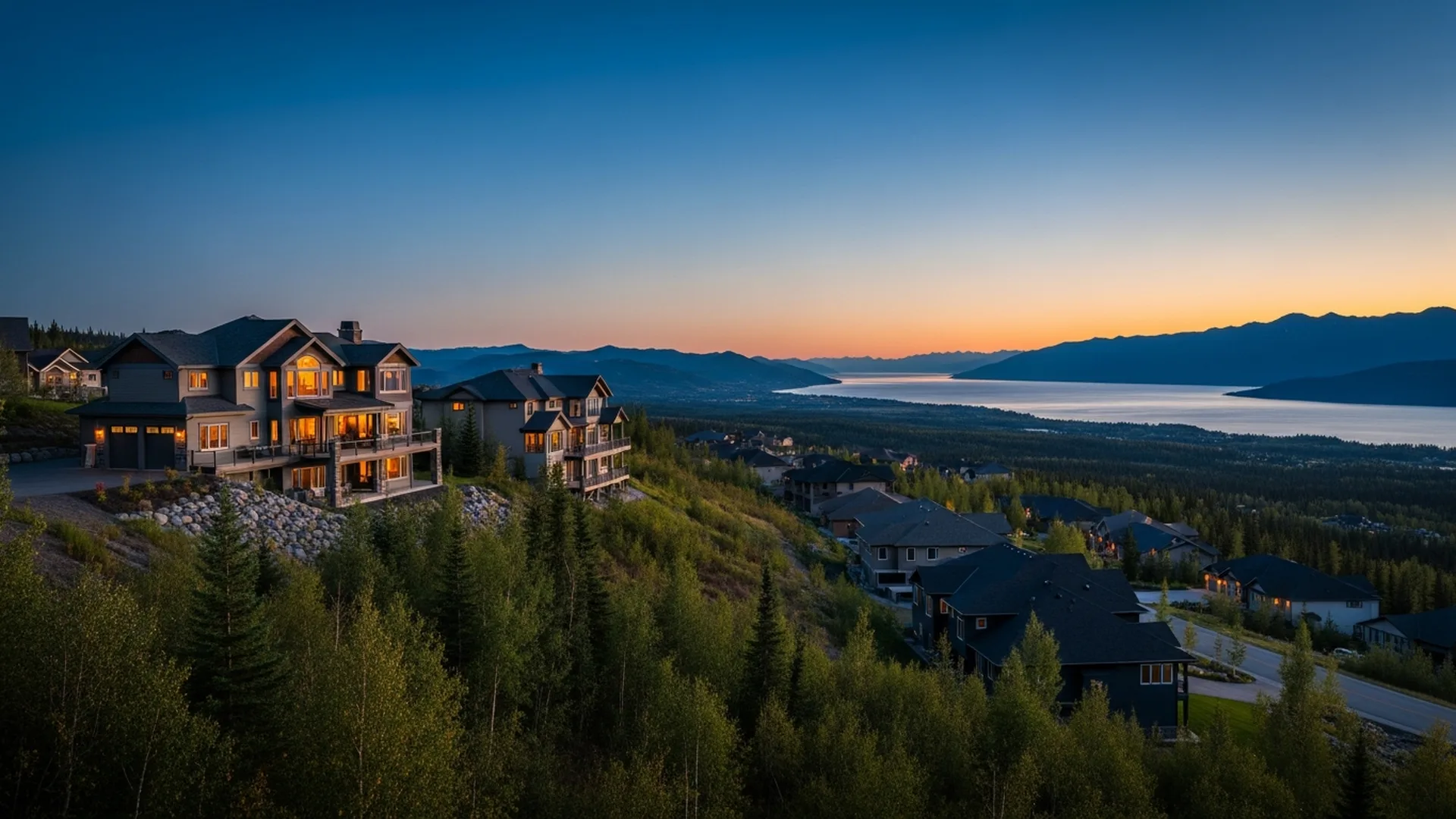
Powder Ridge is a newer, upscale planned subdivision in Eagle River, on the north side of the Municipality of Anchorage, roughly 15 miles from downtown Anchorage along the Glenn Highway. It is defined by newer construction, manicured landscaping, an active homeowners association, and lots that often capture Chugach Mountain views. Streets include Powder Ridge Drive, Baird Circle, Alex Way, Konrad Drive, and Mills Park Circle. Because it is a modern platted subdivision, many parcels are on community or municipal water and sewer rather than private well and septic — but that has to be verified lot by lot, and any Anchorage-area home on a well or septic system needs a Certificate of On-Site Systems Approval (COSA) at title transfer. Homes here are engineered for Anchorage/Eagle River snow loads, an important structural check on any Southcentral Alaska purchase.
Buyers who tour Eagle River quickly notice that its neighborhoods are not interchangeable. Some are older, wooded, and unrestricted; others are newer and tightly planned. Powder Ridge sits firmly in the second camp — a subdivision of newer, higher-finish homes with landscaped lots and an HOA that keeps the streetscape consistent. That combination is exactly what draws buyers who want move-up quality without piecing together an older home, and it is why Powder Ridge has been one of the more active, higher-priced pockets of the Eagle River market.
I have watched Eagle River grow for four decades as an Anchorage local, and the practical questions here are different from the Hillside or coastal Anchorage. On a Powder Ridge home, the questions that actually move the decision are: how the HOA works, whether the parcel is on public utilities or a private well and septic, how the home was built for snow and seismic loads, and what the commute really looks like in winter. This guide answers each of those with sourced Alaska specifics rather than generalities.
- Powder Ridge is a newer, upscale planned subdivision in Eagle River; documented streets include Powder Ridge Drive, Baird Circle, Alex Way, Alex Circle, Konrad Drive, Konrad Circle, and Mills Park Circle.
- The Powder Ridge Planned Community Homeowners Association is a registered, professionally managed HOA — request CC&Rs, dues, and rules during your inspection period.
- Whether a specific home is on public water/sewer or a private well and septic must be confirmed parcel by parcel; many modern Eagle River subdivision lots are on community/municipal service.
- Any Anchorage-area property on a well or septic system needs a Municipality of Anchorage COSA at title transfer (ordinance passed 1998); the MOA review fee is $600 plus engineering.
- Anchorage/Eagle River carries an ASCE 7-22 ground snow load of about 50 psf, and the MOA has long required a minimum 40 psf design — both rise with elevation.
- Eagle River and Chugiak have historically been outside Anchorage's residential building-code enforcement zone, so verify older homes were actually built to those standards.
- Eagle River is about 15 miles north of downtown Anchorage on the Glenn Highway — roughly a 20–25 minute drive in normal conditions, longer in winter.
What kind of neighborhood is Powder Ridge in Eagle River?
Powder Ridge reads as a cohesive, newer subdivision rather than a mix of eras. Local brokerage descriptions consistently characterize it as an area of newer, upscale homes with manicured landscapes and an active homeowners association — a "touch of luxury" corner of Eagle River. That planned character is a real value driver: when the neighboring homes are the same vintage and held to the same standards, values tend to move together instead of one tired property dragging the block.
The subdivision's street network — Powder Ridge Drive, Baird Circle, Alex Way and Alex Circle, Konrad Drive and Konrad Circle, and Mills Park Circle — sits off the main Eagle River corridor. Homes are frequently larger, two-story floor plans with attached garages; publicly listed Powder Ridge properties have historically spanned a wide band, with one older market summary citing a range from the low $300,000s up to around $750,000, and newer construction has continued in the subdivision more recently. Because that spread is wide, the neighborhood name alone doesn't set the price — view, lot, finish level, and vintage do.
| Orientation Fact | Detail |
|---|---|
| Location | Eagle River, within the Municipality of Anchorage, Alaska |
| Distance to downtown Anchorage | ~15 miles south via the Glenn Highway |
| Typical drive time | ~20–25 minutes in normal conditions; longer in winter |
| Documented streets | Powder Ridge Dr, Baird Cir, Alex Way, Alex Cir, Konrad Dr, Konrad Cir, Mills Park Cir |
| View orientation | Many lots face the Chugach Mountain front (east/south) |
| Nearby landmark | Joint Base Elmendorf-Richardson (JBER), between Anchorage and Eagle River |
How does the Powder Ridge HOA affect buying here?
Powder Ridge is governed by the Powder Ridge Planned Community Homeowners Association, a registered Alaska entity that is professionally managed. This is a meaningful contrast with much of Eagle River and the Mat-Su, where a great many parcels are fully unrestricted — no CC&Rs, no dues, no architectural review. An HOA is a two-sided coin: it protects the streetscape and, by extension, resale values, but it also constrains what you can do with your own property.
The practical move is simple. During your inspection period, get the current CC&Rs, the dues schedule, meeting minutes if available, and any rules on parking, RV storage, exterior modifications, and rentals. In an unrestricted Eagle River neighborhood you'd worry about what a neighbor might build; in an HOA neighborhood like Powder Ridge you instead confirm what you are permitted to do. Both matter — they're just different questions.
Is Powder Ridge on city water and sewer, or well and septic?
This is the question I get most often, and the honest answer is: it depends on the parcel, and you must verify it. Powder Ridge is a modern platted subdivision with curb-and-gutter streets, and many newer Eagle River subdivision lots are connected to community or municipal water and sewer rather than individual wells and septic systems. But service can vary lot to lot in the Eagle River area, so I don't let a buyer assume — we confirm it directly on the property's records before it becomes a contract fact.
Why it matters so much comes down to one Municipality of Anchorage requirement. In August 1998, the Municipal Assembly passed an ordinance requiring a Certificate of On-Site Systems Approval (COSA) to transfer title on any property served by a well or septic system. Per the engineering firms that perform them and the MOA's own guidance, the COSA confirms a licensed civil engineer inspected and tested the well and/or septic and found it compliant — and the MOA charges $600 to review the paperwork and issue the certificate, on top of the engineer's testing cost.
If a Powder Ridge home is on public water and sewer, a COSA is not required and this whole line of due diligence disappears. If it's on a private well or septic system, plan for it. That single distinction can change your timeline and your budget, which is exactly why it belongs in your first questions, not your closing week.
What a COSA actually involves if a home is on well/septic
For homes that are on private systems, the process is well documented by Anchorage-area engineers and the MOA. Water samples must be tested for bacteria, nitrates, and arsenic, with sampling that can take on the order of ten business days to process; the septic absorption field must pass an adequacy test within the prior two years; and the MOA requires proof the septic tank was pumped within the past year. Note the seasonality: because field adequacy testing needs unfrozen ground, winter transactions on well/septic properties sometimes rely on a conditional COSA and an escrow arrangement rather than a completed field test — a real logistics wrinkle for a January closing. (This is general guidance, not engineering or legal advice; a licensed engineer verifies any specific property.)
How are Powder Ridge homes built for Alaska snow and seismic loads?
Southcentral Alaska construction is engineered for weather most of the Lower 48 never sees. Per the Structural Engineers Association of Alaska data adopted into ASCE 7-22, the ground snow load for Anchorage/Eagle River is about 50 psf, and the Municipality of Anchorage has historically required buildings to be designed for a minimum of 40 psf. Critically, both figures scale with elevation — the MOA notes ground snow load increases for locations above the cited elevation — so a higher-benched Eagle River lot is engineered for still more than a valley-floor lot.
There's a code-enforcement nuance unique to this part of the municipality that a seasoned local checks and an out-of-state buyer often misses. Eagle River and Chugiak have historically sat outside Anchorage's residential building-code enforcement zone. After the 2018 magnitude-7.1 earthquake, reporting and analysis noted that a disproportionate share of significantly damaged buildings were in areas without code enforcement, including Eagle River and Chugiak, while structures inside code-enforced Anchorage performed markedly better. That doesn't mean an Eagle River home is unsafe — many are excellently built — it means you don't assume code compliance the way you might inside the Anchorage Bowl. On an older Powder Ridge-area home, I want documentation that the roof and framing were built to those snow and seismic standards.
Why buyers choose Powder Ridge
- Newer, higher-finish homes with a cohesive, planned streetscape
- Active HOA protecting neighborhood standards and resale consistency
- Frequent Chugach Mountain views
- Convenient to the Glenn Highway, JBER, and Eagle River amenities
What to verify before you buy
- HOA rules & dues — confirm they fit your plans
- Water/sewer vs. well/septic (COSA implications) — per parcel
- Snow-load & seismic construction on older homes
- Winter commute realities on the Glenn Highway
What is the commute and location like from Powder Ridge?
Eagle River is roughly 15 miles north of downtown Anchorage along the Glenn Highway, which in normal conditions is about a 20 to 25 minute drive. Powder Ridge sits a short distance off the main Eagle River corridor, so daily errands stay local while Anchorage's larger employment, medical, and shopping base is a manageable commute. The proximity to Joint Base Elmendorf-Richardson (JBER) also makes Eagle River, and Powder Ridge specifically, a recurring choice for military-connected buyers.
The honest caveat is winter. The Glenn Highway is the single artery between Eagle River and Anchorage, so weather events and incidents can lengthen that commute considerably. Buyers who tour on a clear September afternoon should picture the same drive in a January storm before committing — the geography that gives Eagle River its space and views is the same geography that adds highway minutes when the weather turns.
Thinking of selling in Powder Ridge? Here's what drives value
On the sell side, the neighborhood's planned character works in your favor — but it doesn't do the whole job. In Powder Ridge, value concentrates in the things buyers can't easily replicate: a genuine Chugach view, a well-oriented lot, updated and cohesive finishes, and clean documentation. My interior-design background is where I earn my keep here; I help sellers stage and present finishes so the home reads at the top of its vintage band rather than the middle, because in a subdivision of similar homes, presentation is often the tiebreaker.
The other seller lever is paperwork readiness. If your home is on a well or septic system, starting the COSA process early — testing well before you list — removes a common closing-week fire drill and protects your timeline. Sellers who confirm their utility documentation, HOA standing, and any as-builts up front consistently transact more smoothly. When you're ready, I'll build you a specific, current valuation for your address; get your Eagle River home value to start.
- Municipality of Anchorage, On-Site Water & Wastewater — Certificate of On-Site Systems Approval (COSA) requirement and process (muni.org).
- Municipality of Anchorage code & local engineering firms — COSA review fee of $600 and testing requirements (bacteria, nitrate, arsenic sampling; septic adequacy test; tank-pumping receipt).
- Alaska Department of Environmental Conservation, 18 AAC 72 (Wastewater Treatment & Disposal) and 18 AAC 72.520 separation-distance rules; MOA holds delegated authority for systems serving up to two dwelling units (dec.alaska.gov).
- Structural Engineers Association of Alaska / ASCE 7-22 — Anchorage/Eagle River ground snow load ~50 psf, increasing with elevation (seaak.net).
- Municipality of Anchorage Building Safety handout — minimum 40 psf snow-load design requirement (muni.org).
- Reporting on the 2018 Anchorage-area magnitude-7.1 earthquake — higher damage rates in non-code-enforced areas including Eagle River and Chugiak.
Considering a Powder Ridge home?
I'll walk you through the HOA, the utilities question, and the construction checks that matter here.
Frequently Asked Questions
Powder Ridge is a planned subdivision in Eagle River, on the north side of the Municipality of Anchorage. Its streets include Powder Ridge Drive, Baird Circle, Alex Way, Alex Circle, Konrad Drive, Konrad Circle, and Mills Park Circle. Eagle River sits roughly 15 miles north of downtown Anchorage along the Glenn Highway, so Powder Ridge combines a suburban subdivision setting with a commute of about 20 to 25 minutes to central Anchorage in normal conditions.
Powder Ridge is known for newer, upscale homes, manicured landscaping, and an active homeowners association that maintains community standards. Many lots capture Chugach Mountain views, and the subdivision layout gives it a planned, cohesive feel that is less common in Eagle River's older, more piecemeal neighborhoods. Buyers who value newer construction and predictable neighborhood upkeep tend to gravitate here.
Yes. The Powder Ridge Planned Community Homeowners Association is a registered entity in Alaska and is professionally managed. Before you write an offer, request the current CC&Rs, the dues schedule, and any rules on parking, exterior changes, and short-term rentals, because an HOA sets enforceable standards that a fully unrestricted Eagle River parcel would not. Reviewing those documents during your inspection period is the single best way to avoid surprises.
This has to be confirmed parcel by parcel. Powder Ridge is a modern platted subdivision, and many Eagle River subdivision lots are connected to community or municipal water and sewer rather than individual wells and septic systems. But service can differ lot to lot, so verify it directly on the property's records before you rely on it. If a home is served by a private well or septic system, the Municipality of Anchorage requires a Certificate of On-Site Systems Approval (COSA) at title transfer.
A COSA, or Certificate of On-Site Systems Approval, is a Municipality of Anchorage document confirming that a property's well and/or septic system was inspected by a professional engineer and meets MOA standards. Under an ordinance the Municipal Assembly passed in 1998, it is required to transfer title on any Anchorage-area property served by a well or septic system. The MOA review fee is $600, plus the engineer's testing cost. If a Powder Ridge home is on public water and sewer, no COSA is required; if it is on well or septic, plan for it.
Anchorage and Eagle River carry a ground snow load of about 50 psf in ASCE 7-22, and the Municipality of Anchorage has long required buildings to be designed for at least 40 psf. Both figures increase with elevation, so higher-benched Eagle River lots are engineered for more. One important local nuance: Eagle River and Chugiak have historically sat outside Anchorage's residential building-code enforcement zone, so on older homes it is worth confirming the roof and framing were actually built to those standards.
Eagle River is about 15 miles north of downtown Anchorage on the Glenn Highway, which typically translates to a 20 to 25 minute drive in normal conditions and longer during winter weather or peak commute times. Powder Ridge is a short distance off the main Eagle River corridor, and its proximity to Joint Base Elmendorf-Richardson (JBER) is a draw for military-connected buyers.