

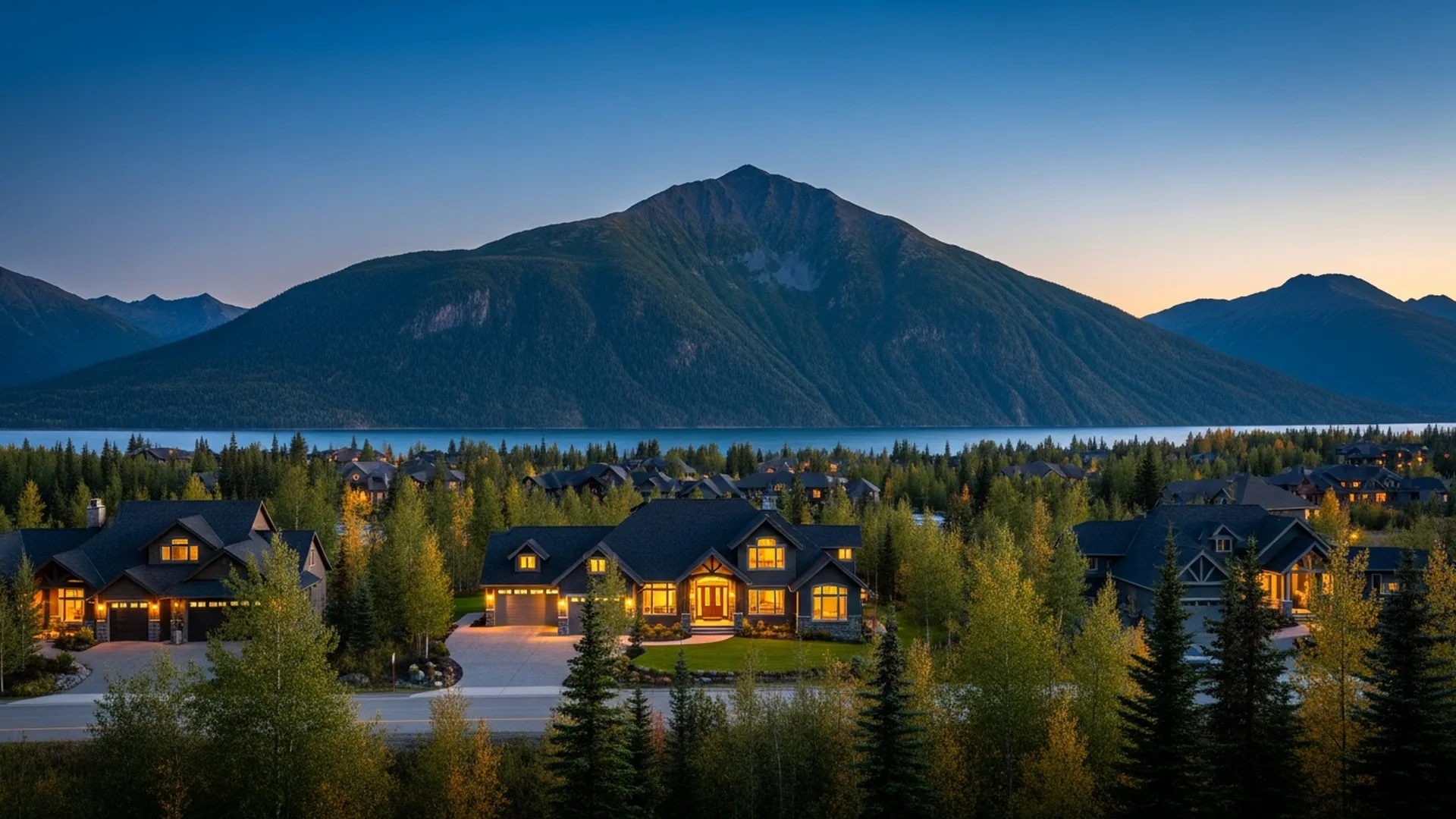
Eaglewood is a planned residential subdivision of more than 900 homes on over 250 acres in Eagle River, inside the Municipality of Anchorage. Unlike the larger acreage parcels farther up the valley, developed Eaglewood lots are served by public water and sewer through the Anchorage Water & Wastewater Utility, and a mandatory homeowners association owns and maintains the streets, street lights, sidewalks, and paved, lighted trails. Homes here favor mountain views, walkable streets, and a short Glenn Highway commute of roughly 13 to 16 miles to downtown Anchorage. It is one of Eagle River's most established subdivisions, so buyers get infrastructure and convenience rather than rural privacy.
Eaglewood is the kind of Eagle River neighborhood buyers ask me about by name. It reads as a self-contained, planned community rather than a scatter of custom parcels, and that structure is exactly what draws some buyers and gives others pause. According to the Eaglewood Homeowners Association, the subdivision holds more than 900 privately owned single-family residences, duplexes, and zero-lot-line homes across over 250 acres — a genuinely large, master-planned footprint by Eagle River standards.
The single most useful thing I can tell an Eaglewood buyer up front is what makes it different from the rest of the valley: this is a public-utility subdivision, not a well-and-septic one. That one fact changes your due-diligence checklist completely, and it's where most out-of-area buyers get their assumptions wrong. Below I'll walk through the neighborhood, the utility and access realities, what drives value here, and how selling in Eaglewood differs from selling an acreage home up Hiland Road.
- Eaglewood is a planned subdivision of 900+ homes on over 250 acres in Eagle River, per the Eaglewood Homeowners Association.
- All owners are mandatory HOA members; the association owns and maintains the streets, street lights, sidewalks, and paved, lighted trail systems.
- Developed Eaglewood lots are on public water and sewer via the Anchorage Water & Wastewater Utility (AWWU), not private well and septic.
- Eagle River sits inside the Municipality of Anchorage, roughly 13–16 miles from downtown Anchorage on the Glenn Highway.
- Alpenglow Elementary (PK–6, Anchorage School District) is the neighborhood elementary school for the Eaglewood area — confirm the current boundary with ASD for any specific address.
- Larger valley and Hiland-area acreage parcels near Eagle River commonly rely on well and septic governed by Alaska DEC 18 AAC 72, which sets a 100-foot well-to-septic separation.
- Home styles run to mountain-view lots, cul-de-sacs, and large "Alaska garages," with proximity to Chugach State Park trails.
What Kind of Neighborhood Is Eaglewood in Eagle River?
Eaglewood was built as a deliberately planned community. The Eaglewood Homeowners Association describes the developers' intent as creating a carefully planned subdivision that preserves the natural, rural character of the area — and it backs that up with real infrastructure. Eaglewood owns its own streets, street lights, sidewalks, and paved, lighted trail systems, along with common areas maintained for residents. That's unusual: in much of Eagle River, streets and maintenance fall to public agencies or nobody at all, but in Eaglewood they're an HOA-owned asset.
Every owner is a mandatory member of the association, which operates under recorded protective covenants and restrictions (PC&R's) and bylaws. In Alaska, where a large share of parcels carry no covenants at all, that's a meaningful distinction — buyers who want predictable upkeep and architectural consistency tend to like it, and buyers who want to run a home business, park heavy equipment, or build without restriction tend to look elsewhere in the valley.
Housing stock is a mix: single-family homes, duplexes, and zero-lot-line homes. In the resale listings I watch, the recurring themes are cul-de-sac lots, cathedral or vaulted ceilings, mountain views, and the oversized "Alaska garage" that Eagle River buyers prize for gear and toys. The neighborhood sits close to Business Boulevard and the Old Glenn Highway commercial spine, so groceries, coffee, the library, and the transit center are short in-town hops rather than a drive into Anchorage.
| Attribute | Eaglewood detail |
|---|---|
| Size | 900+ homes on 250+ acres |
| Water & sewer | Public, via AWWU |
| HOA | Mandatory; owns streets, lights, sidewalks, paved trails |
| Commute to downtown Anchorage | ~13–16 miles on the Glenn Highway |
| Neighborhood elementary | Alpenglow Elementary (PK–6, ASD) |
| View orientation | Chugach mountain views generally east & south |
Does Eaglewood Have Well and Septic or Public Water and Sewer?
This is the question I steer every Eaglewood buyer to first, because getting it wrong reshapes your whole due-diligence process. Developed lots inside Eaglewood are served by public water and sewer through the Anchorage Water & Wastewater Utility (AWWU), which explicitly serves Eagle River, Chugiak, Peters Creek, and Girdwood in addition to the Anchorage bowl. AWWU even operates a dedicated Eagle River Wastewater Treatment Facility, a tertiary treatment plant that discharges to Eagle River. So an Eaglewood buyer is generally not inheriting a private well or a septic drainfield to inspect.
Contrast that with the larger acreage parcels farther up the Eagle River Valley and along Hiland Road, where private well and septic is common. Those systems fall under Alaska Department of Environmental Conservation regulations at 18 AAC 72, and on a rural parcel the water source is a real inspection line item. The practical takeaway: in Eaglewood you're confirming a utility connection; up the valley you're evaluating a whole private system. Never assume — confirm the water and wastewater source for any specific parcel before you write.
What Should You Check on Well-and-Septic Acreage Near Eagle River?
Even though Eaglewood itself is on public utilities, many buyers who tour Eaglewood also look at valley or Hiland acreage, so it's worth knowing the rules. Under Alaska DEC 18 AAC 72, a private water well must maintain minimum separation distances from contamination sources. Per the state regulation at 18 AAC 72.100, that includes at least 100 horizontal feet from a septic tank, soil absorption system, or other wastewater component. And under 18 AAC 72.520, a septic tank or absorption field must sit at least 100 feet from the mean high water level of a lake, river, or stream, with the field kept 50 feet from a steep slope (greater than 25 percent grade with more than a 10-foot drop).
Why this matters on a valley lot: those distances are what physically fit onto the parcel. A smaller or steeply pitched lot near the river can run out of usable space to place a compliant system, and the size of that system is what caps the number of bedrooms. I've seen valley listings where the septic was rated for three bedrooms even though the home was being used with a fourth — a detail that matters for both value and financing. DEC also notes that the Municipality of Anchorage has additional onsite-wastewater requirements beyond the state baseline, since the MOA holds delegated authority for domestic systems serving up to two dwelling units.
Alaska's seasonal high groundwater table typically peaks between June 1 and September 30, per DEC's onsite wastewater guidance. On acreage properties, that's why soil and percolation testing is a summer-and-early-fall exercise — frozen or snow-covered ground can delay a well/septic evaluation and, with it, your closing. This is a logistics reality of buying rural land in the valley; it does not apply to public-utility Eaglewood lots.
How Far Is Eaglewood from Downtown Anchorage and JBER?
Eagle River sits inside the Municipality of Anchorage on the Glenn Highway. Sources put the distance to downtown Anchorage at roughly 13 to 16 miles depending on measurement and route — The Milepost lists Eagle River as 13 miles from downtown, while travel sources cite about 15–16 miles of road distance. A normal drive runs about 20 to 30 minutes, per relocation and travel guides, and Ted Stevens Anchorage International Airport is roughly a 20–30 minute drive as well.
What makes the commute genuinely short in feel is that Joint Base Elmendorf-Richardson sits just down the freeway between Eagle River and the Anchorage bowl. That proximity is a big reason Eagle River, and Eaglewood specifically, draws relocating military households. The honest caveat, and one I always raise: the Glenn Highway is the single main corridor. When there's a collision or hard winter weather, delays ripple through the whole commute, so buyers should plan buffer time and treat "20 minutes" as a fair-weather figure, not a guarantee.
What School Serves Eaglewood?
Alpenglow Elementary, a PK–6 neighborhood school in the Anchorage School District at 19201 Driftwood Bay Drive in Eagle River, is the elementary school associated with the Eaglewood area — listing descriptions in the neighborhood routinely reference walking distance to Alpenglow. Per federal school data, it's a regular public school serving a few hundred students in the Eagle River Valley. Attendance boundaries can and do shift, so verify the current assignment for any specific address directly with the Anchorage School District rather than relying on a listing or a portal.
What Drives Value in Eaglewood, and Who Is It Right For?
In Eaglewood, value clusters around a handful of features I see repeatedly: a genuine Chugach mountain view (orientation matters — east and south exposures capture the range), a private cul-de-sac position, an oversized garage, and updated finishes. Because the subdivision is on public utilities and HOA-maintained streets and trails, buyers are paying for turnkey convenience and predictable infrastructure rather than acreage and privacy.
Eaglewood tends to suit buyers who want
- Public water and sewer, no private well/septic to maintain
- HOA-maintained streets, lighting, and paved trails
- Mountain views with a walkable, established street grid
- A short commute to Anchorage and JBER
- Predictable covenants and neighborhood consistency
Buyers wanting these may prefer valley acreage
- Large lots, privacy, and room for outbuildings
- Freedom from HOA covenants and dues
- Space to store or operate heavy equipment/toys
- Off-grid or well/septic self-sufficiency
- Deep-woods seclusion up Hiland Road or the valley
Thinking of Selling in Eaglewood? What Drives Value Here
Selling in Eaglewood is a different exercise than selling acreage up the valley, and the strongest sellers lean into what the subdivision actually offers. Because the neighborhood is on public utilities, you're not fighting the well/septic questions that slow rural closings — that's a selling point worth stating plainly. Instead, buyers here compare finish quality, view orientation, garage size, and lot position across a fairly deep pool of similar homes, so presentation moves the needle.
This is where my background helps: I hold a degree in Interior Design and spent years in furnishings and design before real estate, so I read finishes, light, and flow the way a buyer's eye does. In a view neighborhood at high latitude, staging to the light — and framing the mountain sightline rather than the wall in front of it — consistently changes how a home shows. If you're weighing a sale, start with a real number: get your Eaglewood home value and we'll build the pricing case from current comparables.
- Eaglewood Homeowners Association — subdivision size (900+ homes, 250+ acres), mandatory HOA, owned streets/trails, PC&R's. (eaglewoodassn.com)
- Anchorage Water & Wastewater Utility (AWWU) — public water/sewer service to Eagle River; Eagle River Wastewater Treatment Facility. (awwu.biz)
- Alaska DEC 18 AAC 72.100 & 18 AAC 72.520 (via Cornell LII) — private well 100-ft separation from septic; 100-ft surface-water separation; 50-ft slope setback.
- Alaska DEC, Installing or Upgrading a Septic System & onsite wastewater guidance — MOA delegated authority; seasonal high groundwater June 1–Sept 30. (dec.alaska.gov)
- The Milepost / Alaska.org / relocation guides — Eagle River within MOA, ~13–16 miles to downtown Anchorage, Glenn Highway commute, JBER proximity.
- National Center for Education Statistics & Anchorage School District — Alpenglow Elementary, PK–6, 19201 Driftwood Bay Dr, Eagle River.
Explore Eaglewood & Eagle River Homes with Bill
Get honest, local guidance on Eaglewood listings, utilities, and views — and how the subdivision compares to valley acreage.
Frequently Asked Questions
Eaglewood is a planned residential subdivision of more than 900 privately owned single-family homes, duplexes, and zero-lot-line homes on over 250 acres in Eagle River, Alaska. It has a mandatory homeowners association that owns and maintains its own streets, street lights, sidewalks, and paved, lighted trail systems, per the Eaglewood Homeowners Association.
Homes inside the developed Eaglewood subdivision are served by public water and sewer through the Anchorage Water & Wastewater Utility (AWWU), which serves Eagle River. That is different from many larger acreage parcels farther up the Eagle River Valley and Hiland Road, which commonly rely on private well and septic systems regulated under Alaska DEC 18 AAC 72. Always verify the water and wastewater source for any specific parcel before writing an offer.
Eagle River sits inside the Municipality of Anchorage on the Glenn Highway, roughly 13 to 16 miles from downtown Anchorage depending on the source and route. A typical drive runs about 20 to 30 minutes in normal conditions, and Joint Base Elmendorf-Richardson is only a few miles down the freeway, which is part of why the area draws relocating military families.
Because Alaska DEC 18 AAC 72 sets minimum separation distances that a lot must physically accommodate. A private water well must sit at least 100 horizontal feet from a septic tank, soil absorption system, or other wastewater component, and at least 100 feet from the mean high water level of a lake or stream. On a small or steeply sloped valley parcel, meeting those distances is exactly what determines how many bedrooms a septic system can support.
Alpenglow Elementary, a PK-6 neighborhood school in the Anchorage School District located at 19201 Driftwood Bay Drive, serves the Eaglewood area of Eagle River. Because attendance boundaries can change, confirm the current assignment for any specific address directly with the Anchorage School District before you rely on it.
Yes. All owners in Eaglewood are mandatory members of the Eaglewood Homeowners Association, which is governed by recorded protective covenants and restrictions (PC&R's) and bylaws. The association owns and maintains the subdivision's streets, street lights, sidewalks, paved and lighted trails, and common areas. Ask for the current PC&R's, bylaws, and dues before you buy so you understand what is restricted and what is maintained.
Eaglewood suits buyers who want an established, walkable neighborhood with public utilities, mountain views, maintained trails, and a short commute to both Anchorage and JBER, rather than large rural acreage. It is one of Eagle River's larger planned subdivisions, so inventory turns over regularly. The right fit depends on whether you value the convenience and HOA-maintained infrastructure of a subdivision over the privacy and space of a valley acreage parcel.