

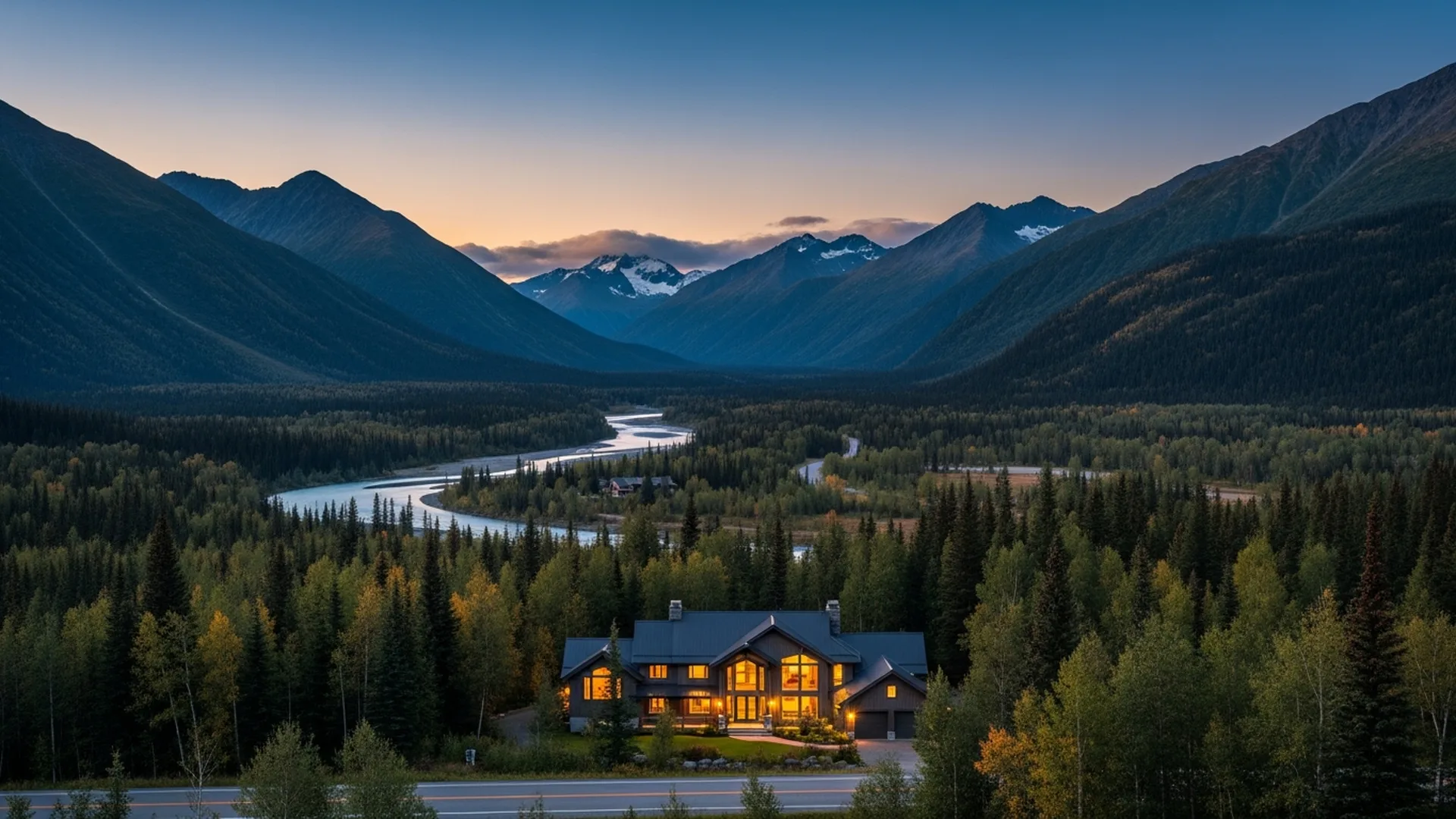
Eagle River Valley is a glacier-carved valley on the western edge of Chugach State Park, inside the Municipality of Anchorage and roughly 15 to 19 miles from downtown by the Glenn Highway. Homes here sit on larger, wooded, often view-facing lots than you’ll find closer to the city, reached by Eagle River Road and Hiland Road as they climb toward the mountains. Many valley properties are served by a private well and on-site septic system rather than municipal utilities, which means a sale requires a Municipality of Anchorage Certificate of On-Site Systems Approval (COSA) before title transfers. The valley’s appeal is space, quiet, and direct trail access to Chugach State Park; the trade-offs are the commute, on-site systems, and checking winter access parcel by parcel.
I’ve lived in Anchorage for 40 years, and Eagle River Valley is one of those places that reads completely differently from behind the windshield than it does on a listing sheet. From the Glenn Highway it looks like an easy suburb of town; drive up Eagle River Road or Hiland Road and you climb into a genuine mountain valley, with homes tucked onto wooded parcels that back up to the third-largest state park in the country. Buyers come here for the space and the views. What surprises them is how much of the value — and the due diligence — is tied to things you can’t see from the street: the well, the septic system, and how a given street handles winter.
This guide covers what the valley actually is, what the homes and lots are like, the well-and-septic rules that govern nearly every valley sale, the access realities, and what drives value if you’re thinking of selling. Where I quote a rule or a figure, I’ve cited the primary source so you can verify it yourself.
- Eagle River Valley is a glacier-carved valley on the western border of Chugach State Park, within the Municipality of Anchorage, reached via Eagle River Road and Hiland Road.
- It sits roughly 15–19 miles from downtown Anchorage; deeper valley locations are often described as around a 40-minute drive, while Eagle River proper is closer to a 15-minute drive from town.
- Lots tend to be larger and wooded — many parcels over an acre — on hilly, winding streets, which is part of why homes cost somewhat more than comparable homes closer to the city.
- Many valley homes use a private well and on-site septic system; per Alaska DEC 18 AAC 72.100, a well must generally be at least 100 feet from a septic tank or drainfield.
- A Municipality of Anchorage Certificate of On-Site Systems Approval (COSA) is required before title transfers on any well-and-septic property, under a 1998 ordinance and AMC 15.55 / 15.65.
- Portions of the valley — notably upper Hiland Road in the South Fork area — are near documented avalanche paths, so winter access should be checked parcel by parcel.
- The Eagle River Nature Center, at the end of Eagle River Road, serves as the valley’s Chugach State Park visitor center and trail gateway.
Where Is the Eagle River Valley, and What Makes It Different?
The Eagle River Valley is a classic glacier-carved valley — glaciers advanced and retreated here over the last million years, leaving behind the sand, gravel, and till the neighborhood now sits on. It runs east from the community of Eagle River into Chugach State Park, with Eagle River Road following the river roughly 13 miles up to the Eagle River Nature Center, which a nonprofit operates as a Chugach State Park visitor center. The community of Eagle River itself is a part of the Municipality of Anchorage, situated between Joint Base Elmendorf-Richardson (JBER) and the Chugach Mountains, and it functions as an Anchorage suburb even as it keeps its own small-town identity.
What separates the valley from the rest of Eagle River is elevation and setting. Neighborhoods along the northern portions of the community, plus Hiland Road and the parts of Eagle River Road that climb out of the section line and descend into the canyon, are largely built across the mountainsides — not on flat suburban blocks. Unlike the level Glenn Highway corridor, the valley is defined by slope, trees, and direct park frontage. That’s the whole draw: many parcels here border or sit minutes from state park trailheads, and the views of the Chugach Range, Knik Arm, and the peak locals call Sleeping Lady are the reason people buy.
| Reference point | Relationship to the valley |
|---|---|
| Downtown Anchorage | Roughly 15–19 miles southwest via the Glenn Highway |
| Community of Eagle River | Gateway at the mouth of the valley; ~15-minute drive from town |
| Eagle River Road | Follows the river ~13 miles east to the Eagle River Nature Center |
| Hiland Road / South Fork | Climbs south into the valley; near mapped avalanche paths in upper sections |
| Chugach State Park | Forms the eastern and southern boundary; 773 sq mi, third-largest state park in the U.S. |
What Are Eagle River Valley Homes and Lots Actually Like?
Most valley homes sit on hilly, winding streets under a canopy of evergreen and birch, and you’ll find a genuine mix of housing styles — log homes, Craftsman-influenced customs, and newer builder homes designed around a wall of south-facing windows. The common thread at the upper end is the view: buyers touring the valley consistently gravitate to the parcels perched to capture the Eagle River Valley, the Chugach Range, and Knik Arm from nearly every room.
Lot size is the other differentiator. Where much of Anchorage is platted into compact city lots, valley parcels commonly run over an acre — the marketed “large lot” subdivisions here advertise 1.25-plus-acre sites, and vacant view parcels of two, three, even 40 acres against the park boundary come up regularly. Unlike a tight in-town lot, that acreage isn’t just elbow room; on well-and-septic it’s a functional requirement, because the well and drainfield have to stay a code-required distance apart. Many valley lots are sold build-ready with a driveway punched in, natural gas and electric adjacent, and sometimes a functioning well or permitted septic already on site — but the presence and status of those systems is exactly what a buyer needs to verify.
Public real-estate aggregators have reported a median sale price around the high-$400,000s for the Eagle River Valley neighborhood over a recent 12-month window, with homes selling faster than the national average. Treat those figures as directional context only — they lump together everything from starter homes to view estates, they shift constantly, and the luxury end of the valley behaves differently from the median. For a defensible number on a specific home or lot, you need a current comparative analysis, not an aggregator estimate.
Why Do Eagle River Valley Homes Use Wells and Septic — and What Should Buyers Check?
This is the single biggest thing that separates a valley purchase from an in-town Anchorage purchase, and it’s where I see out-of-state buyers get caught. A large share of valley homes are not on piped municipal water and sewer; they draw from a private well and dispose of wastewater through an on-site septic system. That’s normal here — but it comes with a specific regulatory framework you need to understand before you write an offer.
The Alaska DEC separation rule
Septic systems statewide fall under Alaska Department of Environmental Conservation regulations at 18 AAC 72, which set minimum treatment standards, construction standards, and separation distances. The one number to memorize: under 18 AAC 72.100, a private drinking-water well must generally be at least 100 horizontal feet from a septic tank, soil absorption system, sewer line, or other listed source of contamination — unless DEC has approved a lesser distance through a waiver. On a sloped, wooded valley lot, keeping that 100-foot separation is precisely why acreage matters, and it’s the encroachment an engineer most often flags at sale.
The Anchorage COSA requirement
Because the valley is inside the Municipality of Anchorage, there’s a second layer. Per an ordinance the Municipal Assembly passed in August 1998, in order to transfer title on any property served by a well or septic system, a Certificate of On-Site Systems Approval (COSA) must be obtained. The MOA issues the COSA based on a registered professional engineer’s inspection and testing confirming the well and/or septic system comply with municipal standards. It applies to single-family dwellings, duplexes, and vacant properties served by on-site systems, with narrow exceptions such as transfers between spouses or to a family trust. Systems serving more than two dwelling units fall under state jurisdiction instead. Practically, the COSA process involves a well flow test, a septic absorption-field adequacy test, water sampling for items like bacteria, nitrate, and arsenic, a recent tank-pumping receipt, and an as-built survey — and if separation distances aren’t met, the engineer has to pursue a waiver, which adds time and cost.
What the on-site model gives you
- Larger, private, wooded parcels with real separation from neighbors
- No monthly municipal water/sewer utility bill
- Independence — your water and wastewater are yours to manage
What you take on
- COSA required at every qualifying sale (seller’s obligation)
- Ongoing maintenance — code requires tank pumping/solids check at least every two years
- Repair or replacement costs if a system fails testing
- Separation-distance waivers can complicate older parcels
What Are the Access and Winter Realities in the Valley?
The valley’s beauty and its hazards come from the same terrain. Because homes climb the mountainsides, some parcels sit near documented snow-avalanche paths — the state’s own Chugach State Park access inventory flags parts of the South Fork area off Hiland Road as prone to avalanche danger. This isn’t abstract: in March 2022, a large natural avalanche buried a stretch of upper Hiland Road in the South Fork Valley with an estimated 60 to 80 feet of snow, knocked out power to more than 100 homes, and cut road access to homes uphill of the slide for days while the debris was cleared.
The honest framing is proportion, not alarm. The overwhelming majority of valley homes are nowhere near a runout zone, and Eagle River sees ordinary Southcentral winters — January temperatures in the community typically range from the single digits to the low 20s Fahrenheit. But the right due diligence on a specific street is real: how is it plowed and maintained in winter, is it a municipally maintained road or a private/shared drive, and does the parcel sit near a mapped slide path? Those are parcel-level questions, and they’re exactly the kind of thing a local agent should be raising before you fall for the view. The valley also carries the usual mountain-community realities — this is active moose, black bear, and brown bear country, which shows up in everything from bear fences on decks to how you store food and garbage.
Thinking of Selling in Eagle River Valley? What Drives Value Here
If you own in the valley, three things move your number more than square footage alone. First is the view and orientation: a cleared, south-facing sightline to the Chugach and Knik Arm is the valley’s premium feature, and buyers pay for genuine winter sun, not just a summer glimpse through the trees. Second is the condition and documentation of your on-site systems — a well and septic with clean, current test records and an as-built on file removes the single biggest source of last-minute friction, and I generally advise sellers to test early rather than discover a problem mid-escrow. Third is finish quality that reads as intentional for this setting.
That last point is where I spend a lot of my time with valley sellers. I hold a degree in Interior Design and spent a career in furnishings and design before real estate, and a mountain-valley home rewards finishes chosen for high-latitude light and a wooded lot — the way a great room’s window wall frames the view, how materials handle the long winter, how the flow works when you’re bringing gear in and out. Staged and finished with that eye, a valley home photographs and shows like the retreat buyers are actually shopping for. When you’re ready for a defensible number, get a current valuation on your specific home rather than leaning on an aggregator estimate.
- Alaska Department of Environmental Conservation — 18 AAC 72 (Wastewater Treatment and Disposal) and 18 AAC 72.100 (private water systems; 100-ft well-to-contamination separation). dec.alaska.gov
- Municipality of Anchorage, On-Site Water & Wastewater Section — Certificate of On-Site Systems Approval (COSA), 1998 ordinance, AMC 15.55 and 15.65. muni.org
- Anchorage Municipal Code 15.65 (Wastewater Disposal) — septic tank sizing (1,000 gal + 250 gal per bedroom over three) and pumping/inspection interval.
- Alaska DNR, Division of Parks & Outdoor Recreation — Chugach State Park Access Inventory (South Fork / Hiland Road avalanche hazard notes) and Eagle River Greenbelt inventory (valley geology). dnr.alaska.gov
- Anchorage Daily News — reporting on the March 2022 upper Hiland Road avalanche (road access and power outages).
- Wikipedia / Travel Alaska — Eagle River geography, distance to Anchorage, January temperature range, and Chugach State Park size (used for general orientation; verify specifics independently).
- Public real-estate aggregators (Homes.com, Redfin) — neighborhood market context (median price, days on market); directional only, not a valuation.
- Anchorage School District — assigned schools for a specific address (confirm current boundaries directly).
Looking at Eagle River Valley?
Let’s find the right lot or home — and check the well, septic, and winter access before you fall for the view.
Frequently Asked Questions
The Eagle River Valley sits roughly 15 to 19 miles from downtown Anchorage along the Glenn Highway, with drive times often quoted around 40 minutes to the deeper parts of the valley up Eagle River Road. Eagle River proper is about a 15-minute drive from town; the valley reads farther because homes climb up Eagle River Road and Hiland Road toward Chugach State Park. Actual commute varies with your exact location in the valley, the season, and Glenn Highway traffic.
Many do. Homes deeper in the valley and up the hillsides are commonly served by a private well and an on-site septic system rather than piped municipal utilities. Because the valley is inside the Municipality of Anchorage, any sale of a home served by a private well and/or septic system requires a Certificate of On-Site Systems Approval (COSA) before title transfers, per an ordinance the Municipal Assembly passed in August 1998.
A COSA is a Certificate of On-Site Systems Approval issued by the Municipality of Anchorage. It confirms that a registered professional engineer has inspected and tested the well and/or septic system and found it in compliance with municipal standards. Under Anchorage Municipal Code (chapters 15.55 and 15.65), the seller must obtain a COSA before transferring title on a property served by an on-site well or septic system, with limited exceptions such as transfers between spouses or to a family trust.
Under Alaska DEC regulation 18 AAC 72.100, a private drinking-water well must generally sit at least 100 horizontal feet from a septic tank, soil absorption (drainfield) system, sewer line, or other listed source of contamination, unless the department has approved a lesser distance through a waiver. This separation is one of the most common issues an engineer flags during the Anchorage COSA process, so it is worth confirming before you write an offer on a valley property.
The valley developed on the fringe of Chugach State Park on land that was never platted into small city blocks, and homes on well-and-septic need room to keep the code-required 100-foot separation between well and drainfield. The result is a neighborhood of larger, wooded parcels — many over an acre — on hilly, winding streets, which is a big part of why buyers trade a longer commute for the space and the views.
It can be for specific parcels, and it is worth checking parcel by parcel. Portions of the valley — particularly upper Hiland Road in the South Fork area — are near documented avalanche paths; in March 2022 a large slide buried a stretch of upper Hiland Road and cut road access to more than 100 uphill homes for days. Most valley homes are well outside runout zones, but a buyer’s due diligence should include how a specific street is maintained and plowed in winter and whether it sits near a mapped slide path.
Eagle River Valley falls within the Anchorage School District. Students in the area generally attend Eagle River High School, and the broader Eagle River and Chugiak area includes schools such as Mirror Lake Middle School and Chugiak High School. School attendance boundaries change, so confirm the current assigned schools for a specific address directly with the Anchorage School District before relying on them.