

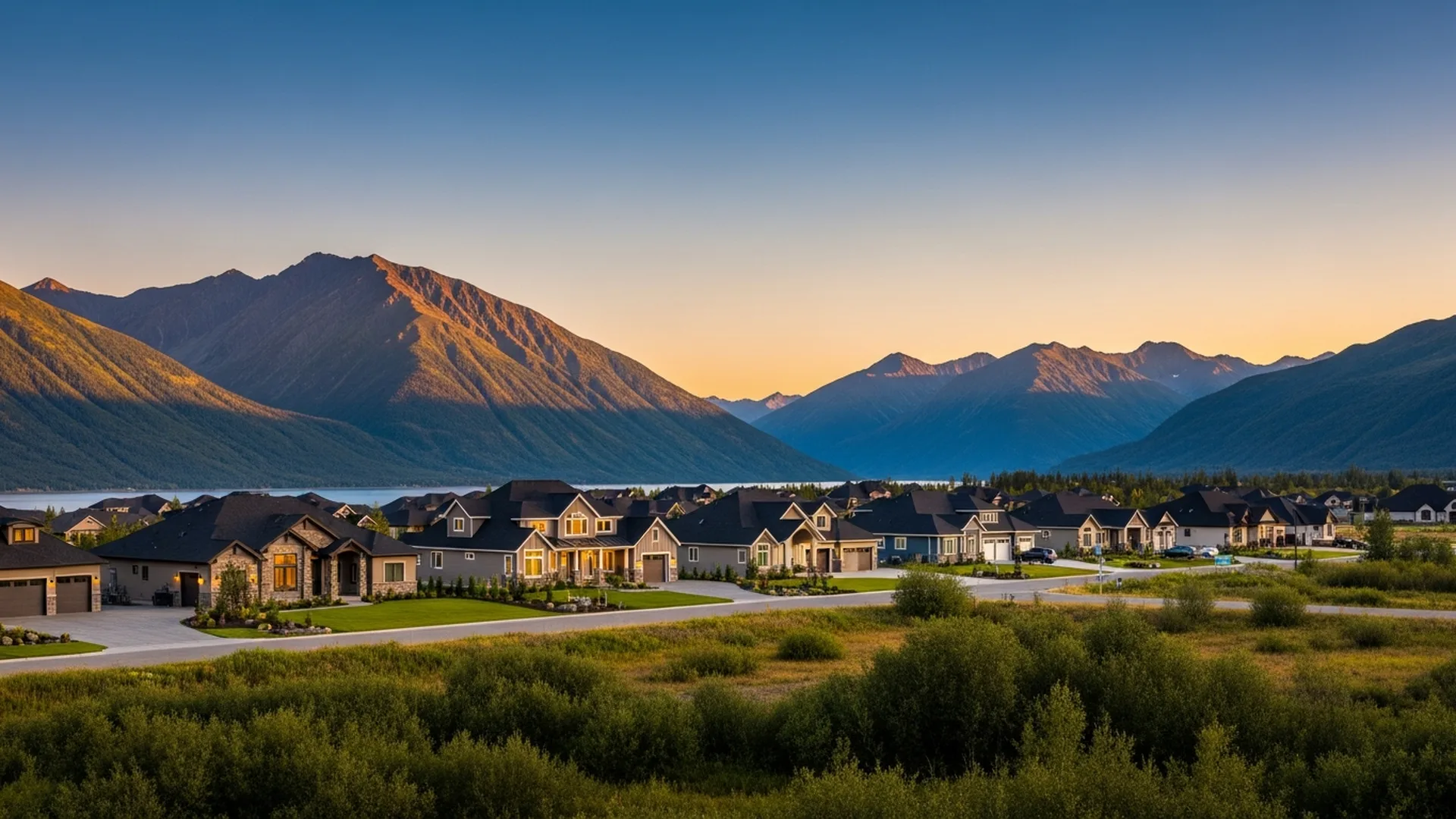
Eagle Pointe is a hillside subdivision in Eagle River, inside the Municipality of Anchorage, about 15 miles and a 15-to-20-minute drive up the Glenn Highway from downtown Anchorage. Many of its lots sit on a bluff with views across the Eagle River valley toward the Chugach Mountains, and it’s within walking distance of Eagle River High School. Because Eagle River homes often run on private wells and on-site septic systems, a Certificate of On-Site Systems Approval (COSA) is required from the Municipality before title can transfer, and testing that system early is the single most important step. Eagle River sits outside Anchorage’s enforced building-code area, so construction quality and the soils under a home also deserve close review here.
Eagle Pointe is one of the addresses buyers name when they picture Eagle River done right: newer homes, a walkable location near the high school, freeway access to town, and — on the bluff lots — a real view. I’ve watched Eagle River grow for four decades, and Eagle Pointe consistently reads as a step up from the valley floor because it combines that view with the kind of finish level luxury buyers expect. But the same features that make a hillside subdivision desirable in this area — slope, private water and wastewater, and a location beyond Anchorage’s code-enforcement line — are exactly the things a careful buyer checks before writing an offer.
This page walks through what makes Eagle Pointe distinct, the well-and-septic realities that catch Eagle River buyers most often, the COSA rule that governs every title transfer here, and what genuinely drives value if you’re selling. Where a specific varies lot-to-lot, I’ll say so rather than guess — the goal is a page you could hand to a client and trust.
- Eagle Pointe sits in Eagle River, within the Municipality of Anchorage, roughly 15 miles and 15–20 minutes from downtown Anchorage on the Glenn Highway, with JBER even closer.
- Many lots are on a bluff overlooking the Eagle River valley and Chugach Mountains; the view lots are the ones that hold value across markets.
- Homes served by a private well or septic system require a Municipality of Anchorage COSA before title transfers — a rule in force since August 1998; the MOA review fee is $600.
- Alaska DEC generally requires a septic drainfield to sit at least 100 feet from a drinking-water well, which limits placement on smaller or sloped lots (18 AAC 72).
- Anchorage sizes septic systems by bedroom count; an added lower-level bedroom can quietly outgrow an older tank — a frequent late-closing surprise.
- Eagle River never joined Anchorage’s Building Safety Service Area, so residential construction is not municipally code-inspected; 2018-earthquake damage rates ran far higher here than in the coded Anchorage Bowl.
- Getting the well and septic tested early in a sale is the most reliable way to avoid a failed-adequacy-test delay in Eagle River.
Where Is Eagle Pointe, and What Makes It Distinct in Eagle River?
Eagle Pointe is a hillside residential subdivision on the eastern side of Eagle River. Its streets — Yellowstone Drive, Acadia Drive, Lassen Street, and a cluster of national-park-named circles like Sonora, Shasta, Mendocino, and Plumas — sit close enough to Eagle River High School that residents describe it as walking distance. The character is suburban and established rather than raw and rural: this is a platted subdivision, not scattered acreage.
What sets it apart within Eagle River is elevation and view. Eagle River itself sits in the mouth of the Eagle River Valley, with slopes rising over a broad valley that reaches deep into the Chugach Mountains, the third-largest state park in the United States. The bluff lots in Eagle Pointe capture that — sightlines over the river valley toward the peaks. Unlike a valley-floor home where the view is the neighbor’s roofline, a genuine bluff parcel here is the feature buyers pay for, and it’s the feature that’s hardest for a competing listing to replicate.
| Reference point | Direction from Eagle Pointe | Approximate distance / time |
|---|---|---|
| Downtown Anchorage | Southwest via Glenn Highway | ~15 miles · ~15–20 min |
| Joint Base Elmendorf-Richardson (JBER) | Southwest via Glenn Highway | Under 20 min |
| Eagle River High School | Adjacent / walkable | Minutes |
| Chugach State Park & peaks | East / southeast | At the doorstep |
| Eagle River Nature Center | Up Eagle River Road (SE) | ~12 miles |
How Far Is the Commute From Eagle Pointe to Anchorage and JBER?
Eagle River is inside the Municipality of Anchorage, about 12 to 15 miles north of downtown on the Glenn Highway, just beyond a swath of mostly undeveloped military land. In normal conditions the downtown drive runs about 15 to 20 minutes; Joint Base Elmendorf-Richardson is closer still, which is a large part of why Eagle River draws military and commuter households. There are three freeway exits — Eagle River Loop, the Old Glenn Highway / Eagle River Road exit into the business district, and North Eagle River — so getting to and from Eagle Pointe rarely means fighting a single choke point.
The honest caveat: those times are fair-weather estimates. The Glenn Highway is the one road to town, and Southcentral winter driving plus rush-hour volume can stretch the commute. Unlike a Hillside buyer choosing between several arterials, an Eagle River buyer is committing to one highway — so I tell clients to drive it at 8 a.m. on a January weekday, not just on a sunny Saturday showing.
Do Eagle Pointe Homes Have Wells and Septic Systems — and What Should You Check?
Whether a specific Eagle Pointe home is on a private well and septic system or on community services varies lot to lot, so this is a property-by-property confirmation, not an assumption. What’s certain is that on-site water and wastewater is common across greater Eagle River, and when a home has it, several Alaska-specific checks apply.
First, separation distances. The Alaska Department of Environmental Conservation regulates on-site systems under 18 AAC 72, and its guidance generally calls for a drinking-water well to sit at least 100 feet from the septic drainfield, with additional setbacks from surface water, slopes over 25%, and property lines. On a smaller or steeply sloped bluff lot, those setbacks genuinely constrain where a system — or a future addition — can go.
Second, sizing. Anchorage sizes septic systems by the number of bedrooms; DEC guidance pegs an adequate tank at 1,000 gallons for a home of up to three bedrooms, plus 250 gallons per additional bedroom. The classic trap: a home originally built with an unfinished lower level, later finished into extra bedrooms, whose septic was only ever designed for the original count. It may have worked fine for the sellers and still not pass for the bedrooms now advertised.
What a clean well-and-septic buy looks like
- Documented, permitted system on file in MOA On-Site / state EDMS records
- Septic sized for the actual bedroom count
- Well and septic separation distances met (no waiver needed)
- Recent COSA or fresh adequacy test in hand
Red flags worth investigating
- Added bedrooms with an older, undersized tank
- Undocumented or unpermitted system
- Driveway or parking built over the drainfield
- Standpipes cut off below grade or missing caps
Practical due diligence: pull the well and septic records from the Municipality’s On-Site Water and Wastewater Section and the state’s Environmental Data Management System, review the seller’s pumping and maintenance history, and get the adequacy testing done early. DEC also recommends testing well water for bacteria, nitrates, and arsenic — the same sampling the COSA process requires.
What Is a COSA, and Why Does It Govern Every Eagle Pointe Sale?
Because Eagle River is inside the Municipality of Anchorage, the COSA rule applies here — a key difference from the Mat-Su Valley, which has no such requirement. A Certificate of On-Site Systems Approval is issued by the Municipality and confirms that a home’s well and/or septic system has been inspected and tested by a licensed civil engineer and found compliant with municipal standards. In August 1998 the Anchorage Assembly passed an ordinance requiring a COSA to transfer title on any property served by a well or septic system, to protect public health by ensuring systems are functional and water is safe and sufficient.
The mechanics matter for both sides of a deal. An engineer performs a well flow test (typically a 4-hour test) and a septic adequacy test (water added to the drainfield and measured over 24 hours), pulls records, and takes water samples that can take about 10 business days to process. The Municipality then charges $600 to review the paperwork and issue the certificate — separate from the engineer’s fees. A COSA is valid for two years, though the bacteria and nitrate water-sample results are only good for 90 days. Assuming no deficiencies, the MOA suggests allowing roughly five days for its review after a complete application.
In winter, when frozen ground makes septic construction impractical, the Municipality can issue a conditional COSA if a new system is required — but selling then typically means establishing an escrow of about one-and-a-half times the highest repair bid. That’s a seasonality-as-logistics reality unique to cold-climate sales, and a reason to start the process before the ground freezes.
Why Does Construction Quality Matter More in Eagle River?
This is the moat topic most agents skip, and it’s the one a 40-year local can speak to plainly. Under Anchorage’s unusual service-area form of government, communities opt into services, and Eagle River never opted into the Building Safety Service Area — so residential construction there is not subject to municipal building-code inspection the way the Anchorage Bowl is. That distinction became visible in the November 30, 2018 magnitude 7.1 earthquake, whose epicenter sat only about 12 miles from Anchorage and 19 kilometers west of Eagle River.
A University of Alaska Anchorage-led study found that damage rates to buildings in Eagle River and Chugiak ran roughly 18 to 20 times higher than in the coded, enforced parts of the Anchorage Bowl, and of the 40 severely damaged buildings in the Municipality, 38 were in areas without code enforcement. Engineers emphasized that much of the serious damage traced to homes built on poorly compacted fill — a ground problem as much as a building problem. Anchorage-area homes also need well-placed shear walls to resist both earthquakes and high winds.
None of this means “don’t buy in Eagle River.” It means a luxury buyer here should treat the foundation, the fill history, and the quality of the build as first-order due diligence — ideally with a qualified inspector and, on a sloped bluff lot, an eye on the geotechnical picture. A well-built, properly sited Eagle Pointe home is a fine buy; the point is to confirm it’s one.
Thinking of Selling in Eagle Pointe? What Drives Value Here
If you’re selling, the value story in Eagle Pointe is specific. A genuine bluff view of the valley and Chugach peaks is the top differentiator — it’s the thing a buyer can’t add later. A clean, current COSA is the second: buyers and their lenders want to see the well and septic already tested and approved, and providing that engineering report early is a real negotiating asset rather than a last-minute scramble. The third is finish and flow.
That third point is where my background helps. I pair a degree in Interior Design with a career in furnishings, design, and real estate, and today I help Anchorage-area sellers present homes so the finishes read as intentional and move-in ready — which matters most in a subdivision like Eagle Pointe where buyers compare several similar floor plans. Small, correct staging and finish choices routinely move the number more than sellers expect. When you’re ready to price it, start with a data-backed valuation for the Eagle River market.
- Municipality of Anchorage, Development Services — Certificate of On-Site Systems Approval (COSA): rule since August 1998, title-transfer requirement, engineer testing, ~5-day review. (muni.org)
- Anchorage COSA fee ($600 MOA review) and process steps — C&M Engineering / MOA On-Site Systems Maintenance Guide (2025); two-year validity and 90-day water-sample window per Pannone Engineering / local engineers.
- Alaska DEC, 18 AAC 72 & Onsite Wastewater System Installation Manual — well/septic separation distances (100-ft well-to-drainfield guidance), slope setbacks; DEC "Buying a Home" (tank sizing: 1,000 gal for up to 3 bedrooms + 250 gal each additional). (dec.alaska.gov)
- Eagle River location & commute (~15 mi / 15–20 min from downtown Anchorage; three Glenn Highway exits; within MOA) — ALASKA.ORG; The Milepost; Rome2Rio/Travelmath driving-distance data.
- 2018 M7.1 earthquake & building-code contrast — UAA-led study via Alaska Beacon / Alaska Public Media (18–20× higher damage rates in Eagle River/Chugiak; 38 of 40 severely damaged buildings in non-code areas); Anchorage Daily News (Building Safety Service Area, fill/foundation, shear walls); Alaska Earthquake Center.
- Eagle Pointe street names & character — greatalaskanhomes.com HOA page; Alaska.org valley/Chugach geography.
Considering a Move to Eagle Pointe?
Let’s walk the bluff lots, review the well-and-septic records, and find the right fit. Call Bill Ure at 907-560-4090.
Frequently Asked Questions
Eagle Pointe is a hillside subdivision on the east side of Eagle River, inside the Municipality of Anchorage, roughly 15 miles and about a 15-to-20-minute drive up the Glenn Highway from downtown Anchorage. It sits within walking distance of Eagle River High School, and its streets include Yellowstone Drive, Acadia Drive, Lassen Street, and several circles named for national parks. Many lots are set on a bluff with views over the Eagle River valley toward the Chugach Mountains.
It varies by street and lot, so confirm on the specific property. Many homes in the greater Eagle River area rely on private wells and on-site septic systems rather than piped utilities. Because Eagle River is inside the Municipality of Anchorage, any home served by a well or septic system requires a Certificate of On-Site Systems Approval (COSA) before the title can transfer, under the 1998 Anchorage ordinance.
A COSA, or Certificate of On-Site Systems Approval, is issued by the Municipality of Anchorage and confirms that a home’s well and/or septic system was inspected and tested by a licensed civil engineer and meets municipal standards. Since August 1998, Anchorage requires a COSA to transfer title on any property served by a well or septic system. The MOA charges $600 to review the paperwork and issue the certificate, on top of the engineer’s testing fees, and the approval is valid for two years.
Eagle River is about 15 miles north of downtown Anchorage on the Glenn Highway, typically a 15-to-20-minute drive in normal conditions. Eagle Pointe residents also reach Joint Base Elmendorf-Richardson (JBER) in well under 20 minutes, which is one reason the area draws military and commuter buyers. Winter weather and Glenn Highway traffic can extend that drive, so it’s worth testing the commute at rush hour before you buy.
A University of Alaska Anchorage-led study found that in the 2018 magnitude 7.1 earthquake, damage rates to buildings in Eagle River and Chugiak ran roughly 18 to 20 times higher than in the parts of the Anchorage Bowl where building codes are mandated and enforced. Eagle River never opted into the Municipality’s Building Safety Service Area, so residential construction there is not subject to municipal building-code inspection. Much of the serious damage was also tied to homes built on poorly compacted fill, so construction quality, the foundation, and the soils are worth investigating.
Start with septic sizing versus the bedroom count, since Anchorage sizes systems by bedrooms and an added lower-level bedroom can outgrow an older tank. Verify separation distances — Alaska DEC generally requires the drainfield to sit at least 100 feet from a drinking-water well. Pull the well and septic records from the Municipality’s On-Site records and the state’s EDMS database, get the COSA testing done early, and, given the 2018 earthquake findings, look closely at the foundation and whether the lot was built on fill.
Eagle Pointe holds appeal because it pairs newer subdivision homes and a walkable location near Eagle River High School with quick freeway access to Anchorage and JBER. The strongest value drivers are a genuine bluff view of the valley and Chugach peaks, a clean and current COSA, and finishes that read as move-in ready. Sellers who test the well and septic early avoid the most common closing delay in Eagle River — a failed adequacy test discovered late.