

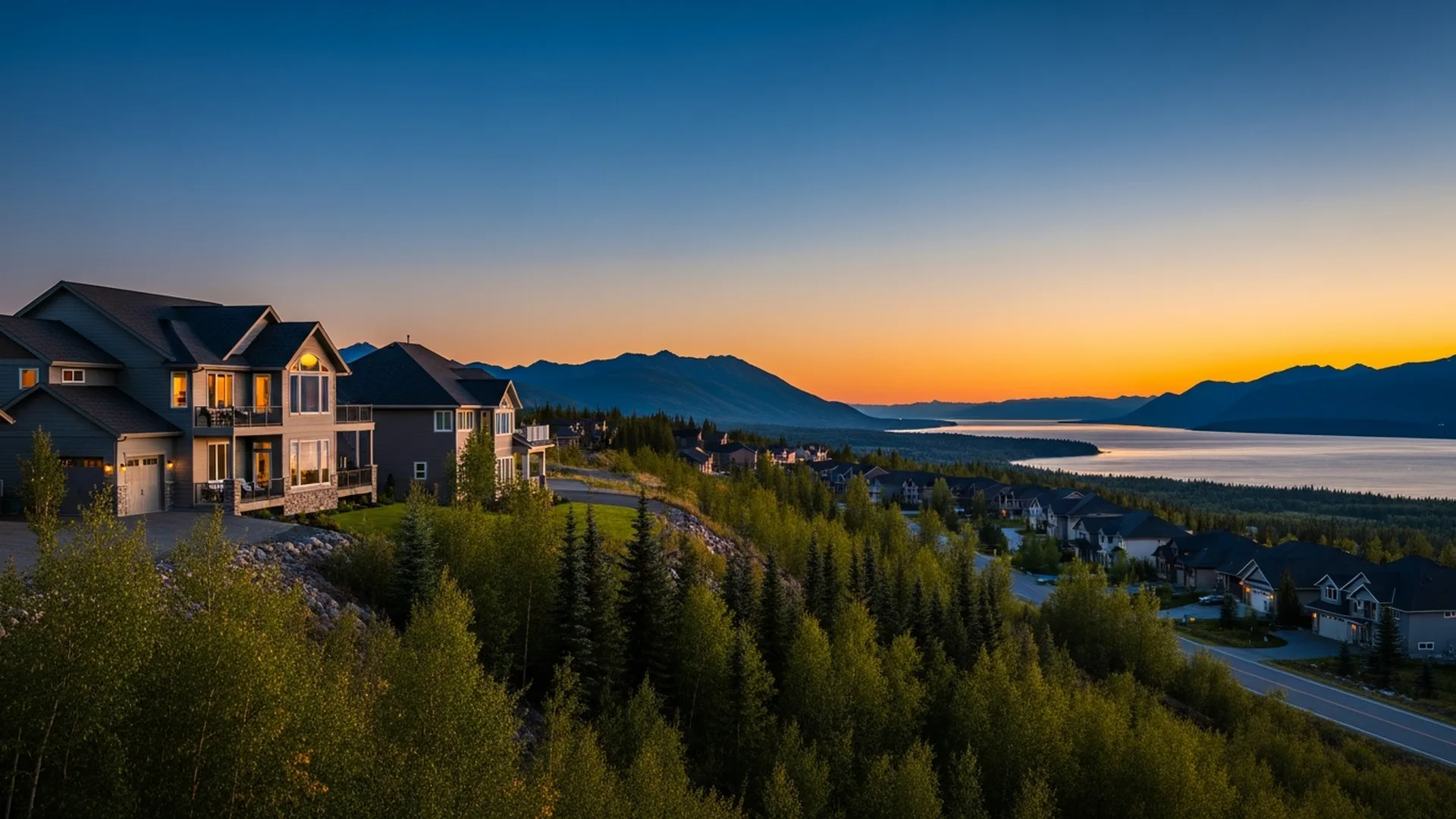
Eagle Bluff is one of Eagle River’s newer premium subdivisions, built for larger view lots on the bluff above the Eagle River Valley, within the Municipality of Anchorage and roughly 15 miles from downtown Anchorage. Its appeal is elevation and sightlines — parcels set above the valley with mountain and river views, Chugach State Park trails nearby, and newer custom construction rather than aging inventory. Because utilities vary lot by lot in the valley, buyers should confirm whether a specific parcel is on community service or private well and septic; any well-and-septic home in Anchorage requires a Certificate of On-Site Systems Approval (COSA) at title transfer. The two things a Bluff buyer should verify first are the view orientation and the water/wastewater setup — both drive value here more than square footage does.
I’ve watched the Chugiak–Eagle River corridor fill in for four decades, and the pattern in the valley is consistent: the parcels that hold value are the ones with a genuine, protected view and clean systems documentation. Eagle Bluff was carved out of that upper-valley terrain specifically to deliver the first of those — large lots elevated above the Eagle River Valley, marketed for their mountain and river sightlines and their newer, build-to-suit homes. The second half of the equation, the systems and access details, is where buyers who don’t know the area get surprised. This page covers both.
Everything below is written for the way people actually buy here — view first, then the practical checks that decide whether the view is worth what’s being asked. A note before we start: Alaska is a non-disclosure state, so recorded sale prices aren’t public; any figures here are market context and asking-price ranges, not closed comps.
- Eagle Bluff is a newer premium, large-lot subdivision on the bluff above the Eagle River Valley, within the Municipality of Anchorage.
- Eagle River Valley large-lot subdivisions commonly run around 1.25 acres and up — larger than many in-town Eagle River parcels.
- Eagle River sits roughly 13–17 miles from downtown Anchorage along the Glenn Highway; a typical drive runs about 20–40 minutes.
- Water/wastewater varies by lot; on private well and septic, Alaska DEC (18 AAC 72.100) requires at least 100 feet between a well and any wastewater source.
- Any Anchorage well-and-septic home needs a Certificate of On-Site Systems Approval (COSA) from the Municipality at title transfer — required since a 1998 ordinance.
- The area is in the Anchorage School District’s Chugiak–Eagle River cluster, including Chugiak Elementary, Mirror Lake Middle, and Chugiak High.
- New construction has been offered in phases by builders including Firebird Realty and Hultquist Homes.
Where Is Eagle Bluff, and What Kind of Homes Are There?
Eagle Bluff sits on the valley side of Eagle River, above the Eagle River Valley floor, inside the Municipality of Anchorage. Eagle River itself is a fast-growing residential community northeast of Anchorage, homesteaded after World War II when the Glenn Highway opened the area, and today it carries a full range of businesses along the Old Glenn Highway. What sets Eagle Bluff apart from that older in-town fabric is its design intent: it was platted as a premium, large-lot subdivision built around elevation and views rather than density.
Unlike the townhome-and-condo inventory clustered near Business Boulevard in downtown Eagle River, Bluff homes are predominantly newer single-family construction on generous parcels. Listings in the area consistently emphasize the same three things — large lots, mountain and Eagle River Valley views, and quick access to Chugach State Park trails. That combination is genuinely scarce in Eagle River, which has relatively few true large-lot subdivisions.
| Orientation fact | Detail |
|---|---|
| Location | Bluff above the Eagle River Valley, on the valley side of Eagle River |
| Jurisdiction | Municipality of Anchorage (not Mat-Su Borough) |
| Access | Glenn Highway to the Eagle River exit (~mile 13), then east into the valley |
| To downtown Anchorage | ~13–17 miles; ~20–40 minute drive |
| Adjacent recreation | Chugach State Park trails and the Eagle River corridor |
| Home type | Predominantly newer single-family, large-lot custom construction |
How Far Is the Anchorage Commute — and Does It Change in Winter?
The commute is the number buyers relocating from Outside most often underestimate in both directions. Sources put Eagle River at roughly 13 to 17 miles from downtown Anchorage along the Glenn Highway, with the Eagle River exit near Glenn Highway mile 13 and a typical drive of about 20 to 40 minutes. That’s a genuinely reasonable commute for a home with acreage and a valley view — the trade Eagle River exists to offer.
The honest caveat: those numbers are fair-weather baselines. The Glenn Highway is the single artery, it threads past the JBER gates, and winter snow, ice, and the occasional closure can stretch the drive well past the average. Unlike an in-town Anchorage neighborhood where you have alternate routes, the valley commuter is largely committed to the Glenn. My standing advice is to drive the exact route at the exact hour you’d actually use it, in the season you’re buying — a February 7:30 a.m. test tells you far more than a summer showing.
Does Eagle Bluff Use Well and Septic or Public Water and Sewer?
This is the question I get most, and the honest answer is that it varies by lot — and you should never assume. Across the Eagle River Valley, some properties are connected to community or public utilities while many larger-lot parcels rely on a private well and an on-site septic system. A newer Eagle Bluff home I’ve seen described in listing data was served by natural gas, but a home’s gas service tells you nothing about its water and wastewater setup. The only reliable move is to verify the specific parcel’s water and wastewater situation in writing before you write an offer.
Why it matters so much: if the home is on well and septic, an entirely different due-diligence process attaches to the sale — one the Municipality of Anchorage enforces strictly. That’s the COSA, and it’s worth understanding before you fall for the view.
Why buyers choose the Bluff
Elevated, large view lots that are scarce in Eagle River; newer custom construction and finish choice; trail and Chugach State Park access; a reasonable ~15-mile Anchorage commute; more usable land, which eases septic siting.
What to weigh carefully
Utility setup varies by lot and must be verified; well-and-septic homes carry the COSA process at sale; single-artery Glenn Highway commute is weather-sensitive; bluff-view value depends on protecting the sightline; premium lots command a premium price.
What Is a COSA, and What Does the Well-and-Septic Check Involve?
If a Bluff (or any Eagle River Valley) home is on private systems, the transaction runs through a Certificate of On-Site Systems Approval — a COSA. Per the Municipality of Anchorage, an August 1998 ordinance requires that, to transfer title on any property served by a well or septic system, the seller obtain a COSA confirming that a professional engineer inspected and tested the systems and found them compliant with municipal standards. The municipal code (AMC 15.65) makes the point bluntly: without a COSA at transfer, the system is deemed out of compliance until one is obtained.
In practice, per the Municipality, getting to an approved COSA typically means: pumping the septic tank within the previous year, an absorption-field adequacy test (commonly within two years), a well flow test, and water samples tested for items including nitrates, arsenic, and coliform bacteria — with the bacteria/nitrate results kept recent. The Municipality advises allowing roughly five days for its review once the engineer’s package is submitted, and more time if deficiencies must be corrected. The reason I flag this early rather than late: problems the COSA surfaces — a failing field, a separation-distance shortfall, a tank that’s no longer watertight — can require repairs or an escrow before closing, which is a very different negotiation than a clean transfer.
What Does Alaska Require for Well-and-Septic Setbacks?
The rules that decide whether a lot can even support a compliant system come from Alaska DEC regulation 18 AAC 72. Per DEC (18 AAC 72.100), a private drinking-water well must sit at least 100 horizontal feet from a septic tank, soil absorption field, sewer line, holding tank, or other potential contamination source. Separately (18 AAC 72.520), DEC requires at least 100 feet between a septic system and the mean annual high water level of a lake, river, stream, or slough — directly relevant near the Eagle River corridor — and a 50-foot horizontal setback from a steep slope with more than a 10-foot drop, which matters on bluff terrain.
Within the Municipality of Anchorage, the MOA holds delegated authority for on-site systems serving up to two dwelling units, and its On-Site Water and Wastewater program administers permits and the COSA; systems serving more than two units fall under the state. This is exactly why lot size is more than a privacy question on the Bluff: unlike a public-sewer lot where the ground is just yard, a well-and-septic lot has to physically fit a well, a tank, and an absorption field while honoring every one of those setbacks. More usable acreage — the thing the valley’s large-lot subdivisions offer — is what makes that math work.
Alaska is a non-disclosure state, so recorded sale prices are not public — asking prices, not closed sales, are what you’ll see quoted anywhere. Broader Eagle River market data has shown a median list price in the low-to-mid five hundreds with homes selling relatively quickly, but Eagle Bluff sits at the premium end because of its lots and newer construction. Treat any single figure as context, not a comp; a lot-specific analysis is the only reliable read.
Which Schools Serve Eagle Bluff?
Eagle Bluff is in the Anchorage School District, within the Chugiak–Eagle River attendance area. Schools serving the broader area by name include Chugiak Elementary, Mirror Lake Middle School, and Chugiak High School. I state these as factual attendance-area references only: the Anchorage School District sets and periodically adjusts boundaries, so confirm the current assignment for a specific address directly with the district rather than relying on a listing or a map.
Thinking of Selling in Eagle Bluff? What Drives Value Here
If you own on the Bluff, your value story is different from a typical Eagle River listing, and it should be marketed that way. The two levers are the view and the systems paperwork. A cleared, protected down-valley or mountain sightline is the single feature buyers pay a premium for — and, from experience, sellers routinely underestimate how much a genuinely open sightline moves the number versus a partially obstructed one. The second lever is documentation: on a well-and-septic home, a clean, current COSA package removes the largest single source of buyer hesitation before it becomes a price negotiation.
With a background in interior design, I also help sellers here spend staging and finish dollars where they actually hold value in an Alaska home — light, flow, and durable cold-climate finishes — rather than on cosmetics that don’t survive the first winter. When you’re ready, the next step is a lot-specific value read; you can start with your Eagle River–area home value and we’ll tailor it to the Bluff.
- Alaska Department of Environmental Conservation — 18 AAC 72.100 (private water system separation distances) and 18 AAC 72.520 (setbacks from surface water and slopes); DEC wastewater-in-real-estate guidance. Supports the 100-foot well-to-septic and surface-water setbacks and the well/septic due-diligence framing.
- Municipality of Anchorage, On-Site Water and Wastewater program — Certificate of On-Site Systems Approval (COSA) requirements and AMC 15.55 / 15.65 (1998 title-transfer ordinance, testing, review timeline, MOA delegated authority for up to two dwelling units). Supports the COSA section.
- The MILEPOST / Glenn Highway travel references and mapping distance sources — Eagle River location ~13–17 miles from downtown Anchorage; Eagle River exit near Glenn Highway mile 13. Supports commute figures.
- National Center for Education Statistics school locator (ZIP 99577) / Anchorage School District — Chugiak Elementary, Mirror Lake Middle School, Chugiak High School attendance-area names.
- Eagle Bluff Estates builder/market descriptions (Firebird Realty, Hultquist Homes) and Alaska MLS/IDX-sourced listing descriptions — large view lots (~1.25+ acres in comparable valley subdivisions), phased new construction, bluff/valley view positioning. Utility status per parcel not conclusively documented publicly; verify per property.
Considering a View Lot in Eagle Bluff?
Let’s check the sightline, the utilities, and the commute together — before you fall for the view.
Frequently Asked Questions
Eagle Bluff is one of Eagle River’s newer premium subdivisions, built for larger view lots on the bluff above the Eagle River Valley. Its draw is elevation and sightlines — parcels set above the valley with mountain and river views, trail access to Chugach State Park nearby, and newer custom construction rather than aging inventory. It sits within the Municipality of Anchorage, roughly 15 miles from downtown Anchorage.
Eagle River sits about 13 to 17 miles from downtown Anchorage along the Glenn Highway, a drive of roughly 20 to 40 minutes in normal conditions. Eagle Bluff is on the valley side of Eagle River, so add a few minutes from the Glenn Highway exit. Winter weather and rush-hour merges through the JBER corridor can extend the commute, so test it at the time of day you’ll actually drive it.
It varies lot by lot in the Eagle River Valley — some properties are on community or public utilities and many larger-lot parcels are on private well and on-site septic. Because a given Eagle Bluff parcel’s utilities are not something to assume, verify the specific water and wastewater setup for the exact property before writing an offer. Any home on well and septic within the Municipality of Anchorage requires a Certificate of On-Site Systems Approval (COSA) at title transfer.
A COSA is a Certificate of On-Site Systems Approval issued by the Municipality of Anchorage. Since a 1998 ordinance, transferring title on any Anchorage-area property served by a well or septic system requires one, confirming a professional engineer inspected and tested the system and found it compliant. It’s the single most important due-diligence item on a well-and-septic purchase, because deficiencies discovered during the COSA can require repairs or an escrow before closing.
Under Alaska DEC regulation 18 AAC 72.100, a private drinking-water well must be at least 100 horizontal feet from a septic tank, soil absorption field, or other wastewater source. DEC also requires at least 100 feet between a septic system and the mean annual high water level of a river, stream, or lake. On smaller or oddly shaped valley lots, meeting these setbacks is exactly what constrains where — or whether — a system can go.
Eagle Bluff falls within the Anchorage School District’s Chugiak–Eagle River attendance area. Nearby schools by name include Chugiak Elementary, Mirror Lake Middle School, and Chugiak High School. Attendance boundaries are set by the district and can change, so confirm the current assignment for a specific address with the Anchorage School District before relying on it.
Yes. Eagle Bluff has been developed in phases, with builders including Firebird Realty and Hultquist Homes offering new plans on view lots, and later phases opening over time. Buying new here means choosing finishes and layout up front rather than remodeling older stock — which, with a design background, is where I help buyers spend money where it holds value in an Alaska home.
Eagle Bluff is marketed as a large-lot, premium subdivision, and Eagle River Valley large-lot subdivisions commonly run around 1.25 acres and up — larger than many in-town Eagle River parcels. Lot size matters beyond privacy: on a well-and-septic property, more usable land makes it far easier to meet Alaska’s required well-to-septic and system-to-surface-water setbacks.