

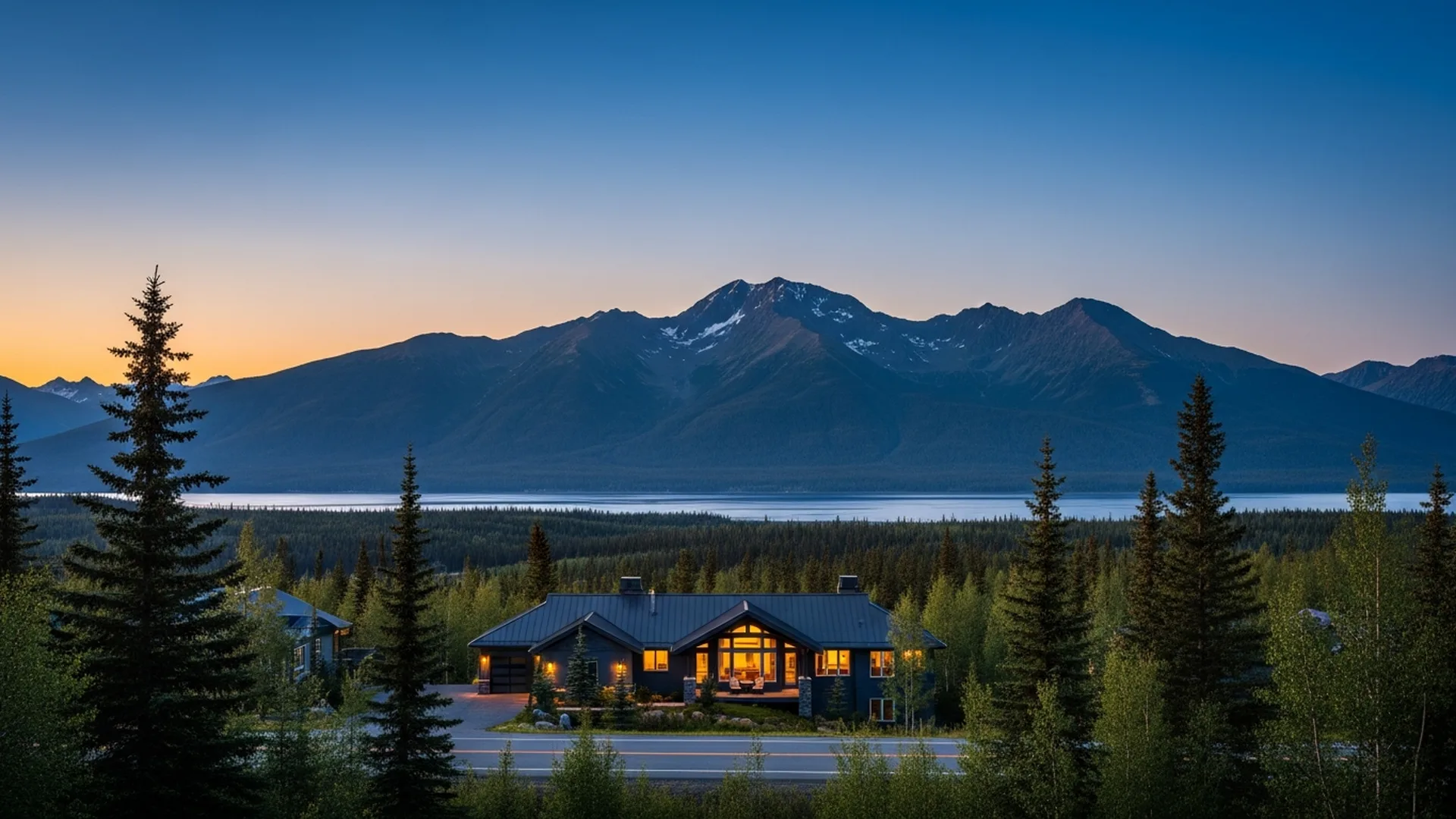
Custom homes on the Anchorage Hillside sit on the wooded western foothills of the Chugach Mountains, prized for larger lots and sightlines toward Cook Inlet, downtown Anchorage, and the Alaska Range. Much of the upper Hillside is outside municipal water and sewer service, so many homes rely on private wells and on-site septic — and a Certificate of On-Site Systems Approval (COSA) is required at title transfer for those parcels. The two factors buyers most often underweight are lot orientation for scarce winter sun and the cold-climate build quality behind the finish: insulation to Alaska’s Building Energy Efficiency Standard, seismic-engineered framing, and a foundation matched to sloped glacial soils. Reading those correctly is where a home’s long-term value is won or lost.
The Hillside is Anchorage’s classic view address — a sloping, heavily wooded band of larger lots climbing the front of the Chugach Mountains in the southeast corner of the municipality. It is where a good share of the city’s custom and estate homes were built, many during the wave of subdivision that ran through the 1980s and 1990s along streets like Upper O’Malley, Birch, and Snow View. What makes it distinct is not one thing but a stack of them: the view, the space, the trees, and the fact that building here means building for genuine cold and genuine seismic risk.
I’ve lived in Anchorage for 40 years and watched this corridor mature from raw hillside into the city’s premier custom-home neighborhood. What I tell buyers touring up here is that a Hillside custom home rewards the person who reads it carefully — the lot, the systems, and the build — and quietly punishes the one who buys the view and stops looking.
- The Hillside sits on the western foothills of the Chugach Mountains; the Glen Alps trailhead area rises to roughly 2,200 feet, and homes below it stair-step down toward the Anchorage Bowl and Cook Inlet.
- Per the Anchorage Water & Wastewater Utility, nearly 7,000 residential lots in southeast Anchorage have no municipal water/sewer — most over an acre, on private wells and on-site septic systems.
- A COSA (Certificate of On-Site Systems Approval) is required by the Municipality of Anchorage at title transfer for MOA-regulated well-and-septic properties, and requires civil-engineer testing of the well and septic.
- South-facing exposure matters as much as the view: a south-facing lot maximizes passive solar gain during Anchorage’s very short winter days and can lower lifetime heating cost.
- New Alaska homes are built to AHFC’s Building Energy Efficiency Standard (BEES); AHFC-financed loans require at least a 5-Star rating, and cold-climate ceilings commonly reach R-49 to R-60.
- Southcentral Alaska is highly seismic; quality Hillside builds pair engineered foundations and heavier framing hardware with a site-specific geotechnical investigation of the glacial soils.
- The Hillside is served by the Anchorage School District, with schools such as O’Malley Elementary, Hanshew Middle, Goldenview Middle, Service High, and South Anchorage High in the broader area.
What makes the Anchorage Hillside a custom-home neighborhood?
Geography, mostly. The Hillside occupies the sloped foothills where the Anchorage Bowl meets Chugach State Park — a 495,000-acre park whose Glen Alps trailhead sits at about tree line, roughly 2,200 feet in elevation, with the Hillside’s residential streets fanning out below. That slope is what produces the views the area is known for: from the right lot you can take in Cook Inlet, the downtown skyline, and, on a clear day, the profiles of Denali, Foraker, and Hunter across the Inlet, with 3,510-foot Flattop rising directly behind you.
Unlike the flatter, gridded neighborhoods of the Bowl, the Hillside developed as larger wooded parcels — many over an acre — which is why it became the natural home for one-off custom builds rather than tract subdivisions. Homes here tend to be individually designed and, as one longtime local agent put it, “a little more personal and not so much neighborhood cookie-cutter style.” That character is the draw, and it’s also why no two Hillside custom homes should be evaluated the same way.
| Zone | Character | Water / sewer | Typical view |
|---|---|---|---|
| Upper Hillside | Steepest, most wooded, largest lots | Mostly private well & on-site septic | Sweeping Cook Inlet & Bowl panoramas |
| Mid-Hillside | Established custom homes, 1960s–2000s builds | Mix; much on well & septic | Cook Inlet, downtown, filtered mountain |
| Lower Hillside | Closer to the Bowl, more services | Portions on AWWU municipal service | Partial views; more tree-screened lots |
How much do Hillside custom homes cost, and what drives the premium?
Prices on the Hillside cover a wide range because the homes are so individual — but the premium over comparable square footage elsewhere in Anchorage comes from a consistent set of drivers, not from anything mysterious. The land is the biggest one: acre-plus view lots are scarce and command real money. On top of the lot, building on a slope in a cold, seismic environment simply costs more than building on a flat, fully-serviced Bowl lot.
Where new construction is concerned, the market runs from more modest new builds into the multi-million-dollar range for large custom estates on premier view parcels; publicly listed Hillside-area new construction has spanned from the mid-six figures up past $2 million depending on lot, size, and finish. Rather than quote a median that will be stale in a month, I’d point buyers to the underlying cost logic below — it holds through any market.
Cost drivers that reliably add to a Hillside build versus a flat, serviced Bowl lot: sloped-site grading and engineered foundations; a private well and septic system where there is no municipal service (site development on outlying Anchorage parcels can add roughly $20,000–$50,000, per contractor cost guidance); geotechnical, permit, and engineering fees; and heavier seismic framing hardware. Insulation and heating systems are a major line item because Alaska homes carry high R-values and often in-floor radiant heat.
Do Hillside homes have well and septic, and what is a COSA?
This is the single most important due-diligence item on the Hillside, and it’s the one out-of-state buyers underestimate most. Much of the upper Hillside is deliberately outside municipal utilities: the Anchorage Water & Wastewater Utility reports that nearly 7,000 residential lots in southeast Anchorage have no municipal water and sewer, and most of those lots are larger than one acre and rely on private wells for drinking water and on-site septic systems for wastewater. When there is no municipal service, water for firefighting on the Hillside largely depends on tanker trucks — a detail worth knowing for insurance and peace of mind.
For any MOA-regulated well-and-septic property, a COSA — Certificate of On-Site Systems Approval — is required at the time of title transfer. Per the Municipality of Anchorage, a licensed civil engineer must field-inspect and test the system: a well flow test (commonly a multi-hour test to gauge production), a water sample sent to a lab, a septic adequacy test on the disposal field, verification of code separation distances between well and septic, and a receipt showing the septic tank was pumped within the past year. If separation distances or performance don’t meet code, upgrades or a case-by-case separation-distance waiver may be required before the sale can close.
There’s also a groundwater angle specific to this area. A Municipality of Anchorage aquifer study of the Hillside examined nitrate in local wells — the State of Alaska drinking-water standard for nitrate is 10 mg/L — because the density of septic systems combined with shallow bedrock in places can move nutrients toward the aquifer. The State standard for nitrate exists precisely so a COSA well test catches problems before you own them.
Which way should a Hillside lot face — view or winter sun?
Both, ideally — and knowing why is where experience pays off. The postcard Hillside view faces west, out over Cook Inlet and the Alaska Range, and it’s genuinely spectacular, especially the winter sunrises and sunsets. But Anchorage winter days are short and low-sun, and a south-facing lot maximizes passive solar gain during exactly those months, which can meaningfully reduce heating load over the life of the home. The best Hillside purchases capture the western view and preserve real southern exposure through window placement and floor-plan orientation.
This is the difference between a home that’s beautiful in a listing photo and one that’s warm and light-filled in January. Strategic window sizing and placement, triple glazing, and a plan that opens to the south are not luxuries here — they’re how a cold-climate home performs. It’s also exactly where my design background earns its keep: reading whether a floor plan actually captures the light and the view it was built to capture.
How are cold-climate custom homes built on the Hillside?
Alaska does not use the IECC as its statewide residential energy code. Instead, the operative standard is the Building Energy Efficiency Standard (BEES), administered by the Alaska Housing Finance Corporation (AHFC). AHFC-financed mortgages require at least a 5-Star BEES rating, and many custom builders voluntarily target 6-Star. In practice, cold-climate Anchorage homes commonly reach roughly R-49 to R-60 in ceilings and R-21 or higher in walls, achieved with deeper wall framing (2x6 or double-stud), spray foam or rigid-plus-batt assemblies, triple-glazed low-E windows, and tight air-sealing confirmed by a blower-door test.
Two cautions I’d flag from the research: first, BEES currently tracks an earlier IECC edition, so a BEES-compliant home is not automatically compliant with the newest IECC — a distinction worth understanding on a high-end build. Second, and more important for real-world comfort, a leaky R-40 wall underperforms a well-sealed R-20 wall in a cold climate, because convective heat loss through air leaks exceeds conductive loss through insulation. Air-sealing is not a detail; it’s the whole game.
Seismic and foundation realities
Southcentral Alaska sits in one of the most seismically active zones on earth, and Anchorage-area construction is engineered to high seismic design categories — heavier connections and more hardware throughout the frame. The Hillside’s glacial soils demand respect: the region’s subsurface includes silt, sand, clay, and the Bootlegger Cove Formation that contributed to devastating landslides in the 1964 Great Alaska Earthquake. A site-specific geotechnical investigation determines the foundation type and is a practical necessity on a sloped Hillside parcel, not an optional expense.
Reading a custom-home spec with a designer’s eye
This is where I lean on my background: I hold a degree in Interior Design and spent a career in furnishings, design, and real estate before helping Anchorage buyers and sellers today. That trained eye is genuinely useful on a custom build — distinguishing finishes that will survive Alaska’s freeze-thaw and dry-winter interiors from finishes that merely look expensive; judging whether the flow, ceiling heights, and glazing actually serve the light and the view; and spotting where a builder spent money that shows versus money that lasts. I apply that lens to real estate; I don’t offer interior-design services.
What holds value on the Hillside
South-facing view lots with real winter sun; documented, well-maintained well and septic with a clean COSA history; engineered foundations on stable soils; genuinely tight, high-R construction; and finishes chosen for cold, dry-winter durability.
What buyers overlook
Buying the view without checking southern exposure; skipping well flow and nitrate results; assuming municipal water/sewer where there is none; steep, icy upper-Hillside access; and confusing a large finish budget with a well-built envelope.
Thinking of selling a Hillside custom home? What drives value here
If you own a Hillside custom home, the value story is the mirror image of the buyer’s checklist. A clean, current COSA and documented well flow and water quality remove the single biggest source of buyer hesitation — get ahead of it rather than negotiating it at closing. Sightlines sell: a cleared, maintained view corridor consistently moves the number more than sellers expect, and buyers pay for the western Cook Inlet panorama and for real southern light. Finish presentation matters too, and it’s where my design credential helps me advise on staging and pre-list improvements that photograph well and read as quality. When you’re ready, I can build you an accurate, Hillside-specific valuation — see the Anchorage home-value page to start.
- Anchorage Water & Wastewater Utility (AWWU) — water/sewer service on Anchorage’s Hillside; ~7,000 lots on well and septic; firefighting via tanker where no service exists.
- Municipality of Anchorage, Development Services, On-Site Water & Wastewater Section — well and septic permitting; COSA required at title transfer; civil-engineer testing and separation-distance rules.
- Municipality of Anchorage Development Services / Dept. of Health — Hillside aquifer well water nitrate studies; State of Alaska drinking-water nitrate standard of 10 mg/L.
- Alaska Housing Finance Corporation (AHFC) — Building Energy Efficiency Standard (BEES); 5-Star rating requirement for AHFC-financed mortgages; Alaska cold-climate building guidance.
- Cold-climate construction references (Alaska Energy Code / BEES; UAF Cooperative Extension building guidance) — R-value ranges, air-sealing, and window standards for Zone 8.
- USGS / general geologic sources — Chugach Mountains, Cook Inlet geography, Glen Alps elevation, Bootlegger Cove Formation and 1964 Great Alaska Earthquake landslides.
- Chugach State Park / Glen Alps trailhead — elevation and view context for the Hillside.
- Anchorage School District School Finder — school boundaries serving the Hillside area (named for factual reference only).
Looking at Hillside custom homes?
Work with a 40-year Anchorage local who reads the lot, the systems, and the build — not just the view.
Frequently Asked Questions
Hillside custom homes carry a premium mostly for the land and the view. The area sits on the western foothills of the Chugach Mountains with larger lots — many over an acre — and sightlines toward Cook Inlet, downtown Anchorage, and the Alaska Range. On top of the lot, cold-climate construction to Alaska’s Building Energy Efficiency Standard (BEES), sloped-site engineering, and seismic detailing all add cost that a flat, fully-serviced lot elsewhere in town does not.
Many do, especially on the upper Hillside. According to the Anchorage Water & Wastewater Utility, nearly 7,000 residential lots in southeast Anchorage have no municipal water and sewer service, and most are larger than one acre and rely on private wells and on-site septic systems. Lower Hillside areas may have AWWU service. Always confirm the specific parcel before you write an offer.
A COSA is a Certificate of On-Site Systems Approval. Per the Municipality of Anchorage, a COSA is required at the time of title transfer for properties served by MOA-regulated on-site water and wastewater systems. A licensed civil engineer inspects and tests the well and septic — including a well flow test and a septic adequacy test — and verifies code separation distances before the certificate is issued.
South-facing. Anchorage winter days are very short, and a south-facing lot maximizes passive solar gain during those low-sun months, which can meaningfully reduce heating load over the life of the home. Buyers often chase the panoramic west-facing Cook Inlet view; the smartest Hillside purchases balance that view with genuine southern exposure so the home is both beautiful and warm in January.
Alaska uses the Building Energy Efficiency Standard (BEES), administered by the Alaska Housing Finance Corporation. AHFC-financed mortgages require at least a 5-Star BEES rating. In practical terms, cold-climate Anchorage homes commonly target roughly R-49 to R-60 in ceilings and R-21 or higher in walls, with high-performance triple-glazed windows and tight air-sealing verified by a blower-door test.
Yes. Southcentral Alaska is one of the most seismically active regions on earth, and Anchorage-area structures are engineered to high seismic design categories. A quality Hillside custom build reflects that in heavier framing connections and hardware, an engineered foundation matched to the site, and a site-specific geotechnical investigation — especially important given the glacial soils that contributed to landslides in the 1964 Great Alaska Earthquake.
Roughly 20 minutes from much of the Hillside to downtown Anchorage via O’Malley Road and the Seward Highway, with about a 10-mile drive from the Mid-Hillside area. The Hillside is car-dependent, but the main connector roads are generally well maintained through winter. Upper Hillside streets can be steeper and icier, so four-wheel-drive and winter tires are common.
Bill holds a degree in Interior Design and spent a career in furnishings, design, and real estate before helping Anchorage buyers and sellers today. That trained eye is useful when reading a custom build: judging whether finishes will hold up through Alaska winters, whether the floor plan captures light and view, and where a spec is genuinely high-quality versus merely expensive. He applies a designer’s eye to real estate — he does not offer interior-design services.