

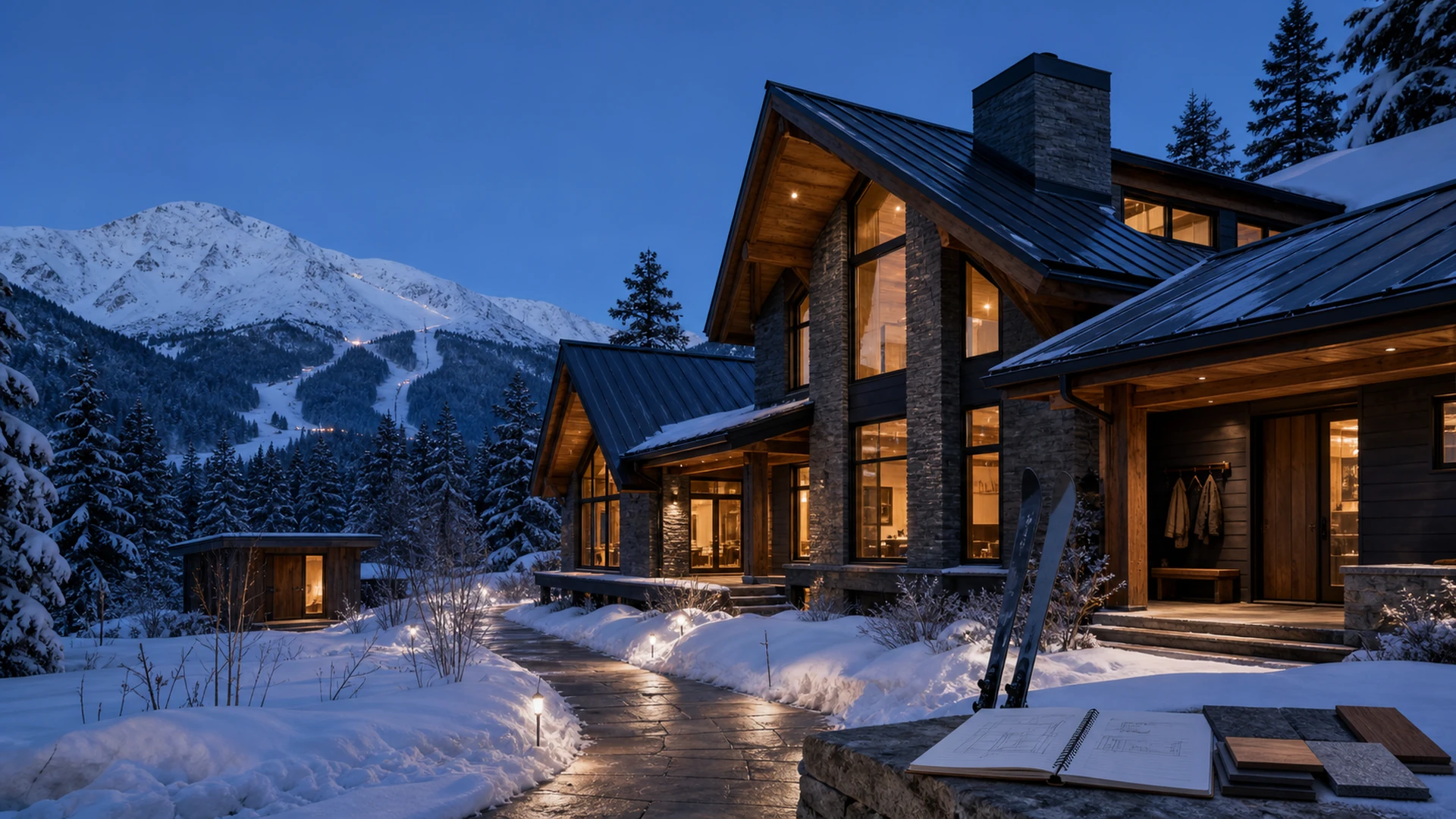
A Girdwood custom chalet is a luxury home built in a glacier-carved valley at the base of the Chugach Mountains, about 40 miles south of downtown Anchorage and home to Alyeska Resort. Girdwood has been part of the Municipality of Anchorage since 1975, so it follows Anchorage’s building rules, and most of the townsite is on community water and sewer through the Anchorage Water & Wastewater Utility rather than well and septic. What sets a Girdwood chalet apart is the construction: the valley averages roughly 214 inches of snow a year, sits in the northernmost temperate rainforest, and lies in one of the highest seismic-hazard zones in the country. Snow-load engineering, a complete thermal break in the walls, triple-pane windows, condensation control, and durable exterior materials are what separate a chalet that lasts from one that fights the climate.
Girdwood is the one place in the Anchorage market where the mountain is the address. The valley was founded as a gold-supply camp along Turnagain Arm in the 1890s, and after the 1964 Good Friday earthquake dropped the original townsite below the high-tide line, the town moved roughly two and a half miles up the valley to where it sits today. Alyeska Resort — the largest ski area in the state, with the longest continuous double-black-diamond run in North America — turned that valley into a year-round resort community. When buyers ask me about a Girdwood custom chalet, they’re usually picturing the lifestyle. The part that decides whether the home actually delivers on it is the build.
I’ve lived in Anchorage for 40 years, and I pair that local knowledge with a formal background in interior design — a discrete credential I use to read finishes, light, and flow. In Girdwood, that lens matters, because a chalet here has to solve for extremes most homes never see: deep snow, near-constant winter moisture, short December daylight, and seismic ground. The specifics below come from the Municipality of Anchorage, the Anchorage Water & Wastewater Utility, the Alaska building code, the Structural Engineers Association of Alaska, and Alaska’s Cold Climate Housing Research Center — not generic real-estate talking points.
- Girdwood incorporated in 1961 and merged into the Municipality of Anchorage in 1975 — it follows Anchorage building and land-use rules despite being ~40 miles south of downtown.
- Most of the Girdwood townsite is on community water and sewer via the Anchorage Water & Wastewater Utility (AWWU), fed by local wells, with wastewater treated at the tertiary Girdwood Wastewater Treatment Facility — not the well-and-septic setup common in outlying areas.
- The valley averages roughly 214 inches of snow annually; Alyeska’s summit averages well over 600 inches. Snow-load and snow-shedding design are central to any chalet here.
- Southcentral Alaska carries some of the highest seismic-hazard ratings in the U.S.; a chalet must be engineered for its seismic design category under Anchorage’s adopted code.
- Cold-climate durability features — a complete thermal break in the walls (e.g., a REMOTE exterior-insulation system), triple-pane windows, condensation control, and durable exterior materials — are the real value drivers.
- Triple-pane windows can retain roughly 30–40% more heating energy than double-pane in the Alaska climate and sharply cut interior condensation.
- Land is scarce: the valley is hemmed in by Chugach National Forest, which supports value for well-built chalets near the resort.
Where Is Girdwood, and Why Does That Shape the Whole Build?
Girdwood sits about 40 miles south of downtown Anchorage along the Seward Highway, tucked into a glacier-carved valley where Glacier Creek and the surrounding drainages feed Turnagain Arm. It is, geographically, part of the northernmost temperate rainforest on earth — a detail that sounds like tourism copy until you realize it means the valley receives roughly four times the precipitation of downtown Anchorage. That moisture, combined with the Chugach terrain, is why the valley averages around 214 inches of snow a year and why Alyeska’s summit can exceed 600 inches.
Unlike a Hillside view lot or an Eagle River acreage parcel, a Girdwood chalet is boxed in by public land: Chugach National Forest surrounds the valley and is the closest point of access to that forest from Anchorage. That containment is exactly what keeps buildable land scarce — and scarcity is a quiet but durable value driver. It also means the Seward Highway is the single road in, running along an avalanche-prone corridor that Alaska DOT&PF actively manages for snow-slide mitigation. For a weekend chalet that’s a minor consideration; for a primary residence it’s a real one.
| Orientation fact | Detail |
|---|---|
| Distance from downtown Anchorage | ~40 miles south via the Seward Highway (~45-min drive) |
| Setting | Glacier-carved valley at the base of the Chugach Mountains, ringed by Chugach National Forest |
| Valley snowfall (average) | ~214 inches per year |
| Alyeska summit snowfall (average) | Well over 600 inches per year |
| December daylight (average) | ~5.7 hours |
| Jurisdiction | Municipality of Anchorage (merged 1975) |
Does a Girdwood Chalet Use City Water and Sewer, or Well and Septic?
This is the single most common assumption I have to correct. Because Girdwood feels remote, buyers expect it to be a well-and-septic situation like parts of Eagle River, Chugiak, or the Mat-Su Valley. In fact, most of the Girdwood townsite is on community water and sewer operated by the Anchorage Water & Wastewater Utility (AWWU). Girdwood’s drinking water is drawn from local wells — AWWU reports Girdwood well production at roughly 82.5 million gallons, about 1% of the utility’s total — and wastewater is treated at the Girdwood Wastewater Treatment Facility, a modern tertiary (three-stage) plant that discharges near-drinking-water-quality effluent to Glacier Creek.
Practically, that changes your due diligence. On a well-and-septic parcel you’re inspecting the well, the septic system, and (in the Municipality) obtaining a Certificate of On-Site Systems Approval at sale. On a Girdwood townsite lot connected to AWWU, you’re confirming the connection, the service tap, and any assessment. The one thing you should never do is assume — parcels on the fringes of the valley can still be on private systems. Confirm the specific parcel’s water and wastewater situation in writing before you buy or draw plans.
How Do Snow Loads and Seismic Risk Change How a Chalet Is Engineered?
Snow is the governing structural load in Girdwood. The Alaska building code (an IBC-based code adopted through the Municipality of Anchorage) and ASCE 7 require a chalet’s roof and structure to be designed for the site’s ground snow load, and the Structural Engineers Association of Alaska publishes the ground-snow-load data engineers use — with the rule that in the Anchorage area the load increases with elevation. On a sloped valley site like Girdwood’s, that means the number climbs as you build higher up the mountainside, and drift loads around the building can locally exceed the base ground load. This is why a properly engineered Girdwood roof is steep, designed to shed snow away from entries and utilities, and detailed to handle drifting — not a flat or low-slope roof borrowed from a milder climate.
Seismic design is the second non-negotiable. Southcentral Alaska, including Girdwood and the Kenai Peninsula, has some of the highest seismic-hazard ratings in the nation, and the 1964 quake is the reason the town sits where it does. Under Anchorage’s code, a custom chalet must be engineered for the applicable seismic design category, and where flat-roof snow loads exceed 30 psf, a portion of the snow load is combined with seismic loads in the analysis — a detail that quietly makes a deep-snow, high-seismic site like Girdwood one of the more demanding places in the country to engineer a home well.
What Cold-Climate Features Make a Girdwood Chalet Worth Building Well?
This is where Alaska diverges sharply from Lower-48 “luxury.” The Cold Climate Housing Research Center — founded in 1999 by Alaska homebuilders — makes the point that a northern wall needs a complete thermal break: nothing that touches the inside of the thermal envelope should also touch the outside, because a standard stud wall leaks heat through the framing itself. Their REMOTE (Residential Exterior Membrane Outside insulation TEchnique) wall system wraps insulation on the exterior to solve exactly that. In a wet climate like Girdwood’s, that thermal and moisture control isn’t a luxury upgrade — it’s what prevents condensation, rot, and mold over the life of the home.
The rest of the durability stack follows the same logic. Triple-pane windows, which local installers and the Cold Climate Housing Research Center’s “Alaska Tough” testing point to as the cold-climate standard, can retain roughly 30–40% more heating energy than double-pane and largely eliminate the interior condensation that damages window frames — while keeping the glass surface warm enough that you can sit near a big view window in January in comfort. Heating is best layered: in-floor radiant heat with a high-efficiency boiler and a backup source, because when the power or a system fails in a Girdwood winter, redundancy is what keeps the pipes from freezing. And exterior materials should be chosen for low maintenance in deep snow and constant moisture — metal roofing that sheds snow, fiber-cement siding, and sealed, durable finishes.
Built for the valley
- Steep, engineered snow-shedding roof
- Complete thermal break (e.g., REMOTE wall)
- Triple-pane windows, warm-edge spacers
- Vapor/ventilation control for a wet climate
- Layered heating (radiant + backup)
- Metal roof, fiber-cement siding
Under-built for the valley
- Low-slope roof that traps snow
- Standard stud wall with thermal bridging
- Double-pane windows, condensation on frames
- Minimal ventilation → moisture problems
- Single heat source, no redundancy
- High-maintenance finishes in snow/wet
How Do Design and Light Factor Into a Girdwood Chalet?
December daylight in Girdwood bottoms out around 5.7 hours, and the valley’s cloud cover limits solar exposure even further. That reality drives design choices most buyers don’t think about until they’ve lived through a winter: where the glazing goes to capture what light there is, how interior finishes read under low, flat winter light versus 20 hours of summer sun, and how a floor plan keeps a large chalet from feeling cavernous in the dark months. This is where my interior-design training earns its keep — a room that photographs beautifully in July can feel entirely different in January, and reading finishes for high-latitude light is a specific skill, not a matter of taste.
The counterpoint is summer: near 20 hours of daylight, the valley turns green and the same view windows that fight winter darkness become the whole point. A well-designed Girdwood chalet is built to work at both ends of that swing — which is a genuinely different design problem from a home in a place with a normal light cycle.
Thinking of Selling a Girdwood Chalet? What Drives Value Here
If you own a chalet in Girdwood, the value story is different from anywhere else in the Anchorage market. Buyers here are paying for proximity to Alyeska and the ski terrain, for mountain and valley views, for the scarcity created by a valley boxed in by Chugach National Forest, and — increasingly — for build quality suited to the climate. In a limited resort market with strong second-home demand, the chalets that command premiums are the ones that visibly answer the valley’s realities: an engineered snow roof, a warm and dry envelope, triple-pane glass, and finishes that hold up.
When I prepare a Girdwood home for sale, I lean on the interior-design side of my background to stage and present the finishes and light in the best defensible way — and I’m candid about what a chalet’s construction will and won’t support at the offer table. If you want a specific, current read on your home, start with a valuation and we’ll build it from the property up. Get your Girdwood home value →
- Anchorage Water & Wastewater Utility (AWWU) — Girdwood water/sewer service, Girdwood well production (~1% of total), and the tertiary Girdwood Wastewater Treatment Facility discharging to Glacier Creek.
- Municipality of Anchorage — jurisdiction over Girdwood (merged 1975), building permits, and adopted building code.
- Structural Engineers Association of Alaska (SEAAK) — Alaska ground snow load data; snow load increases with elevation in the Anchorage area.
- Alaska Building Code / ASCE 7 (via Alaska IBC, Chapter 16) — ground snow load, snow-drift, and snow/seismic load combination requirements.
- Cold Climate Housing Research Center (CCHRC) — complete-thermal-break walls, REMOTE exterior-insulation wall system, and “Certified Alaska Tough” window testing standards.
- NOAA NCEI Climate Normals and NWS-referenced data — Girdwood valley floor snowfall (~214"/yr), December daylight (~5.7 hrs), and subarctic (Dfc) climate classification.
- Alyeska Resort Mountain Stats / Chugach National Forest references — resort scale, upper-mountain snowfall averages (600"+ / 650" avg), and the valley’s surrounding public land.
- Historical record — 1964 Good Friday earthquake and the relocation of the Girdwood townsite up the valley.
Building or Buying a Chalet in Girdwood?
Work with a 40-year Anchorage local who reads Girdwood’s construction, light, and value the way the valley actually behaves.
Frequently Asked Questions
Yes. Girdwood incorporated as a city in 1961 and merged into the Municipality of Anchorage in 1975. That means a Girdwood custom chalet is subject to Municipality of Anchorage land-use and building rules, even though it sits roughly 40 miles south of downtown along Turnagain Arm.
Most of the Girdwood townsite is served by community water and sewer operated by the Anchorage Water & Wastewater Utility (AWWU). Girdwood’s water comes from local wells, and wastewater is treated at the Girdwood Wastewater Treatment Facility, a tertiary plant discharging near-drinking-water-quality effluent to Glacier Creek. This is a major difference from outlying areas like parts of Eagle River and the Mat-Su, where well and septic is common — always confirm the specific parcel’s connection before you buy or build.
Girdwood is exceptionally snowy — it sits in the northernmost temperate rainforest and averages roughly 214 inches of snow a year in the valley, with Alyeska Resort’s summit averaging well over 600 inches. That drives everything about a chalet’s structure: roof pitch and snow-shedding design, ground snow load engineering per ASCE 7 and the Alaska building code, and careful placement to manage drift loads around the building.
The features that carry value in Girdwood are the ones built for its snow, moisture, and seismic realities: an engineered roof and snow-load structure, a complete thermal break in the wall assembly (such as a REMOTE exterior-insulation wall), triple-pane windows, robust vapor and ventilation control to fight condensation in a wet climate, layered heating like in-floor radiant with a backup, and durable low-maintenance exterior materials such as metal roofing and fiber-cement siding.
In a cold, wet, snowy climate like Girdwood’s, triple-pane windows can retain roughly 30 to 40 percent more heating energy than double-pane and dramatically reduce interior condensation that otherwise damages frames. They also keep the glass surface temperature closer to the wall temperature, which improves comfort near large view windows — a real consideration for a chalet designed around mountain views.
Yes. Southcentral Alaska, including Girdwood and the Kenai Peninsula, carries some of the highest seismic hazard ratings in the nation. The 1964 Good Friday earthquake dropped the original townsite into Turnagain Arm and forced the town to move up the valley. A Girdwood custom chalet under Anchorage’s adopted building code must be engineered for the applicable seismic design category.
Value in Girdwood is driven by proximity and access to Alyeska Resort and the ski terrain, mountain and valley views, the year-round resort economy, the scarcity of buildable land inside a valley bounded by Chugach National Forest, and build quality suited to the climate. Because Girdwood is a limited market with strong second-home and resort demand, well-built chalets near the mountain tend to hold value.
Girdwood sits about 40 miles south of downtown Anchorage along the Seward Highway on Turnagain Arm — roughly a 45-minute drive in good conditions. Because that highway runs along an avalanche-prone corridor, winter weather and road maintenance can affect travel times, which is a practical factor for a primary residence versus a weekend chalet.