

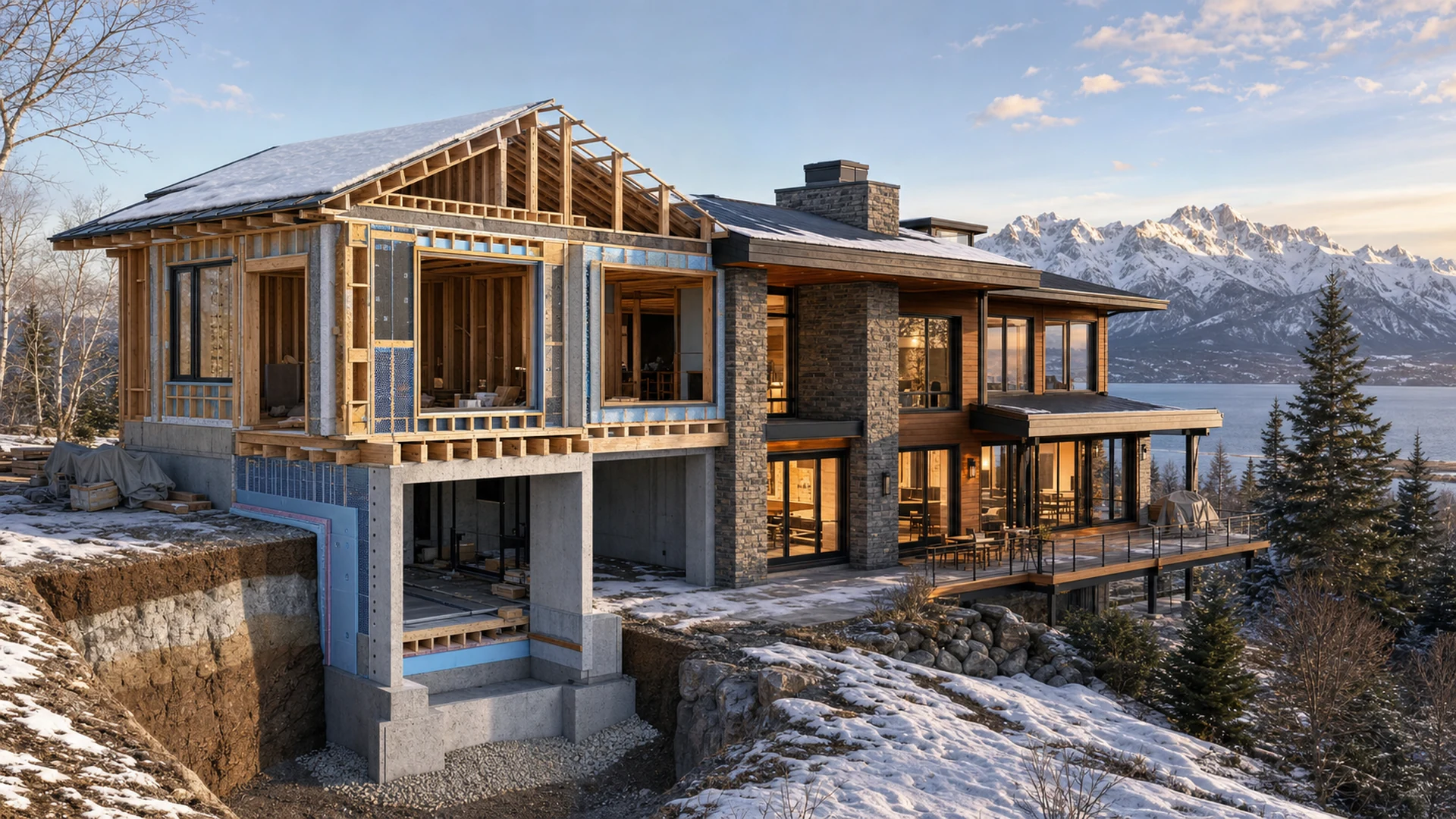
New construction homes in Anchorage are built under the Municipality of Anchorage’s Title 23 code, which adopts the International Building and Residential Codes with local amendments for cold, seismic, and snow-load conditions. That means thick, heavily insulated walls, foundation footings below a roughly 42–48-inch frost line, and mandatory seismic design because Anchorage sits in the highest seismic category (D2). Nearly all new homes carry a BEES energy rating on Alaska’s AkWarm scale, and most new construction targets 5-Star or better — which can qualify buyers for an AHFC interest-rate reduction. New luxury construction concentrates on the Hillside and South Anchorage for views, in Eagle River and Chugiak for larger lots, and in Girdwood near Alyeska. I read these specs closely on every walk-through, because in Alaska the quality of the envelope is what separates a comfortable home from an expensive one to heat.
Buyers touring new homes in Anchorage almost always start with the visible things — the great room, the view corridor, the finishes. Fair enough. But after forty years living here and a career built on reading how homes are put together, I’ve learned that in Alaska the most important parts of a new build are the ones you can’t see from the entryway: the depth of the footings, the tightness of the air barrier, the R-value stacked into the walls, and the star rating printed on the energy certificate. Those details decide whether a home is genuinely luxurious to live in through a dark, cold winter — or just expensive.
This guide walks through how new construction actually works across Greater Anchorage: the code that governs it, the energy standards that price it, the earthquake and cold-climate realities that shape it, and the communities where new luxury homes are being built. My design background credentials how I read finishes and flow; my four decades here credential how I read the ground, the light, and the winter. Both matter when you’re buying something that doesn’t exist yet.
- New homes across Anchorage, Eagle River, Chugiak, and Girdwood are built under one code — the Municipality of Anchorage’s Title 23, which adopts the IBC/IRC with local cold-climate, seismic, and snow-load amendments.
- Anchorage is in Seismic Design Category D2, the highest under the International Building Code; new construction and most structural work require seismic analysis, and the city goes beyond the base IBC on soil review for sloped sites.
- Foundation footings must extend below the frost line, which the MOA sets at approximately 42–48 inches for most of the municipality.
- Alaska’s energy code (BEES, administered by AHFC) requires far more insulation than the national baseline; Anchorage’s winter design temperature is around minus 18°F, and ceiling insulation commonly runs R-49 to R-60.
- Most new construction in Anchorage and the Mat-Su targets a 5-Star BEES rating or better; many older homes rate only 2-Star or 3-Star, per AHFC.
- A 5-Star Plus or 6-Star home can qualify a buyer for an AHFC interest-rate reduction, and a 5-Star Plus new build with a foundation completed on or after January 2, 2025 may qualify for AHFC’s $10,000 New Home Construction Rebate.
- Natural gas heating dominates the Anchorage bowl (served by ENSTAR); a typical new home pairs a high-efficiency gas furnace with a heat recovery ventilator, and many custom homes add in-floor radiant heat.
What Code Governs New Construction Homes in Anchorage?
Here’s something that surprises a lot of relocating buyers: Alaska has no statewide residential building code for a city Anchorage’s size. Instead, the Municipality of Anchorage adopts and enforces its own code. Because the City of Anchorage and the Greater Anchorage Area Borough consolidated into a single home-rule municipality in 1975, there is no separate city or borough permit office — the MOA Building Safety Division handles building permits for the entire municipality, including the Anchorage bowl, Eagle River, Chugiak, and Girdwood.
That code lives in Title 23 of the Anchorage Municipal Code, which adopts the International Building Code and International Residential Code — recent guidance points to the 2024 IBC — along with mechanical, plumbing, electrical, fire, and energy codes, all with Anchorage-specific amendments for cold climate, seismic zone, snow load, and remote-access conditions. Alaska does maintain statewide plumbing and electrical codes that also apply in Anchorage. The practical upshot for a buyer: a new home in Girdwood and a new home on the Hillside answer to the same building official, even though the mountains, soils, and snow loads around them are very different.
| Area | Location vs. downtown | New-build character | Draws buyers for |
|---|---|---|---|
| Hillside / South Anchorage | Southeast, along the mountain front | View-premium lots, smaller parcels | Cook Inlet & Chugach views, prestige |
| Eagle River / Chugiak | ~15–20 min north via Glenn Hwy | Larger lots, often 1+ acre | Space, value, room to build |
| Girdwood / Alyeska | ~40 mi southeast on Turnagain Arm | Mountain chalets near the resort | Ski access, recreation, second homes |
Why Are New Anchorage Homes Built With Such a Heavy Envelope?
Because in Alaska the building envelope isn’t about comfort alone — it’s about the cost of survival through the winter. Anchorage’s 99% winter heating design temperature is roughly minus 18°F, and heating a home here is one of the largest ongoing costs of ownership. Alaska’s energy code, the Building Energy Efficiency Standard (BEES), is administered by the Alaska Housing Finance Corporation and imposes minimum insulation and air-tightness requirements more stringent than the national model energy code baseline. AHFC-financed mortgages require homes to meet BEES, and all homes constructed on or after July 1, 2013 must meet BEES 2012.
In practical terms, that pushes new construction toward thicker walls — 2x6 or heavier framing with exterior continuous insulation — ceiling insulation commonly in the R-49 to R-60 range, and a continuous, tested air barrier. Here’s the part I stress to every buyer, and it’s backed by the building science: air-sealing matters as much as raw R-value. A wall with high insulation but significant air leakage will underperform a properly detailed, tighter wall with less insulation, because convective heat loss through infiltration can exceed conductive loss through the insulation layer. That’s why rated Alaska homes get a blower-door test to measure air changes per hour — a lower number is a better, tighter home.
How Does the 2018 Earthquake Change How I Read a New Build?
On November 30, 2018, a magnitude 7.1 earthquake struck about 12 kilometers north of Anchorage and 19 kilometers west of Eagle River. There were no collapsed large buildings and no loss of life, and state and local officials publicly credited Anchorage’s strong building codes — the legacy of the devastating 9.2 Great Alaska Earthquake of 1964, which drove Alaska to adopt the International Building Code and comprehensive seismic engineering.
But the honest, less-quoted part matters more for a buyer. A UAA-led study warned that the 2018 shaking was only about half as powerful as the level the design-based earthquake standard is meant to absorb — so it was not a full test of the region’s built environment. And engineering reconnaissance found that a significant share of the damage that did occur was geotechnical: poorly compacted fill, sensitive clays, and liquefiable soils failing beneath structures, rather than the structures themselves failing. That’s exactly why Anchorage requires comprehensive soil analysis and, for sloped sites, goes beyond the base IBC — engineers must demonstrate the safety of hillside lots under a defined level of shaking using deep soil borings. On a new build, I care as much about the ground the home sits on as the frame that sits on the ground.
Anchorage is Seismic Design Category D2 under the IBC — the highest category — and all new construction plus most significant structural alterations require seismic analysis, with engineering stamps typically required for structural work. Note too that Alaska still has no statewide residential building code; that’s a reason Anchorage’s local Title 23 enforcement is a genuine value signal for a new home here.
What Energy Rating Should a New Anchorage Home Have — and Why It Affects Your Loan?
Every rated Alaska home carries a BEES star rating generated by AkWarm, the state’s own energy-modeling software, which accounts for the envelope, ventilation, heating efficiency, and air-tightness (via a blower-door test). Per AHFC, most new construction in Anchorage and the Mat-Su targets 5-Star or better, while many older homes rate only 2-Star or 3-Star. Because heating costs are so high — industry sources cite roughly $6,000 to $12,000+ per year for an average Anchorage home — that rating gap is a real dollar difference, not a rounding error.
The rating also directly affects financing. AHFC’s Energy Efficiency Interest Rate Reduction gives qualifying buyers a rate reduction on the first $250,000 of an AHFC loan for homes rated highly (commonly 5-Star Plus or 6-Star), with the reduction depending on whether the home has natural gas access — homes without gas access receive a larger reduction. Separately, AHFC’s New Home Construction Rebate pays up to $10,000 to eligible applicants for a new owner-occupied 1–4-unit home that achieves a 5-Star Plus or higher rating, provided the foundation was completed and inspected on or after January 2, 2025. Programs and terms change and funds are limited, so confirm current details with AHFC — but the principle is durable: in Alaska, a better-built home can literally earn a better mortgage.
Why buyers choose new construction here
- Built to current Title 23 code and a strong BEES rating — lower heating costs
- May unlock AHFC rate reductions and the New Home Construction Rebate
- Control over finishes, layout, and how the home is oriented to light and views
- Modern seismic detailing and a tested, tight envelope
Trade-offs to weigh honestly
- Higher price per square foot than older stock
- Weather-driven scheduling — unfrozen ground limits some work windows
- Permit timelines stretch in peak spring/summer season
- Quality varies builder to builder; specs and ratings must be verified
How Do New Homes in Anchorage Get Heated?
Natural gas is the workhorse of the Anchorage bowl. ENSTAR — the largest utility in Southcentral Alaska, serving gas since 1961 — supplies most of the area, and a typical new single-family home built to BEES 2012 or later pairs a high-efficiency gas furnace (often 95%+ AFUE) with a heat recovery ventilator that reclaims most of the heat from exhaust air before it leaves the tight shell. For new construction, ENSTAR can install a service line once the foundation is complete and backfilled to within six inches of final grade.
In custom and luxury builds, in-floor radiant heat is common on the lower slab — a hydronic system of pipes cast into the concrete that delivers even, quiet, draft-free warmth and keeps floors comfortable underfoot. Homes outside the gas service area lean more on oil-fired boilers or cold-climate air-source heat pumps, the latter an expanding category encouraged by AHFC programs, though their efficiency degrades in deep sub-zero cold and they’re typically paired with a backup. Whatever the system, Alaska’s mechanical code requires proper load calculations — an undersized system won’t hold temperature on a design-cold day, and an oversized one cycles inefficiently.
Where Are New Luxury Homes Being Built Around Anchorage?
New custom construction isn’t evenly spread — it follows the land, the views, and the lot supply. On the Anchorage Hillside and in South Anchorage, new luxury homes chase the south- and west-facing lots that capture Cook Inlet and Chugach views; parcels tend to be smaller but view-premium, and hillside sites bring the extra soil-and-slope engineering the municipality requires. In Eagle River and Chugiak, roughly fifteen to twenty minutes north on the Glenn Highway, buyers find larger lots — frequently an acre or more — and more room to build a substantial custom home for the money. And in Girdwood, about forty miles southeast along Turnagain Arm at the base of Alyeska, new construction skews toward ski-oriented mountain chalets and second homes.
All three build under the same MOA code — but the buying decision hinges on what you value: the view and prestige of the Hillside, the space and value of Eagle River, or the recreation and lifestyle of Girdwood. Explore each community below, and use the neighborhoods directory to compare them side by side.
- Municipality of Anchorage, Development Services Department / Building Safety Division — Title 23 code adoption (IBC/IRC with local amendments), BSSA permit requirement, ~10-working-day residential processing, 18-month permit validity, and residential permit fee structure.
- Municipality of Anchorage guidance (via building-permit references) — Seismic Design Category D2, ~42–48″ frost-line footing depth, and enhanced soil/slope analysis requirements.
- Alaska Housing Finance Corporation (AHFC) — Building Energy Efficiency Standard (BEES), AkWarm ratings, Energy Efficiency Interest Rate Reduction (first $250,000), and the $10,000 New Home Construction Rebate (5-Star Plus; foundation on/after Jan. 2, 2025).
- ICC / PBS / Engineering News-Record / UAA-led study reporting on the November 30, 2018 M7.1 earthquake — strong code performance, geotechnical-driven damage, and the design-based-earthquake caveat.
- Geotechnical & structural reconnaissance (SAGE Journals) on the 2018 Anchorage earthquake — poor performance of anthropogenic fill and sensitive/liquefiable soils.
- ENSTAR Natural Gas — service-line installation for new construction; Southcentral Alaska gas provider since 1961.
- Alaska HVAC and cold-climate construction references — ~−18°F Anchorage winter design temperature, gas furnace + HRV + in-floor radiant configurations in new builds.
- IECC Climate Zone / Alaska energy references — subarctic envelope context and typical R-value ranges. Exact prescriptive values vary by assembly and should be verified at permitting.
This page is general and educational, not legal, engineering, tax, or financial advice. Code provisions, fees, and AHFC program terms change and vary by site — always confirm current requirements with the Municipality of Anchorage Building Safety Division and AHFC, and have structural and geotechnical work performed or reviewed by a licensed Alaska professional.
Building or buying new in Anchorage? Let’s read the specs together.
I’ll help you evaluate the envelope, the energy rating, the site, and the finishes — before you commit.
Frequently Asked Questions
Generally yes, per square foot. New homes are built to current Municipality of Anchorage Title 23 code and typically carry a much stronger energy rating than the older stock, which lowers heating costs but raises the purchase price. In Alaska’s climate, heating a poorly insulated older home can cost thousands more per year, so the true cost gap is smaller than the sticker price suggests.
Look for a BEES rating expressed in stars on the AkWarm scale. AHFC notes most new construction in Anchorage and the Mat-Su targets 5-Star or better, while many older homes rate 2-Star or 3-Star. A 5-Star Plus or 6-Star rating can qualify buyers for an AHFC interest-rate reduction, and a 5-Star Plus home with a foundation completed on or after January 2, 2025 may qualify for AHFC’s New Home Construction Rebate of up to $10,000.
Because the cold is severe and heating fuel is expensive. Anchorage’s winter design temperature is roughly minus 18°F, and Alaska’s energy code (BEES, administered by AHFC) sets minimum insulation values well above the national baseline. Meeting them commonly means 2x6 or thicker walls with exterior insulation, ceilings in the R-49 to R-60 range, and a continuous air barrier. Air-sealing matters as much as R-value, since infiltration losses can exceed conductive losses through the insulation.
The magnitude 7.1 earthquake on November 30, 2018 caused no collapsed large buildings and no loss of life, and officials credited Anchorage’s strong building codes. However, a UAA-led study cautioned that the shaking was only about half the intensity the design-based earthquake standard is meant to absorb, and much of the damage that did occur came from geotechnical failures such as poorly compacted fill, not the structures themselves. That is why site-specific soil review matters so much for a new build.
The Municipality of Anchorage Development Services Department reports typical processing of about 10 working days for one- and two-family dwellings after a complete submittal, with prescreening requiring at least 48 business hours. Timelines stretch during peak spring and summer construction season. Building permits are valid for 18 months from issuance, and all work inside the Building Safety Service Area requires a permit before construction begins.
Natural gas dominates in the Anchorage bowl, where ENSTAR serves most of the area. A typical new single-family home built to BEES 2012 or later pairs a high-efficiency gas furnace (often 95%+ AFUE) with a heat recovery ventilator, and many custom builds add in-floor radiant heat on the lower slab. Homes outside the gas service area more often use oil-fired boilers or cold-climate heat pumps with a backup.
New custom and luxury construction concentrates on the Anchorage Hillside and South Anchorage for Cook Inlet and Chugach views, in Eagle River and Chugiak for larger lots and more space, and in Girdwood for ski-oriented mountain homes near Alyeska. All of these communities are inside the Municipality of Anchorage, so they build under the same Title 23 code, but lot character, views, and access differ significantly by area.
Footings must extend below the frost line, which the Municipality of Anchorage sets at approximately 42 to 48 inches for most of the municipality. Anchorage is also in the highest seismic design category (D2) under the International Building Code, so new construction and most significant structural work require seismic analysis, and the city requires comprehensive soil analysis, going further than the base IBC on sloped and problem-soil sites.
It depends on your timeline, budget, and appetite for the process. Building gives you control over finishes, layout, and energy performance but takes longer and exposes you to weather-driven scheduling and permit timing. Buying an existing new or newer home gives you a known finished product sooner. Because Alaska is a non-disclosure state and finishes and energy ratings vary widely, having someone who reads construction specs closely is valuable either way — which is exactly the lens my design background brings.