

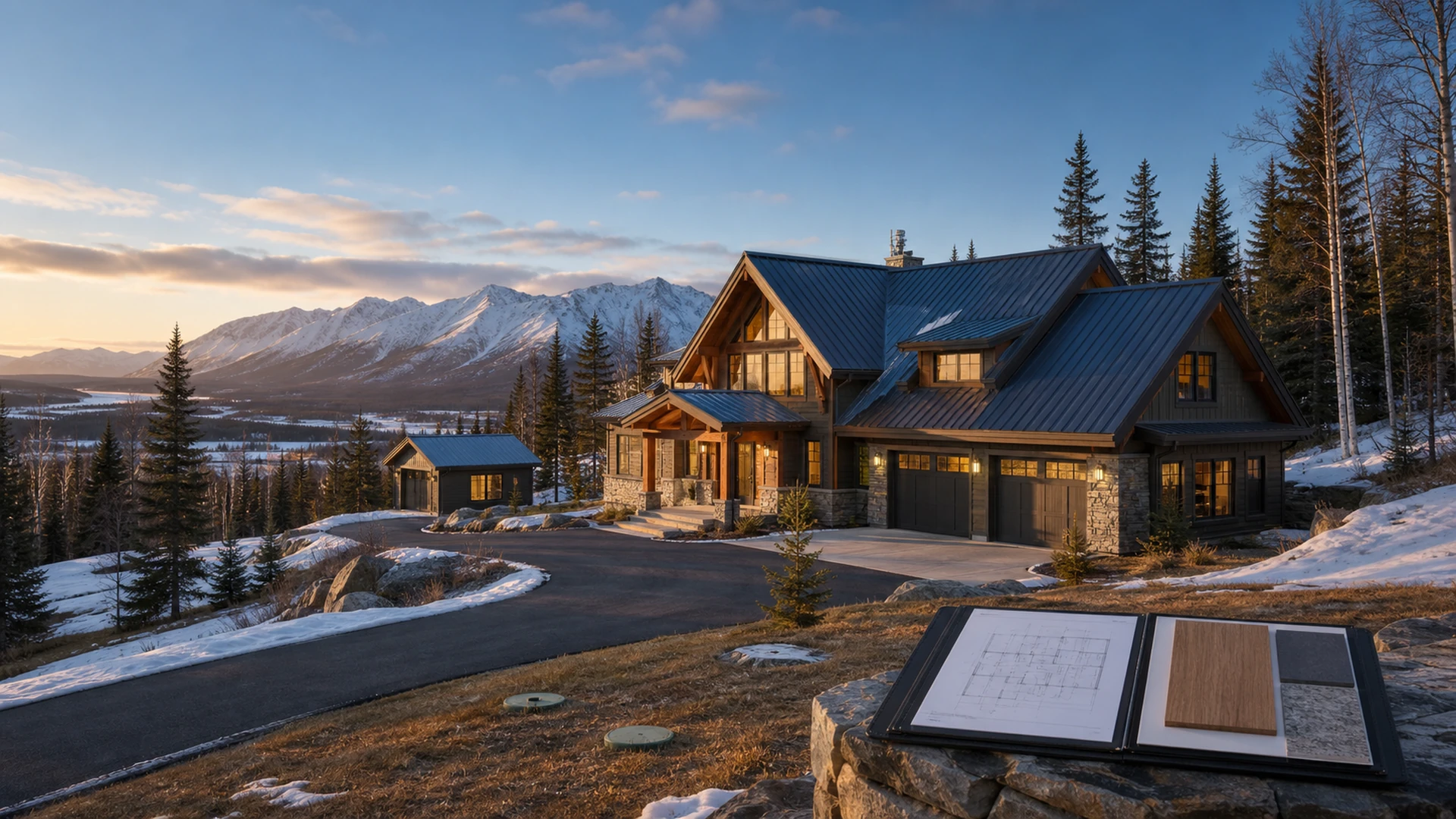
Eagle River is a community within the Municipality of Anchorage, set between Joint Base Elmendorf-Richardson and Chugach State Park about 15 miles north of downtown. Its appeal for custom homes is land and views: a lower-density, larger-lot pattern with many parcels of an acre or more and elevated lots with Chugach Mountain and Eagle River valley vistas that are scarce inside the Anchorage Bowl. The most important buyer distinction is that much of Chugiak-Eagle River sits outside the Municipality’s Building Safety Service Area, so plan review and inspection are handled privately rather than automatically by the municipality — a fact the 2018 earthquake made concrete. Many outlying parcels also rely on a private well and septic system rather than city utilities, which requires a Certificate of On-Site Systems Approval at title transfer. For a cold-climate custom home this far north, the building envelope, energy rating, and seismic engineering matter as much as the finishes.
In forty years of watching Anchorage grow, I’ve seen Eagle River shift from a homesteader outpost into a genuine custom-home destination — and the reason is simple. Buyers who want acreage, a real view corridor, and Chugach State Park at the back door can find those things here far more easily than inside the city grid. But building or buying a custom home in Eagle River is a different exercise than shopping the Anchorage Bowl. The land is more varied, the utilities are not uniform, and the oversight rules are not the same. This guide walks through what actually moves the needle on an Eagle River custom home, grounded in Municipality of Anchorage, Alaska DEC, USGS, and AHFC-adjacent sources rather than generalities.
- Eagle River is part of the Municipality of Anchorage, located between JBER and Chugach State Park roughly 15 miles north of downtown, commonly a 15–20 minute drive in normal conditions.
- Chugiak-Eagle River follows a larger-lot, lower-density pattern; acreage living here often means one-acre-or-larger parcels with more separation between homes.
- Much of Chugiak-Eagle River lies outside the Municipality’s Building Safety Service Area, so builders use private inspectors and plan review is not automatically required.
- Many outlying parcels use a private well and septic system; a Certificate of On-Site Systems Approval (COSA) is required by the MOA at title transfer for regulated on-site systems.
- Alaska sits near IECC climate Zone 7/8; builders commonly target about R-49–R-60 ceilings, R-21–R-30 walls, and AHFC-financed mortgages require a 5-Star BEES rating.
- The 2018 M7.1 earthquake’s epicenter was about 12 km north of Anchorage and 19 km west of Eagle River; non-engineered wood homes, especially in Eagle River, took the heaviest structural damage.
- Elevated lots command a view premium; Eagle River Road runs 13 miles into the Chugach, and Chugach State Park (773 square miles) borders the community.
Why Do People Build Custom Homes in Eagle River Instead of the Anchorage Bowl?
The honest answer is land and light. The Chugiak-Eagle River Comprehensive Plan describes many neighborhoods as larger-lot areas shaped by limited public infrastructure and a lower-density development pattern — the opposite of the Anchorage Bowl, where zoning districts are built around smaller lots and fully developed municipal services. In practice that means more privacy, room for outbuildings, and the kind of acreage that lets you site a home for a specific view and a specific slice of winter sun.
Geographically, the community lies mostly within the Cook Inlet–Susitna Lowland — low hills, hummocky ridges, and sloping alluvial fans — with the eastern edge climbing the steep slopes of the Chugach Mountains, per the U.S. Geological Survey. That terrain is exactly what produces the elevated parcels with Chugach Mountain and Eagle River valley views that carry a noticeable premium. Unlike a flat Bowl subdivision lot, a well-chosen Eagle River hillside parcel gives a custom builder a genuine view corridor to design around. Eagle River is also one of the principal gateways to Chugach State Park, the third-largest state park in the country at 773 square miles, with Eagle River Road running 13 miles into the range.
How Big Are Eagle River Lots, and Where Are the View Parcels?
Acreage living in Chugiak and Eagle River often means a rural or semi-rural setting with one-acre-or-larger lots, more separation between homes, and a stronger connection to the landscape — genuinely larger than a compact Anchorage Bowl lot. That scale is the whole point for many custom buyers: more privacy, more storage, room for a shop or a second structure. The community also isn’t monolithic. Neighborhoods along the Glenn Highway and Old Glenn Highway corridor are level or sloping and rise toward the Chugach east of the Old Glenn, while others sit along the Eagle River canyon. For custom homes, the elevated eastern parcels are where the value concentrates — hillside lots with Chugach Mountain and valley views are consistently described as among the area’s most desirable.
Does an Eagle River Custom Home Have City Water and Sewer, or Well and Septic?
This is where Eagle River buyers get surprised most often, so check it before you fall in love with a property. Utility service is genuinely mixed: the Municipality lists Anchorage Water & Wastewater Utility among providers serving Chugiak-Eagle River, and parcels closer to the Eagle River core are more likely to be on municipal service, while many acreage and outlying lots rely on a private well and septic system. One property may have municipal connections and the next may not.
If a home is on well and septic, ownership comes with real responsibilities. The Alaska Department of Environmental Conservation is clear that private well owners are responsible for sampling and testing their own water — the state does not test private wells. And per the Municipality of Anchorage, a Certificate of On-Site Systems Approval (COSA) is required at time of title transfer for properties served by MOA-regulated on-site water and wastewater systems. The COSA process requires a licensed civil engineer to perform a field inspection, research records, and — if there hasn’t been a test within the past two years — conduct a well flow test and/or a septic adequacy test, and verify code-required separation distances between the well and septic. There’s also a seasonal wrinkle worth knowing: an MOA on-site permit condition notes that from October 15 to April 15, a soil-absorption system built in freezing weather must be opened and closed the same day or covered, sealed, and heated to prevent freezing — a reason septic work clusters around unfrozen ground.
Well & Septic — the upside
No monthly utility bill; common on the larger, more private acreage lots buyers come to Eagle River for; a properly engineered modern system serves reliably for many years with maintenance.
Well & Septic — the diligence
Owner is responsible for water testing (the state won’t do it); COSA and engineer testing needed at sale; separation-distance and adequacy issues can surface only at closing; testing is season-dependent.
What R-Values and Build Quality Should an Eagle River Custom Home Have?
Anchorage and the Mat-Su sit near the IECC Zone 7/8 boundary — among the strictest, coldest building climates in the country. That makes the building envelope the heart of a good custom home here, not an afterthought. General Alaska guidance points to roughly R-49 to R-60 in attics, R-21 to R-30 in walls, and R-25 to R-30 in floors. Alaska’s Building Energy Efficiency Standard (BEES), administered by the Alaska Housing Finance Corporation, currently tracks the 2018 IECC plus Alaska-specific amendments; AHFC-financed mortgages require a 5-Star BEES rating, and many private custom projects pursue 6-Star voluntarily.
Because well-built Alaska homes are very airtight, mechanical ventilation isn’t optional — heat-recovery ventilators (HRVs) are essentially universal in this climate, and combustion-air supply for any heating appliance is a critical detail in a tight home. On the wall system itself, builders here often go beyond 2x4 framing: 2x6 walls, closed-cell spray foam for high R-per-inch and moisture resistance, or structural insulated panels (SIPs) — prefabricated foam-core panels the Cold Climate Housing Research Center specifically studies for Alaska — which deliver low air leakage and let HVAC systems run smaller. When you tour a custom home, ask for the energy rating and the ventilation approach; those two answers tell you more about lifetime comfort and heating cost than the finish package does.
| Envelope element | Common Alaska target | Why it matters here |
|---|---|---|
| Attic / ceiling | ~R-49 to R-60 | Largest heat-loss surface; small upgrade cost vs. lifetime heating |
| Walls | ~R-21 to R-30 (2x6, spray foam, or SIPs) | Continuous insulation reduces thermal bridging at Zone 7/8 |
| Floors | ~R-25 to R-30 | Cold-climate comfort; matters over unconditioned space |
| Air sealing + ventilation | Tight envelope + HRV | Tight homes require mechanical ventilation; HRVs universal |
| Energy rating | 5-Star BEES (AHFC min.); 6-Star voluntary | Required for AHFC-financed mortgages |
Is Eagle River Inside Anchorage’s Building Safety Inspection Area? (The Question Most Buyers Miss)
This is the single most important thing I tell buyers about Eagle River custom homes, and almost no one asks it unprompted. Much of Chugiak-Eagle River sits outside the Municipality of Anchorage’s Building Safety Service Area. Inside the Anchorage Bowl, builders submit plans for municipal review and inspection; outside it, builders hire private inspectors and don’t need to have their building plans reviewed by the municipality. That’s not automatically a problem — plenty of excellent custom homes are built here — but it shifts more of the verification burden onto the buyer.
The 2018 earthquake made the distinction tangible. The magnitude 7.1 event on November 30, 2018 had its epicenter about 12 km north of Anchorage and 19 km west of Eagle River, and studies found the heaviest structural damage in non-engineered single-family wood buildings, especially in Eagle River. A month into recovery, the Municipality had red-tagged buildings in Eagle River at roughly 20 times the Anchorage rate, and inspectors were called to single-family homes about five times more often; of 72 red tags issued, 55 were in the Chugiak-Eagle River area. Anchorage Daily News reporting connected part of that gap to the lighter oversight outside the safety service area, and noted AHFC has its own protocol for homes it finances, including building codes on par with the municipality’s. The practical takeaway: on an Eagle River custom home, your own inspection, seismic engineering documentation, and (if applicable) AHFC financing standards do real work that municipal plan review does elsewhere.
Most of the region’s development boom occurred after seismic construction details were introduced in the early 1980s, and code-conforming buildings showed only minor structural damage in 2018. The concern isn’t Eagle River custom homes as a category — it’s that oversight varies by location, so buyers should confirm how a specific home was engineered and inspected.
How Bill’s Design Background Reads an Eagle River Custom Home
I hold a degree in Interior Design and spent a career in furnishings, design, and real estate before focusing on the Anchorage market — and that background changes what I look at first in a custom home. Instead of starting with the countertop brand, I read how the plan handles high-latitude light: window placement relative to the winter sun, how the great-room glazing frames the Chugach view without turning the room into a cold-season heat sink, and whether finishes will hold up to the moisture and temperature swings a Zone 7/8 climate throws at them. On an Eagle River build, that designer’s eye pairs naturally with the technical questions — envelope, ventilation, seismic engineering — because in this climate, how a home looks and how it performs are the same conversation.
Thinking of Selling a Custom Home in Eagle River? What Drives Value Here
If you own an Eagle River custom home, the value levers are specific. A cleared, well-oriented Chugach or valley sightline is a genuine premium — buyers pay for the view lot, so protecting and presenting it matters. So does documentation: a current COSA, well test records, the home’s energy rating, and any seismic engineering are exactly the things a serious buyer’s agent will ask for, and having them ready shortens the deal and defends your price. Larger acreage, a functional heated shop or garage, and a modern high-efficiency envelope all read as value to this market. When it’s time to prepare the home, my design background helps present finishes and light in the way that resonates with buyers shopping at this level. To see what your specific property could bring in today’s market, start with a valuation — you can get your Eagle River home value and we’ll refine it with a custom market analysis.
- Municipality of Anchorage — On-Site Water & Wastewater Program (well/septic permits, COSA requirement and engineer testing, freezing-weather construction condition).
- Alaska Department of Environmental Conservation — private well owner testing responsibility (as summarized in a local real-estate resource citing DEC).
- U.S. Geological Survey — Geology and Ground Water for Land-Use Planning in the Eagle River–Chugiak Area, Alaska (terrain and setting); USGS/EERI reporting on the M7.1 November 30, 2018 Anchorage earthquake.
- Alaska Housing Finance Corporation — Building Energy Efficiency Standard (BEES) / 5-Star rating for AHFC-financed mortgages; AHFC inspection protocol (via ADN).
- IECC Climate Zone 7/8 R-value guidance; Cold Climate Housing Research Center (SIPs, cold-climate envelope); and Alaska Housing Finance Corporation (AHFC BEES Guidance).
- Anchorage Daily News — reporting on 2018 earthquake damage and the Building Safety Service Area distinction in Chugiak-Eagle River.
- Municipality of Anchorage / community and comprehensive-plan sources; Travel Alaska and Anchorage visitor resources (Chugach State Park, Eagle River Road, location/commute context).
Looking at Eagle River Custom Homes?
Let’s find the right lot or the right build — and make sure the utilities, envelope, and inspection details actually check out before you commit.
Frequently Asked Questions
There is no single custom-home price in Eagle River, and any specific figure varies by lot, size, finish level, and whether the property is on utilities or well and septic. As a benchmark, single-family homes in the broader Chugiak-Eagle River area have generally ranged from roughly the mid-$300,000s to the mid-$500,000s in 2025–2026, with larger acreage parcels and Chugach view lots running higher. Custom builds on view or acreage lots typically sit at the upper end and above, because the lot and the finishes drive the number more than square footage alone. I always recommend pricing a specific lot and build plan rather than relying on an area average.
Largely no, and this is one of the most important things to check on an Eagle River custom home. Much of Chugiak-Eagle River sits outside the Municipality of Anchorage’s Building Safety Service Area, so builders there hire private inspectors and are not required to submit building plans for municipal review the way projects inside the Anchorage Bowl are. After the November 30, 2018 magnitude 7.1 earthquake, the Municipality issued red tags in the Chugiak-Eagle River area at roughly 20 times the rate of Anchorage, and reporting attributed part of the difference to that lighter oversight. It means a buyer’s own inspection and documentation review carries more weight here.
It depends on the parcel, and you cannot assume. Some Eagle River properties, especially closer to the core, are on Anchorage Water & Wastewater Utility service, while many acreage and outlying lots rely on a private well and septic system. The Municipality of Anchorage requires a Certificate of On-Site Systems Approval (COSA) at title transfer for properties served by regulated on-site water and wastewater systems, which involves a licensed civil engineer inspecting and testing the well and septic. Always verify the exact utility type for a specific address before writing an offer, because it affects financing, due diligence, and long-term maintenance.
The Anchorage and Eagle River area sits near the IECC Zone 7/8 boundary, among the coldest building climates in the country, so envelope quality is central to a good custom home. Alaska builders commonly target roughly R-49 to R-60 in ceilings, R-21 to R-30 in walls, and R-25 to R-30 in floors, and AHFC-financed mortgages require a 5-Star Building Energy Efficiency Standard (BEES) rating, with many private builds pursuing 6-Star voluntarily. Very tight Alaska homes require mechanical ventilation, and heat-recovery ventilators are essentially universal. When touring a custom home, ask for the energy rating and the ventilation approach, not just the square footage.
For many buyers tied to Joint Base Elmendorf-Richardson, yes, because Eagle River sits between JBER and Chugach State Park and offers a shorter, more predictable commute than most Mat-Su options. Eagle River is about 15 miles north of downtown Anchorage, commonly described as a 15 to 20 minute drive in normal conditions, with the base gate closer still. Buyers gain larger lots and mountain access without a full Valley commute. The trade-off is winter driving on the Glenn Highway and, for some, the reality of clearing snow on a longer driveway.
The core reasons are land and views. Eagle River and neighboring Chugiak follow a lower-density, larger-lot pattern than the Anchorage Bowl, with many parcels of an acre or more, and elevated lots deliver Chugach Mountain and Eagle River valley views that are scarce inside the city. Buyers who want privacy, room for outbuildings, and direct trail and Chugach State Park access often find those things only exist here or in the Valley. Building custom lets an owner match the home to a specific view corridor, sun exposure, and slope, which matters a great deal at this latitude.
Beyond a standard home inspection, focus on three Alaska-specific items. First, ask whether the home was engineered for seismic loads and whether it has seismic tie-downs, since the 2018 earthquake exposed non-engineered wood homes in Eagle River. Second, if the property is on well and septic, get the COSA and review the engineer’s flow and adequacy testing. Third, evaluate the building envelope and heating system for cold-climate performance, including insulation levels, ventilation, and any signs of moisture or ice-damming problems. A property outside the municipal safety service area especially rewards this extra diligence.