

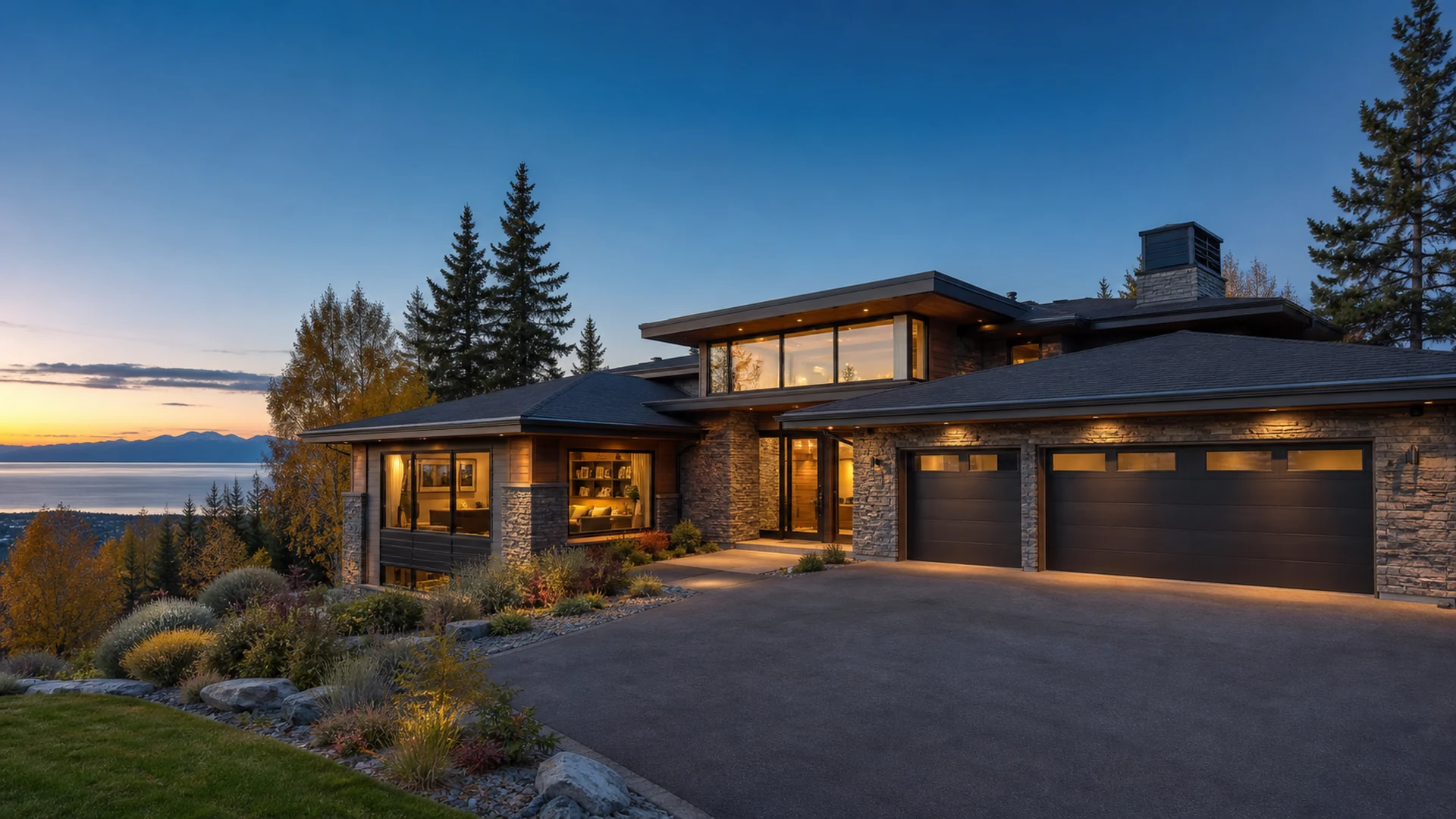
In Anchorage, an executive home is a larger, higher-finish single-family home — typically 2,500 to 5,000-plus square feet with quality construction, an open or formal great-room layout, an oversized heated garage, and usually a view, privacy, or acreage. There is no legal definition; the term describes the caliber of the home. These homes cluster on the Hillside and in South Anchorage, in West/coastal neighborhoods like Turnagain, and in Eagle River, where lots run larger. Because the overall Anchorage median sale price was roughly $428,000 over the three months ending May 2026 (Redfin), executive homes sit well above it — commonly $650,000 into the $1 million-plus range depending on size, view, and lot. What sets Anchorage’s tier apart from a warm-climate market is the cold-climate substance beneath the finishes: seismic-code construction, in-floor radiant heat, and view orientation.
“Executive home” is one of the most-searched and least-defined terms in the Anchorage market. Buyers relocating for a management role — often in health care, the oil and resource sector, aviation, or the military command tied to Joint Base Elmendorf-Richardson — type it into a search bar expecting a clear category, and instead find it stretched across everything from a 2,400-square-foot tract home to a $1.4-million view estate. After four decades living in this city and watching the upscale corridor mature, I’ll tell you what the tier actually means here, where the homes are, what they cost, and — the part most out-of-state buyers underestimate — the Alaska-specific things that decide whether a home holds its value.
The most useful way to think about it: in Anchorage, an executive home is defined less by a price tag and more by a combination — scale, finish, an oversized heated garage built for Alaska, and a location that delivers view, privacy, or acreage. Unlike a Sun Belt market where a “luxury” home is mostly about square footage and a pool, the Anchorage executive tier is judged as much on how it’s built for the climate and how it’s oriented to the light and the mountains as on the countertops.
- “Executive home” has no legal definition in Alaska — it describes a larger, higher-finish single-family home, usually 2,500–5,000+ sq ft with quality construction, an oversized heated garage, and a view, privacy, or acreage advantage.
- The overall Anchorage median sale price was about $428,000 over the three months ending May 2026 (Redfin), at roughly $256 per square foot — so executive homes sit well above the market, commonly $650,000 into the $1 million-plus range.
- They cluster on the Hillside and in South Anchorage (Goldenview, Prominence Pointe, Rabbit Creek, Bear Valley), in West/coastal Turnagain, and in Eagle River, which offers the largest lots and acreage in the corridor.
- The Municipality of Anchorage enforces the International Building Code with local seismic amendments; engineers credited those codes for limited structural damage in the magnitude 7.1 earthquake of November 30, 2018.
- In-floor radiant heat is common at this tier, and many acreage homes build in redundant heat sources for outages and fuel-price swings.
- Larger executive lots on the Hillside and in Eagle River are frequently on well and septic, which adds due diligence — and in Anchorage a Certificate of On-Site Systems Approval typically documents the well and septic before a transfer.
- Value at this tier is driven heavily by view orientation and lot — a cleared south- or west-facing sightline can move the number more than an extra bedroom.
What Is Considered an Executive Home in Anchorage?
There’s no zoning class or statute that stamps a home “executive.” It’s a market description, and in Anchorage it lands on homes that combine four things: scale (commonly 2,500 to 5,000-plus square feet — the Hillside’s established view neighborhoods generally run 2,500–4,500 sq ft, with luxury enclaves like Prominence Pointe reaching well into the 5,000–7,000 range), finish (chef’s kitchens, spa-style primary baths, vaulted or great-room volume), an Alaska-built garage (attached, heated, two to three-plus bays), and a location advantage — a view, real privacy, or acreage.
That last factor is where Anchorage diverges from most markets. A big home on a small interior lot doesn’t read as “executive” here the way the same square footage on an elevated view parcel does. Unlike a warm-climate suburb where the house is the whole story, in Anchorage the land, orientation, and how the home handles winter carry a large share of the value.
| Attribute | What it looks like in Anchorage |
|---|---|
| Scale | 2,500–5,000+ sq ft; established Hillside view homes ~2,500–4,500 sq ft; luxury enclaves (e.g., Prominence Pointe) 5,000–7,000 sq ft |
| Finish | Chef’s kitchen, spa-style primary bath, vaulted / open great-room volume |
| Garage | Attached, heated, 2–3+ bays for vehicles and gear |
| Location advantage | Cook Inlet / Chugach view, privacy, or acreage — the value multiplier |
Where Are Anchorage’s Executive Homes?
Four areas carry most of the corridor’s executive inventory, and each reads differently.
The Hillside and South Anchorage
The Hillside — perched on the Chugach foothills above the Anchorage Bowl — is the aspirational tier, prized for panoramic views of Cook Inlet, the Alaska Range, and Denali on clear days, on larger lots with a more rural feel than the rest of the municipality. South Anchorage runs from the O’Malley/Hillside area down through De Armoun, Rabbit Creek, Bear Valley and Potter Valley, mixing established view homes with newer custom builds. Named executive-caliber neighborhoods include Goldenview (roughly 2,000–3,000 sq ft, built ~1996–2007, Cook Inlet views), Prominence Pointe (large luxury homes, some 5,000–7,000 sq ft, still adding new construction), and new-construction enclaves such as Cross View Estates, which has listed from the high $700,000s past $1 million.
West and Coastal Anchorage
Turnagain and the coastal pockets near the Tony Knowles Coastal Trail hold executive homes valued for proximity to downtown, the airport, and Kincaid Park, plus inlet exposure. The trade-off versus the Hillside is smaller lots and a different view profile — water and city rather than the elevated foothill panorama.
Eagle River
Part of the Municipality of Anchorage but 15–20 minutes north up the Glenn Highway, Eagle River offers the largest lots and true acreage in the corridor — custom mountain-view estates, oversized shops, and privacy against the Chugach. Executive listings here run past $1 million, and it’s where you find genuine acreage parcels that simply don’t exist inside the Bowl. It’s the natural landing spot for a buyer who wants a shop, room for equipment, and a view without the Hillside price per square foot.
How Much Do Executive Homes Cost in Anchorage?
Anchorage is a comparatively small, lightly-contested luxury market, so price bands matter more than a single median. For context, Redfin reported the overall Anchorage median sale price at about $428,000 over the three months ending May 2026, up 3.1% year-over-year, at roughly $256 per square foot. Executive homes sit above that baseline. From the neighborhood ranges above and current market listings, a practical picture:
| Tier | Approx. range | Where / example |
|---|---|---|
| Entry executive | ~$650K–$775K | Larger, well-finished South Anchorage / West Anchorage homes above the market |
| New-construction luxury | High $700Ks–$1M+ | Hillside enclaves such as Cross View Estates |
| View / acreage estates | $1M–$1.25M+ | Hillside view parcels; Eagle River custom estates (recent Eagle River listings include 4-bed homes near $1.2M) |
These are structural ranges, not a live valuation. Anchorage runs a genuine shortage in nearly every band except the over-$1 million market, and new construction is contending with material cost inflation, since essentially all building materials are imported into Alaska — a dynamic long-time local broker Connie Yoshimura has flagged. Ranges shift with season and inventory; for a specific home, get a comparative market analysis.
What Cold-Climate Details Should You Check on an Anchorage Executive Home?
This is where a genuinely local read matters, and where out-of-state buyers most often need slowing down. The finishes are visible; the substance underneath is not.
Seismic construction
Anchorage sits near a subduction zone with soils — clays and fill — that can liquefy in a quake, and the state averages tens of thousands of earthquakes a year. The Municipality of Anchorage is one of the Alaska jurisdictions that enforces the International Building Code with local amendments requiring in-depth soil analysis and reinforced connections between beams, columns, and foundations. That regime was tested on November 30, 2018, when a magnitude 7.1 earthquake struck just north of the city; engineers and the International Code Council credited the codes for the absence of collapsed buildings. Notably, of the 40 buildings in the municipality that suffered severe damage, 38 were in areas without code enforcement, per the Alaska Seismic Hazards Safety Commission. For an executive home — especially an older one or a hillside build — confirm it was permitted under Anchorage code and ask about the soils report and foundation design.
Heating — and redundancy
In-floor radiant heat is a common and sought-after feature at this tier for its even, comfortable warmth across a long heating season. On acreage and off-grid-leaning properties, the smarter builds carry redundant heat — more than one source — so a power outage or a fuel-price swing never leaves the house cold. Confirm the system type, its age, and the fuel source, particularly on well-and-septic parcels beyond the gas grid.
Well, septic, and the COSA
Many executive lots on the Hillside, in outer South Anchorage, and in Eagle River are on private well and septic because the parcels sit beyond municipal water and sewer. That’s not a drawback — it comes with the acreage — but it’s real due diligence: review the well log and septic as-built, and plan for testing on unfrozen ground. In Anchorage, property transfers commonly involve a Certificate of On-Site Systems Approval (COSA) through the Municipality’s On-Site Water & Wastewater Program, documenting that the well and septic meet standards before closing.
Views, orientation, and daylight
At high latitude, view orientation is not a luxury nicety — it’s a value driver. South- and west-facing exposures capture both the Cook Inlet/Chugach sightlines and the winter sun, and a cleared sightline can move the number more than an extra bedroom. This is the single most overlooked factor when an out-of-state buyer tours in summer, when everything looks bright; the homes that hold value are the ones that also get genuine light in January.
What lifts an Anchorage executive home’s value
- South/west view orientation with winter light
- Larger lot, privacy, or acreage
- Permitted under Anchorage seismic code
- In-floor radiant heat, ideally with redundancy
- Oversized heated garage / shop
What to investigate before you commit
- Well & septic condition (log, as-built, COSA)
- Steep road grades and winter access/maintenance
- Soils and foundation on older hillside builds
- Heat source, age, and backup
- Whether “view” holds once trees leaf out or grow
Executive Home vs. Luxury Home vs. Custom Home — What’s the Difference Here?
These terms overlap in Anchorage, but they aren’t identical. Executive emphasizes the caliber and turn-key readiness of a substantial home suited to a professional household. Luxury is the broader top-of-market label — it can include an executive home, but also a one-of-a-kind view estate or a high-end condo. Custom speaks to how it was built — a bespoke design, often by a named Anchorage builder, which many executive homes are but not all. In practice a buyer searching “executive homes Anchorage” is usually after a move-in-ready, larger, well-finished home with a location advantage — which is exactly the intersection this page covers.
- Redfin, Anchorage Housing Market — overall median sale price (~$428K, 3 mo. ending May 2026) and ~$256/sq ft used for market context.
- Municipality of Anchorage — building permits, On-Site Water & Wastewater Program (Certificate of On-Site Systems Approval / COSA), and local seismic code enforcement.
- Alaska Seismic Hazards Safety Commission / International Code Council; Engineering News-Record; Anchorage Daily News — International Building Code with local seismic amendments; November 30, 2018 magnitude 7.1 earthquake and the 40/38 severe-damage figure.
- U.S. Geological Survey (USGS) — Alaska seismicity and subduction-zone context.
- Alaska Dept. of Environmental Conservation (DEC) — well and septic (on-site systems) framework, 18 AAC 72.
Looking for an executive home in Greater Anchorage?
I’ll help you weigh the view, the lot, and the build — not just the finishes — and find the ones that actually hold value.
Frequently Asked Questions
In Anchorage, an executive home generally means a larger, higher-finish single-family home — often 2,500 to 5,000+ square feet — with quality construction, a formal or open great-room layout, an oversized heated garage, and usually a view, privacy, or acreage. It is a step above a standard family home in size, finish, and location, and typically sits well above the Anchorage median price. There is no legal definition; the term describes the caliber of the home, not a specific price threshold.
Executive homes cluster on the Hillside and in South Anchorage — including neighborhoods like Goldenview, Prominence Pointe, Rabbit Creek and Bear Valley — where the Chugach foothills deliver panoramic Cook Inlet and mountain views. West and coastal Anchorage neighborhoods such as Turnagain hold executive homes near the Tony Knowles Coastal Trail, and Eagle River offers custom mountain-view estates on the largest lots and acreage in the corridor.
The overall Anchorage median sale price was about $428,000 over the three months ending May 2026 per Redfin, so executive homes sit well above that. In practice most fall roughly in the $650,000 to $1 million-plus range depending on size, view, lot, and finish, with new-construction Hillside enclaves listing from the high $700,000s past $1 million. True view and acreage estates in the Hillside and Eagle River regularly exceed $1 million.
The Hillside commands a premium because it combines scarce, larger lots with elevated, south- and west-facing exposures that capture Cook Inlet, the Alaska Range, and Chugach views — a combination that cannot be built anywhere else in the Anchorage Bowl. Those same lots often carry well and septic and steeper roads, so the value is in the land and orientation as much as the house itself.
Anchorage sits near a subduction zone with liquefaction-prone soils, and the Municipality enforces the International Building Code with local seismic amendments requiring soil analysis and reinforced structural connections. After the magnitude 7.1 earthquake on November 30, 2018, engineers credited these codes for limited structural damage. For an executive home, confirm the build was permitted under Anchorage code and, on older or hillside properties, ask about the soils report and foundation.
Higher-end Anchorage homes very commonly feature in-floor radiant heat, which many buyers prefer for even, comfortable warmth through a long winter. Many executive and acreage properties also build in redundant heat sources — such as a boiler plus a backup — which matters during outages and fuel-price swings. On well-and-septic properties outside the gas grid, confirm the fuel type and the condition of the system.
Many are, especially on the Hillside, in outer South Anchorage, and in Eagle River, where larger lots sit beyond municipal water and sewer. Well and septic add annual maintenance cost and require due diligence — a well log, septic as-built, and testing on unfrozen ground. In Anchorage, transfers commonly involve a Certificate of On-Site Systems Approval (COSA) documenting the well and septic before closing.