

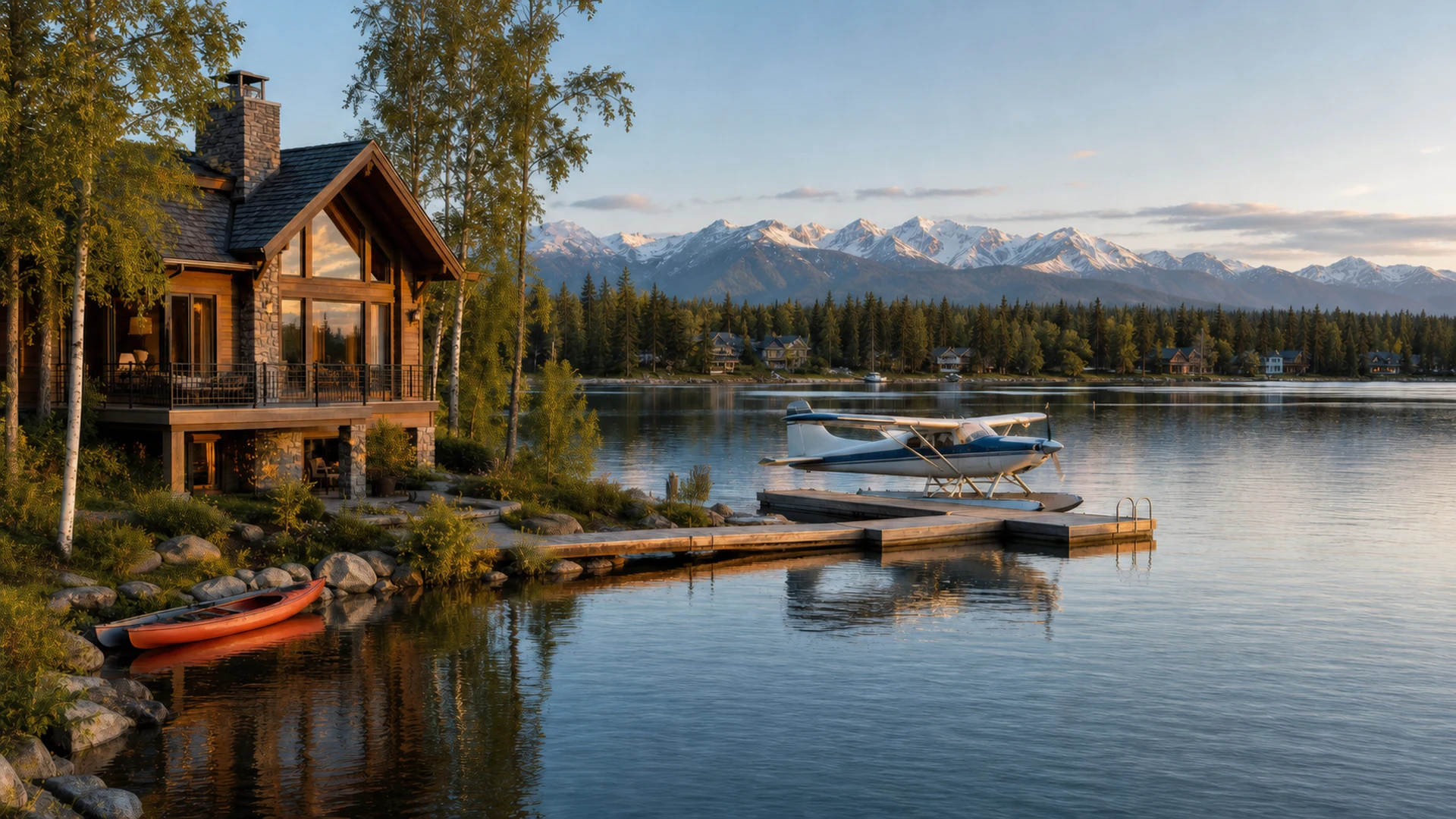
Anchorage waterfront homes fall into three distinct categories, and the word alone tells you very little. Lakefront homes — on Sand Lake, Campbell Lake, Jewel Lake, and the Lake Hood/Spenard complex — are the true waterfront: some allow a float plane at your own dock. Cook Inlet and Turnagain Arm “coastal” homes are big-water view properties, not beach or dock frontage, because the arm has up to a roughly 40-foot tidal range and dangerous mudflats. Creekside homes line the Campbell and Chester Creek greenbelts. Under Alaska law the public can use navigable or public waters regardless of who owns the shore, so a listing that calls a lake “private” — as many long did with Campbell Lake — is describing the neighborhood, not a legal right.
Waterfront is one of the most misunderstood categories in Anchorage real estate, and it’s the one where a buyer’s assumptions from the Lower 48 tend to be most wrong. Elsewhere, “waterfront” usually means a beach, a dock, and a body of water you own down to. Here it can mean a lake where your neighbor lands a floatplane in the backyard, a bluff over Cook Inlet where the water is a view and not an amenity, or a lot backing a salmon creek inside a city greenbelt. I’ve watched all three trade over four decades of living in this city, and the buyers who do well are the ones who figure out which kind of water they’re actually buying before they fall for the listing photos.
This page breaks Anchorage waterfront down by water type, prices each category honestly, and walks through the Alaska-specific due diligence — public-water law, float-plane access, tides, and lake health — that separates a smart waterfront purchase from an expensive misunderstanding.
- Anchorage waterfront splits into three types with very different value logic: lakefront (some float-plane capable), Cook Inlet / Turnagain Arm coastal view, and creekside greenbelt.
- Sand Lake and Campbell Lake are the city’s established residential float-plane lakes; Fire Lake in Eagle River has private slip leases. The public option, Lake Hood, has historically carried a slip waitlist of about a decade or more.
- Under the Alaska Constitution, the public may access navigable or public waters regardless of who owns the shore — the State and Municipality jointly confirmed Campbell Lake is a public lake, not private, despite decades of listings saying otherwise.
- Owners generally do not control the water or the bed below the ordinary high water mark; you own the upland lot, your dock, and the access — not the public’s right to use the water.
- Cook Inlet / Turnagain Arm frontage is a view, not a beach — up to a roughly 40-foot tidal range (among the largest in North America) and quicksand-like mudflats make the shoreline unusable and hazardous.
- Lake-specific risks matter to value: Elodea, an invasive weed found in Sand Lake, can hurt recreation, floatplane operations, and property values; some lakes have had water-level swings.
- Usable, south-facing lakefront in the city is genuinely scarce, which is why the best parcels rarely come to market and tend to price well above the blended “waterfront” median.
What Counts as a “Waterfront” Home in Anchorage?
The first thing to sort out is which body of water is in the picture, because the three types behave nothing alike. Buyers touring listings labeled “waterfront” consistently find they’re looking at three fundamentally different products under one search filter.
Lakefront is the true waterfront category — homes directly on Anchorage’s residential lakes, mostly in the southwest part of the city. Sand Lake covers about 78 acres between Jewel Lake and Sand Lake roads, its shores mostly privately owned with a small park allowing public access. Campbell Lake, created when a developer dammed Campbell Creek in 1959, is arguably the largest lake in Anchorage and is rimmed with large homes and float planes. Jewel Lake and Sundi Lake sit in the same wetland-connected system, and the Lake Hood/Lake Spenard complex sits just south of the airport.
Coastal homes front Cook Inlet or Turnagain Arm — and this is where the biggest misconception lives. This is view property. Turnagain Arm has among the largest tidal ranges in North America, and its shoreline is a broad, silt-laden mudflat at low tide, not a beach. You buy these homes for the water on the horizon, not the water at your feet.
Creekside homes back Anchorage’s salmon-bearing creeks — Campbell Creek and Chester Creek most notably — often along the municipal greenbelt trail system. These offer the sound of moving water, wildlife, and trail access, usually at a far more attainable price than lakefront.
| Type | Where | What you get | Relative price |
|---|---|---|---|
| Lakefront | Sand Lake, Campbell Lake, Jewel Lake, Sundi Lake, Lake Hood/Spenard | Most usable water; docks and paddling; float plane on Sand, Campbell & Fire lakes | Highest — prime south-facing lots often seven figures |
| Coastal view | Cook Inlet & Turnagain Arm — Turnagain, South Anchorage bluff | Panoramic water, Alaska Range & sunset views; Coastal Trail. Not beach/dock (tides to ~40 ft, mudflats) | View premium |
| Creekside | Campbell Creek, Chester Creek greenbelts | Moving-water sound, wildlife, greenbelt trail access | Most attainable of the three |
How Much Do Waterfront Homes Cost in Anchorage?
Honest answer: the median “waterfront” number you see on portals is nearly useless on its own, because it averages a creekside condo against a lakefront estate. In 2025, national aggregators typically showed only about 30 to 50 Anchorage waterfront homes on the market at once, with a reported median list price in the high-$400,000s. That figure is a blend, not a benchmark for the category most luxury buyers actually mean.
What the median hides is scarcity at the top. Genuine, usable, south-facing lakefront on Sand Lake or Campbell Lake is one of the rarest products in the city — listings themselves note that Campbell Lake frontage “doesn’t come on the market often.” Cook Inlet bluff estates with unobstructed inlet, Chugach, and city-lights views likewise trade well above the blended median. Unlike a tract subdivision where comparable sales set a tight range, each waterfront parcel is close to one-of-a-kind, so pricing is a parcel-by-parcel exercise, not a per-square-foot rule.
Because waterfront inventory is thin and idiosyncratic, snapshot medians swing sharply month to month on just a handful of sales. Treat any single “median waterfront price” as context, not valuation. A current comparative market analysis on the specific water body and lot is the only reliable number.
Which Anchorage Lakes Let You Keep a Float Plane at Home?
This is the feature that makes Anchorage lakefront genuinely rare nationally. Sand Lake and Campbell Lake are the city’s two established residential float-plane lakes, where owners commonly keep a seaplane at a private dock in the backyard — a level of at-home aviation access almost nowhere else in the country offers inside a major city. In Eagle River, Fire Lake has float-plane slips available through a private yearly lease.
The contrast with the public alternative is what drives the value. Lake Hood, adjacent to Ted Stevens Anchorage International Airport, is the state-owned and world’s busiest seaplane base, handling roughly 190 flights a day with about 500 float slips. But demand is so far beyond supply that the slip waitlist has historically run about a decade — a state economic study cited a roughly 13-year wait, and reporting has described hundreds of pilots in line. For a pilot who wants water access now, buying a home on Sand Lake or Campbell Lake is the direct route, and that scarcity is baked into those lots’ prices.
Float-plane lakefront — the upside
- Seaplane at your own dock — no decade-long Lake Hood waitlist
- Direct access to remote Alaska: lodges, cabins, fishing, hunting
- Genuinely scarce; strong long-term demand from pilots
- Sand & Campbell lakes are proven, established float communities
What to weigh
- Aircraft traffic patterns and noise; planes have right of way on the water
- Float-plane use is subject to FAA operations and lake rules
- Winter conversion to skis; seasonal operations
- Invasive weeds (Elodea) can disrupt floatplane operations on affected lakes
Is Campbell Lake Private — and Who Actually Owns the Water?
This is the single most important legal point on Anchorage lakefront, and it’s one many buyers — and even many listings — get wrong. For decades, Campbell Lake was marketed as an exclusive “private lake,” and real-estate listings routinely described homes on “private Campbell Lake.” The reality is different: the State of Alaska and the Municipality of Anchorage issued a joint statement confirming Campbell Lake is a public, navigable water body, and identified the lawful ways the public can reach it — including public-access easements and access via Campbell Creek.
This flows from Alaska’s constitution. Article VIII guarantees free public access to navigable and public waters, and under state law owning the uplands next to navigable or public water does not give you an exclusive right to control the water. Land below the ordinary high water mark is subject to the public’s right to use it for boating, fishing, and similar activities — and it’s actually a misdemeanor to obstruct someone’s free passage on navigable water. So what a lakefront owner holds is the upland lot, the dock and improvements, and the frontage’s access and views — not the water itself or the public’s right to be on it.
If a lakefront listing leans on the word “private” to justify a premium, treat it as describing the character of the neighborhood, not a legal exclusion of the public. Confirm the water body’s navigability status and where any public-access easements fall on the plat before you write an offer. This is exactly the kind of detail that’s far cheaper to check up front than to discover afterward.
What About Cook Inlet and Turnagain Arm “Coastal” Homes?
Coastal Anchorage frontage is spectacular — and it’s a view, full stop. Turnagain Arm, the branch of Cook Inlet that runs south of the city along the Seward Highway, has one of the largest tidal ranges in North America, second only to the Bay of Fundy, swinging up to roughly 40 feet between high and low water. At low tide the arm becomes a vast expanse of silty mudflats that behave like quicksand; there have been fatalities when people became stuck as the tide returned. The arm is also famous for its bore tide — a wall of water that can reach 6 to 10 feet and travel 10 to 15 mph — one of only about 60 such tidal bores worldwide.
The practical takeaway for a buyer: there is no meaningful private dock, swim beach, or water access on this water. What you’re paying for is the panorama — Cook Inlet, the Alaska Range and its volcanoes, sunsets, wildlife like beluga whales and Dall sheep, and often proximity to the Tony Knowles Coastal Trail. These homes cluster in West Anchorage neighborhoods such as Turnagain and Bootlegger’s Cove and along the South Anchorage bluff. Value them as premium view real estate, and judge them on sightline, orientation, and light — not on frontage you can use.
What Should You Check Before Buying Anchorage Waterfront?
Waterfront due diligence in Alaska has moving parts a standard home purchase doesn’t. Sellers on waterfront lots routinely underestimate how many of these a sharp buyer’s agent will run down — and buyers who skip them are the ones with surprises after closing. The essentials:
- Water-body legal status. Navigable/public vs. genuinely private, and where the ordinary high water mark and any public-access easements sit on the plat. (See the Campbell Lake lesson above.)
- Float-plane rights and patterns. On Sand and Campbell lakes, confirm dock rights, traffic patterns, and that aircraft have right of way; float-plane use is subject to FAA operations.
- Lake health. Ask about invasive Elodea — found in Sand Lake and adjacent water bodies — which can degrade recreation, floatplane operations, fish habitat, and property values. Ask about water-level history, too; Sand Lake, for example, has seen level swings that affected shoreline docks.
- Well and septic. Many Anchorage-area lots are on private well and on-site septic; confirm status and testing per Municipality of Anchorage and Alaska DEC requirements.
- Flood and wetland status. Several of these lakes sit in wetland-connected systems; check FEMA flood mapping and any wetland limits on the specific parcel.
- Seismic construction. Southcentral Alaska is highly seismically active — the 1964 quake dropped parts of Turnagain Arm and submerged old Girdwood. On any waterfront (especially near soft or filled ground), how the home was built matters.
None of this should scare a buyer off waterfront — it should get handled before the offer, with the right inspections and a local agent who knows which questions each water body demands. That’s the difference between the panorama you fell for and the property you can actually live with.
Where Are Anchorage’s Waterfront Neighborhoods?
Most of the city’s residential lakefront is in West and South Anchorage. Sand Lake, Jewel Lake, and Sundi Lake form a connected system in the southwest; Campbell Lake sits nearby, straddling the West/South Anchorage line; and the Lake Hood/Lake Spenard complex is just south of the airport. Creekside homes follow the Campbell Creek and Chester Creek greenbelts across the city. Coastal, big-water view homes concentrate in West Anchorage (Turnagain, Bootlegger’s Cove) and along the South Anchorage bluff, while Eagle River adds Fire Lake and river frontage. The right one depends entirely on the water experience you’re after — a float plane, a paddling lake, a salmon creek, or a horizon view.
- Alaska Department of Fish & Game — Public Access to Alaska Waters: constitutional right to use navigable/public waters (AK Const. Art. VIII §14); no exclusive control by upland owners; use below the ordinary high water mark (AS 38.05.126–.128).
- State of Alaska DNR & Municipality of Anchorage — Joint Statement: Campbell Lake: Campbell Lake confirmed a public/navigable lake; four lawful public-access methods.
- Wikipedia / Anchorage Daily News — Sand Lake facts (~78 acres; between Jewel Lake & Sand Lake roads; Elodea discovered 2011; water-level concerns).
- Alaska Landmine — history of Campbell Lake (dammed 1959; float-plane shores; “private lake” marketing).
- Wikipedia / Alaska DOT&PF Lake Hood economic study / ADN — Lake Hood Seaplane Base: world’s busiest, ~190 flights/day, ~500 float slips, ~10–13-year slip waitlist.
- Visit Anchorage / Alaska.org / NOAA-NWS / Wikipedia (Turnagain Arm, Cook Inlet) — ~40-ft tidal range, mudflat hazard, bore tide 6–10 ft, one of ~60 bores worldwide; 1964 earthquake subsidence.
- Redfin / Homes.com / Zillow — 2025 Anchorage waterfront inventory (~30–50 listings) and reported blended median list price (~high-$400Ks). Blended figures; not a category benchmark.
- For parcel-specific due diligence: Municipality of Anchorage (On-Site Water & Wastewater, plats/easements), Alaska DEC (well/septic, 18 AAC 72), and FEMA flood mapping.
Looking for the Right Anchorage Waterfront Home?
Lakefront, float-plane capable, or a Cook Inlet view — I’ll help you find the water that actually fits and vet it properly before you offer.
Frequently Asked Questions
Prices span a very wide range because “waterfront” covers everything from a creekside home to a lakefront estate. In 2025, aggregator sites listed roughly 30 to 50 Anchorage waterfront homes at a time, with a reported median list price around the high-$400,000s — but that median blends condos and creekside homes with true lakefront. Genuine south-facing lakefront on Sand or Campbell Lake and Cook Inlet bluff estates typically price well above that, often into seven figures, because usable frontage is scarce. A current comparative market analysis on the specific parcel is the only reliable way to price it.
Sand Lake and Campbell Lake are Anchorage’s two established residential float-plane lakes, where homeowners commonly keep a seaplane at a private backyard dock. Fire Lake in Eagle River has float-plane slips through a private lease. The public option, state-owned Lake Hood — the world’s busiest seaplane base — runs on a slip waitlist that has historically stretched about a decade or more, so buying on Sand or Campbell Lake is the direct path to at-home float-plane access. Any lake use is subject to FAA operations and the lake’s traffic patterns.
No. Despite decades of listings calling it a “private lake,” the State of Alaska and the Municipality of Anchorage issued a joint statement confirming Campbell Lake is a public, navigable water body. Under the Alaska Constitution, the public may use navigable and public waters regardless of who owns the adjacent uplands, and there are established public-access methods, including easements and access via Campbell Creek. Homeowners own their upland lots and docks — not exclusive rights to the water. Buyers should understand this before paying a premium framed on “privacy.”
Generally not below the ordinary high water mark on navigable or public waters. Under Alaska law, owning uplands next to navigable or public water does not grant exclusive control of the water, and land below the ordinary high water mark is subject to the public’s right to use it for boating, fishing, and similar purposes. What you own is the upland lot, your dock or improvements, and the frontage’s access and views — not the water itself. It’s a defining feature of Alaska waterfront, and one to confirm in the specific title and plat.
Practically, no — Cook Inlet and Turnagain Arm frontage is view property, not usable beach or dock frontage. Turnagain Arm has one of the largest tidal ranges in North America (up to roughly 40 feet), and at low tide the shoreline becomes vast, silty mudflats that behave like quicksand and are genuinely dangerous. There’s no meaningful private-dock or swim-beach use on this water. Coastal Anchorage homes are valued for the panoramic Cook Inlet, Alaska Range, and sunset views and for proximity to the Tony Knowles Coastal Trail.
Confirm the water body’s legal status (navigable/public vs. genuinely private), where the ordinary high water mark and any public-access easements fall on the plat, and whether float-plane rights and traffic patterns apply. On lakes, ask about water-level history and invasive weeds like Elodea (found in Sand Lake), which can affect recreation, floatplane operations, and value. On any waterfront lot, verify well and septic, flood and wetland status, and — because Southcentral Alaska is seismically active — how the home was built. Handle these before your offer, not after.
Most of Anchorage’s residential lakefront is in West and South Anchorage — Sand Lake, Jewel Lake, and Sundi Lake form a connected system in the southwest, Campbell Lake sits nearby, and Lake Hood/Lake Spenard is just south of the airport. Creekside homes line the Campbell Creek and Chester Creek greenbelts. Coastal, Cook Inlet–view homes cluster in West Anchorage neighborhoods like Turnagain and along the South Anchorage bluff, while Eagle River offers Fire Lake and river frontage. Which one fits depends on whether you want a float plane, a paddling lake, a salmon creek, or a big-water view.