

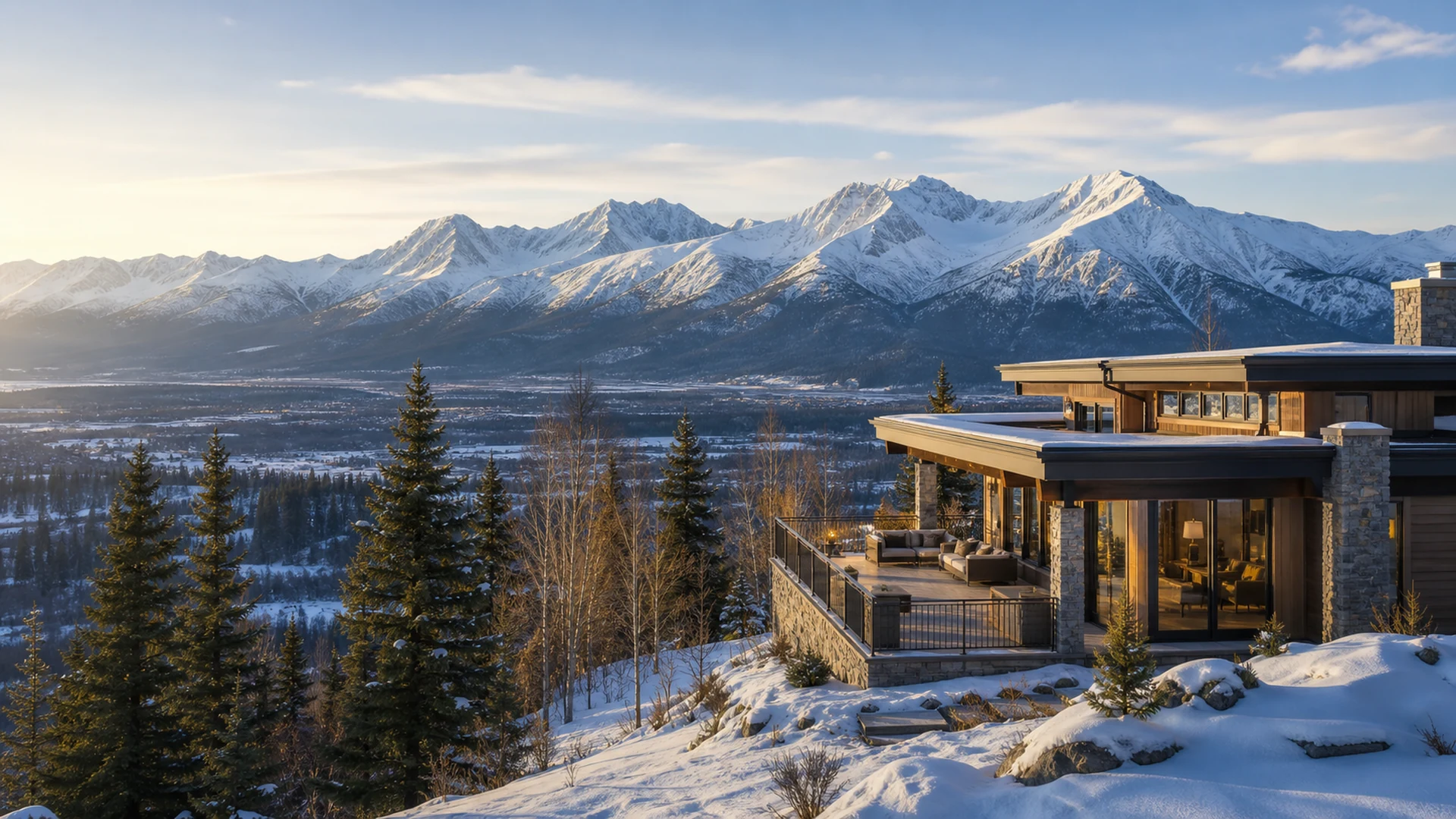
Luxury homes with mountain views in Anchorage fall into a few distinct corridors: east-facing sites that look at the Chugach front range and its skyline peaks like O’Malley (about 5,184 feet) and Wolverine (4,491 feet); west-facing sites that look across Cook Inlet to Mount Susitna — Sleeping Lady — and, on clear days, the Alaska Range and Denali; and elevated benches that catch both. The mountain itself is only half the picture. Because Anchorage sits at about 61° north and gets roughly 5.5 hours of daylight at the December solstice with the sun peaking near 5° above the horizon, the view lots that hold value are the ones where a genuine mountain sightline and real south-facing winter light coincide. Orientation, elevation, protected sightlines, and the soils under the home matter as much as the peaks on the horizon.
Anchorage is one of the few American cities where several major mountain ranges are visible from residential neighborhoods at the same time. The Chugach Mountains rise directly off the city’s eastern edge, and across Cook Inlet to the west you can pick out Mount Susitna and, when the weather cooperates, the Alaska Range and Denali more than 100 miles away. That abundance is exactly why buyers relocating here often underestimate how much a “mountain view” can vary from one lot to the next.
Having lived in Anchorage for four decades, I’ve learned that the view a home actually delivers — in December, not just in a July listing photo — is the thing that separates a good view lot from a great one. This guide walks through the real view corridors, why orientation drives both the panorama and the winter light, and what to verify before you pay a premium for a sightline.
- Anchorage sits in a bowl ringed by the Chugach Mountains to the east and Cook Inlet to the west; homes commonly see multiple ranges at once, and mountains are visible from most of the city, especially at higher elevations.
- Prominent Chugach skyline peaks visible from South Anchorage include O’Malley Peak (about 5,184 feet) and Wolverine Peak (4,491 feet); Flattop, Alaska’s most-climbed peak, sits at about 3,510 feet.
- Across Cook Inlet to the west, homes can see Mount Susitna — “Sleeping Lady,” about 4,396 feet — and on clear days the Alaska Range and Denali.
- At the December solstice Anchorage gets roughly 5.5 hours of daylight, and the midday sun peaks near 5° above the horizon on a low southern arc — so a view lot without south-facing exposure can sit in shadow much of a winter day.
- Chugach State Park is roughly 495,000 acres and borders the city, which permanently limits how much land can be developed against the mountains and helps sustain view premiums.
- In the 2018 magnitude 7.1 earthquake, most severely damaged buildings in the Municipality were in areas without enforced building codes; Anchorage enforces the International Building Code for residences, so soils, slope, and permitted construction are core view-lot due diligence.
What kinds of mountain views do Anchorage homes actually have?
Buyers touring Anchorage for the first time tend to say “I want a mountain view” as if it were one thing. In practice it’s at least three distinct products, each tied to which way the home faces. The Chugach Mountains form a dramatic wall along the city’s eastern skyline — the Hillside and South Anchorage sit closest to it and gain elevation as you climb toward the Glen Alps area at about 2,200 feet. From those benches, prominent front-range peaks like O’Malley Peak (roughly 5,184 feet, the sharp summit that dominates the south end of the Anchorage bowl) and Wolverine Peak (4,491 feet) read clearly on the horizon.
The second product faces the opposite direction. West and coastal Anchorage neighborhoods look across Knik Arm and Cook Inlet toward Mount Susitna — the recumbent profile locals call Sleeping Lady, about 4,396 feet — which is visible from most of the city and especially from higher ground. On clear days that same westward and northwestward sightline picks up the Alaska Range and Denali. The third is the prize: an elevated bench site with the openness to hold both the Chugach wall and the inlet-and-Alaska-Range panorama. Those are rare, and priced accordingly.
| View corridor | Home orientation | What you see | Where it’s found |
|---|---|---|---|
| Chugach front range | East-facing | O’Malley (~5,184 ft), Wolverine (4,491 ft), Flattop (~3,510 ft) | Upper Hillside, South Anchorage benches, Eagle River |
| Cook Inlet / Alaska Range | West / northwest-facing | Mount Susitna “Sleeping Lady” (~4,396 ft); Alaska Range & Denali on clear days | West & coastal Anchorage, elevated benches |
| Panoramic bench | Open exposure + elevation | Both the Chugach wall and the inlet-and-range panorama | Select upper-elevation Hillside & South Anchorage sites |
| Winter sun (all corridors) | South-facing | Genuine December daylight; low arc peaking ~5° at solstice | Site-specific — independent of the view direction |
Why does winter sun matter more than the view itself?
This is the point I return to with every view buyer, because it’s the one that separates a lot that thrills you in summer from one you love in February. Anchorage sits at roughly 61° north latitude. At the December 21 solstice the city receives only about 5.5 hours of daylight, and the midday sun climbs to just around 5° above the horizon before setting again — it hangs low and tracks across the southern sky. Compared with a Lower-48 city, the difference is stark; the sun never gets high, and shadows stay long all day.
The practical consequence: a home with a spectacular east-facing Chugach view can still sit in cold shadow for much of a short winter day if the lot and the build don’t capture that low southern light. Unlike a summer-only cabin, a luxury primary residence has to live well in the dark half of the year. So the lots that genuinely hold value are the south-facing view parcels where the mountain sightline and real winter sun coincide — and that combination is rarer than either attribute alone.
Which Anchorage areas have the best mountain-view homes?
The upper Hillside and South Anchorage sit closest to the Chugach and gain elevation, which is why they hold so much of the luxury view inventory — from the right bench you get the mountain wall to the east and, from open sites, the inlet and Alaska Range to the west. West and coastal Anchorage neighborhoods near the Tony Knowles Coastal Trail favor the Cook Inlet and Sleeping Lady view across the water. Eagle River and Chugiak tuck against the Chugach on generally larger parcels, trading some panorama for space and valley-and-peak sightlines. And Girdwood, down Turnagain Arm, offers a completely different mountain setting entirely surrounded by peaks.
A structural point worth understanding: much of the land facing the mountains simply can’t be built on. Chugach State Park covers roughly 495,000 acres and borders Anchorage directly. That permanent public boundary is part of why developable view frontage is scarce — and scarcity is what underwrites the premium a good view lot commands.
How much of a premium do mountain views add in Anchorage?
Here I want to be straight with you rather than quote a tidy number I can’t defend. View premiums in Anchorage vary widely by corridor, elevation, how open and protected the sightline is, and whether the lot also delivers winter sun — and clean, published, view-specific price-per-square-foot data for a market this size isn’t something I’ll invent to fill a table. What I can tell you from working this market: an open, protected, south-facing view commands a materially stronger and more durable premium than a partial or north-facing one, and views that can be closed off by future construction or tree growth are worth less than buyers assume. For current, address-specific numbers, a comparative market analysis is the honest tool — not a blog statistic.
“A view” and “a protected view” are different assets. Before paying a premium, confirm whether anything — a downhill vacant lot, a zoning change, or maturing trees — could close the sightline you’re buying. A permanent, unbuildable foreground (public land, a park boundary, or steep terrain) is what makes a view durable.
What should you check on a mountain-view lot before you buy?
Views sit on terrain, and in Southcentral Alaska terrain deserves scrutiny. The region is seismically active, and construction quality matters more than the panorama. In the November 30, 2018 magnitude 7.1 earthquake centered near Point Mackenzie, the great majority of severely damaged buildings in the Municipality of Anchorage — by the Alaska Seismic Hazards Safety Commission’s account, 38 of the 40 most severely damaged — were in areas without enforced building codes, and much of the worst damage traced to geotechnical failures on poorly compacted fill and saturated soils rather than the shaking alone. Modern, code-conforming homes generally performed well, and researchers noted the event did not fully test the region’s building stock.
The takeaway for a view buyer: the Municipality of Anchorage enforces the International Building Code for residences, so verify the home was permitted and built to code, and pay attention to the ground it sits on. Bluff-edge and steep view sites, and lots on fill, carry more seismic and drainage risk than a home on stable, well-drained soil. Add the view-specific and access checks, and you have a real due-diligence list.
What makes a strong view lot
- Open, protected sightline (public land or terrain in the foreground)
- South-facing exposure for genuine winter daylight
- Stable, well-drained soils; not on uncompacted fill
- Permitted, code-conforming construction
- Reliable winter road access to elevated sites
What quietly erodes view value
- A sightline that future building or tree growth can close
- North-facing orientation — the view without the winter light
- Bluff-edge or fill sites with elevated seismic/drainage risk
- Steep, hard-to-maintain winter access
- A “peek” view oversold as a full panorama
Do view homes near acreage and water fit the same logic?
They do, and this is where mountain-view buyers should look laterally. If space matters as much as the panorama, the larger-parcel corridors in Eagle River and Chugiak and out into the Mat-Su Valley combine mountain sightlines with acreage. If you want the water in the frame too, Anchorage waterfront and lake homes and the coastal corridor pair Cook Inlet with the western ranges. The same four tests — protected sightline, winter sun, sound ground, and access — apply everywhere; only the mix of view, water, and land changes.
- USGS Geographic Names Information System & peak records — Chugach Mountains, O’Malley Peak, Wolverine Peak (4,491 ft), Mount Susitna / Sleeping Lady (4,396 ft) elevations and skyline prominence.
- Chugach State Park (Alaska DNR) / Visit Anchorage — park extent (~495,000 acres) bordering the city; Glen Alps trailhead elevation (~2,200 ft); Flattop (~3,510 ft) as Alaska’s most-visited peak.
- Time and Date / sunrise-sunset data & Anchorage Daily News — Anchorage winter solstice daylight (~5.5 hours) and low winter sun angle (~5° at midday) at ~61°N latitude.
- 2018 Anchorage earthquake reporting (Wikipedia summary of USGS data; Alaska Beacon / Anchorage Daily News on the Alaska Seismic Hazards Safety Commission) — M7.1 event; damaged-building code-enforcement pattern; geotechnical failures.
- Municipality of Anchorage / ICC — Anchorage’s adoption and enforcement of the International Building Code for residences.
- Journal of Earthquake Spectra (Hassan et al., 2022) — structural performance and geotechnical failure findings from the 2018 earthquake.
Find the view lot that lives well all year
Let’s tour the corridors together — and check the winter sun before you fall for the summer view.
Frequently Asked Questions
Anchorage homes look out on several ranges at once. To the east rises the Chugach front range, including prominent skyline peaks like O’Malley Peak (about 5,184 feet) and Wolverine Peak (4,491 feet). To the west, across Cook Inlet, homes can see Mount Susitna — known locally as Sleeping Lady, about 4,396 feet — and, on a clear day, the Alaska Range and Denali roughly 130 miles to the north. Which range a home sees depends almost entirely on its orientation and elevation.
Not automatically — and this is the single most overlooked factor in a view purchase. On the December 21 winter solstice, Anchorage gets only about 5.5 hours of daylight, and the midday sun peaks at roughly 5 degrees above the horizon, tracking low across the southern sky. A home with a dramatic east-facing Chugach view can still sit in shadow much of a winter day if its build and lot don’t account for that low southern arc. The lots that hold value are the ones where the mountain view and genuine south-facing winter light coincide.
The upper Hillside and South Anchorage benches sit closest to the Chugach front range and gain elevation, which opens both the mountain wall to the east and, from the right sites, Cook Inlet and the Alaska Range to the west. West and coastal Anchorage neighborhoods near the Tony Knowles Coastal Trail favor the Cook Inlet and Sleeping Lady view across the water. Eagle River and Chugiak sit tucked against the Chugach on generally larger parcels with valley-and-peak views.
View is a scarce, permanent attribute, and in Anchorage the best sightlines are concentrated on elevated benches and coastal frontage that can’t be manufactured. Because much of the land facing the Chugach is public — Chugach State Park is roughly 495,000 acres and borders the city — the developable view inventory is limited, which supports premiums. Views that combine an open sightline with south-facing winter light command the strongest and most durable premium.
Southcentral Alaska is seismically active, so construction quality and ground conditions matter more than the view itself. In the November 30, 2018 magnitude 7.1 earthquake, the great majority of severely damaged buildings in the Municipality of Anchorage were in areas without enforced building codes, and most modern code-conforming homes performed well. Anchorage enforces the International Building Code for residences; the key due-diligence items on any view lot are the soils, any bluff or slope, and whether the home was permitted and built to code.
Check four things. First, whether the sightline is protected — could future construction or tree growth close it? Second, winter sun — does the lot get real south-facing light in December, not just a view? Third, the soils and slope — bluff sites and fill areas carry more seismic and drainage risk. Fourth, access — how the road is maintained in winter for elevated Hillside sites. Touring a view home in January tells you more than a July showing ever will.
Yes, on clear days. Denali and the neighboring Alaska Range peaks are visible from parts of Anchorage that have an open northwest sightline across Cook Inlet, especially from higher elevations. It is a weather-dependent view rather than an everyday guarantee, so buyers who prize it should verify the sightline in person and understand that clouds hide the range much of the year.