

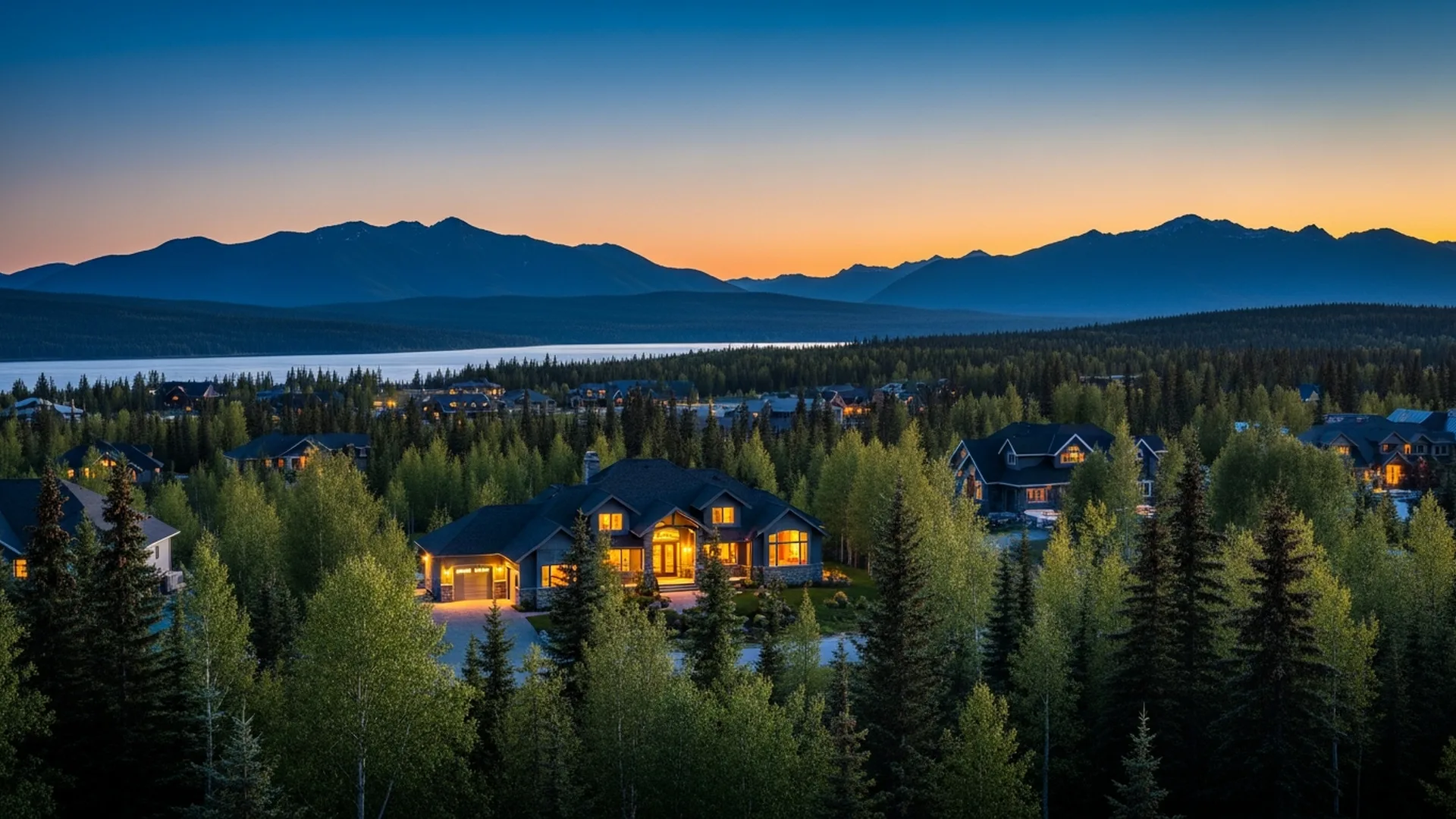
Valli Vue Estates is an established subdivision of about 229 lots on Anchorage’s Mid-Hillside, roughly 11 miles from downtown, developed in the early 1970s and mostly built out with homes from the late 1970s and early 1980s. It stands apart from much of the Hillside because it has a community water system with fire hydrants and recorded, enforceable covenants, rather than the private wells and unrestricted parcels common nearby. Sitting on the west-facing slope, its best lots look out over Anchorage toward Cook Inlet, Sleeping Lady, and the Alaska Range, with the Chugach Mountains behind. Roads are maintained by the Valli Vue Limited Road Service Area, a locally elected board separate from the HOA. Because many individual homes are on private septic, a Municipality of Anchorage Certificate of On-Site Systems Approval is typically required before a sale can close.
Valli Vue Estates is one of those Hillside neighborhoods that reads differently once you understand how it was built. I’ve watched the Anchorage Hillside grow and change over four decades of living here, and the subdivisions that hold their value most reliably tend to share a few unglamorous traits: a real water system, enforceable covenants, and a road-maintenance arrangement people can actually count on in February. Valli Vue checks all three — which is exactly why it deserves a closer look than a listing photo of a snowy driveway can give you.
This guide walks through the geography, the view orientation, the community water and septic realities, the road service area, and what buyers and sellers should genuinely verify. It’s the substance I’d cover with a client standing in the driveway, minus anything I can’t back up.
- Valli Vue Estates sits on Anchorage’s Mid-Hillside, roughly 11 miles from downtown, and was developed in the early 1970s as a subdivision of about 229 lots.
- Most homes date to the late 1970s and early 1980s; the subdivision was essentially built out by the 1990s, with a few final homes around 2007 — this is an established-home market, not new construction.
- The neighborhood has a community water system with fire hydrants (regulated by the Regulatory Commission of Alaska), so most homes are not on a private drinking-water well.
- Wastewater is separate: many individual homes are on private septic, so a Municipality of Anchorage Certificate of On-Site Systems Approval (COSA) is typically required before title transfers.
- Roads are maintained by the Valli Vue Limited Road Service Area (LRSA) under Anchorage Municipal Code Title 27 — a locally elected board funded by property taxes, and separate from the HOA.
- The west-facing slope gives the best lots views toward Cook Inlet, Mount Susitna (“Sleeping Lady”), and the Alaska Range; Anchorage’s low winter sun (about 5 hours of daylight at solstice) makes exposure a real value factor.
- Valli Vue carries recorded, enforceable covenants (CCRs) — unlike many unrestricted Hillside parcels — which buyers should review before making an offer.
Where is Valli Vue Estates, and what makes it distinct on the Hillside?
Valli Vue Estates is a subdivision within the larger Mid-Hillside area of Anchorage, sitting roughly 11 miles from downtown on the west-facing slope beneath the Chugach Mountains. If you’re driving the streets, you’ll notice the neighborhood’s “tree” naming theme — Main Tree Drive, Lone Tree Drive, Round Tree Drive, Ridge Tree Circle, Crooked Tree Drive, and a few others — which is a quick tell that you’ve arrived.
What actually sets it apart isn’t the street names, though. The subdivision was developed in the early 1970s as a planned hillside community of about 229 lots, and it was built with infrastructure that a lot of the surrounding Hillside doesn’t have: paved roads, a community water system that also feeds fire hydrants, and recorded, enforceable covenants. On much of the Anchorage Hillside, buyers are dealing with private wells and unrestricted parcels; here, the developer put a shared framework in place from the start. That framework is the difference between “a house on a hill” and a genuine neighborhood, and it’s a big part of why Valli Vue has stayed a stable, desirable address.
| Feature | Valli Vue Estates detail |
|---|---|
| Location | Mid-Hillside, Anchorage; ~11 miles from downtown |
| Slope / orientation | West-facing; elevation rises west to east toward the Chugach |
| Prime view direction | West/northwest — Cook Inlet, Mount Susitna (Sleeping Lady), Alaska Range |
| Behind the neighborhood | Chugach Mountains & Chugach State Park (Glen Alps, Flattop) |
| Water | Community water system with fire hydrants (RCA-regulated) |
| Roads | Valli Vue Limited Road Service Area (LRSA), AMC Title 27 |
| Governance | HOA with recorded, enforceable covenants (CCRs) |
What views do Valli Vue Estates homes have, and why does orientation matter here?
This is where the Hillside rewards people who understand it. Because Valli Vue sits on a west-facing slope, the signature views look out over Anchorage toward Cook Inlet, with Mount Susitna — the reclining profile locals call “Sleeping Lady” — on the horizon and the Alaska Range beyond to the northwest. On a clear day, the same western sweep that draws the eye also frames the sunset. Turn around, and the Chugach Mountains climb steeply behind the neighborhood toward Chugach State Park, Glen Alps, and Flattop.
Buyers who tour the Hillside consistently discover that not every “view lot” is equal. On this slope, elevation and an unobstructed western sightline are what create the premium; a lot lower on the hill, or one boxed in by mature trees, simply doesn’t deliver the same outlook. There’s a specific Valli Vue wrinkle here, too: the neighborhood was hit hard by the spruce bark beetle that swept through Southcentral Alaska, and the community spent years spraying and then removing dead spruce to reduce fire hazard. That tree loss has, in places, opened up or altered sightlines — so the view a home has today may differ from the mature-forest setting it started with. Stand on the actual deck before you fall for a listing photo.
I’ve watched the Hillside for forty years, and here’s the thing buyers chase the view and miss: winter sun. At our latitude the December sun tops out barely 5 degrees over the horizon and sits low in the south-southwest all day. Unlike a summer tour where every lot looks bright, the lots that feel livable in January are the ones with real southern and western exposure and no ridge stealing that low light. Check the daylight, not just the vista.
How does winter daylight and the low sun affect a Hillside home here?
Anchorage sits at about 61 degrees North, and the numbers are dramatic: around the December solstice the city gets roughly five and a half hours of daylight, and the midday sun peaks at only about 5 degrees above the horizon — so shadows stay long all day and the light keeps a permanently low, golden quality. That’s not trivia; it’s a value factor specific to buying on a slope. A west/southwest-facing Valli Vue lot with an open exposure catches what little low-angle sun there is, while a lot tucked behind a rise or a wall of spruce can sit in shadow for much of a short winter day.
This is exactly where my design background changes how I read a home. When I walk a Hillside house, I’m looking at where the glazing is placed, how the main living spaces are oriented to that low southern light, and whether the deck and windows were sited to capture the winter sun or just the summer view. Two homes on the same street can feel completely different in December depending on those choices.
Does Valli Vue have well water or a septic system — and what’s a COSA?
Here’s a distinction that trips up buyers who assume “Hillside = well and septic.” Valli Vue Estates is served by a community water system that also supplies its fire hydrants — a shared utility, regulated by the Regulatory Commission of Alaska, rather than an individual drinking-water well on each lot. So the well side of the equation that dominates many Hillside purchases usually doesn’t apply the same way here.
Wastewater is a separate question. Many individual homes in the area are on private septic systems, and that’s where the Municipality of Anchorage’s rules kick in. Since an August 1998 ordinance, the Municipality has required a Certificate of On-Site Systems Approval (COSA) before title can transfer on any property served by a well or septic system. The COSA is signed by a registered engineer certifying the on-site system is functional and compliant; per the Municipality, that involves confirming the septic tank has been pumped within the past year, an absorption-field adequacy test, and (where a well is involved) water testing for coliform bacteria, nitrates, and arsenic. A COSA is generally valid for two years, subject to the water-sample timing rules.
The seasonal wrinkle matters in Alaska. If a system needs work, the ground has to be workable — and per the Municipality, in winter a conditional COSA can be issued with an escrow arrangement so a sale can close before frozen-ground repairs are physically done. That’s a solvable problem, but only if you know it’s coming. The single most useful move a seller can make is to have the septic tested early rather than discover a problem days before closing.
Because Valli Vue has a community water system, a full well-and-septic COSA workup isn’t always the scenario — but a septic COSA very often is. Confirm the exact water and wastewater setup for the specific address, since it varies lot to lot. On-site records for a property can be looked up through the Municipality’s On-Site Water and Wastewater Section.
Who plows the roads, and how reliable is winter access?
Road maintenance on the Hillside works differently than in the Anchorage Bowl, and Valli Vue is a clear example. Its streets are maintained by the Valli Vue Limited Road Service Area (LRSA) — one of about 21 hillside limited road service areas established under Anchorage Municipal Code Title 27. An LRSA is a separate legal entity from the homeowners association: it’s governed by a locally elected board of supervisors (your neighbors), it hires private contractors through competitive bids for snow removal, grading, and ice control, and it’s funded by a dedicated portion of residents’ property taxes rather than general city plowing.
The practical upshot is twofold. On the plus side, Valli Vue’s own materials describe its LRSA road maintenance as costing residents less than half what many other Anchorage areas pay — a genuine, quantifiable perk. On the cautionary side, LRSAs have limited authority: under municipal code they can grade, clear ditches, control dust, and plow, but they can’t save tax funds for big capital road projects. And regardless of who plows the street, the Municipality is explicit that clearing your own driveway is the property owner’s responsibility — a bigger job on a sloped Hillside lot than a flat one. When I evaluate a Valli Vue home, driveway grade and how the lot handles snow storage are part of the conversation, not an afterthought.
What buyers tend to value here
Community water with fire hydrants; enforceable covenants (rarer on the Hillside); west-facing views toward Cook Inlet and the Alaska Range; lower-cost LRSA road maintenance; established, larger-lot feel close to Chugach trailheads.
What to check before you commit
Septic status and COSA readiness; the actual (not photographed) view given beetle-thinned trees; driveway grade and snow storage; winter sun exposure on the specific lot; the current covenants and any HOA/LRSA assessments.
What are homes in Valli Vue Estates like — and what should buyers expect?
Valli Vue is an established single-family neighborhood, not a new-construction pocket. Most homes were built from the late 1970s through the early 1980s, the subdivision was essentially complete by the 1990s, and only a small final group of homes was finished around 2007. In practice that means you’re usually buying a home of a certain era on a Hillside lot — often with updates — rather than a spec build.
That’s where an honest read of finishes and construction pays off. Homes of this vintage vary enormously in how well they’ve been maintained and updated, and cold-climate details matter: heating systems, window quality for our winters, and how a remodel handled that low southern light. My design training is genuinely useful here — I look at whether a renovation improved how the home lives in an Alaska winter, or just refreshed the surfaces. The best-value homes in an established neighborhood like this are the ones where the bones, the exposure, and the updates all line up.
Thinking of selling in Valli Vue Estates? What drives value here
If you’re selling in Valli Vue, the value levers are specific. First, the view: a cleared, unobstructed western sightline moves the number, and sellers on view lots routinely underestimate how much a thoughtfully managed sightline (versus an overgrown or half-dead spruce screen) affects buyer perception. Second, the septic: getting your COSA testing done early removes the single most common closing-delay risk on a Hillside sale. Third, presentation for our light — staging and finish choices that make the most of low winter sun read as “this home lives well year-round,” which is exactly what a Hillside buyer is quietly worried about.
This is where I bring both the local read and the designer’s eye. When you’re ready to understand what your specific Valli Vue home is worth in today’s market, start with a real, address-level valuation — not a generic online estimate. You can begin on the Anchorage home value page and I’ll build you an accurate picture from there.
- Valli Vue Homeowners Association (vallivue.com) — subdivision history (early-1970s development, ~229 lots), community water system and fire hydrants, covenants, spruce bark beetle tree removal, and the HOA/LRSA distinction.
- Municipality of Anchorage, Street Maintenance — Limited Road Service Area (LRSA) program and Anchorage Municipal Code Title 27; ~21 Hillside LRSAs; scope of maintenance; driveway snow removal as the owner’s responsibility.
- Municipality of Anchorage, On-Site Water and Wastewater Section — Certificate of On-Site Systems Approval (COSA) requirement since the 1998 ordinance, testing requirements, conditional/winter COSA and escrow, AMC 15.55 & 15.65.
- Regulatory Commission of Alaska — Valli Vue community water utility entity record.
- Alaska Climate Research Center / U.S. Naval Observatory-based sun data — Anchorage winter-solstice daylight (~5.5 hours) and low midday solar altitude (~5°) at 61°N latitude.
- Chugach State Park (Alaska DNR) — Hillside geography, Glen Alps/Flattop trailheads, and Cook Inlet / Alaska Range / Sleeping Lady view context.
Considering a home in Valli Vue Estates?
Let’s tour the neighborhood the way a 40-year local reads it — views, exposure, septic, and access.
Frequently Asked Questions
Valli Vue Estates is a subdivision on Anchorage’s Mid-Hillside, roughly 11 miles from downtown Anchorage. It sits on the west-facing slope below the Chugach Mountains, with streets that share a “tree” naming theme such as Main Tree Drive, Lone Tree Drive, and Round Tree Drive.
Valli Vue Estates is served by a community water system with fire hydrants, so most homes are not on a private drinking-water well. Wastewater is a separate matter: many individual homes are on private septic systems, and in the Municipality of Anchorage a home on a septic system requires a Certificate of On-Site Systems Approval (COSA) before title can transfer. Always verify the specific water and wastewater setup for any address you’re considering.
Because Valli Vue sits on the west-facing Hillside slope, the marquee views look out over Anchorage toward Cook Inlet, Mount Susitna (widely called Sleeping Lady), and the Alaska Range to the northwest, with the Chugach Mountains rising behind to the east. The best view lots are those with an unobstructed western sightline; mature and, in places, beetle-thinned spruce can either frame or block that view depending on the lot.
Valli Vue’s roads are maintained by the Valli Vue Limited Road Service Area (LRSA), one of about 21 hillside LRSAs established under Anchorage Municipal Code Title 27. The LRSA is a separate entity from the homeowners association, is run by a locally elected board, hires private contractors for snow removal and grading, and is funded through a portion of residents’ property taxes.
Around the December solstice Anchorage gets roughly five and a half hours of daylight, and the midday sun peaks only about 5 degrees above the horizon at the city’s 61 degrees North latitude. That low winter sun stays in the south and southwest, which is why a home’s exposure and how it’s sited on the slope matter so much on the Hillside.
Valli Vue Estates was developed in the early 1970s as a hillside subdivision of about 229 lots, and most homes were built from the late 1970s through the early 1980s. The subdivision was essentially built out by the 1990s, with a final handful of homes finished around 2007, so buyers are typically looking at established homes rather than new construction.
Yes. Valli Vue Estates has a homeowners association and recorded, enforceable covenants (CCRs), which is not universal on the Anchorage Hillside where many parcels are unrestricted. The HOA manages the community water system and common areas and enforces the covenants; it is a separate legal entity from the Valli Vue LRSA that handles the roads. Review the current covenants before you buy.