

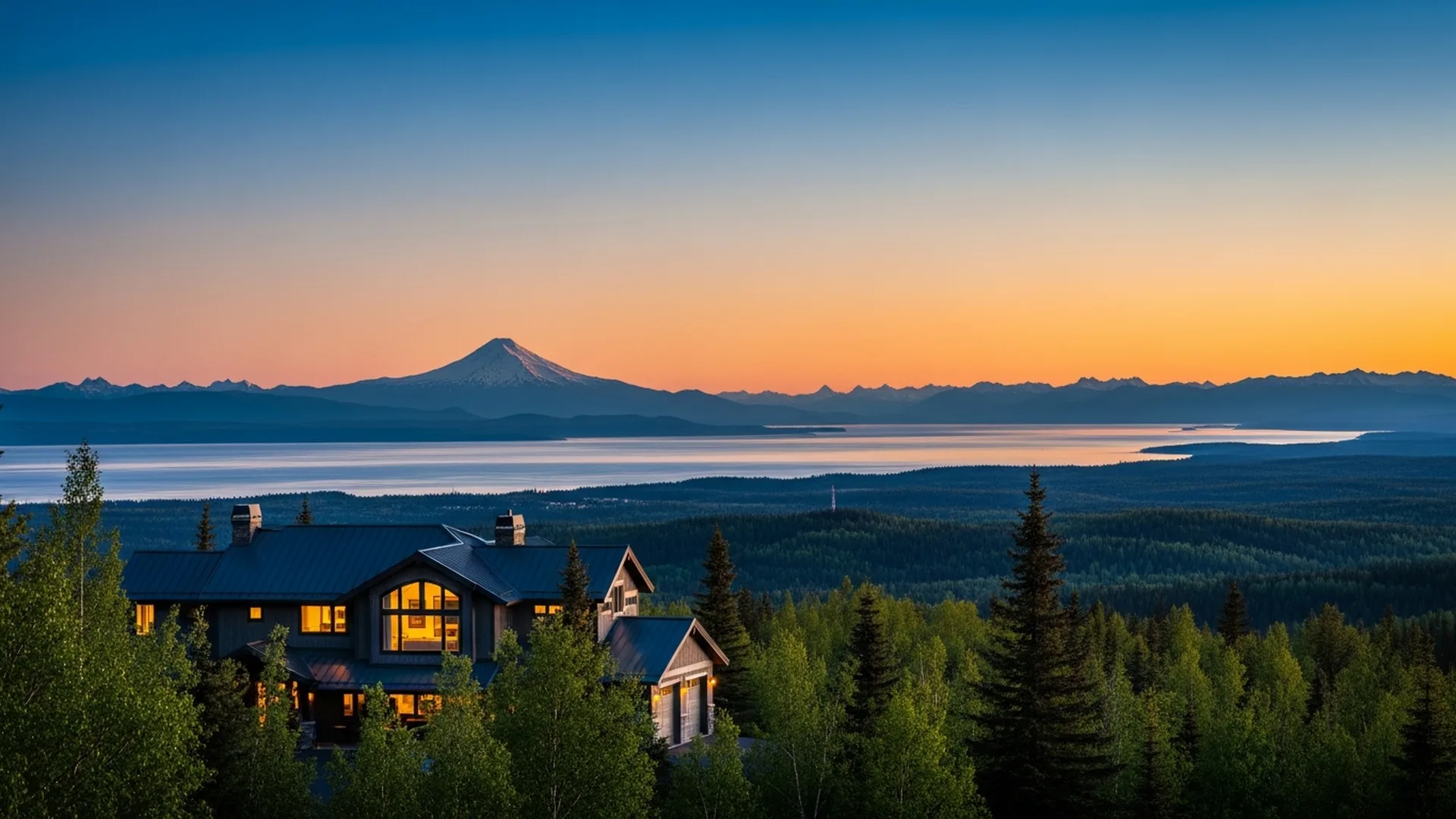
Goldenview is an upscale hillside area of South Anchorage centered on Goldenview Drive, part of the greater Rabbit Creek and Hillside community roughly 13 miles from downtown. Its defining traits are broad west- and south-facing views over Cook Inlet, Turnagain Arm, and Mt. Susitna (Sleeping Lady), and the fact that the Goldenview subdivision is served by public water and sewer — unusual for the Hillside, where most homes rely on private well and septic. Homes range from newer traditional and Craftsman houses on platted lots to larger custom view homes on the surrounding slope. The value questions that matter most here are the view corridor, winter sun exposure on the slope, driveway grade and winter access, and whether a given property is on public utilities or well and septic.
I’ve watched the Anchorage Hillside fill in over four decades, and Goldenview is one of the more misread pockets on the whole slope. Buyers see the name, picture a single subdivision, and stop there. In practice “Goldenview” is a corridor along Goldenview Drive on the lower and mid Hillside, running through and around the larger Rabbit Creek community, and the homes along it vary enormously — from newer subdivision houses to custom view homes on acreage. The address alone tells you far less than the lot does.
What follows is the guide I’d give a client before we ever tour: how the geography and the view corridor actually work here, why Goldenview’s utilities are genuinely different from the rest of the Hillside, and the due-diligence items that separate a smart Hillside purchase from an expensive lesson. This applies the same “designer’s eye” I bring to finishes and light — only pointed at the land.
- Goldenview runs along Goldenview Drive on the lower-to-mid Anchorage Hillside within the greater Rabbit Creek community, roughly 13 miles from downtown.
- The Goldenview subdivision proper has public water and sewer — genuinely unusual on the Hillside, where most homes rely on private well and septic.
- West- and south-facing lots look over Cook Inlet, Turnagain Arm, and Mt. Susitna (Sleeping Lady), with the Alaska Range and Denali visible on clear days.
- Slope orientation drives winter livability: Anchorage sees about 5.5 hours of daylight on the December solstice, with the midday sun only about 5–5.5° above the horizon.
- Well-and-septic properties in the surrounding area require a Municipality of Anchorage COSA to transfer title — a rule in force since 1998.
- Much of the surrounding Hillside is zoned R-6 (large-lot, up to one dwelling unit per acre); the Goldenview subdivision itself is more typical suburban platting.
- Anchorage School District attendance areas here include Bear Valley Elementary, Goldenview Middle, and South Anchorage High — confirm the current boundary per address.
Where Is Goldenview, and What Makes It a Hillside Address?
Goldenview sits in South Anchorage, east of the Seward Highway, climbing the lower and mid Hillside along Goldenview Drive. It falls within the greater Rabbit Creek community, and the Municipality even organizes local road-service areas by names like “Goldenview” and “Bear Valley” on the south Hillside. Downtown is roughly 13 miles away, but the drive feels shorter than the mileage because so much of it is a straight shot down to the highway.
The character shifts as you climb. Lower on the slope you’ll find platted subdivisions with wide, quiet streets and built-in garages; higher up and along the edges you get larger, more secluded lots — some wooded acreage, some bluff parcels overlooking the Rabbit Creek greenbelt and the inlet. Unlike the tightly gridded neighborhoods closer to town, most of Goldenview reads as suburban-to-rural, which is exactly what draws buyers up here.
| Orientation fact | Detail |
|---|---|
| Position | South Anchorage, east of Seward Highway; lower-to-mid Hillside along Goldenview Drive |
| Distance to downtown | Roughly 13 miles to the northwest |
| View direction | West / southwest — Cook Inlet, Turnagain Arm, Mt. Susitna, Alaska Range |
| Behind the slope | Chugach Mountains and Chugach State Park to the east |
| Main access | Goldenview Drive; Rabbit Creek Road to the Seward Highway |
How Does the Goldenview View Corridor Actually Work?
This is where the “designer’s eye” earns its keep. The reason Goldenview homes advertise inlet views is simple geography: the slope faces broadly west and southwest, down toward Cook Inlet and Turnagain Arm. Listings up here routinely describe unobstructed Cook Inlet views, Mt. Susitna (Sleeping Lady), the Alaska Range, and Denali on clear days — and the best of them are homes and bluff lots deliberately sited to capture that sightline.
But not every lot at the same elevation sees the same view. Three variables decide it: how high you are on the slope, which direction the primary living space faces, and how much mature spruce and birch stands between the house and the water. I’ve toured “view” lots where the inlet is fully screened by trees you’d have to clear — and lower lots with a cut sightline that outperform parcels 200 feet higher. Unlike a flat neighborhood where the view is roughly the same house to house, on the Hillside the view is a per-lot fact you verify with your own eyes, ideally standing where the great-room windows will go.
Why Does Winter Sun Matter More Than the Summer View?
Anchorage is a high-latitude city, and the numbers are stark. On the December solstice the city gets only about five hours and 28 minutes of daylight, and the sun climbs to roughly 5 to 5.5 degrees above the horizon at solar noon. Climatologists point out that below about five degrees, that low sun delivers almost no heating — the light is beautiful, but it’s a long, sideways glow rather than overhead sun.
On a slope, that changes everything about how a house lives in winter. A west- and south-facing Goldenview lot catches that low, prolonged light across the short day; a lot tucked on a north-facing pitch, or behind its own ridge, can lose the sun by early afternoon and feel dim for months. This is the durable advantage of Goldenview’s dominant orientation — and the reason I always want a client to see a candidate home in the darkest part of the year, not just at midsummer.
What Makes Goldenview’s Utilities Different From the Rest of the Hillside?
Here is the genuinely unusual thing about Goldenview, and it’s a real value driver: the Goldenview subdivision is served by public water and sewer. On the Anchorage Hillside that’s the exception, not the rule — most Hillside and Rabbit Creek homes rely on private wells and on-site septic systems. Real estate coverage of Rabbit Creek specifically calls out the Goldenview subdivision’s public utilities as distinctive for the area.
Why does that matter to a buyer? Public utilities take an entire category of due diligence — well yield, water quality, septic capacity and condition — off the table for those homes, along with the recurring cost and risk of maintaining them. But you cannot assume it. “Goldenview” as a corridor includes plenty of surrounding parcels that are on well and septic and zoned for large lots. Confirm the utilities on the exact property — the difference changes both the inspection process and, potentially, the price.
Public-utility Goldenview lots
No well/septic to test, maintain, or replace; no COSA required at sale; more predictable carrying costs; typically newer, platted subdivision homes.
Well-and-septic parcels nearby
Require well-yield, water-quality, and septic-adequacy verification; a Municipality COSA is required to transfer title; larger R-6 lots but more owner responsibility and seasonal testing constraints.
What Should You Check on a Well-and-Septic Goldenview-Area Property?
If the home you like sits on the well-and-septic side of the area, the central document is the COSA — a Certificate of On-Site Systems Approval. Per a Municipality of Anchorage ordinance passed in 1998, a COSA must be obtained to transfer title on any property served by a well or septic system. It’s the Municipality’s confirmation that a licensed civil engineer has inspected and tested the well and/or septic and found them compliant with municipal standards.
The mechanics are specific, and worth knowing before you’re under contract. The engineer runs a well flow test and pulls a water sample, and tests the septic absorption field. Per the Municipality’s guidelines and the engineers who do this work, the septic adequacy and well flow tests are generally valid for about two years, arsenic samples for about one year, and bacteria and nitrate samples for only about 90 days — and the MOA requires proof the septic tank was pumped within the past year. A frequent surprise: a lower level finished with extra bedrooms over the years can exceed the septic system’s original bedroom rating, which the COSA sizing is based on. Unlike a public-utility home, where none of this applies, a well-and-septic purchase lives or dies on getting this right early.
COSA costs vary by property, engineer, and the year, and public figures for the Municipality’s fees have changed over time — so I don’t quote a single current dollar amount here. Budget for an engineer’s inspection plus lab testing, and if a system needs work, replacement bids have historically ranged widely. Confirm current fees directly with the Municipality of Anchorage On-Site Water and Wastewater Section. Note too that Alaska’s frozen winter ground can constrain when septic and well testing can physically be done, which is why timing matters on a Hillside sale.
What About Access, Roads, and Winter Driving in Goldenview?
Two access questions decide whether a Hillside home is a pleasure or a chore for the six-plus months of winter. First, driveway grade: a steep, north-shaded driveway that ices over is a very different daily reality than a gentler, sun-exposed approach. Listings in the immediate area even note that easy access off Goldenview Drive can be more convenient than the steeper climbs on some neighboring streets. Second, road maintenance: on the Hillside, some roads are Municipality-maintained and some are community- or privately maintained through limited road service areas or small HOA-style arrangements, occasionally with a modest annual plowing-and-sanding fee. Ask specifically who plows the road to your prospective home, and how the driveway sheds snow and ice.
What Zoning and Lot Characteristics Should Buyers Expect?
The Goldenview subdivision proper is fairly conventional suburban platting with garages and quiet streets. Much of the surrounding Hillside, by contrast, is zoned R-6 — which the Municipality defines as a low-density, large-lot residential district intended for single- and two-family homes at densities up to about one dwelling unit per acre. That’s why you’ll see everything from half-acre subdivision lots to multi-acre wooded and bluff parcels within a short drive of one another. If you’re considering a vacant lot to build on, the zoning district, the on-site utility requirements, and buildable-area constraints on a sloped, treed parcel all deserve a hard look before you fall for the view.
Thinking of Selling in Goldenview? What Drives Value Here
When I prepare a Goldenview home for market, I start with the same three levers buyers price: the view corridor, the winter light, and the utilities story. If your home is on public water and sewer, that’s an advantage to state plainly — it removes buyer uncertainty. If you’re on well and septic, getting your COSA testing done early is the difference between a clean closing and a scramble; a failed or borderline system discovered late can delay or cost you a sale.
Then there’s presentation. My background is a degree in Interior Design and a long career in furnishings and design, and I use that eye specifically for how a Hillside home reads: staging the great room to frame the inlet sightline, choosing finishes that hold up and photograph well in Alaska’s low winter light, and directing photography to capture the view that buyers are actually paying for. When you’re ready, I can give you a current, address-specific read on value — the local numbers change, and a Goldenview home should be priced on its own lot, view, and utilities, not a neighborhood average.
- Municipality of Anchorage, On-Site Water & Wastewater Section — Certificate of On-Site Systems Approval (COSA) requirement and process; ordinance in effect since 1998 (muni.org/onsite).
- Municipality of Anchorage, Title 21 / Planning — R-6 Low-Density Residential (1 acre) district definition and intent.
- Municipality of Anchorage, Assembly limited road service area (LRSA) map — Goldenview and Bear Valley south-Hillside service areas and local roads.
- USGS — Little Rabbit Creek at Goldenview Drive monitoring site (area hydrology / greenbelt).
- timeanddate.com and Anchorage Daily News / University of Alaska Fairbanks climatologist commentary — Anchorage December-solstice daylight (~5h 28m) and low midday sun angle (~5°).
- Anchorage School District — attendance areas: Bear Valley Elementary, Goldenview Middle, South Anchorage High (confirm current boundary by address).
- Homes.com / area real estate market summaries — Goldenview subdivision public water & sewer, home size and price ranges (used as market reference, not municipal fact).
Touring Goldenview? Let’s Read the Lots Together.
I’ll help you check the view corridor, winter sun, utilities, and access before you write an offer.
Frequently Asked Questions
Goldenview is an upscale hillside area of South Anchorage centered on Goldenview Drive, part of the greater Rabbit Creek and Hillside community. It sits east of the Seward Highway and is roughly 13 miles from downtown Anchorage. The area climbs the lower and mid Hillside, so homes higher on the slope generally have wider Cook Inlet and Turnagain Arm views.
It depends on the exact subdivision. The Goldenview subdivision proper is served by public water and sewer, which is unusual for the Anchorage Hillside where most homes rely on private wells and septic systems. Many surrounding Rabbit Creek and Hillside parcels are on well and septic, so you should confirm utilities on each specific property before you write an offer.
West- and south-facing Goldenview homes and bluff lots look out over Cook Inlet, Turnagain Arm, and Mt. Susitna (Sleeping Lady), with the Alaska Range and Denali visible on clear days. The exact view depends on elevation on the slope, the direction the lot faces, and how much mature tree cover stands between the house and the inlet. Higher lots and cleared sightlines generally hold the widest, most durable views.
Anchorage gets only about five and a half hours of daylight on the December solstice, and the sun climbs to roughly five degrees above the horizon at midday. On the Hillside, a south- and west-facing slope catches that low, angled winter light for far more of the short day than a lot tucked on a north-facing hillside or behind a ridge. That is why checking sun exposure, not just the summer view, is one of the most important things to verify before buying.
A COSA is a Certificate of On-Site Systems Approval. Under a Municipality of Anchorage ordinance in effect since 1998, a COSA is required to transfer title on any property served by a private well or septic system, so it applies to well-and-septic homes rather than the public-utility parts of Goldenview. A licensed civil engineer tests the well and septic system and submits the results to the Municipality’s On-Site Water and Wastewater Section for approval.
Goldenview appeals to buyers who want Hillside views and newer construction with more predictable utilities than much of the surrounding area, since the Goldenview subdivision has public water and sewer. Homes range from newer traditional and Craftsman-style houses on subdivision lots to larger custom homes on view acreage nearby. As with any Hillside purchase, the value drivers to weigh are the view corridor, winter sun exposure, driveway grade and winter access, and whether the property is on public utilities or well and septic.
The Goldenview area is served by the Anchorage School District. Attendance areas in this part of the Hillside include Bear Valley Elementary School, Goldenview Middle School, and South Anchorage High School. Attendance boundaries are set by the district and can change, so confirm the current assignment for any specific address directly with the Anchorage School District.
Pricing varies widely by lot, view, and whether the home is in a platted subdivision or on custom view acreage. Published market summaries have placed three-bedroom homes in the Goldenview subdivision roughly in the $500,000s to $600,000s and four-bedroom homes roughly $600,000 to $900,000, while larger custom view homes in the broader Rabbit Creek and upper Hillside area can run well above one million dollars. Because these figures move with the market, treat them as a starting reference and ask for a current, address-specific analysis.