

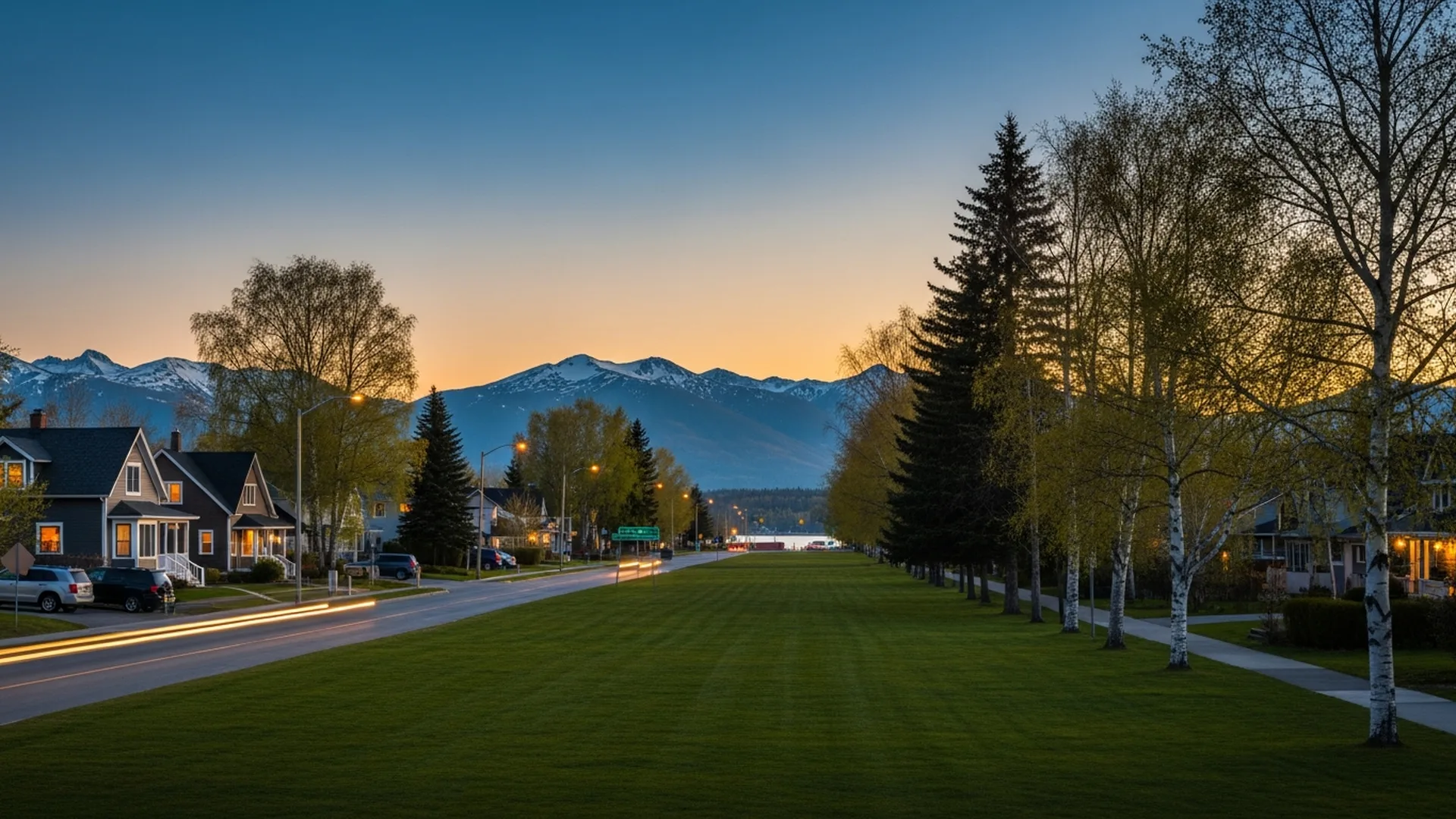
South Addition is a historic residential neighborhood at the southern edge of downtown Anchorage, bounded by Delaney Park Strip to the north, Westchester Lagoon to the south, the Tony Knowles Coastal Trail bluffs and Cook Inlet to the west, and roughly L and Cordova Streets to the east. It is one of Anchorage's four original neighborhoods, with a housing mix of 1940s wartime cottages, mid-century ranches, renovated historic homes, and bluff-front properties in adjacent Bootlegger's Cove. What sets it apart is genuine walkability — unusual for Anchorage — and a fixed supply of land between downtown and the inlet that keeps inventory tight and turnover low. West-facing bluff homes look across Cook Inlet to the Alaska Range and, on clear days, Denali.
I have watched Anchorage change for forty years, and South Addition is the one neighborhood that has never really had to reinvent itself. It was here before most of the city — one of Anchorage's four original neighborhoods, alongside downtown, Government Hill, and Fairview — and it still does the one thing almost no other part of town can: it lets you live an unhurried, walkable, downtown-edge life while looking out over Cook Inlet and the Alaska Range. For a certain buyer, nothing else in Anchorage substitutes for it.
This is a buyer-first neighborhood profile, with a dedicated section for owners thinking about selling. My aim is to give you the real geography, the real housing stock, and the two due-diligence items that actually matter here — not a brochure.
- South Addition sits at the southern edge of downtown, framed by Delaney Park Strip (north), Westchester Lagoon and Chester Creek (south), the Coastal Trail bluffs and Cook Inlet (west), and roughly L/C/Cordova Streets (east).
- It is one of Anchorage's four original neighborhoods, with planning that began in the early 1900s and a housing wave tied to 1940s World War II military expansion.
- Housing stock is unusually varied and old for Anchorage: 1940s cottages, mid-century ranches, renovated historics, and newer infill townhomes. Roughly 40 properties appear in the Alaska Heritage Resources Survey.
- The Oscar Anderson House on M Street (built 1915), considered the first wood-frame house in Anchorage, is on the National Register of Historic Places and sits in Elderberry Park.
- Homes here are served by AWWU public water and sewer, so the Municipality's COSA well-and-septic requirement generally does not apply — unlike Hillside or Eagle River.
- The Bootlegger Cove Formation — water-saturated glacial clay under the coastal bluff — amplifies seismic shaking and is a real geotechnical due-diligence item.
- The Tony Knowles Coastal Trail (11 paved miles to Kincaid Park) runs the western edge; bluff-side homes reach it in a short walk, and it is used year-round for cycling, running, and skiing.
Where exactly is South Addition, and what surrounds it?
South Addition occupies the wedge of ground directly south of downtown. Per neighborhood boundary descriptions, it runs from Delaney Park Strip on the north — Anchorage's first airstrip, now its central green — south to the Chester Creek greenbelt and Westchester Lagoon, west to the Cook Inlet bluffs, and east toward the C Street and Cordova Street edge. The Alaska Heritage record and local history place the neighborhood among Anchorage's four original residential areas, with planning that began in the early 1900s.
What matters for value is the geometry: the neighborhood is boxed in by downtown on one side and salt water on the other. As one local market write-up put it plainly, you cannot manufacture more land between downtown and the inlet. That permanent supply ceiling — combined with owners who tend to hold homes for decades — is the structural reason inventory stays tight and prices hold their footing through market cycles.
| Edge | Boundary feature | What it means for buyers |
|---|---|---|
| North | Delaney Park Strip & downtown | Walk to museum, Performing Arts Center, offices |
| West | Cook Inlet bluff & Coastal Trail | West-facing views; Bootlegger's Cove bluff-front homes |
| South | Westchester Lagoon & Chester Creek Trail | Waterfowl park, skating, car-free trail commute |
| East | Roughly L / C / Cordova Streets | Transition toward Fairview and midtown |
What kind of homes will you actually find in South Addition?
This is the oldest and most architecturally varied housing you'll find in Anchorage. The neighborhood grew during the 1940s World War II boom, when it was platted south of the original townsite to house military families and civilian workers; by the 1970s and 1980s, as the oil economy expanded, it shifted from working-class wartime housing to a neighborhood prized for its proximity to downtown, mature trees, and established streets.
The Anchorage Daily News has noted the neighborhood holds World War II–era houses — and some older — with architectural details you don't typically see in South Anchorage, Midtown, or Spenard, and that roughly 40 South Addition properties are described in the Alaska Heritage Resources Survey. The Oscar Anderson House on M Street, built in 1915 and considered the first wood-frame house in Anchorage, is on the National Register of Historic Places and sits in Elderberry Park. Practically, you'll encounter three broad buckets: preserved or renovated historic and 1940s–50s homes, mid-century ranches (many thoughtfully updated), and a limited amount of newer infill — including modern townhomes on the last waterfront parcels in Bootlegger's Cove.
What views do South Addition and Bootlegger’s Cove homes have?
The neighborhood's western edge is its trophy. Homes on the bluff — and in adjacent Bootlegger's Cove — face west across Cook Inlet toward Mount Susitna (the "Sleeping Lady") and the Alaska Range, with Denali visible on clear days to the north. Because the sightline runs west over open water, these homes catch Anchorage's long summer sunsets, and the low light pollution along the coast makes the darker months a genuine northern-lights vantage. Newer Bootlegger's Cove townhome projects have been designed specifically to orient living space and primary suites toward the inlet, with staggered massing so each unit keeps a water view.
A realistic note on orientation: a west-facing view here trades morning sun for evening light and sunset. In a high-latitude city where daylight swings dramatically through the year, that's a lifestyle choice worth thinking through before you fall for the view. It's the kind of thing I walk clients through room by room.
Do you need a COSA or well-and-septic inspection in South Addition?
Generally, no — and this is a real structural difference from the Hillside and Eagle River luxury markets. As a downtown-edge neighborhood, South Addition is served by the Anchorage Water and Wastewater Utility (AWWU) municipal water and sewer. The Municipality of Anchorage requires a Certificate of On-Site Systems Approval (COSA) for title transfers of homes served by a private well and/or septic system — a process that involves engineer testing, a septic adequacy test, well water sampling for arsenic, nitrates and bacteria, and a $600 Municipality review fee. On public utilities, that whole layer typically drops away.
What replaces it here is ordinary urban due diligence: confirm the property is in fact connected to AWWU (not on a legacy private system), and note that AWWU permits and inspects new and repaired service connections. It's a lighter lift than a well-and-septic property, but it's not zero — verify, don't assume.
Because South Addition homes are on public water and sewer, sellers here avoid the COSA timing risk that shapes well-and-septic sales elsewhere in the Municipality — where septic and well testing need unfrozen ground and lab turnaround, and a failed system can delay or derail a closing. That's one fewer seasonal variable in a South Addition transaction.
Is the Bootlegger Cove clay a real concern for buyers?
It's the moat item most out-of-state buyers have never heard of, and it's worth taking seriously without letting it scare you off. The coastal bluff sits on the Bootlegger Cove Formation — water-saturated glacial clay laid down beneath much of downtown Anchorage. This clay amplifies seismic shaking and is prone to liquefaction, and it contributed significantly to the destruction in the 1964 Great Alaska Earthquake, when a coastal-bluff neighborhood failed. By contrast, the more consolidated soils in the hills to the east are more stable.
Practically, this is a lot-by-lot geotechnical question, not a neighborhood verdict. On or near the bluff, I'd want a look at the soils, the foundation, and any post-1964 engineering or slope work before writing an offer — the same way a Hillside buyer checks the septic. Homes have been built and rebuilt here successfully for decades; the point is to buy with eyes open, which is exactly where a local who knows the ground earns their keep.
What is daily life like — and can you really leave the car home?
This is the payoff, and it's the one thing South Addition offers that the rest of Anchorage largely can't. Flat terrain and sidewalks put the Anchorage Museum, the Alaska Center for the Performing Arts, downtown offices, New Sagaya City Market, and neighborhood cafes within an easy walk. The Tony Knowles Coastal Trail — eleven paved miles from downtown to Kincaid Park — runs the western edge and is used year-round: running and cycling in summer, cross-country skiing and fat-biking in winter. The Chester Creek Trail heads east from Westchester Lagoon toward Goose Lake and the university district, forming a nearly car-free commute route, and both tie into Anchorage's larger greenbelt network.
What buyers love
- Genuine walkability — rare in Anchorage
- Historic character and mature, tree-lined streets
- West-facing Cook Inlet & Alaska Range views on the bluff
- Coastal Trail and Chester Creek Trail at the doorstep
- Public water/sewer — no COSA layer
- Fixed land supply supports long-run pricing
What to weigh
- Tight inventory and low turnover — you may wait for the right home
- Older housing stock means systems/updates to evaluate
- Bluff lots warrant a geotechnical review (Bootlegger Cove clay)
- West-facing views trade morning sun for evening light
- Smaller, in-town lots vs. Hillside or Eagle River acreage
Thinking of selling in South Addition? What drives value here
South Addition rewards a different playbook than a new-construction submarket. Value turns first on lot position — proximity to the Park Strip, a bluff view line, or Westchester Lagoon — then on the quality and restraint of any renovation, and on view orientation. Buyers here are paying for the neighborhood's authenticity, so the highest returns generally come from preserving period character while updating systems, kitchens, and baths tastefully. This is where my design background does real work: staging and prep that honor a mid-century or historic home read as premium, while an over-modernized flip can actually leave money on the table in this specific market.
Because turnover is low and supply is structurally capped, a well-prepared South Addition home tends to find serious buyers without languishing. When you're ready to understand your specific number, start with a data-backed valuation for the West and Coastal Anchorage market — get your Anchorage home value — and I'll build a custom pricing view around your lot, your view line, and your home's era.
- Municipality of Anchorage — On-Site Water & Wastewater Section: COSA requirement and guidelines, and $600 review fee (muni.org / On-Site program).
- Anchorage Water and Wastewater Utility (AWWU) — water/sewer service connection permits and private-system disconnection rules.
- Alaska Dept. of Environmental Conservation — on-site wastewater systems in real estate transactions (dec.alaska.gov).
- Anchorage Daily News — South Addition as one of Anchorage's four original neighborhoods; Alaska Heritage Resources Survey (~40 properties); WWII-era and older housing stock.
- USGS / CoastView — Bootlegger Cove Formation: water-saturated glacial clay, seismic amplification, and liquefaction relevance to the 1964 earthquake.
- Municipality of Anchorage Office of Community Planning & Development — South Addition Historic Context Statement & Building Survey.
- Alaska.org / Municipality of Anchorage Parks — Tony Knowles Coastal Trail (11 paved miles, downtown to Kincaid Park) and Chester Creek Trail.
- Oscar Anderson House (built 1915), Elderberry Park — National Register of Historic Places listing.
Looking for the right home in South Addition?
Inventory is tight and homes move quickly. Let’s make sure you see the right one first — call Bill at 907-560-4090.
Frequently Asked Questions
South Addition sits at the southern edge of downtown Anchorage. It is generally bounded by Delaney Park Strip to the north, Westchester Lagoon and Chester Creek to the south, the Tony Knowles Coastal Trail bluffs and Cook Inlet to the west, and roughly L, C, and Cordova Streets to the east. It is one of Anchorage's four original neighborhoods, with planning that began in the early 1900s.
South Addition pairs a walkable, downtown-adjacent location with historic architecture and a permanent supply ceiling — you cannot manufacture more land between downtown and Cook Inlet. The mix of 1940s wartime cottages, mid-century ranches, renovated historic homes, and bluff-front estates gives the streets a character newer Anchorage submarkets don't have, and lots tend to be held by owners for decades, keeping turnover low.
As a downtown-edge neighborhood, South Addition homes are served by the Anchorage Water and Wastewater Utility (AWWU) public water and sewer rather than private wells and septic systems. That means the Certificate of On-Site Systems Approval (COSA) the Municipality requires for well-and-septic sales generally does not apply here — a meaningful difference from Hillside and Eagle River properties. Always confirm connection on a specific property.
West-facing homes along the bluff and in adjacent Bootlegger's Cove look across Cook Inlet toward the Alaska Range, Mount Susitna (the "Sleeping Lady"), and — on clear days — Denali on the northern horizon. Because the sightline faces west over the water, these properties also capture long summer sunsets and, with low light pollution near the coast, northern-lights viewing in the darker months.
The Bootlegger Cove Formation — water-saturated glacial clay beneath much of downtown Anchorage — can amplify seismic shaking and is prone to liquefaction, and it contributed to damage in the 1964 earthquake. This is a genuine due-diligence item on the coastal bluff, not a reason to avoid the neighborhood. Soil conditions vary lot by lot, so a geotechnical review and a look at the home's foundation and any post-1964 engineering are worth doing before you buy.
South Addition has some of Anchorage's oldest and most varied housing — 1940s wartime cottages, 1950s ranches, renovated historic homes, and newer infill townhomes. Roughly 40 properties in the neighborhood are documented in the Alaska Heritage Resources Survey, and the Oscar Anderson House on M Street, built in 1915, is on the National Register of Historic Places. Many homes have been renovated while preserving original details.
Yes — this is the exception to Anchorage's generally car-oriented layout. Flat terrain and sidewalks put the Anchorage Museum, the Alaska Center for the Performing Arts, downtown offices, New Sagaya City Market, and cafes within walking distance, and the Tony Knowles Coastal Trail and Chester Creek Trail wrap the neighborhood's western and southern edges for car-free running, cycling, and winter skiing.
Value here rewards preserved period character combined with tasteful, well-executed updates — buyers pay for the neighborhood's authenticity, not a gut-renovation that erases it. Pricing turns on lot position (proximity to the Park Strip, the bluff, or the lagoon), the quality of any renovation, and view orientation. Because turnover is low and inventory tight, well-prepared homes tend to attract serious buyers quickly.