

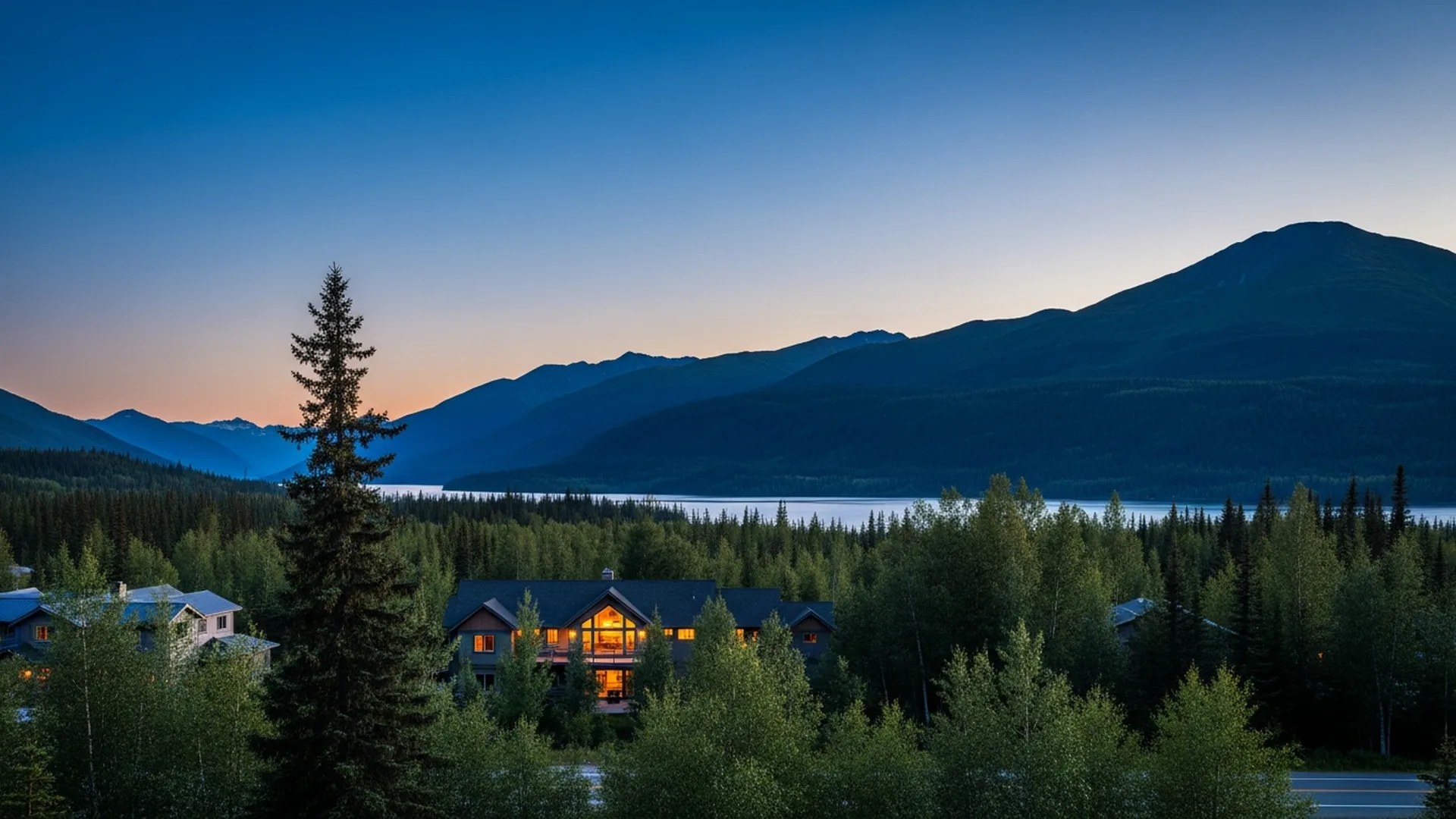
Peters Creek is a wooded, hillside residential area within Chugiak, in the Municipality of Anchorage, sitting along the Glenn Highway about 20 to 21 miles northeast of downtown Anchorage between Eagle River and Eklutna. It appeals to buyers who want larger, more private lots — commonly a half-acre to five acres — with long views toward Knik Arm and the Chugach, in exchange for a longer commute than the Anchorage Bowl. Most homes here run on private wells and on-site septic, so the two things that most affect a purchase are the Certificate of On-Site Systems Approval (COSA) the Municipality requires before a title transfer, and the area's higher snow-load and lighter historical code-enforcement compared with central Anchorage. Get both reviewed carefully and Peters Creek can deliver more land and privacy per dollar than almost anywhere else inside the Municipality.
Buyers touring Peters Creek for the first time almost always react to two things at once: how much more land they can get here than closer to town, and how quickly the wooded hillside makes them forget they are still inside the Municipality of Anchorage. That combination is the whole appeal. Peters Creek sits within Chugiak, a collection of historically separate neighborhoods that were settled in the 1950s largely by homesteaders and are now one of the main areas of suburban expansion near Anchorage.
Having watched this corridor grow for forty years, I tell buyers the same thing every time: the land is the easy part to love. The details that decide whether a Peters Creek home holds its value — the well, the septic, the snow load, the road access — are the ones that reward homework. This guide walks through the parts of a Peters Creek purchase that a seasoned local checks before writing an offer, not after.
- Peters Creek is part of Chugiak, within the Municipality of Anchorage, roughly 20–21 miles northeast of downtown along the Glenn Highway, between Eagle River and Eklutna.
- Lots commonly range from about a half-acre to five acres, with wooded, hillside parcels and a mix of split-level, ranch, log, and Craftsman homes.
- Private wells and on-site septic systems are common; the Municipality of Anchorage requires a Certificate of On-Site Systems Approval (COSA) — obtained by the seller — before title transfer on a well/septic home.
- A licensed civil engineer performs the COSA, including a well flow test and a septic adequacy test, and verifies code-required separation distances.
- Anchorage's baseline ground snow load is about 50 psf and increases with elevation in the Anchorage/Eagle River area, so higher Peters Creek lots can carry heavier design snow loads.
- Chugiak, Peters Creek, and Eagle River have historically had lighter residential building-code enforcement than the Anchorage Bowl — a reason to prioritize inspection and structural review, especially on older homes.
- Upper hillside lots can capture long views toward Knik Arm and the mountains, which is a primary value driver for premium buyers in the area.
Where Is Peters Creek and What Is It Like to Live There?
Peters Creek is a residential area inside the Chugiak community, which itself is part of the consolidated Municipality of Anchorage. Chugiak is described geographically as sitting between Eagle River to the south and Eklutna to the north, and between Knik Arm to the west and Chugach State Park — the Chugach Mountains — to the east. Peters Creek takes its name from the glacier-fed stream that flows northwest through the area toward Knik Arm, part of the Cook Inlet watershed.
The character here is genuinely rural-feeling: winding residential streets climb the forested hillside, lots are large and tree-filled, and the homes range from tidy split-levels and ranches to custom log and Craftsman houses tucked into the woods. Local orientation is simple — the Glenn Highway is the spine, everything drains toward Knik Arm to the west, and the terrain rises toward Chugach State Park to the east. Peters Creek Community Park, with its wooded disc-golf course along the creek, and trailheads reaching into the Chugach are the kind of amenities that define daily life here.
| Orientation Fact | Detail |
|---|---|
| Parent community | Chugiak, within the Municipality of Anchorage |
| Position on the Glenn Highway | North of Eagle River, south of Eklutna |
| Distance to downtown Anchorage | About 20–21 miles southwest |
| To the west | Knik Arm (Cook Inlet watershed) |
| To the east | Chugach State Park / Chugach Mountains |
| What rises with elevation | Views, and design snow load |
How Long Is the Commute from Peters Creek to Anchorage?
Plan on roughly 20 to 21 miles into downtown Anchorage along the Glenn Highway — generally a 25 to 35 minute drive outside of peak conditions, longer on a snowy morning. Eagle River's shopping and services sit just a few minutes south, and the Mat-Su Valley (Wasilla, Palmer) is a short drive north. The People Mover system provides limited bus service connecting the area to Anchorage for commuters.
Here is the honest trade-off, and it is the one every serious buyer weighs. Unlike a home in the Anchorage Bowl, where you pay a premium for proximity and get a smaller lot, Peters Creek asks you to spend more time on the road in exchange for meaningfully more land and privacy. For buyers who value acreage, a shop, or a quiet wooded setting over a five-minute commute, that math works well. For those who commute downtown daily in winter, it is worth driving the route in January before deciding.
Do Peters Creek Homes Have Well and Septic — and What Should You Check?
Yes, very often. Because of the rural setting, private wells and on-site septic systems are common across Chugiak and Peters Creek. That is the single most important due-diligence area on almost any home here, and Alaska has a clear framework for it.
All septic (on-site wastewater) systems in Alaska fall under the Alaska Department of Environmental Conservation's regulations at 18 AAC 72, which set minimum treatment standards, separation distances, and construction requirements and require registration or approval for wastewater systems. Design flow is calculated at 150 gallons per day per bedroom, and a private-residence septic tank must hold at least 1,000 gallons plus 250 gallons per bedroom over three. Notably, DEC points out that the Municipality of Anchorage is one of only two local governments in the state (with the City of North Pole) that actually regulate private water wells and set their own standards — so in Peters Creek you have both the state and the Municipality in play.
The COSA: What It Is and Why It Matters at Closing
The mechanism that brings this to a head in a Peters Creek sale is the Certificate of On-Site Systems Approval, or COSA. Per the Municipality of Anchorage's On-Site Water and Wastewater Section, municipal code requires a COSA before the transfer of ownership of a single-family home or duplex served by an on-site well or septic system, and the seller is responsible for obtaining it. A licensed civil engineer researches the records, and if there hasn't been a test within the past two years, performs a well flow test and a septic adequacy test, verifies code-required separation distances, and submits the results. If the system falls short, upgrades may be required before a final COSA is issued.
Two municipal details are worth remembering. First, the well flow standard: for wells serving three or fewer dwelling units, if the sustained production and recovery is less than 150 gallons per day per bedroom, the Municipality issues an advisory notice. Second, separation distances: Anchorage code generally requires a septic disposal field to sit at least 100 feet from surface water and at least 100 feet between a well and a septic system, among other setbacks. If those distances can't be met, a home may be eligible for a case-by-case waiver from the department.
On-Site Property Upsides
- Larger, more private lots than city-serviced neighborhoods
- No monthly municipal water/sewer utility bill
- Documented, engineer-verified systems via the COSA process
- Room for shops, gardens, and acreage uses
What to Budget For
- Well flow and septic adequacy can require upgrades before sale
- Separation-distance shortfalls may need a waiver
- Periodic pumping and system maintenance are the owner's job
- Frost-protection and insulation matter for tanks and lines here
What About Snow Load, Seismic Risk, and Code Enforcement in Chugiak?
Cold-climate construction is where a designer's eye and local experience pay off. Anchorage's baseline ground snow load is roughly 50 pounds per square foot. But the Structural Engineers Association of Alaska notes that in the Anchorage/Eagle River area the ground snow load increases with elevation — guidance adds load for every 100 feet of elevation above the cited base. Because Peters Creek climbs the Chugach foothills, a higher lot can carry a meaningfully heavier design snow load than a valley-floor home. On any hillside or custom house, I ask what snow load the roof was actually engineered for.
Two more Southcentral realities: Anchorage sits in a high seismic zone (Seismic Design Category D), and frost depth is severe, so foundations in the Municipality typically extend to roughly 42 to 48 inches. The most important local nuance for buyers, though, is code enforcement. While Chugiak, Peters Creek, and Eagle River are inside the Municipality of Anchorage, they have historically had lighter residential building-code enforcement than the Anchorage Bowl. Reporting on the 2018 magnitude 7.1 earthquake, and a University of Alaska Anchorage study, found that buildings in non-code-enforced areas were damaged at dramatically higher rates than those in code-enforced areas. That doesn't mean avoid Peters Creek — it means an older home here earns a careful inspection and, where warranted, a structural review.
Because much of Chugiak's inventory sits outside heavy code enforcement, quality varies more here than in the Anchorage Bowl — a well-built, engineered custom home and a deferred-maintenance older cabin can sit on similar lots at very different real values. Inspection quality is what separates them, and it's why a documented, engineer-tested system and a sound structure command a premium at resale.
What Kinds of Homes and Lots Should Buyers Expect in Peters Creek?
Peters Creek offers one of the widest ranges in the Eagle River–Chugiak corridor. You'll find split-level and ranch homes on wooded lots, custom log and Craftsman houses, and larger acreage parcels — commonly a half-acre to about five acres — that can support horse setups, shops, or dog-team space. The upper hillside lots are where premium value concentrates: elevation buys both privacy and long views toward Knik Arm and the mountains, and a creek-frontage or view parcel is genuinely scarce.
For buyers coming from the Hillside or West Anchorage, the mental adjustment is that value here is measured in land, privacy, and setting as much as in finishes. A thoughtfully finished custom home on acreage with a documented well and septic and an engineered structure is the combination that holds value best in this market.
Thinking of Selling in Peters Creek? What Drives Value Here
If you're selling in Peters Creek, three things move your number more than staging alone. First, your on-site systems: because the Municipality requires the seller to obtain a COSA before title transfer, getting your well and septic tested early — ideally before listing — removes the biggest deal-timing risk and lets you address any upgrade on your schedule rather than under closing pressure. Second, documentation: as-builts, permits, well logs, and any engineered structural or septic work reassure buyers in an area known for uneven code enforcement, and that confidence shows up in the price. Third, presentation of the land and light — where my background in interior design and finishes helps most is reading how a home's flow, sightlines, and finish level should be shown to a premium buyer. When you're ready, I can prepare a specific market analysis for your Peters Creek property. Start with the Anchorage home value page for a first read on your number.
- Municipality of Anchorage, Development Services — On-Site Water & Wastewater Section (Wells & Septic; COSA requirement at title transfer; engineer testing; separation-distance verification and waivers).
- Anchorage Municipal Code, Chapters 15.55 (Water Wells) and 15.65 (Wastewater Disposal) — separation distances (100 ft from surface water; well/septic setbacks) and 150 gpd-per-bedroom well flow advisory.
- Alaska Dept. of Environmental Conservation — 18 AAC 72 (wastewater design flow of 150 gpd/bedroom; minimum septic tank capacity; separation distances at 18 AAC 72.100); DEC Private Drinking Water Wells page (MOA and North Pole as the only local well-regulating governments).
- Structural Engineers Association of Alaska — Alaska ground snow loads (Anchorage/Eagle River load increases with elevation).
- Municipality of Anchorage Building Safety Division — Title 23 code adoption, ~42–48 in. frost-depth footings, Seismic Design Category D; reporting/UAA study on 2018 M7.1 earthquake damage in non-code-enforced areas including Chugiak/Eagle River.
- USGS Geographic Names / U.S. Census geography — Chugiak and Peters Creek location, Glenn Highway corridor, and distance to Anchorage.
Looking at Homes in Peters Creek?
Work with a 40-year Anchorage local who knows the wells, septic, and hillside lots here. Call Bill Ure at 907-560-4090.
Frequently Asked Questions
Peters Creek is a residential area within Chugiak, in the Municipality of Anchorage, sitting along the Glenn Highway between Eagle River to the south and Eklutna to the north. It is roughly 20 to 21 miles northeast of downtown Anchorage, backed against Chugach State Park to the east and sloping toward Knik Arm to the west. The name comes from the glacier-fed Peters Creek that flows through the area toward Cook Inlet's Knik Arm.
Peters Creek sits about 20 to 21 miles northeast of downtown Anchorage along the Glenn Highway, generally a 25 to 35 minute drive depending on traffic and winter conditions. Eagle River, with its shopping and services, is only a few minutes south. The trade-off most buyers weigh is a longer commute in exchange for larger, more private lots than they would find closer to the Anchorage Bowl.
Many do. Because of the rural setting, private wells and on-site septic systems are common in Peters Creek and Chugiak. Before you buy, confirm the system through a Certificate of On-Site Systems Approval (COSA). Under Anchorage Municipal Code, the seller must obtain a COSA before transferring title on a home served by a well or septic, and a licensed civil engineer inspects and tests the systems to confirm they are adequate and meet code.
A COSA is a Certificate of On-Site Systems Approval issued by the Municipality of Anchorage's On-Site Water and Wastewater Section. Municipal code requires one before the title transfers on a single-family home or duplex served by an on-site well or septic system, and the seller is responsible for obtaining it. A licensed civil engineer performs a well flow test and a septic adequacy test, verifies code-required separation distances, and submits the results for the certificate.
Anchorage's baseline ground snow load is about 50 pounds per square foot, and per the Structural Engineers Association of Alaska it increases with elevation in the Anchorage and Eagle River area. Because Peters Creek climbs the Chugach foothills, higher lots can carry meaningfully heavier design snow loads than valley-floor properties. On a hillside or custom home, ask what snow load the roof was engineered for before you buy.
This is an important due-diligence point. Although Chugiak, Peters Creek, and Eagle River are inside the Municipality of Anchorage, they have historically had less residential building-code enforcement than the Anchorage Bowl. A University of Alaska Anchorage study of the 2018 magnitude 7.1 earthquake found buildings in non-code-enforced areas were damaged at far higher rates than code-enforced areas. That makes a thorough inspection and structural review especially valuable on an older Peters Creek home.
Peters Creek offers a wide mix, from split-level and ranch homes on wooded lots to custom log and Craftsman homes on multi-acre parcels climbing the hillside. Lots commonly range from about a half-acre to five acres, and some larger parcels support horse setups, shops, or dog-team space. Upper hillside lots can capture long views toward Knik Arm and the mountains, which is a primary value driver for premium buyers here.