

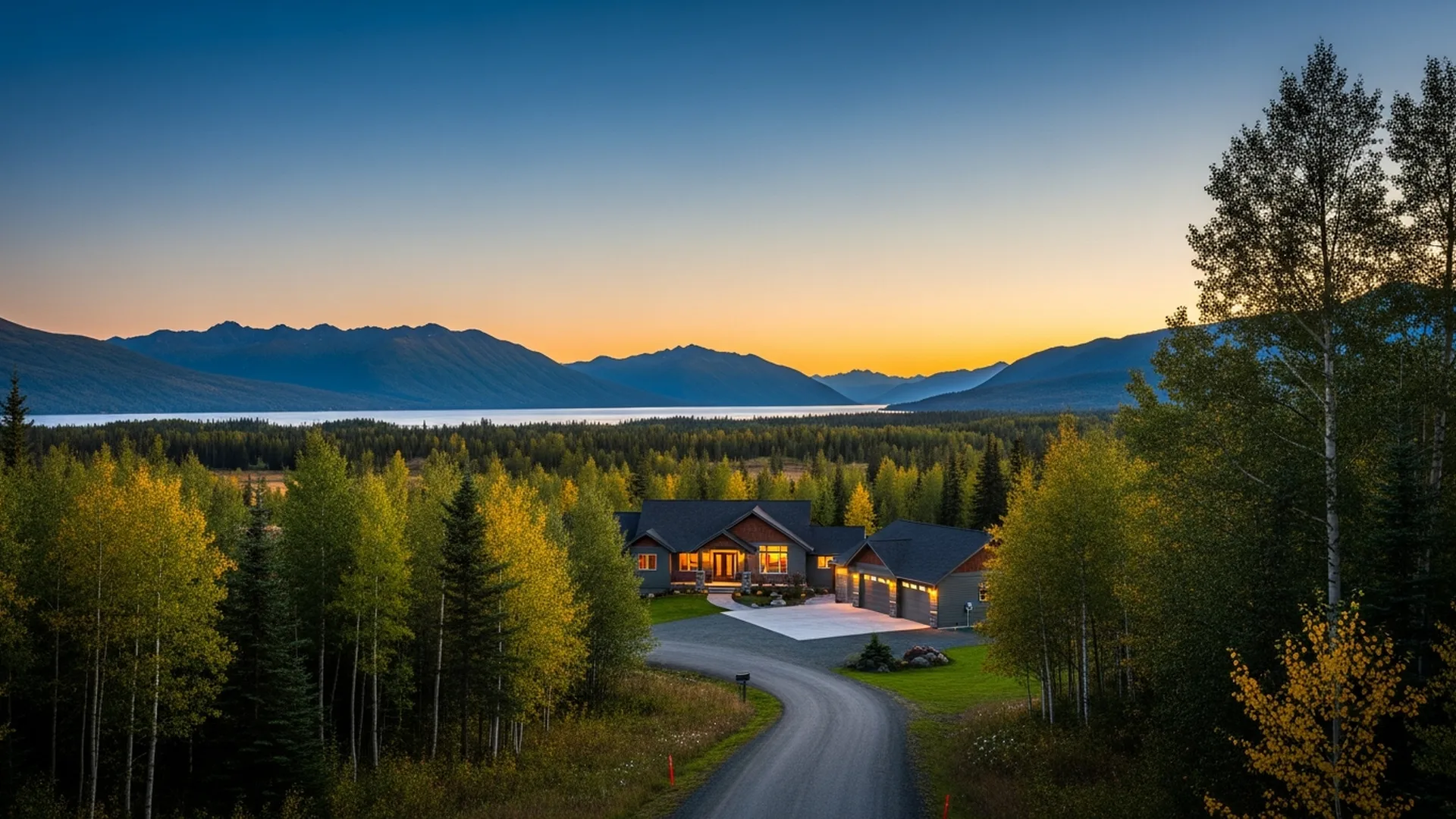
Chugiak is an unincorporated community inside the Municipality of Anchorage, about 20 to 21 miles northeast of downtown along the Glenn Highway, between Eagle River and Eklutna. Homes here are defined by wooded acreage — commonly a half-acre to five acres — with Chugach Mountain views and a rural feel, yet the commute to Anchorage is usually under 45 minutes and to JBER often 20 to 30. Because many Chugiak parcels rely on a private well and on-site septic rather than city utilities, the two things that most shape a purchase here are the water and wastewater system and the lot itself. Any well-and-septic home requires a Municipality of Anchorage Certificate of On-Site Systems Approval (COSA) at title transfer, so I tell buyers to understand those systems early rather than at the closing table.
Chugiak is one of those Anchorage-area names that even longtime residents sometimes lump in with Eagle River — but on the ground it’s a distinct place with a distinct kind of home. Where Eagle River has a compact commercial core, Chugiak spreads out along the Glenn Highway in wooded, large-lot parcels that climb toward the Chugach. Having watched this stretch of the corridor for forty years, I’ve seen the same pattern hold: buyers come to Chugiak because they want land, trees, and elbow room, and the deciding factors almost always come down to the lot and the systems that serve it, not the square footage.
This guide is written for exactly that decision. It covers where Chugiak sits and what the commute really looks like, why the acreage character exists, and the two topics that separate a smooth Chugiak purchase from a stressful one: well-and-septic due diligence and the seismic-and-construction realities of building outside Anchorage’s code-enforcement zone.
- Chugiak is inside the Municipality of Anchorage, about 20–21 miles northeast of downtown, with a typical drive of 25–45 minutes on the Glenn Highway and roughly 20–30 minutes to the JBER main gate.
- The housing stock — ranch homes, cabins, and Craftsman houses — sits on wooded lots that commonly range from about a half-acre to five acres, a legacy of 1950s homesteading.
- Many Chugiak parcels run on a private well and on-site septic; homes on City of Anchorage utilities are generally easier to finance and more liquid at resale.
- Alaska DEC regulation 18 AAC 72.100 generally requires at least 100 feet of separation between a private well and a septic tank, absorption field, or other contamination source.
- Since 1998, the Municipality of Anchorage has required a Certificate of On-Site Systems Approval (COSA) at nearly every title transfer of a well/septic home — a registered engineer must inspect and test the systems.
- Chugiak lies outside Anchorage’s residential building-code-enforcement zone; a UAA study found un-enforced areas were damaged 18–20 times more than code-enforced Anchorage in the 2018 M7.1 earthquake.
- Chugiak typically offers more acreage per dollar than Eagle River proper, while keeping a shorter commute than most of the Mat-Su Valley.
Where Is Chugiak, and What Is the Commute to Anchorage Really Like?
Chugiak is an unincorporated community within the Municipality of Anchorage, sitting between Eagle River to the south and the Native village of Eklutna to the north, and between Knik Arm to the west and Chugach State Park — the Chugach Mountains — to the east. Downtown Anchorage is about 20 miles (roughly 32 km) northeast, and the driving distance clocks in at about 21 miles.
In practice, the Glenn Highway commute typically runs 25 to 45 minutes to downtown depending on time of day and where in Chugiak you start. What buyers relocating for the base often care about more is the trip to Joint Base Elmendorf-Richardson: most Chugiak addresses are roughly 20 to 30 minutes to the JBER main gate, which makes Chugiak one of the closer rural-residential options to the base — comparable to Eagle River and shorter than most of the Wasilla area. And unlike a true Mat-Su Valley move, you’re not far from services: Eagle River’s commercial corridor — groceries, retail, medical — is only about a 5 to 10 minute drive from most Chugiak homes.
| Destination from Chugiak | Approx. distance / time | Route |
|---|---|---|
| Downtown Anchorage | ~21 mi · 25–45 min | Glenn Highway (Rte 1) |
| JBER main gate | ~20–30 min | Glenn Highway |
| Eagle River services | ~5–10 min | Glenn Highway (south) |
| Eklutna / Thunderbird Falls | Adjacent (north) | Glenn Highway (north) |
Why Do Chugiak Homes Sit on So Much Acreage?
The acreage isn’t an accident — it’s history. Chugiak was named in 1947 and heavily settled in the 1950s, largely through homesteading by former military personnel who had served in Alaska during World War II. That homesteading legacy produced a rural-residential fabric of large private parcels rather than the tight subdivision grids you see closer to the city. Today the housing is a mix of ranch-style homes, cabins, and Craftsman houses on tree-filled lots that commonly range from roughly a half-acre to five acres.
Within Chugiak there are a few distinct pockets worth knowing by name. Birchwood, the southern transition zone toward Eagle River, mixes residential subdivisions with hobby-farm-style properties and sits near the small general-aviation Birchwood Airport — a genuine draw for pilot-owners. Peters Creek, on the Knik Arm side of the Glenn Highway, keeps a rural character with larger lots, and some parcels have creek or waterway frontage. And the hillside parcels — elevated lots with Chugach Mountain views and Eagle River valley vistas — are among Chugiak’s most desirable properties, which is exactly where the view premium shows up.
What buyers love about Chugiak
- Wooded acreage and privacy — typically more land per dollar than Eagle River proper
- Chugach Mountain backdrops and, on hillside lots, valley and inlet-direction views
- Short commute relative to the Mat-Su; JBER and Eagle River services close by
- Rural lifestyle without leaving the Municipality of Anchorage
What to weigh carefully
- Many homes on private well and septic — more due diligence than a city-utility home
- Outside Anchorage’s residential code-enforcement zone (see seismic section)
- Older 1970s–80s housing stock can need updating; condition varies widely
- Winter access and snow management on longer private driveways
What Should You Check on a Well-and-Septic Property in Chugiak?
This is the single most important section for a Chugiak buyer, so I’m going to be specific. Because Chugiak is inside the Municipality of Anchorage, both state and municipal rules apply, and they surface in every sale.
The separation distances (Alaska DEC, 18 AAC 72)
Alaska’s Department of Environmental Conservation sets minimum separation distances for private water systems. Under 18 AAC 72.100, a private drinking-water well must generally sit at least 100 horizontal feet from a wastewater treatment works, septic tank, soil absorption system, or other contamination source, and at least 25 feet from certain private sewer lines — measured nearest edge to nearest edge. Separately, 18 AAC 72.520 requires a septic system to sit at least 100 feet from the high-water level of a lake, stream, or slough, and at least 50 feet from a steep slope — which matters on Chugiak’s hillside and creekside lots. These are minimums; DEC can require greater distances based on soils, groundwater, and topography.
Why does this matter to a buyer? On a smaller or awkwardly shaped lot, meeting those distances constrains where a replacement well or drainfield can go — and a non-conforming setback can complicate financing or a future sale. The well-and-septic surprise that catches buyers most often isn’t a failed test; it’s discovering, after the offer, that the lot geometry limits the fix.
The COSA (Municipality of Anchorage)
Since August 1998, the Municipality of Anchorage has required a Certificate of On-Site Systems Approval (COSA) before nearly any title transfer of a single-family home or duplex served by an on-site well and/or septic system — with narrow exceptions such as transfers between spouses or to a family trust. As the MOA On-Site Water and Wastewater Section explains, a registered professional engineer inspects and tests the systems, and the Municipality issues the COSA confirming they meet the standards in effect at construction and don’t create a health hazard.
Practically, the engineer’s work typically includes a well flow test, a water sample sent to a lab (arsenic, nitrate, and bacteria are common parameters, with tight time limits on the results), and a septic absorption-field adequacy test sized to the home’s bedroom count. Anchorage Municipal Code sizes septic systems by number of bedrooms — so a home finished with more bedrooms than the septic was originally approved for is a classic issue. Because a system can fail or need repair, I advise sellers to test early; the MOA can issue a conditional COSA in winter when ground conditions prevent construction, but that usually means establishing an escrow. Fees and lab turnaround change over time, so confirm current figures with the Municipality or your engineer rather than relying on an older published number.
An engineer’s COSA process commonly includes a multi-hour well flow test and a 24-hour septic absorption test, plus lab analysis that can take several business days. Building that timeline into your contract dates — and testing before you list — is what keeps a Chugiak sale from stalling. The Municipality maintains an online On-Site document search where prior as-builts and records can often be found.
How Does the 2018 Earthquake and Building Code Affect Chugiak Homes?
Here’s a genuine Chugiak differentiator most listing descriptions skip. Alaska is the only state where residential buildings of three units or fewer aren’t covered by any statewide building code, and Chugiak — along with Eagle River — sits inside the Municipality of Anchorage but outside its residential code-enforcement zone. All of Southcentral Alaska is in a high-seismic zone (Anchorage is Seismic Design Category D).
The data is worth taking seriously: a University of Alaska Anchorage study found that in the November 2018 magnitude 7.1 Anchorage-area earthquake, buildings in areas without code enforcement were damaged at roughly 18 to 20 times the rate of buildings in code-enforced Anchorage. That doesn’t mean a given Chugiak home is unsafe — plenty were built well — but it means construction quality varies more, and enforcement is left to market mechanisms like bank requirements, insurance, and resale inspections rather than a permit office. For an older or custom Chugiak home, that’s a strong reason to review the framing, foundation connections, and any structural work, and to design or verify to modern seismic and snow-load standards. For reference, the Structural Engineers Association of Alaska and the Anchorage building code treat local ground snow load as a mandatory design input — and it increases with elevation, which matters on Chugiak’s hillside lots.
Thinking of Selling in Chugiak? What Drives Value Here
Sellers in Chugiak often underestimate how much the intangibles move the number. Because the market prizes land and setting, a cleared or thinned sightline to the Chugach, usable flat acreage, and genuine privacy between structures can matter as much as an updated kitchen. On the flip side, a documented, recently tested, correctly sized well and septic is one of the most reassuring things a buyer can see — it removes the biggest unknown in a Chugiak transaction and keeps your deal from getting re-traded during the COSA process.
This is where my background genuinely helps. I pair a degree in Interior Design with a career in furnishings, design, and real estate, so when I walk a Chugiak home I’m reading the finishes, the light, and the flow the way a buyer’s eye will — and advising which improvements actually return at this price point and which don’t. Combine that with a realistic read on the lot and the systems, and you price to sell without leaving money on the table. When you’re ready, start with a data-backed estimate on the what’s my Anchorage home worth page, and I’ll follow up with a Chugiak-specific market read.
- Alaska Dept. of Environmental Conservation — 18 AAC 72.100 (private water system separation distances) and 18 AAC 72.520 (septic separation distances); DEC Private Drinking Water Wells & onsite wastewater guidance. Supports the 100-foot well-to-septic and 100-foot surface-water separation rules.
- Municipality of Anchorage, On-Site Water & Wastewater Section — Certificate of On-Site Systems Approval (COSA) program page and COSA Guidelines; AMC Ch. 15.55 & 15.65. Supports the 1998 COSA requirement, engineer inspection/testing, and bedroom-based septic sizing.
- U.S. Census / Wikipedia community profile & Municipality of Anchorage Chugiak-Eagle River Comprehensive Plan — Chugiak location (~20 mi NE), boundaries (Eagle River, Eklutna, Knik Arm, Chugach State Park), and homesteading history.
- Structural Engineers Association of Alaska (snow-load whitepapers) and Anchorage/Alaska building code (Seismic Design Category D; ground snow load as required design input). Supports the seismic and snow-load discussion.
- University of Alaska Anchorage study on the 2018 M7.1 earthquake — damage rates 18–20× higher in areas without code enforcement, including Eagle River/Chugiak.
Looking at Chugiak with a clear head?
I’ll help you read the lot, the well, and the septic before you write an offer — not after.
Frequently Asked Questions
Chugiak sits about 20 to 21 miles northeast of downtown Anchorage along the Glenn Highway (Alaska Route 1). The drive typically runs 25 to 45 minutes depending on traffic and where in Chugiak you are. To the main gate of Joint Base Elmendorf-Richardson (JBER), most Chugiak addresses are roughly 20 to 30 minutes, making it one of the closer rural-residential options to the base.
Confirm there is a documented, approved well and septic system on file with the Municipality of Anchorage On-Site Water and Wastewater Section, verify the septic is sized for the number of bedrooms you intend to use, and check separation distances. Under Alaska DEC regulation 18 AAC 72.100, a private well generally must sit at least 100 feet from a septic tank, soil absorption field, or other contamination source. Because Anchorage requires a Certificate of On-Site Systems Approval (COSA) at title transfer, these issues surface in every sale, so it pays to look early.
Yes, if the home is served by a private well and/or septic system. Since August 1998, the Municipality of Anchorage has required a Certificate of On-Site Systems Approval (COSA) for nearly all title transfers of single-family homes and duplexes on on-site water or wastewater, with narrow exceptions such as transfers between spouses or to a family trust. A registered engineer inspects and tests the systems, and the MOA issues the COSA if they meet the applicable standards. Chugiak is inside the Municipality of Anchorage, so this applies here.
Chugiak was largely homesteaded starting in the 1950s, and much of it developed as rural-residential land on private well and septic rather than dense city utilities. That history left a housing stock of ranch-style homes, cabins, and Craftsman houses on tree-filled lots that commonly range from about a half-acre to five acres. The wooded acreage, privacy, and Chugach Mountain backdrop are the main reasons buyers choose Chugiak over the more built-up parts of the corridor.
It varies by subdivision. Some Chugiak neighborhoods are on City of Anchorage utilities while many rural parcels rely on a private well and on-site septic system. Homes on public utilities are often easier to finance and more liquid at resale, so the water and wastewater setup is one of the first things to confirm on any Chugiak listing.
Chugiak and Eagle River lie within the Municipality of Anchorage but outside its residential building-code-enforcement zone. A University of Alaska Anchorage study found that during the November 2018 magnitude 7.1 earthquake, buildings in areas without code enforcement were damaged at roughly 18 to 20 times the rate of code-enforced areas of Anchorage. That doesn’t mean every Chugiak home is at risk, but it’s a strong reason to review a home’s construction and, on an older or custom house, consider a structural review.
For buyers who want acreage, trees, and mountain views but still commute to Anchorage, Chugiak is a practical middle ground. Downtown is about 20 to 21 miles and typically under 45 minutes on the Glenn Highway, while Eagle River’s shopping, groceries, and services are only about a 5 to 10 minute drive from most Chugiak addresses. It offers more land per dollar than Eagle River proper while keeping a shorter commute than most of the Mat-Su Valley.