

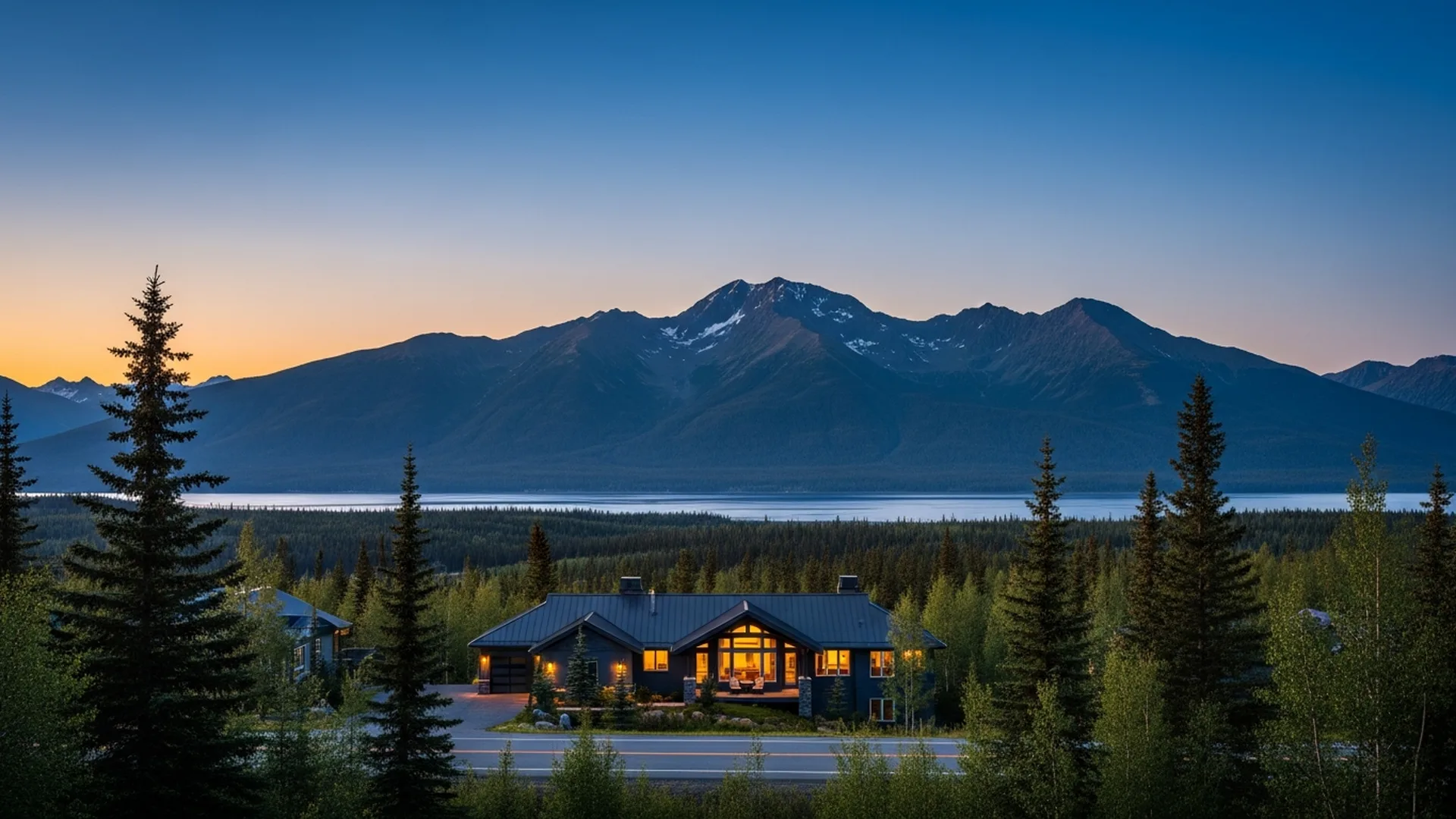
Hillside East is a wooded, semi-rural custom-home neighborhood on the western slope of the Chugach Mountains in South Anchorage, bordering Chugach State Park. Homes here sit on larger lots — many over an acre — and are prized for panoramic Cook Inlet, city, and mountain views that improve with elevation up the slope. Nearly every property is served by a private well and on-site septic system, so the Municipality of Anchorage requires a Certificate of On-Site Systems Approval (COSA) at sale. The three things that most separate a strong Hillside East buy from a weak one are the direction and openness of the view corridor, how much genuine winter sun the lot keeps, and the condition of the well and septic.
I have lived in Anchorage for 40 years, and I have watched the Hillside fill in the whole time — from scattered A-frames on gravel roads to the terraced custom homes that define Hillside East today. It is one of the most distinctive addresses in the city: bounded roughly by Far North Bicentennial Park and Hillside Park to the north, Holman Avenue and East Klatt Road to the south, Hillside Drive to the west, and Chugach State Park to the east. What makes it work as a luxury market is also what makes it easy to get wrong: the same slope that produces the views also decides how much winter light a lot keeps, and the same rural character that buyers love means you are buying a well and a septic field, not a city utility hookup.
This guide is written from the perspective of someone who reads finishes and light for a living — I hold a degree in interior design and spent a career in furnishings and design before real estate — but every neighborhood-specific figure below traces to a public source I have cited, not to memory or a sales pitch.
- Hillside East sits on the west-facing slope of the Chugach Mountains in South Anchorage and borders Chugach State Park; it is set well away from retail corridors.
- Lots are large and often wooded — a Jack White Real Estate broker, quoted in a Homes.com guide, noted properties over one acre have ranged from the mid-$700,000s to the low $2,000,000s.
- Almost every home runs on a private well and on-site septic system, which triggers a required Certificate of On-Site Systems Approval (COSA) at title transfer.
- The MOA On-Site fee to review and issue a COSA is $600; well water must test clean for coliform bacteria, nitrates, and arsenic, and those bacteria/nitrate results are only valid 90 days.
- Anchorage gets only about 5 hours 28 minutes of daylight on the December solstice, with the midday sun peaking near 5.4° — so lot orientation and slope shading drive real winter livability.
- In the 2018 magnitude 7.1 earthquake, ADN mapping of city inspection data showed the southeastern Hillside among the lightest-damaged areas, though damage overall tracked soil and construction quality more than location.
- Area schools may include Hanshew and Goldenview middle schools and Service and South Anchorage high schools — confirm the exact assignment for any address with ASD.
Where is Hillside East, and what does the neighborhood feel like?
Hillside East is one of the higher, more secluded neighborhoods in South Anchorage. It is defined less by a shopping district than by what surrounds it: Far North Bicentennial Park, the BLM Campbell Tract, and several Chugach State Park trailheads open onto thousands of acres of trail-laced public land right at the neighborhood's edge. The Glen Alps / Flattop trailhead — the launch point for Alaska's most-visited peak — is minutes up the hill. Custom homes line the hilly, tree-lined streets, and it is genuinely common to see moose and, at the wilder margins, bears in a yard.
Unlike the flat, gridded neighborhoods down in the Anchorage Bowl, Hillside East is a slope. That single fact organizes everything a buyer cares about here: which way the house faces, how the driveway climbs, and how the light lands in December. You will need a car — but the everyday commercial core of South Anchorage, from the Huffman Road Carrs to Dimond Center and Costco, is only about five miles away.
| Direction | What’s there | View / consideration |
|---|---|---|
| West / Southwest | Anchorage Bowl, Cook Inlet | City and inlet views; best from higher, open lots |
| East | Chugach State Park, Flattop | Mountain & forest views; trail access |
| North boundary | Bicentennial / Hillside Park | Trail and greenbelt buffer |
| South boundary | Holman Ave / E. Klatt Rd | Transition toward lower Hillside |
Which Hillside East lots get the best views — and which keep their winter sun?
This is the question I wish more buyers asked before they fell for a listing photo. Because Hillside East is a west-facing slope, the Cook Inlet and city panoramas come from the west and southwest, and they get better the higher you go — one longtime Anchorage broker described the top lots as feeling “like you’re sitting in the cockpit of an airplane”. East-facing rooms trade the inlet for close-up Chugach mountain and forest views. Neither is wrong; they are simply different products, and a buyer should know which one a given house actually delivers before touring in the flattering light of a summer evening.
The trap is winter sun. Anchorage's latitude is about 61.15°N, and on the December solstice the whole city sees only about 5 hours 28 minutes of daylight with the midday sun peaking near 5.4° above the horizon, keeping shadows long all day. On a slope with tall spruce, that low sun is easily blocked by terrain or the treeline on the wrong lot. A parcel with a genuinely open southern and southwestern exposure holds usable winter light; a shaded or north-tucked lot can sit in blue shadow for much of a December day even when the view photo looks spectacular.
What should you check on a well-and-septic home in Hillside East?
Here is the part of a Hillside East purchase that catches out-of-town buyers most: almost every property is on a private well and septic system, not city water and sewer. That is a genuine perk — no monthly water bill — but it comes with a specific municipal process. Per the Municipality of Anchorage On-Site Water and Wastewater program, a 1998 ordinance requires a Certificate of On-Site Systems Approval (COSA) to transfer title on any property served by a well or septic system.
The COSA is not a rubber stamp. A licensed civil engineer must field-inspect and test the system: a well flow test, a septic absorption-field adequacy test, verification of code-required separation distances between well and septic, and well water samples analyzed for coliform bacteria, nitrates, and arsenic. Timing matters because those lab windows are short — per Anchorage engineering firms that run these tests, bacteria and nitrate results are only valid 90 days and arsenic results one year, and the well/septic tests are good for two years. The MOA charges $600 to review the paperwork and issue the COSA, separate from the engineer's fees.
Well & septic upside
No monthly municipal water bill; large lots that support private systems; independence from utility rate changes; established systems on the Hillside are common and well-documented in MOA records dating to the late 1980s.
What to verify early
Septic is sized by bedroom count — a finished lower level can exceed the original design. Confirm the tank has been pumped (a receipt within the past year is required), that standpipes are visible and capped, and that no driveway or parking sits over the absorption field.
Seasonality is logistics here. Well and septic field testing generally needs unfrozen ground, so Hillside sellers who plan to list in winter often test earlier in the year. The MOA can issue a conditional COSA in winter when a needed repair can’t be completed until the ground thaws — a real planning point for a winter closing.
How do driveway grade and winter access affect a Hillside East home?
On a Chugach slope, the driveway is part of the property, not an afterthought. A steep, north-facing driveway that never sees the low winter sun can hold ice for months and demands serious snow management; a graded, better-exposed approach is far more forgiving. This is the kind of detail that doesn't show in a listing photo but shapes daily life from October to April. When I walk a Hillside East property with a buyer, the driveway grade, its exposure, and how the road above it is maintained get as much attention as the kitchen — because in Anchorage, they should.
Are Hillside East homes a good bet for earthquake safety?
Southcentral Alaska is seismically active, and the reference event is the November 30, 2018 magnitude 7.1 earthquake centered near Point Mackenzie, about 10 miles north of Anchorage. The reassuring nuance for this neighborhood: according to Anchorage Daily News mapping of municipal inspection data, the southeastern part of the Anchorage Hillside suffered some of the lightest damage in the city. Engineering reviews of the event found that damage tracked soil quality and construction more than any single location, and that minor structural damage was seen even in code-conforming buildings while the worst residential failures were tied to poorly compacted fill. The takeaway for a custom-home buyer: have the foundation and the fill the house sits on evaluated — that, not the neighborhood name, is what governs seismic performance.
Thinking of selling in Hillside East? What actually drives value here
Sellers on Hillside East view lots routinely underestimate two things and overestimate a third. The overestimate is square footage in a vacuum; the underestimates are the openness of the view corridor and the winter livability of the lot. A cleared, protected sightline and genuine south exposure move the number more than another few hundred finished square feet in a shaded pocket. Because I read finishes and light through a design lens, I focus staging and pre-list prep on the things that photograph and show honestly in Alaska light — not on masking a limitation a buyer's agent will find anyway.
The other seller reality is the well and septic timeline above: getting your COSA testing done before you list removes the single most common closing surprise on the Hillside. When you're ready, the smartest first step is a real number — get your Hillside home value grounded in what your specific lot, view, and systems actually support.
- Municipality of Anchorage, On-Site Water & Wastewater Section — Certificate of On-Site Systems Approval (COSA) requirements, 1998 title-transfer ordinance, and well/septic testing standards (muni.org).
- Anchorage-area civil engineering firms (C&M Engineering; Pannone Engineering) — MOA $600 COSA issuance fee and 90-day bacteria/nitrate sample validity.
- Homes.com Hillside East neighborhood guide — lot-size price ranges and view/character description (quoting Jack White Real Estate broker).
- GreatAlaskanHomes.com — Hillside East boundaries and ASD attendance-area schools (Hanshew, Goldenview, Service, South Anchorage).
- Solar/daylight data for Anchorage (61.15°N): December-solstice daylight ~5h 28m and ~5.4° midday sun altitude — Time and Date, Alaska Climate Research Center, and Alaska Center for Climate Assessment and Preparedness (ACCAP).
- Anchorage Daily News & USGS — 2018 M7.1 Anchorage earthquake reporting; southeastern Hillside among lightest-damaged areas; damage tied to soil and construction quality.
- Verify current school attendance boundaries for a specific address with the Anchorage School District.
Considering a Hillside East home?
Let’s tour the lots that keep their view and their winter sun — and read the well & septic before you write an offer.
Frequently Asked Questions
Hillside East is a neighborhood in South Anchorage on the western slope of the Chugach Mountains. It sits roughly between Far North Bicentennial Park and Hillside Park to the north and Holman Avenue and East Klatt Road to the south, with Hillside Drive to the west and Chugach State Park along its eastern edge. It is set away from retail and commercial zones and offers quick access to Chugach State Park trailheads.
Hillside East homes command a premium mainly because of larger lots, elevation and the panoramic Cook Inlet, city and Chugach Mountain views, and the semi-rural setting bordering Chugach State Park. According to a Jack White Real Estate broker cited in a Homes.com neighborhood guide, houses on lots under one acre have ranged from the mid-$500,000s to the mid-$900,000s, while properties over one acre have ranged from the mid-$700,000s to the low $2,000,000s. Higher-elevation view lots generally carry the strongest premium.
Almost every Hillside East property is served by a private well and on-site septic system rather than public water and sewer. Because of this, the Municipality of Anchorage requires a Certificate of On-Site Systems Approval (COSA) at title transfer. A licensed civil engineer must field-inspect and test the well and septic, and the well water is sampled for coliform bacteria, nitrates, and arsenic before the sale can close.
A COSA (Certificate of On-Site Systems Approval) is a Municipality of Anchorage document confirming that a home’s private well and/or septic system have been inspected and tested by a licensed civil engineer and meet MOA standards. It has been required at title transfer for well/septic properties since a 1998 ordinance. The MOA charges $600 to review the paperwork and issue the COSA, on top of the engineer’s testing fees; well water lab results for bacteria and nitrates are only valid 90 days, so timing matters.
Because Hillside East sits on a west-facing slope of the Chugach Mountains, the strongest Cook Inlet and city views generally come from higher-elevation, west- and southwest-facing lots where trees and neighboring rooflines do not block the sightline. Homes are terraced up the slope, so as one Anchorage broker described it, the views improve with each switchback up the hill. East-facing rooms typically capture Chugach mountain and forest views instead of the inlet.
Anchorage as a whole receives only about 5 hours and 28 minutes of daylight on the December solstice, and the midday sun peaks at roughly 5.4 degrees above the horizon, keeping shadows long all day. On the Hillside’s slope, terrain and tall spruce can shorten direct sun on a specific lot even further, which is why south- and southwest-facing parcels with an open exposure hold usable winter light better than shaded or north-facing lots.
In the November 30, 2018 magnitude 7.1 earthquake, damage across Anchorage was patchy and driven largely by soil type and construction quality rather than location alone. According to Anchorage Daily News mapping of municipal inspection data, the southeastern part of the Anchorage Hillside suffered some of the lightest damage in the city, and minor structural damage was observed in code-conforming buildings. Buyers should still have any custom home evaluated for its foundation and the fill it is built on.
Students in the Hillside East area may attend Hanshew and Goldenview middle schools and Service and South Anchorage high schools within the Anchorage School District, though exact attendance boundaries vary by street. Because boundaries can change and can split within a neighborhood, always confirm the current assigned schools for a specific address with the Anchorage School District before you buy.