

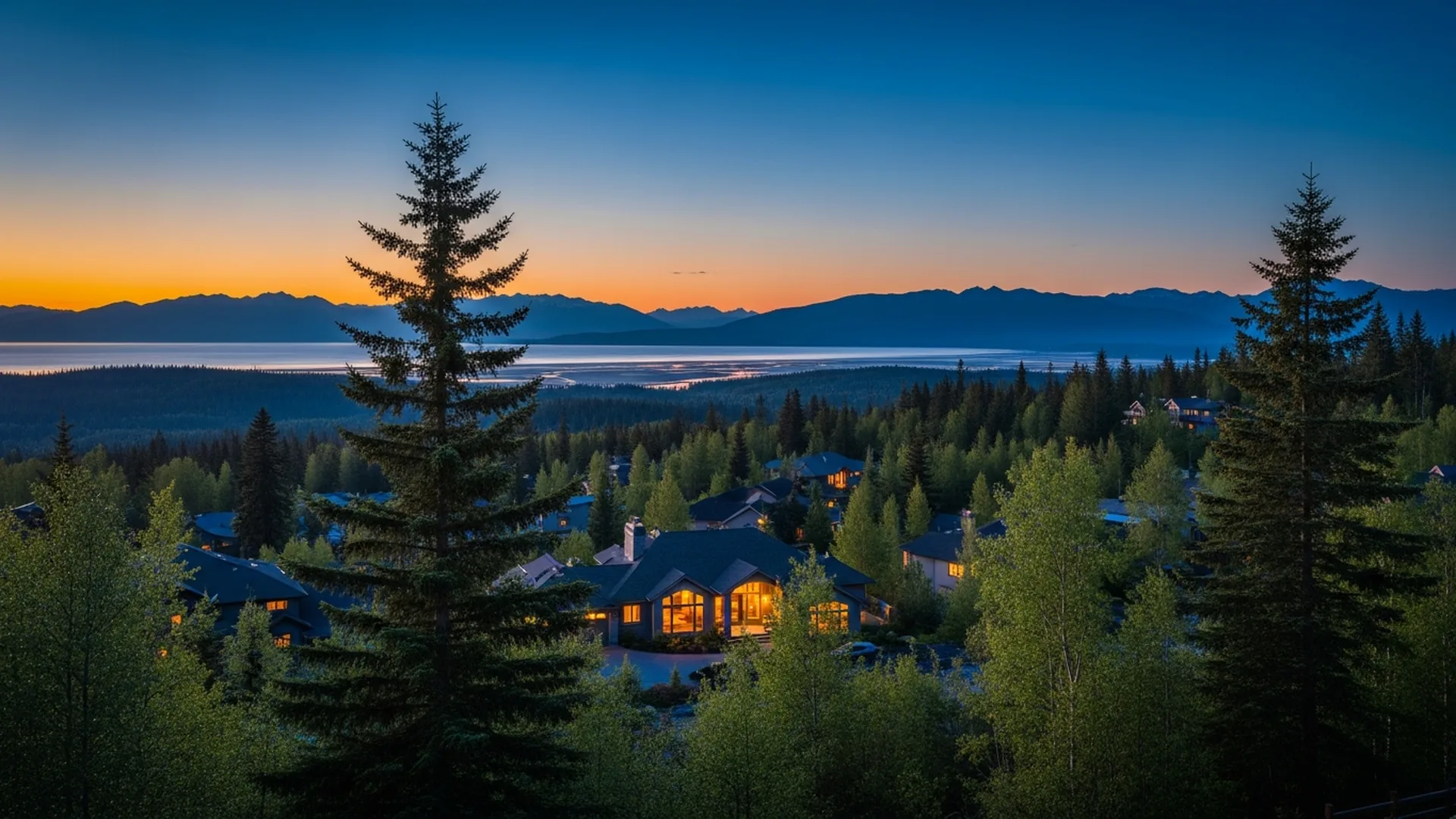
Hidden Cove is a residential neighborhood of over 100 homes in southwest Anchorage, tucked into the larger Bayshore-Klatt community just south of Campbell Lake. Most homes were built in the 1990s along curving, nautically-named streets — Maritime Loop, Halfhitch Drive, Lido Circle, Skiff Circle — and commonly feature vaulted ceilings, updated kitchens and generous decks, with some lots offering Campbell Lake access. The neighborhood is organized into several homeowners'-association phases with design-review covenants, sits about 15 minutes from downtown, and connects easily to the Campbell Creek and Tony Knowles Coastal trails. Because it is flat coastal ground rather than the elevated Hillside, its Chugach and Cook Inlet views come from lot position and window placement rather than steep terrain.
Anchorage has a lot of neighborhoods that read as ordinary from the main road and then surprise you once you turn in. Hidden Cove is one of them. It lives up to its name — a compact, tree-lined subdivision off the busier southwest Anchorage corridors, with a street layout that curls in on itself so the traffic never really finds you. I've watched this part of town fill in over four decades of living here, and the appeal of Hidden Cove has stayed remarkably consistent: proximity to water and trails, quiet streets, and 1990s-era homes with the kind of volume and light that still show well today.
What Hidden Cove is not is a Hillside neighborhood, and that distinction matters more than most listings let on. This is flat, coastal ground near Campbell Lake, not the steep south-facing benches above O'Malley and Huffman. That single fact reshapes almost everything a serious buyer should evaluate here — the views, the utilities, the winter access, and the price logic. This guide walks through it honestly.
- Hidden Cove sits in southwest Anchorage within the Bayshore-Klatt community, just south of Campbell Lake — not on the Hillside.
- It's a subdivision of over 100 homes, many built in the 1990s, on nautically-themed streets like Maritime Loop, Halfhitch Drive, Lido Circle, Skiff Circle and Excursion Circle.
- The neighborhood is organized into multiple HOA phases (Hidden Cove, Hidden Cove III, Hidden Cove Phase 4), most with design-review approval required before exterior changes.
- Some lots include Campbell Lake access; the Campbell Creek and Tony Knowles Coastal trails, plus Kincaid Park, are all close.
- Most homes are on public water and sewer, so the Municipality's COSA well/septic requirement usually does not apply here — but verify utilities per property.
- Views are lot-driven, not elevation-driven: Chugach views face east, and coastal Cook Inlet/Turnagain Arm scenery is reached via nearby parks rather than from the flat neighborhood itself.
- Downtown Anchorage is roughly 15 minutes north via Walter J. Hickel Parkway; the Dimond shopping district is about five minutes away.
Where exactly is Hidden Cove, and how do you get around it?
Hidden Cove is a neighborhood within the larger South/southwest Anchorage community of Bayshore-Klatt, positioned just south of Campbell Lake. Bayshore-Klatt as a whole is described as a coastal neighborhood of south Anchorage bordering Turnagain Arm, and Hidden Cove is one of its residential pockets. Downtown Anchorage sits roughly eight miles north, reachable in about 15 minutes via Walter J. Hickel Parkway, and the Dimond Center shopping area is only a few minutes away.
The interior street network is distinctive: rather than a grid, Hidden Cove uses a set of looping, nautically-named streets — Maritime Loop, Halfhitch Circle and Halfhitch Drive, Lido Circle, Skiff Circle and Excursion Circle. The result is exactly what buyers touring here notice first: almost no through-traffic, and a strong sense of enclosure. Unlike the arterial-facing subdivisions closer to Dimond Boulevard, the cove layout keeps the interior lots calm.
| Direction | What’s there | Distance / note |
|---|---|---|
| North | Campbell Lake; then downtown Anchorage | Lake is adjacent; downtown ~8 mi / ~15 min |
| East | Chugach Mountains (view direction) | Views are lot- and window-dependent |
| West | Cook Inlet, Tony Knowles Coastal Trail, Kincaid Park | Short drive; coastal recreation |
| Nearby | Dimond Center shopping district | ~5 minutes |
What are Hidden Cove homes actually like?
Hidden Cove holds over 100 homes, and the character is fairly cohesive because much of the neighborhood went up in the 1990s. The housing stock leans toward two-story homes with vaulted ceilings, updated kitchens, spa-style baths and generous decks — the kind of open, light-forward floor plans that were popular when the subdivision was built and that have aged well with renovation. You'll see individual homes in the roughly 2,000–2,500-square-foot range and up, with some larger custom builds mixed in.
Here's where my design background changes how I read these homes. A 1990s vaulted great room is an asset only if its glazing is doing real work — capturing the low southern winter sun and, where the lot allows, framing the Chugach to the east. I walk buyers through the difference between a home whose big windows face a neighbor's siding and one whose windows were placed to pull in light and a sightline. Two homes on the same street, built the same year, can live completely differently because of orientation. That's the read most tours skip.
Does Hidden Cove have an HOA, and what should you check?
Yes — and it's not one association but several. Hidden Cove is organized into multiple phases, including Hidden Cove, Hidden Cove III, and Hidden Cove Phase 4, each with its own homeowners' association registered with the State of Alaska. Practically, that means covenants (CC&Rs) apply, dues are collected, and the boards require design-review approval before you make exterior modifications, additions, or accessory buildings.
In Alaska this is worth flagging, because many parcels around Anchorage are entirely unrestricted — no HOA, no covenants. Hidden Cove is the opposite: it's a governed subdivision. That's a genuine plus for buyers who want the neighborhood's look protected, and a real constraint for buyers planning a big remodel or an RV pad. During your review period, get the current declarations, the fee schedule, the design-review forms, and any fine policy in writing, and confirm which specific phase your target home belongs to.
Why buyers like the HOA structure
- Neighborhood appearance and standards are protected
- Quiet, cohesive streetscape maintained over time
- Clear process for exterior projects
What to verify before you fall in love
- Which phase/HOA governs the exact address
- Dues, reserves, and any special assessments
- Design-review limits on additions, colors, outbuildings, parking
Do Hidden Cove homes need a COSA, and what about well & septic?
This is the single most common Anchorage due-diligence question, and the honest answer for Hidden Cove is reassuring — but you still have to verify. In the Municipality of Anchorage, a Certificate of On-Site Systems Approval (COSA) is required to transfer title only when a home is served by a private well and/or septic system. The requirement dates to a 1998 Municipal Assembly ordinance and is designed to confirm that septic systems function and that well water is safe and adequate.
Hidden Cove is a developed 1990s subdivision in the urban southwest bowl, so most homes here connect to public water and sewer, which means the well/septic COSA process usually does not apply. That's a meaningful contrast with true Hillside neighborhoods, where the Municipality has noted that most Anchorage well-and-septic home sales occur. Where a COSA does apply anywhere in Anchorage, a registered engineer must test the well (including a flow test and lab analysis for arsenic, nitrates, and coliform bacteria) and verify the septic system, the tank must have been pumped within the prior year, and the certificate is generally valid for two years. If your Hidden Cove home turns out to have any on-site system, that timeline — and the frozen-ground season — matters. Always confirm the actual utilities on the specific parcel.
Because Campbell Lake is directly north and some Hidden Cove lots carry lake access, waterfront-adjacent parcels can behave differently in value than interior lots. Lake access, view sightlines, and lot position — not just square footage — are what separate comparable-looking homes here. For sport-fishing buyers, note that Campbell Lake is closed year-round to fishing; the appeal is the water view and calm setting, not the catch.
What are the views and the outdoor life like here?
Set expectations correctly and you'll be delighted; set them by Hillside standards and you'll be disappointed. Hidden Cove is flat coastal ground, so it does not offer the sweeping, elevation-driven Cook Inlet panoramas you'd get from an upper-Hillside bench or the Glen Alps overlook. What it does offer is genuine access to some of Anchorage's best coastal and creek recreation. The neighborhood is surrounded by trees and greenery, sits beside Campbell Lake, and connects to the Campbell Creek Trail — a paved route that follows the creek from the Chugach foothills toward Cook Inlet and forms part of the 32-mile "Moose Loop" trail network with the Tony Knowles Coastal Trail.
The coastal trail itself runs 11 miles along Cook Inlet from downtown to Kincaid Park, with views of the water, the Chugach, and on clear days Denali and Mount Susitna (Sleeping Lady). Kincaid Park — roughly 1,400–1,500 acres at the southwest tip of the Anchorage Bowl — is a short drive west, and the Campbell Creek Estuary Natural Area nearby opens onto wetlands and Cook Inlet views. For a buyer who wants trails and water at the doorstep more than a hilltop vista, this is a strong location.
Thinking of selling in Hidden Cove? What drives value here
If you own in Hidden Cove, the value levers are specific and worth pricing correctly. First is lot position and access — a Campbell Lake-access lot or a quiet interior cul-de-sac position (think Skiff or Excursion Circle) reads differently to buyers than a home closer to the busier edges. Second is light and finish. These are 1990s homes; the ones that sell fastest are the ones where the kitchen, baths, flooring, and window treatments have been updated with a coherent eye, and where the vaulted spaces have been kept bright. This is exactly where my design training earns its keep for sellers — I help stage and present so the home's real light advantage is obvious in photos and in person, not buried behind heavy drapes.
Third is HOA clarity: buyers move faster when the CC&Rs, dues, and any pending assessments are documented up front. And because most homes here are on public utilities, sellers usually avoid the septic-escrow surprises that can stall a Hillside closing — a quiet advantage worth highlighting. To see what your specific home could bring in today's market, get a Hidden Cove home valuation and we'll build the number from real, local comparables.
- Municipality of Anchorage — Certificate of On-Site Systems Approval (COSA) requirements, On-Site Water & Wastewater Section (muni.org); confirms COSA is required at title transfer for well/septic properties and the 1998 ordinance.
- Municipality of Anchorage / Alaska engineering firms — COSA testing scope (well flow test; arsenic, nitrate, coliform sampling; two-year validity; annual tank pumping).
- Alaska DCCED corporations database — Hidden Cove, Hidden Cove III, and Hidden Cove Phase 4 homeowners' association registrations.
- Neighborhood location and street layout: Hidden Cove within the Bayshore-Klatt community, southwest Anchorage; streets Maritime Loop, Halfhitch, Lido, Skiff, Excursion.
- Campbell Lake, Campbell Creek Trail, Tony Knowles Coastal Trail, and Kincaid Park — Visit Anchorage / Alaska.org.
- Anchorage daylight and sun angle at ~61°N (approx. 5.5 hours on Dec. solstice, ~19 hours on Jun. solstice) — timeanddate.com, Alaska Climate Research Center, and Alaska Center for Climate Assessment and Preparedness (ACCAP).
- Anchorage geography (Cook Inlet, Turnagain Arm, Chugach Mountains orientation) — U.S. Geological Survey (USGS)-referenced summaries and Visit Anchorage.
Explore Hidden Cove & southwest Anchorage homes with Bill
Get a local read on lots, light, and lake access before you tour — call 907-560-4090.
Frequently Asked Questions
Hidden Cove is a residential neighborhood in southwest Anchorage, within the larger Bayshore-Klatt community and just south of Campbell Lake. It sits roughly a 15-minute drive from downtown Anchorage via Walter J. Hickel Parkway, with the Dimond Center shopping area about five minutes away.
Hidden Cove is a subdivision of over 100 homes, many built in the 1990s, on curving nautically-named streets such as Maritime Loop, Halfhitch Drive, Lido Circle and Skiff Circle. Homes commonly feature vaulted ceilings, updated kitchens and generous decks, and some lots offer access to Campbell Lake just to the north.
Yes. Hidden Cove is organized into multiple homeowners'-association phases (Hidden Cove, Hidden Cove III, and Hidden Cove Phase 4). These associations enforce covenants and typically require design-review approval before exterior modifications, so buyers should request the current CC&Rs, dues, and rules during the review period and confirm which phase governs the specific address.
A Certificate of On-Site Systems Approval (COSA) is required by the Municipality of Anchorage only when a home is served by a private well and/or septic system at title transfer. Most Hidden Cove homes are connected to public water and sewer, so a COSA usually does not apply — but always confirm the specific property's utilities, because it changes the closing timeline and testing needs.
Some Hidden Cove homes capture Chugach Mountain views to the east, and homes with upper-level living space or cleared sightlines see them best. The neighborhood sits on flat, coastal southwest Anchorage ground, so mountain and inlet views come from window placement and lot position rather than the steep elevation you get on the Hillside.
Yes. Campbell Lake sits directly north of the neighborhood, and some Hidden Cove lots include lake access. The Campbell Creek Trail and the wider network — including the 11-mile Tony Knowles Coastal Trail along Cook Inlet — are close by, and Kincaid Park is a short drive to the west.
Like all of Anchorage, Hidden Cove gets about 5.5 hours of daylight on the December solstice and roughly 19 hours on the June solstice, at a latitude near 61°N. Because the winter sun stays very low in the sky, homes with south-facing living areas and large windows feel dramatically brighter through the dark months — which is why lot orientation matters so much here.