

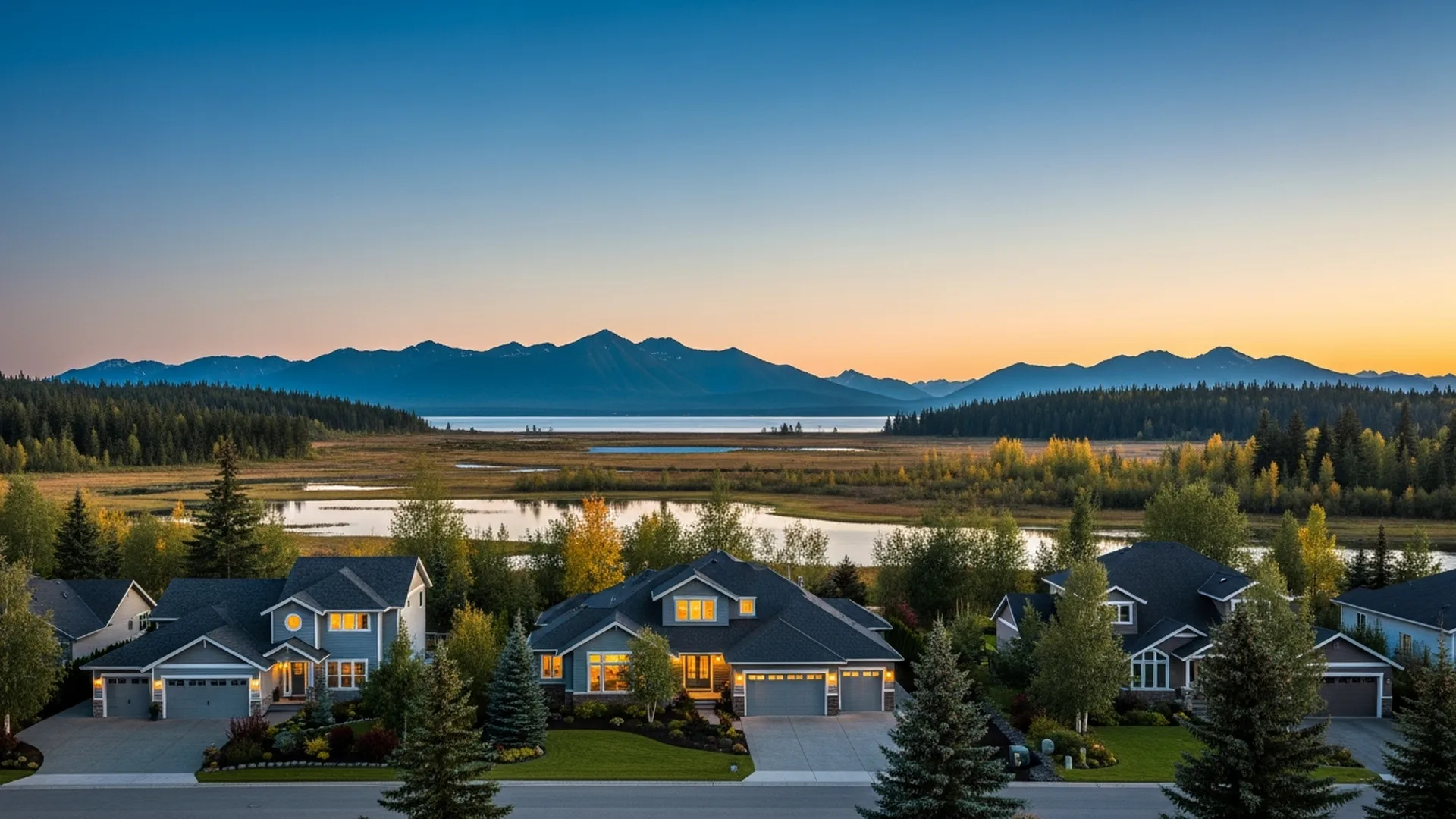
Bayshore is a coastal, planned neighborhood in South Anchorage, Alaska (ZIP 99515), set along Turnagain Arm within the larger Bayshore-Klatt area, next to Campbell Lake and the Anchorage Coastal Wildlife Refuge. Although it is often grouped with Anchorage's Hillside listings, Bayshore actually sits low near the coast rather than up in the Chugach foothills, so its views read west and south over water, tidal flats, and the lake instead of up-slope toward the mountains. Homes range from ranch and two-story traditionals, townhomes, and condos built mostly from the late 1970s onward to a premium tier of larger custom and Campbell Lake waterfront estates with private docks and floatplane access. Because it was developed on public water and sewer, Bayshore generally avoids the private well-and-septic COSA process that shapes so many Hillside sales. Buyers value its clubhouse and green-space amenities, proximity to trails and the coast, and roughly eight-mile access to downtown Anchorage.
If you search “Bayshore Anchorage homes,” the first thing worth clearing up is geography, because it changes everything about how you should read a listing here. Bayshore is not on the Hillside. It is a low-lying, coastal-and-lake neighborhood on the southwest edge of South Anchorage, and after four decades living in this city I can tell you the difference is not academic — it decides which way your light falls, what your view actually looks at, and how a home holds value.
The wider planning area is usually written as Bayshore-Klatt, a South Anchorage neighborhood that sits, as local guides describe it, between Campbell Lake to the north and East Klatt Road to the south, with Cook Inlet and Turnagain Arm to the west and the New Seward Highway corridor to the east. Within that, “Bayshore” proper is a well-planned residential enclave of shared greenbelts, a clubhouse, and streets that back onto the Anchorage Coastal Wildlife Refuge. What follows is the honest, source-grounded version of what living and buying here really involves.
- Bayshore is a coastal, planned South Anchorage neighborhood (ZIP 99515) along Turnagain Arm — not an elevated Hillside subdivision, despite how it is sometimes categorized.
- Its views point west and south over Cook Inlet, the tidal flats, the coastal wildlife refuge, and Campbell Lake, rather than up-slope toward the Chugach the way Hillside homes do.
- Housing is a mix of ranch and two-story traditionals, townhomes, and condos built largely from the late 1970s onward, plus a premium tier of custom and lakefront estates.
- Campbell Lake is Anchorage's largest lake (about 123 acres), ringed by high-value homes with private docks and floatplanes; a 2019 city–state joint statement clarified it is open to the public for boating and permissible recreation.
- Because Bayshore is on public water and sewer, the Municipality's well/septic COSA requirement that governs many Hillside sales generally does not apply here.
- The area is served by Bayshore Elementary, Mears Middle, and Dimond High in the Anchorage School District, with a resident clubhouse, pool, and greenbelt trails via the Bayshore Owners Association.
- The Turnagain Arm tidal flats are a stunning amenity to view but genuinely dangerous to walk on — glacial silt plus near-40-foot tides.
Where Is Bayshore in Anchorage, and Why Does the Location Surprise Buyers?
Here is the truth that most out-of-town buyers miss: the name “Bayshore” and the way it is filed under Hillside searches suggest an elevated, mountain-facing address, but the neighborhood actually sits at the coast. Local real estate guides place Bayshore-Klatt in South Anchorage between Campbell Lake to the north and East Klatt Road to the south, with Cook Inlet to the west and the New Seward Highway to the east. It is roughly eight miles south of downtown Anchorage, in the 99515 ZIP code, and it borders the Anchorage Coastal Wildlife Refuge.
Why does that matter? On the Anchorage Hillside, elevation and slope are the whole game — you are buying height, a south or west aspect, and a sightline up into the Chugach. In Bayshore you are buying the opposite orientation: a flat, walkable, planned community whose best views look outward and downward across water and marsh. Both are genuinely desirable. They are simply different products, and a buyer who wants one and tours the other usually feels the mismatch within the first ten minutes. I always tell people to name the view they actually want before we start touring, because Bayshore and the true Hillside answer two different wishes.
| Direction | What borders Bayshore | What it means for homes |
|---|---|---|
| West | Cook Inlet / Turnagain Arm & Coastal Wildlife Refuge | Water and marsh views; tidal flats (view-only, not walkable) |
| North | Campbell Lake (~123 acres) | Premium lakefront tier with docks & floatplane access |
| East | New Seward Highway corridor | Quick commute; Chugach rises beyond the highway |
| South | East Klatt Road / Johns Park area | Trails, parks, quieter residential edge |
What Do the Views Really Look Like in Bayshore?
This is where the coastal setting pays off. Unlike a Hillside home that trades on elevation, a well-sited Bayshore home earns its view from proximity to open water and protected wildlands. Homes on the neighborhood's western edge look out across the tidal flats of Turnagain Arm and the Anchorage Coastal Wildlife Refuge — a refuge that runs about 16 miles of Anchorage coastline from Point Woronzof to Potter Creek and hosts more than 130 bird species over its intertidal flats and marsh. That is a living, changing foreground most cities cannot offer.
Then there is Campbell Lake. At roughly 123 acres it is the largest lake in Anchorage, formed in 1958 when a dam was built across Campbell Creek's outflow over the intertidal wetlands. A lakefront Bayshore home is a genuinely rare Anchorage product: still water at your dock, floatplanes lifting off in summer, and sunsets over the inlet beyond. Buyers touring the western and lakeside streets consistently discover that the “quiet” here is a working quiet — birds, tides, and the occasional aircraft — rather than the mountain hush of the upper Hillside.
What Kinds of Homes Are for Sale in Bayshore?
Bayshore reads as a planned suburb with a luxury ceiling rather than a wall-to-wall estate district. Development began in the early 1980s, producing a mix of traditional homes, townhouses, and condos, and the Bayshore subdivision itself is often described as roughly 450 homes across several subdivision units. On the streets you'll find ranch-style and two-story traditionals on standard suburban lots, plus newer contemporary construction filling in over time.
The premium tier is smaller and specific: larger custom homes and the Campbell Lake waterfront estates. Waterfront homes on Campbell Lake have historically ranged from around 1,500 to 3,000 square feet, with some luxury homes reaching about 6,000 square feet, and most lakefront lots falling between a quarter and a half acre. Many were built in the late 1970s and early 1980s and have since been extensively updated, so on the lake you are often buying location and dock rights first and finishes second. This is exactly where my design background earns its keep — reading which updates were done well and which merely papered over an aging envelope.
What Bayshore does well
- Rare coastal-and-lake setting with water and refuge views
- Planned community with clubhouse, pool, and greenbelt trails
- On public water & sewer — no routine well/septic COSA hurdle
- Roughly 8 miles to downtown; quick New Seward Highway access
- Campbell Lake floatplane & dock access at the premium tier
What to weigh carefully
- Not an elevated mountain-view address — different from the true Hillside
- Much of the stock is 1980s–90s; verify updates vs. cosmetics
- HOA structure and dues vary by subdivision unit — confirm per property
- Coastal/silt soils & seismic history warrant a construction review
- Adjacent tidal flats are hazardous — a view amenity, not a play area
What Should You Check Before Buying a Coastal or Lake Home in Bayshore?
The due-diligence list here is genuinely different from a Hillside purchase, and knowing that difference is where a local agent saves you money. First, utilities and COSA. The Municipality of Anchorage requires a Certificate of On-Site Systems Approval only for title transfers of homes served by a private well and/or septic system. Per the Municipality of Anchorage, a COSA is required for all title transfers within the MOA involving single-family dwellings, duplexes, or vacant properties served by an on-site potable water supply and/or on-site wastewater disposal system. Bayshore's planned lots are on public utilities, so — unlike much of the Hillside — you generally won't be chasing a well flow test and septic adequacy test here. Still verify the specific parcel, because edge lots in any area can surprise you.
Second, seismic and soils. This is coastal Anchorage built partly over former wetlands and glacial silt, and Alaska's earthquake history is not theoretical. Campbell Lake's dam failed during the 1964 Anchorage earthquake, and during the 2018 Anchorage earthquake a sewer pipe under the lakebed was dislodged, requiring the lake to be drained in May 2019 for repairs. None of that should scare a buyer off — it should prompt a proper structural and foundation review, especially on older homes and lakefront lots.
Third, lake and dock rights. Campbell Lake carries decades of “is it private?” history. In December 2019 the City of Anchorage and the State of Alaska released a joint statement clarifying that the lake is open to the public for boating and all forms of permissible recreation. If you're buying on the water, we read the actual recorded dock, floatplane, and access rights for that property rather than relying on the neighborhood's reputation.
Reported figures for the broader Bayshore-Klatt area in 2026 put the median sale price in the roughly $500,000–$512,000 range with homes selling in the mid-20s of days on market, according to aggregated portal data — well above many Anchorage neighborhoods. Treat these as directional context, not an appraisal: lakefront and custom homes trade far above area medians, and any single property's value depends on view corridor, condition, lot, and dock rights. For a real number, use a current comparative market analysis.
What Amenities and Access Define Daily Life in Bayshore?
Bayshore is one of the more amenity-rich planned neighborhoods in South Anchorage. The Bayshore Owners Association maintains shared green spaces and a clubhouse that features an event space, fitness facilities, and a swimming pool, with walking paths connecting the neighborhood. Those greenbelts tie into the wider recreation network — the area sits near Campbell Creek trails, Carr-Gottstein Park, the Campbell Creek Estuary Natural Area, and South Anchorage Sports Park, and the Tony Knowles Coastal Trail runs along the Cook Inlet shoreline nearby.
For everyday errands, the neighborhood leans on the Dimond and Huffman commercial corridors just east and north, and the New Seward Highway puts downtown roughly eight miles away. It is, in short, a neighborhood where the natural setting is the headline and the conveniences are a short drive rather than at your doorstep — a trade most Bayshore buyers happily make.
Thinking of Selling in Bayshore? What Drives Value Here
If you own in Bayshore, your home's value is set by a specific hierarchy, and pricing to it is how you avoid leaving money on the table. At the top: water orientation — a true Campbell Lakefront lot with dock and floatplane rights, or a western lot that genuinely frames Turnagain Arm and the refuge, sits in a category of its own. Below that, condition and finish quality carry outsized weight because so much of the stock dates to the 1980s and 90s; buyers pay a real premium for updates that are done to a coherent, durable standard rather than a quick flip.
This is where I put my design training to work for sellers. Staging and pre-list improvements here should emphasize light, flow, and the view corridor — the things a Bayshore buyer is actually paying for — not generic upgrades that don't move this market. When you're ready for a specific number, I'll build you a current comparative market analysis grounded in real Bayshore and Campbell Lake comparables. Start with your Anchorage home value estimate.
- Municipality of Anchorage, Development Services — On-Site Water & Wastewater Section (COSA guidelines and requirements for title transfers of well/septic properties).
- Alaska Department of Fish and Game & Wikipedia — Anchorage Coastal Wildlife Refuge (16-mile coastline, Point Woronzof to Potter Creek; 130+ bird species; intertidal flats).
- Wikipedia — Campbell Lake (Anchorage): ~123 acres, formed 1958, 1964 & 2018 earthquake impacts, 2019 city–state public-access joint statement.
- Anchorage Daily News / Alaska's News Source (KTUU) — Turnagain Arm tidal flats and near-40-foot tidal range hazards.
- Anchorage School District — school attendance areas (Bayshore Elementary, Mears Middle, Dimond High).
- Aggregated real estate portal data (Homes.com and others) — Bayshore-Klatt home-style mix, development era, and 2026 median/DOM context (directional only; not an appraisal).
Explore Bayshore & South Anchorage Homes With a 40-Year Local
Tell me the view you actually want — lake, inlet, or up-slope — and I’ll help you find the right corridor. Call 907-560-4090.
Frequently Asked Questions
Bayshore is a coastal neighborhood in South Anchorage, Alaska, in the 99515 ZIP code. It sits along Turnagain Arm within the larger Bayshore-Klatt area, bordered by Campbell Lake to the north, the New Seward Highway to the east, and Cook Inlet and the Anchorage Coastal Wildlife Refuge to the west. Despite sometimes being grouped with Hillside listings, Bayshore is near sea level at the coast, not up in the Chugach foothills.
Many do. Because Bayshore sits low along Turnagain Arm and next to the coastal wildlife refuge, homes on the western edge can capture inlet and mountain views across the tidal flats, and lakeside homes look out over Campbell Lake. The views here read west and south over water and marsh, which is a different value driver than the elevated, Chugach-facing views up on the Anchorage Hillside.
Bayshore is a planned subdivision developed largely from the late 1970s through the early 2000s, so you'll find a mix of ranch-style and two-story traditional homes, townhomes, and condos, plus a smaller set of larger custom and Campbell Lake lakefront estates. Most of the neighborhood is on standard suburban lots, while lakefront properties are the premium tier with private docks and floatplane access.
Usually not. The Municipality of Anchorage requires a Certificate of On-Site Systems Approval (COSA) only for title transfers of homes served by a private well and/or septic system. Bayshore was developed as a planned community on public water and sewer, so the COSA well/septic requirement that heavily affects Hillside sales generally does not apply here. Always verify the specific property's utility service, since a few fringe parcels can differ.
Homes in the Bayshore area are generally zoned to Bayshore Elementary, Mears Middle, and Dimond High within the Anchorage School District, with Klatt and Oceanview Elementary also serving parts of the wider Bayshore-Klatt area. School attendance boundaries change, so confirm the current assignment for a specific address directly with the Anchorage School District before you buy.
Campbell Lake is Anchorage's largest lake and is ringed by high-value homes with private docks and floatplanes, and for decades it was treated as private. In December 2019 the City of Anchorage and the State of Alaska issued a joint statement clarifying that the lake is open to the public for boating and permissible recreation. If you're buying a lakefront home, review the actual dock, floatplane, and access rights recorded for that specific property.
Yes. The glacial-silt tidal flats along Turnagain Arm are genuinely hazardous and should be admired, not walked on. Turnagain Arm has one of the highest tidal ranges in North America, near 40 feet, and the saturated silt can trap a person as the tide returns. It's a spectacular natural amenity to view from a Bayshore-area home or the coastal refuge boardwalks, but treat the flats themselves as off-limits.
Bayshore sits roughly eight miles south of downtown Anchorage, with the New Seward Highway and Walter J. Hickel Parkway providing a quick route north. Everyday shopping is concentrated along the nearby Dimond and Huffman corridors, and the airport is only a few miles northwest — part of why the area appeals to buyers who value both coastal quiet and city access.