

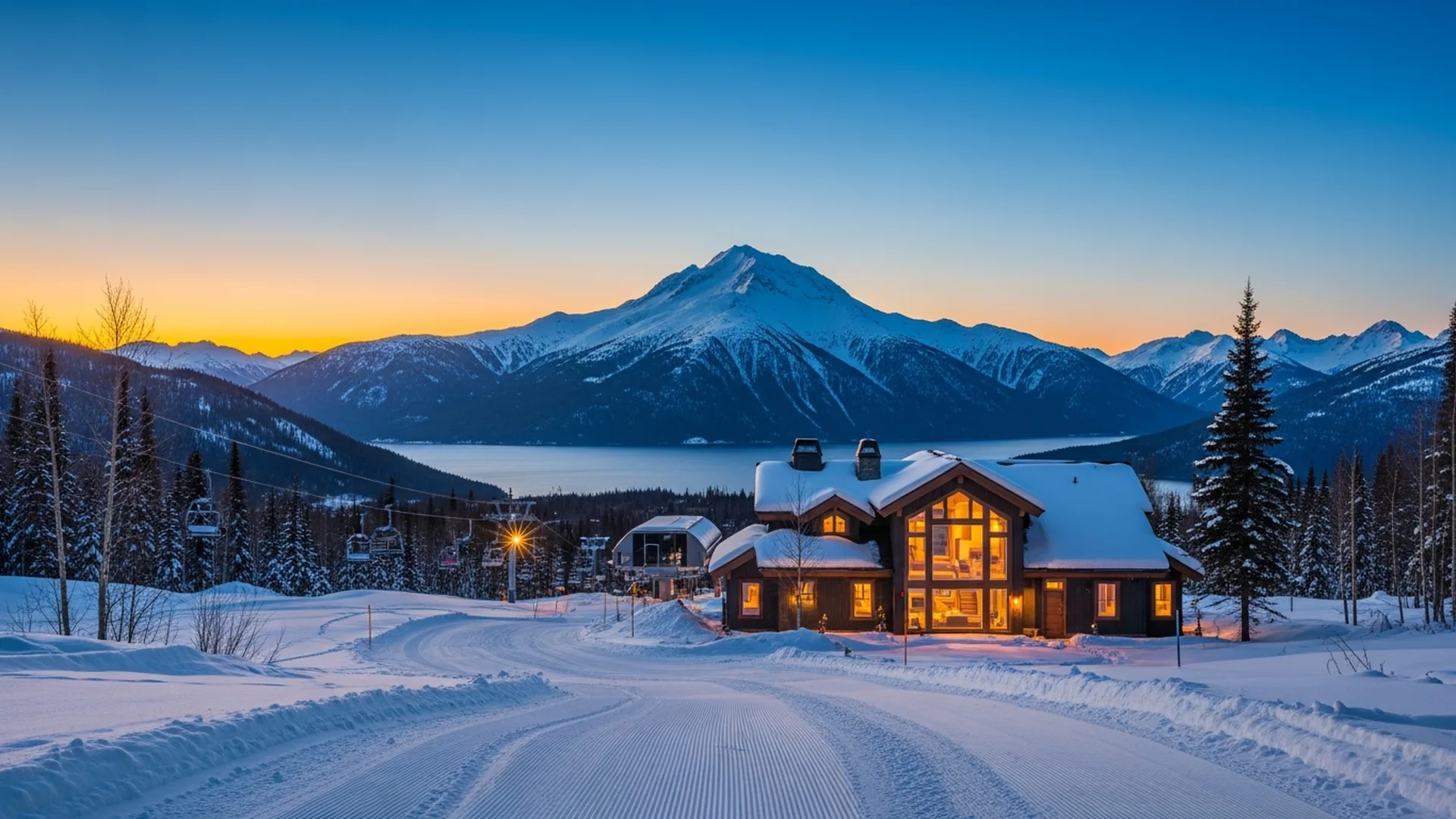
Alyeska ski-in/ski-out homes are a small, tightly held segment of the Girdwood market at the base of Mount Alyeska — Alaska’s largest ski resort, about 38 to 40 miles southeast of Anchorage along Turnagain Arm. Because the resort’s lift base and tram sit in Girdwood’s valley, genuinely door-to-snow parcels are limited and cluster near the base, while many homes marketed as ski-access are actually a short walk or shuttle away. Buying here means weighing resort-town realities: heavy snowfall (roughly 209 inches at the base), mapped avalanche-hazard areas that can require engineered construction, and a market where a large share of homes are second homes or vacation rentals. Since 2026 the Municipality of Anchorage requires short-term rentals to register, and Girdwood land-use rules are being updated. The essential step is verifying, parcel by parcel, exactly how a home connects to the mountain, what hazard and permitting conditions apply, and how you may legally use it.
Every winter for four decades I’ve watched Anchorage drivers stream down the Seward Highway toward Girdwood the moment fresh snow lands on the Chugach. Alyeska is the mountain we grew up skiing, and its base village is one of the few places in Southcentral where the phrase “ski-in/ski-out” genuinely applies. But that phrase gets stretched hard in listings, and the homes that actually deliver it — skis on at the door, snow the whole way back — are a narrow slice of an already small market.
This guide is written to be useful whether or not you ever call me. It covers what slope-side really means at Alyeska, how Girdwood’s second-home and rental economy is structured, and the specific due diligence — avalanche zones, snow load, access, utilities, and short-term rental rules — that a resort-adjacent purchase demands. I lean on primary sources: the Municipality of Anchorage, Alaska DOT&PF, Anchorage Water and Wastewater Utility, and Alyeska Resort’s own published figures.
- Alyeska is the largest ski area in Alaska, part of the Chugach Range, sitting at the base of Mount Alyeska in Girdwood roughly 38–40 miles from Anchorage along Turnagain Arm.
- True ski-in/ski-out inventory is scarce and concentrated near the resort base; many “ski-access” homes are a short walk or shuttle ride from the lifts rather than door-to-snow.
- Alyeska averages about 209 inches of snow at its base and over 600 inches near the top — roof snow-load and drainage are core, not cosmetic, concerns.
- Parts of Girdwood are in mapped avalanche-hazard areas; where an overlay applies, the Municipality can require engineered, avalanche-certified construction and underground utilities before a permit issues.
- A Girdwood housing analysis found roughly 42% of homes are owned by Alaskans living elsewhere — mostly Anchorage and Eagle River — underscoring a heavy second-home and vacation-rental character.
- Since 2026, Anchorage requires short-term rentals (under 30 days) to register through a free Municipal portal; short-term rentals pay the 12% room tax, and Girdwood land-use rules are still being updated.
- Many established Girdwood areas have AWWU water/sewer and Enstar natural gas, but service is not universal — confirm utilities parcel by parcel.
What Does “Ski-In Ski-Out” Actually Mean at Alyeska?
Alyeska Resort is the largest ski area in Alaska, set on Mount Alyeska in the Chugach Range within Girdwood. Its terrain is served by five chairlifts, a 60-passenger aerial tram, and two surface lifts, with a vertical rise in the neighborhood of 2,300–2,500 feet and roughly 1,600 skiable acres across 76 named trails. The base sits at only about 250–306 feet of elevation, which is why the lower mountain is cut through coastal forest while the upper slopes open into a broad alpine bowl.
Here is the part that matters for real estate: the resort’s two access points — the wooded Main Face and the North Face tram base steps from Hotel Alyeska — both sit down in Girdwood’s valley. That geography is what makes genuine slope-side homes possible at all, but it also makes them rare. Unlike a sprawling resort where lift-served terrain wraps around subdivisions, Alyeska’s skiable acreage is a single glacier-carved bowl above a compact base. So “ski-in/ski-out” in practice means a small cluster of resort-base properties, and a wider ring of homes that are a short walk, bike, or shuttle from the lifts. When a listing says “ski home on powder days,” I read that literally and then go verify the actual snow route.
| Location element | What it means for a buyer |
|---|---|
| Resort base & tram (~250–306’ elevation) | The single point all lift terrain flows from; ski-in/ski-out homes cluster nearest here. |
| Ski-in/ski-out cluster | Small, tightly held; skis-on-at-door access on snow — verify the actual winter route. |
| Resort-adjacent homes | A short walk, bike, or shuttle to lifts — often marketed as “ski access.” |
| Alyeska Highway | Connects the resort base down through Girdwood to the Seward Highway junction. |
| Seward Highway to Anchorage | ~38–40 miles along Turnagain Arm; ~45–60 minute drive; occasional avalanche closures. |
| Avalanche-hazard slopes | Steep terrain above the valley can trigger overlay permitting and engineered construction. |
How Is Girdwood’s Second-Home and Rental Market Structured?
Girdwood is Alaska’s destination ski town, and its ownership pattern reflects that. A Girdwood housing analysis cited in Anchorage Daily News reporting found that about 42% of Girdwood homes are owned by Alaskans who live somewhere else — most in Anchorage or Eagle River. Local officials have described a good share of newer builds as homes “to use” rather than to live in, with some designed for days-or-weeks rentals rather than year-round residency. That is a materially different market than a primary-residence subdivision on the Hillside, and it changes how you evaluate a property.
The practical consequence is that inventory is thin and turns over on resort logic, not commuter logic. Because Girdwood is small and part of the Municipality of Anchorage, listings surface intermittently and desirable slope-side homes rarely sit. It’s also why so much new construction leans mountain-modern — floor-to-ceiling glass and wrap-around decks — built with the rental and second-home buyer in mind.
Why buyers choose slope-side Alyeska
- Ski access to Alaska’s largest resort, plus year-round hiking, biking, and the Nordic Spa
- Under an hour to Anchorage along a scenic Turnagain Arm drive
- Scarce, tightly held inventory that has historically attracted consistent buyer demand
- Established AWWU water/sewer and Enstar natural gas in many areas
What deserves a hard look
- Avalanche-hazard designation and engineered-construction requirements on some parcels
- Very heavy snowfall — roof loads, drainage, and clearing are ongoing costs
- Evolving short-term rental registration and land-use rules
- Seasonal access and occasional highway avalanche closures
What Should You Check on an Avalanche-Zone or Snow-Country Parcel?
Girdwood sits in the avalanche-prone Chugach Mountains, and the hazard is real and documented. The Seward Highway corridor near Girdwood has been recognized as highly avalanche-susceptible since it opened in 1951, and Alaska DOT&PF actively manages it with forecasting, explosive mitigation, and radar — the state was awarded a federal grant in January 2025 for advanced avalanche-detection systems along the highway. Historically, slides have reached the Crow Creek area. This isn’t a reason to avoid Girdwood; it’s a reason to buy with your eyes open.
Where a parcel falls inside a mapped avalanche overlay, the rules tighten. In avalanche-zone frameworks like those used in Alaska mountain communities, before a building permit issues for new construction, an owner may need plans signed by a licensed engineer certifying the structure will withstand documented avalanche forces and won’t deflect avalanches toward neighboring property; utilities generally must be installed underground; and altering natural protective barriers is restricted. Because avalanche and hazard mapping is administered locally, confirm a specific parcel’s designation and permitting conditions with the Municipality of Anchorage before you write an offer — not after.
Snow load is the everyday cousin of avalanche risk. Alyeska averages about 209 inches at the base and more than 600 inches near the summit, driven by heavy, moisture-rich Gulf of Alaska storms — the resort itself notes its sea-level snow carries higher water content, which is exactly what makes roof structure, drainage, and deck engineering matter so much. A home built and maintained for that reality ages very differently from one that wasn’t.
Utilities are a genuine Girdwood advantage: Anchorage Water and Wastewater Utility (AWWU) serves Girdwood among its service areas, and Enstar distributes natural gas across Southcentral Alaska, so many established Girdwood homes run on public water/sewer and gas heat rather than well, septic, and oil. That said, coverage is not universal to every parcel — verify the exact water, sewer, gas, and electric setup for the specific property, since it affects both operating cost and what you can build.
Can You Short-Term Rent an Alyeska Home — and What Are the Rules Now?
This is the fastest-changing piece of the Girdwood picture, so treat any rule as a snapshot to confirm. In December 2025 the Anchorage Assembly passed an ordinance (AO 2025-115) requiring registration of short-term rentals — defined as any rental of fewer than 30 consecutive days. The Municipal Clerk opened a free online registration portal on May 1, 2026; existing operators, including previously permitted bed-and-breakfasts, must register by July 30, 2026, and listings on platforms like Airbnb and Vrbo must display a municipal registration number. Registration is free and renews annually. Short-term rentals also pay Anchorage’s 12% room tax, the same rate as hotels.
Officials have been explicit that the registry’s current purpose is data, not a cap — but sponsors have also called registration “step one” if restrictions are ever contemplated, and short-term rentals are a live part of Girdwood’s housing conversation. On top of that, in 2026 the Municipality was still working on Girdwood-specific code amendments to align local land-use rules with the newly adopted area plan. The takeaway for a buyer: verify current zoning, allowed uses, and any parcel-specific restrictions before assuming a home can be used as a short-term rental, and build local compliance and on-the-ground oversight into your plan — especially if you won’t live in Girdwood full time.
Short-term rental rules, tax rates, and Girdwood zoning are actively being updated by the Municipality of Anchorage. The dates and figures above are current as of this writing and should be re-verified with the Municipality for any specific property. This is general educational information, not legal or tax advice.
Thinking of Selling a Ski-In Ski-Out Home in Girdwood? What Drives Value Here
On the sell side, the value story at Alyeska is different from most of the Anchorage corridor. Scarcity does a lot of work: Girdwood is small, slope-side parcels are limited, and buyers arrive with resort motives, so a genuinely ski-in/ski-out home with a clean, verifiable snow route to the lifts is a rare asset. What sellers here most often underestimate is how much presentation of use moves the number — documenting the winter ski route, the roof and snow-load history, the utility setup, and the rental picture (registration status, seasonality) turns a vague “ski home” claim into a substantiated one buyers will pay for.
This is where my background matters in a practical way. I pair a degree in Interior Design with a career in furnishings, design, and real estate, so when I walk a Girdwood home I’m reading how the finishes, light, and layout will photograph and live through a dark, snowy winter — and where a targeted staging or finish decision earns back more than it costs. If you own near the base, the smartest first step is a market-specific valuation rather than a generic online estimate. You can start with a Girdwood home value request.
- Municipality of Anchorage — short-term rental registration ordinance (AO 2025-115), Girdwood land-use code (Title 21, Ch. 21.09), and avalanche/hazard planning (muni.org).
- Alaska Department of Transportation & Public Facilities (DOT&PF) — Seward Highway avalanche mitigation and 2025 federal detection grant.
- Anchorage Water and Wastewater Utility (AWWU) — service areas including Girdwood; Enstar Natural Gas — Southcentral Alaska gas service.
- Alyeska Resort & published resort data — lift/tram, vertical, skiable acreage, and base/summit snowfall figures.
- Anchorage Daily News & Alaska Public Media — Girdwood housing analysis (share of non-resident Alaskan owners) and STR registration reporting.
- U.S. reference sources (Wikipedia, NOAA-cited climate normals) — distance to Anchorage and Chugach/Turnagain Arm geography (corroborating detail).
Looking at Ski-In Ski-Out Homes at Alyeska?
Get a 40-year Anchorage local’s read on which Girdwood parcels truly deliver slope-side access — and which don’t. Call Bill at 907-560-4090.
Frequently Asked Questions
At Alyeska, true ski-in/ski-out means you can put on skis at your door and reach a lift or a run without driving, and glide back to the property on snow. Because the resort’s Main Face and the North Face tram base sit in Girdwood’s valley, genuinely slope-side homes are limited and cluster near the resort base. Many homes marketed as ski-access are really a short walk or shuttle ride to the lifts rather than door-to-snow, so it is worth confirming exactly how a specific parcel connects to the mountain in winter.
Girdwood sits about 38 to 40 miles southeast of Anchorage along the Seward Highway, roughly a 45-minute to one-hour drive along Turnagain Arm. Alyeska Resort is described as about 30 to 40 miles from downtown Anchorage depending on the source and route. That proximity is a big part of why Girdwood functions as both a ski town and an Anchorage-area second-home market.
Parts of Girdwood sit in mapped avalanche-hazard areas because the community lies in the steep, snowy Chugach Mountains. Where an avalanche overlay applies, the Municipality of Anchorage can require engineered construction certified to withstand documented avalanche forces, underground utilities, and other restrictions before a building permit is issued. Any buyer near the slopes should verify a parcel’s hazard designation and ask what engineering or permitting conditions attach to it before making an offer.
As of 2026, the Municipality of Anchorage requires short-term rentals — any rental of fewer than 30 consecutive days — to register with the Municipality through a free online portal that opened May 1, 2026, with existing operators required to register by July 30, 2026 and listings needing to display a municipal registration number. Short-term rentals also pay Anchorage’s 12% room tax, the same rate as hotels. Girdwood-specific land-use rules are being updated, so buyers should verify current zoning and allowed uses for a specific parcel before assuming short-term rental use is permitted.
Many established Girdwood neighborhoods are served by Anchorage Water and Wastewater Utility (AWWU), and natural gas is distributed by Enstar, which is unusual for a small Alaska mountain community. However, service is not universal across every parcel, and some lots rely on private water or septic. Confirm the exact water, sewer, gas, and electric setup for the specific property, since it affects both cost and what you can build.
Girdwood’s appeal as Alaska’s premier destination resort, combined with its short drive from Anchorage, means a large share of homes are used part-time rather than as primary residences. A Girdwood housing analysis cited by local reporting found that about 42% of Girdwood homes are owned by Alaskans who live elsewhere, most in Anchorage or Eagle River. That pattern shapes inventory, pricing, and the mix of homes designed for seasonal use.
Alyeska averages roughly 209 inches of snow at its base and well over 600 inches near the top, driven by heavy, moisture-rich coastal storms off the Gulf of Alaska. For a homeowner, that means roof snow-load capacity, drainage, and the practicality of clearing driveways and decks are central, not cosmetic, concerns. A home built and maintained for that snowfall behaves very differently over time than one that was not.
Girdwood is a scarce, tightly held resort market where small-town size keeps inventory low, and buyers value proximity to the state’s largest ski resort and to Anchorage. That scarcity supports value, but it is not a guarantee — resort-adjacent property carries seasonal use costs, evolving short-term rental rules, and hazard and access considerations that a generic listing does not surface. The realistic question is whether a specific property fits your intended use and holds value on its own merits.