

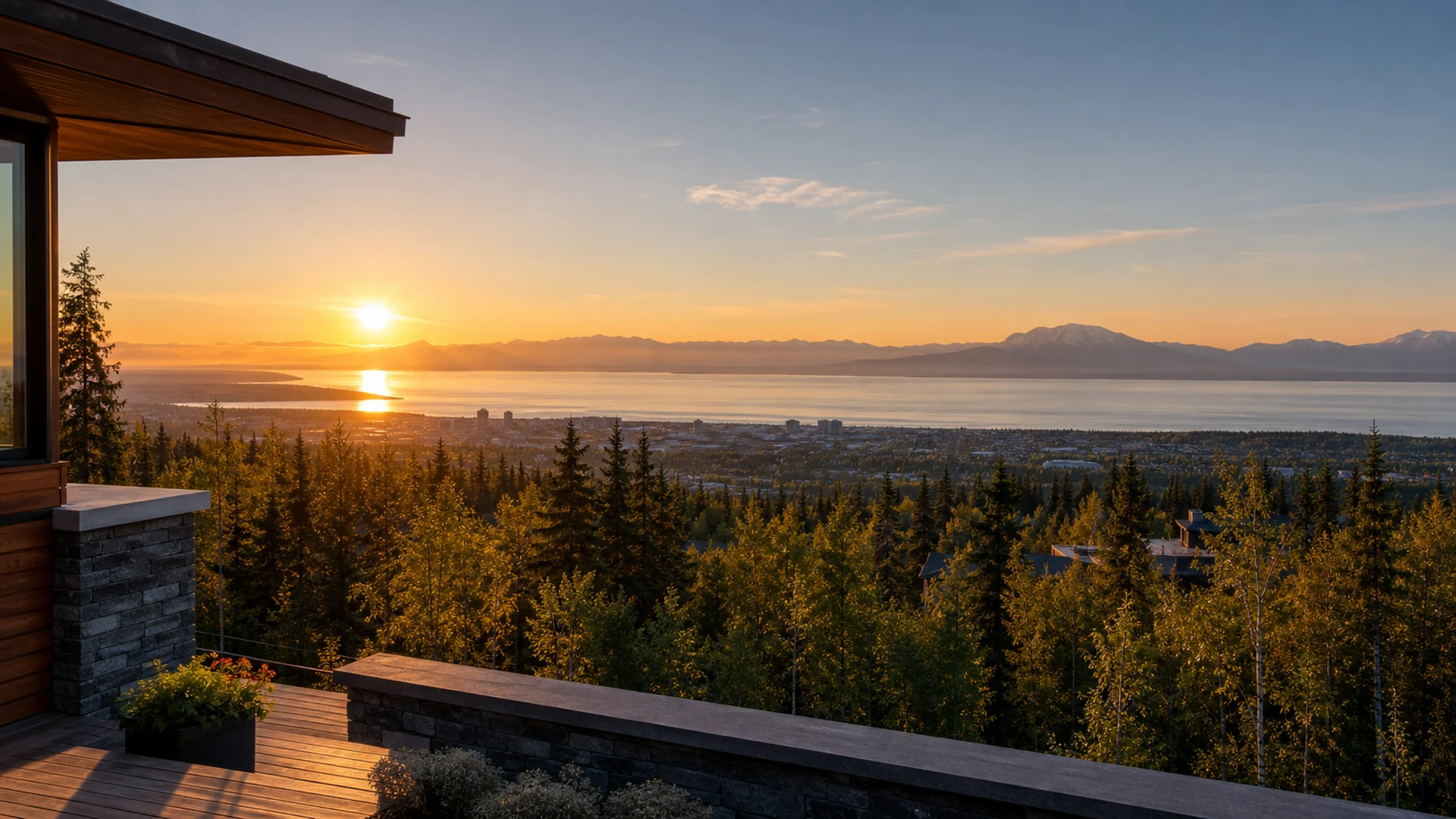
In Anchorage real estate, Cook Inlet view value is the price premium a home earns for an open, protected sightline over Cook Inlet and the surrounding mountains. Three things drive it: how much water and mountain the view captures, whether the sightline is permanently protected from being built out, and orientation. Because Cook Inlet lies to the west and northwest of the Anchorage Hillside, and the summer sun sets to the northwest, a west-facing inlet lot points the water view and the long evening light in the same direction. That alignment — open water, city lights, mountains, and sunset all at once — is why inlet-view lots consistently lead the Hillside luxury market.
Almost every luxury listing on the Anchorage Hillside sells the same three words in some order: inlet, city, mountains. “Cook Inlet view value” is the shorthand buyers and agents use for the dollars that sightline is actually worth — and in a market this view-driven, it is one of the most misunderstood numbers in the deal. A view can be spectacular on the day you tour and half gone in five years when the empty lot below you gets built. Having watched this corridor grow for four decades, I’ve learned the view that holds its value is never just about what you see today — it’s about what protects it.
- Cook Inlet view value is the premium a home commands for an open, protected view of Cook Inlet and the surrounding mountains.
- Cook Inlet is the large body of water west of Anchorage; Turnagain Arm is its narrow southeastern branch between the Chugach and Kenai mountains.
- Because the summer sun in Anchorage sets to the northwest — the same direction as the inlet — a west-facing view captures both the water and the long evening light.
- Anchorage gets roughly 19 hours of daylight around the June solstice and about 5.5 hours near the December solstice, so evening light is a genuine amenity in summer.
- The most valuable views layer water, the Anchorage city skyline, Sleeping Lady (Mount Susitna), and on clear days Denali and the Alaska Range.
- A view is only as durable as what protects the sightline — elevation, covenants, tree control, and whether a downhill lot can be built up.
Cook Inlet view value — the price premium an Anchorage home commands for an open, protected sightline to Cook Inlet and the surrounding mountains. It rises with the amount of water and mountain the view captures, with how permanently the sightline is protected from being built out, and with west/northwest orientation, which aligns the view with Anchorage’s long summer evening light.
What Is Cook Inlet, and How Is It Different From Turnagain Arm?
Cook Inlet is the waterway that opens the western edge of Anchorage. Its two northern branches are Knik Arm to the north and Turnagain Arm to the southeast. Per geographic references on the region, Turnagain Arm runs roughly east–west for about 40 to 45 miles and boasts the second-highest tides in North America after the Bay of Fundy, which is what produces the famous daily bore tide. That distinction matters for a buyer: a Cook Inlet view typically reads as wide-open water toward Sleeping Lady and the west-side mountains, while a Turnagain Arm view is a narrower water corridor framed by steep peaks — more common as you move into South Anchorage and Girdwood.
Anchorage’s luxury inventory sells the view directly. Hillside listings routinely advertise “panoramic views of Cook Inlet,” and higher-tier homes stack the water with the Anchorage skyline, Sleeping Lady, and on clear days Denali and the Alaska Range — the layered view that commands the top of the market.
| Factor | Higher value | Lower value |
|---|---|---|
| Orientation | West / northwest (sunset alignment) | North / east |
| View content | Water + city skyline + mountains | Water only / partial |
| Protection | Elevation, covenant, or view easement | Depends on an empty downhill lot |
| Daylight leverage | ~19 hrs of summer light to enjoy it | ~5.5 hrs of winter light |
| Obstruction risk | Controlled tree height | Buildable parcel below |
Why Does West-Facing Orientation Make a Cook Inlet View Worth More?
This is the factor most buyers miss, and it is the one a 40-year local checks first. Cook Inlet lies to the west and northwest of the Hillside. In Anchorage, per solar data for the city’s latitude of about 61°N, the sun rises and sets well to the north of due east and west around the summer solstice and to the south around the winter solstice. In practice that means the long summer evenings — and the sunset itself — happen to the northwest, the same direction as the water. A west-facing inlet lot therefore points the view and the best light of the day at the same horizon. Unlike a north- or east-facing lot that may see water but loses the evening light, the west-facing lot delivers both together.
That amenity is amplified by how much daylight Anchorage gets to enjoy it. On the summer solstice Anchorage has roughly 19 hours between sunrise and sunset, and even the shortest day of the year brings nearly 5.5 hours of daylight. A west-facing inlet view is something you can actually live in front of for hours on a summer evening — which is exactly why listings on the corridor sell “sunset views” and “west-facing decks” as headline features.
What Makes a Cook Inlet View Durable — or Fragile?
A view premium is only as real as the thing protecting the sightline. Before I let a buyer pay for a view, we work through four questions: How high does this lot sit relative to the lots downhill? Are there recorded covenants (CCRs) or a view easement protecting the sightline — and note that many Anchorage-area parcels are unrestricted with no HOA at all? How tall are the trees below, and who controls them? And most important: is there a vacant, buildable parcel between this home and the water? A view that depends on an empty downhill lot staying empty is not a protected view — it is a temporary one, and it should be priced that way.
- Visit Anchorage — hours of daylight (roughly 19-hour summer solstice framing; nearly 5.5 hours on the shortest day).
- Alaska.org — shortest/longest day in Alaska (about 19 hours of daylight on the summer solstice in Anchorage).
- Sun-position data for Anchorage (~61°N) — the sun sets to the northwest in summer and southwest in winter; solstice daylight figures.
- Wikipedia / geographic references — Turnagain Arm length (~40–45 mi) and second-highest tides in North America after the Bay of Fundy.
- Visit Anchorage & NOAA/NWS resources — Cook Inlet tidal range and Turnagain Arm bore-tide context.
Judging a View Before You Pay for It?
Ask Bill to walk the sightline with you — orientation, protection, and what it’s really worth.
Frequently Asked Questions
Yes. An open, protected Cook Inlet view is one of the most consistent value drivers in the Anchorage luxury market, which is why hillside listings routinely lead with panoramic inlet, city, and mountain views. The size of the premium depends on how much water and mountain the sightline captures and whether it is protected from future building.
Cook Inlet sits to the west and northwest of the Anchorage Hillside, and in summer the Anchorage sun sets to the northwest. That means a west-facing inlet view captures the long evening light and sunset during the season when Anchorage gets up to about 19 hours of daylight, so the water view and the best light of the day point the same direction.
A view is only as durable as what protects the sightline. Check the elevation of your lot versus the lots downhill, any recorded covenants or view easements, tree height and who controls it, and whether a vacant parcel below you could be built up. A view that depends on an empty downhill lot is not a protected view.
Cook Inlet is the main body of water west of Anchorage; Turnagain Arm is its narrow southeastern branch running between the Chugach and Kenai mountains, home to the daily bore tide. A Cook Inlet view typically reads as wide open water toward Sleeping Lady and the west-side mountains, while a Turnagain Arm view is a narrower water corridor framed by steep peaks, more common in South Anchorage and Girdwood.
Often yes. Many Hillside view properties are marketed with combined views of Cook Inlet, the Anchorage city skyline, Sleeping Lady (Mount Susitna), and on clear days Denali and the Alaska Range. A layered view that stacks water, city lights, and mountains typically commands more than water alone.