

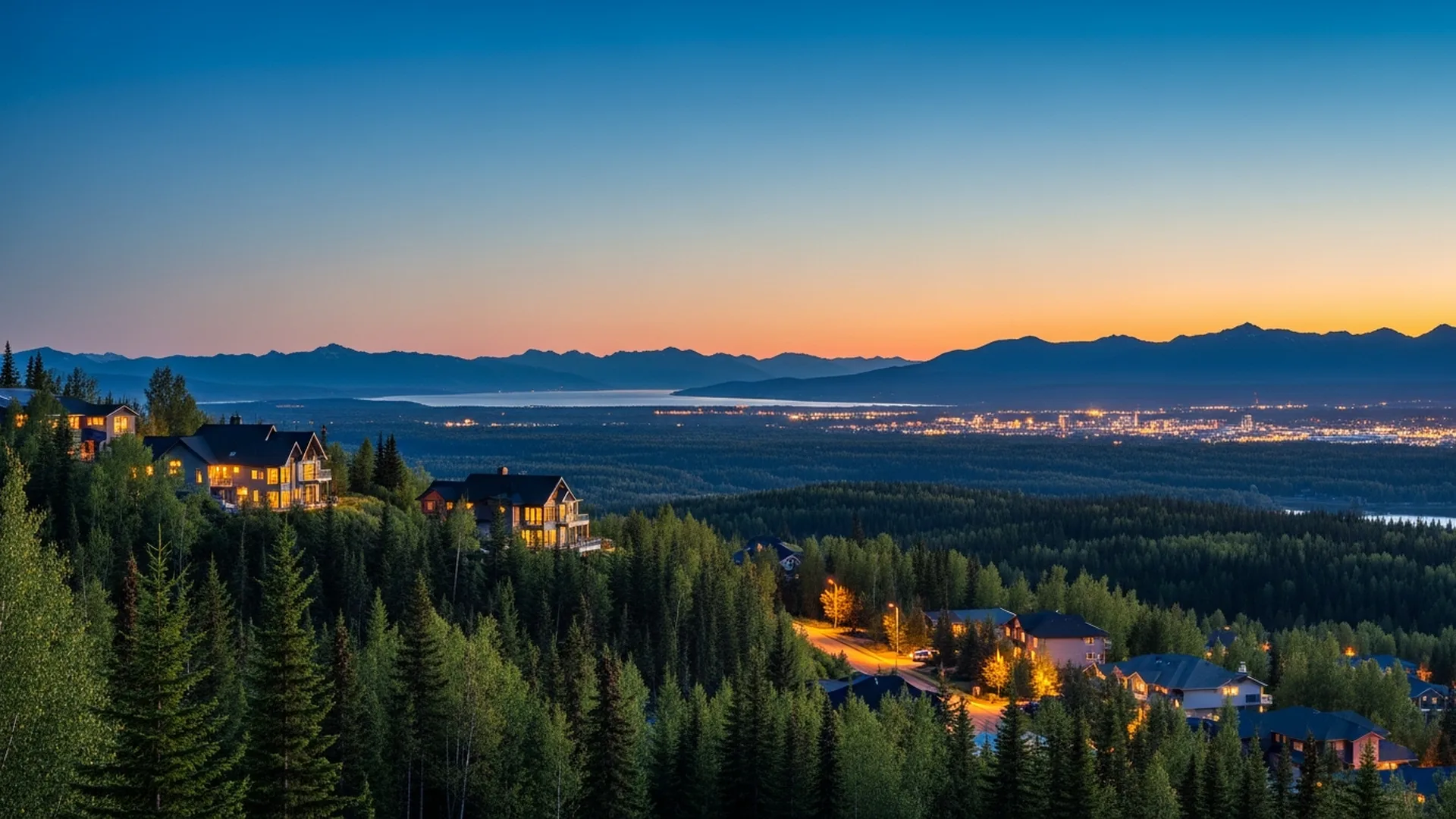
Stuckagain Heights is a forested, low-density enclave on the northeast edge of the Anchorage Hillside, reached primarily by Campbell Airstrip Road through Far North Bicentennial Park and set directly against the Chugach front range. Homes here sit on large, private acre-plus lots — most without an HOA — and rely on private wells and on-site septic systems rather than city water and sewer. Because the neighborhood faces west off the mountain shoulder, cleared or elevated parcels can capture views across the Anchorage Bowl toward Cook Inlet and, on clear days, the Alaska Range and Denali. The trade-offs a buyer weighs are the required Municipality of Anchorage well-and-septic certification at sale, the single park-road access, and a documented wildland-urban interface wildfire exposure. It is one of the most nature-immersed places to own a home inside Anchorage’s city limits.
Stuckagain Heights is the kind of Anchorage neighborhood people either haven’t heard of or have always quietly wanted to live in. It is a locality on the northeast Hillside, situated near Chugach Foothills and Conifer Heights and set apart by the fact that you largely reach it through Far North Bicentennial Park — the largest park in Anchorage, home to over 100 miles of trails and a gateway into nearly half-a-million-acre Chugach State Park. That single detail shapes almost everything about buying here: the seclusion, the wildlife at the doorstep, the light through the trees, and the practical realities of access and utilities that a Lower-48 buyer rarely thinks about.
Having watched the Hillside develop for four decades as an Anchorage resident, I’ll tell you what I tell every client touring up here: the qualities that make Stuckagain Heights special are inseparable from the qualities that require homework. Big forested lots mean privacy — and a well and a septic field you need to verify. A west-facing mountain shoulder means sunset views — and, often, slope. This guide walks through both sides honestly.
- Stuckagain Heights sits on the northeast Anchorage Hillside, reached mainly via Campbell Airstrip Road through Far North Bicentennial Park, with Chugach State Park trails essentially at the doorstep.
- Lots are large — commonly an acre or more — heavily forested, and frequently without a homeowners association; homes typically date from the 1990s and later.
- Homes here use private wells and on-site septic; the Anchorage Water and Wastewater Utility places most of the upper Hillside outside its service boundary.
- A Certificate of On-Site Systems Approval (COSA) from the Municipality of Anchorage is required before any well/septic property can change title — a $600 Municipal issuance fee plus separate engineer testing.
- The neighborhood faces west off the Chugach shoulder, so cleared or elevated lots look toward the Anchorage Bowl, Cook Inlet, and on clear days the Alaska Range and Denali.
- Level lots with panoramic views are rare here; great views usually come on sloped ground that raises excavation and foundation cost.
- Stuckagain Heights is in Anchorage’s wildland-urban interface and was flagged as an extreme-risk wildfire area in the Municipality’s updated planning; a 2025 fuel break was cut along its access road.
Where Exactly Is Stuckagain Heights, and How Do You Get There?
Stuckagain Heights lies on the northeast edge of the Anchorage Hillside, south-east of Scenic Foothills and north-east of Mid-Hillside, tucked into the Chugach foothills. What makes it geographically unusual is the approach: the primary way in is Campbell Airstrip Road, which threads through Far North Bicentennial Park before reaching the homes. As the Anchorage Fire Department has described it, that access road serves roughly 200 homes and doubles as the neighborhood’s evacuation route. Unlike a typical grid subdivision, you don’t so much drive into Stuckagain Heights as drive up through a forest into it.
The upside of that geography is immediate and rare: the Alaska Botanical Garden and the trail networks of Far North Bicentennial Park sit within a couple of miles, and Chugach State Park — where the Hillside is known for Denali views, mountainous backdrops, and northern lights, per Alaska State Parks — is a short distance uphill. The Dome trail off Campbell Airstrip Road is a locally loved sunset perch. Few Anchorage neighborhoods put a moose-and-bear wilderness this close to a driveway while still keeping you inside city limits.
| Direction | What is there | Relevance to buyers |
|---|---|---|
| West / Northwest | Anchorage Bowl, downtown, Cook Inlet, Knik Arm; Alaska Range & Denali on clear days | Primary view & sunset direction from cleared/elevated lots |
| East | Chugach front range, Chugach State Park | Mountains rise directly behind; trail access; blocks low SE winter sun |
| West (access) | Far North Bicentennial Park & Campbell Airstrip Road | Single wooded access route and evacuation route for ~200 homes |
What Are Homes and Lots Like in Stuckagain Heights?
The physical character here is consistent: large, wooded, private parcels — commonly an acre or more — with homes set well back on long driveways behind tall trees. Many parcels carry no homeowners association, which is common across the upper Hillside and appeals to buyers who want to build, expand, or keep things unrestricted. Housing styles run an eclectic range, from log-cabin-inspired and timber builds to newer traditional custom homes, with much of the stock built from the 1990s onward.
Here is the reality that separates a seasoned Hillside read from a listing photo: on this terrain, panoramic views and level ground rarely arrive together. In Stuckagain Heights, the truly flat, view-open lot is the exception, not the rule — great views usually sit on slope, and slope inflates excavation and foundation cost on a custom build. Unlike a flat Bowl subdivision where you’re mostly buying the house, up here you’re buying the land’s behavior — how it drains, where the sun lands, and what it costs to build on. This is precisely where a design-trained eye earns its keep.
Which Way Do the Views Face — and Why Does Winter Sun Matter?
Because the neighborhood sits on a west-facing shoulder below the Chugach, the value view looks west and northwest: out over the Anchorage Bowl and downtown toward Cook Inlet and Knik Arm, with the Alaska Range and Denali appearing on the northwest horizon on clear days. The mountains stand to the east, directly behind the homes. That orientation is a genuine asset in a place like Anchorage, where locals prize the long summer sunset over the Inlet — on the June solstice the city gets roughly 19–plus hours of daylight and the latest sunsets fall near 11:40 p.m.
But the same latitude that gives those endless June evenings takes them back hard in winter. Anchorage sits at about 61°N; on the winter solstice daylight shrinks to roughly five and a half hours and the midday sun peaks only a few degrees above the horizon. That low, southeast winter arc is exactly the direction the Chugach blocks here. So on a Stuckagain Heights parcel, the practical question isn’t just “is there a view?” but “does this specific lot hold usable winter light, or does the ridge shade it by early afternoon?” Heavy spruce and birch also mean many view lots need selective clearing to open the sightline — a real cost and, on some parcels, a value lever.
What Should You Check on a Well-and-Septic Home in Stuckagain Heights?
This is the single most important piece of due diligence up here, and it’s where local knowledge saves real money. Most of the upper Hillside — including Stuckagain Heights — is outside the Anchorage Water and Wastewater Utility (AWWU) service boundary. AWWU states that nearly 7,000 residential lots in southeast Anchorage lack municipal water and sewer, most of them larger than an acre and served by private wells and on-site septic. That means every transaction here runs through the Municipality’s on-site systems process.
Since a 1998 Municipal ordinance, transferring title on any well- or septic-served home in Anchorage requires a Certificate of On-Site Systems Approval (COSA). Per the Municipality of Anchorage, a COSA confirms an engineer inspected and tested the well and/or septic and found them compliant. The engineer’s work typically includes a well flow test, water sampling that is required to include bacteria, nitrates and arsenic, and a septic adequacy test that verifies the drainfield absorbs the design load. The Municipality charges $600 to review the package and issue the certificate; the septic tank must also have been pumped within the past year and an as-built survey provided. Septic systems are sized by bedroom count under Anchorage Municipal Code 15.65, so the “bedrooms” the septic is approved for may not match the tax record — a detail that catches buyers off guard.
What holds value here
- Documented, recently-tested well & septic with a clean COSA history
- A cleared or clearable west/northwest view corridor
- Usable winter light, not just a summer view
- Large, private, low-restriction acreage
What deserves scrutiny
- Undocumented or older steel septic tanks (DEC flags corrosion risk over ~15 yrs)
- Steep excavation/foundation cost on view-slope lots
- Single park-road access & winter snow removal on that route
- Wildland-urban interface wildfire exposure & defensible space
The Alaska Department of Environmental Conservation advises buyers to start the on-site records search early rather than waiting for the lender. The Municipality maintains its own on-site well/septic records online, and the ground has to be unfrozen to run the septic adequacy test — which makes timing a real factor on a winter closing up here.
How Serious Is the Wildfire Question, Really?
It’s a fair and honest question, and the answer is: it’s real, it’s manageable, and it’s being actively addressed. Roughly 82% of Anchorage falls within the wildland-urban interface, and in the Municipality’s first rewrite of its community wildfire protection plan since 2007, Stuckagain Heights was named among neighborhoods carrying an extreme risk rating — a rating driven by factors like dead-end road access, distance to a fire station, and dense surrounding vegetation, per the Anchorage Fire Department.
What I point clients to is the response, not just the rating. In 2025 the Anchorage Fire Department’s wildfire division cut a fuel break along about three miles of Campbell Airstrip Road — the neighborhood’s access and evacuation route — thinning trees and clearing ground fuels. For a specific home, the questions worth asking are concrete: how much defensible space surrounds the structure, what the roof and siding materials are, and how the driveway and access read for emergency vehicles. These are answerable, property-by-property, and they belong in your inspection conversation.
Thinking of Selling in Stuckagain Heights? What Drives Value Here
If you own here, the levers that move your number are specific to this terrain. First, get ahead of the COSA: sellers who test the well and septic early — rather than discovering a problem mid-escrow — protect both timeline and price, and testing requires unfrozen ground, so season matters. Second, the view corridor is often your biggest untapped asset; a thoughtfully cleared sightline toward the Inlet can meaningfully reset buyer perception, and it’s something buyers consistently underestimate until they stand on the deck.
Third — and this is where my background in design and furnishings comes in — how a home reads to a luxury buyer in this setting is not accidental. Finishes that suit a forested, high-latitude home, staging that draws the eye to the west-facing light, and presentation that frames the acreage as a lifestyle rather than a maintenance list all change the offer. I bring a designer’s eye to how a Hillside home is prepared and presented, then pair it with pricing grounded in what these unique parcels actually trade for. When you’re ready, I can build you a specific value picture — see your Hillside home value.
- Municipality of Anchorage — On-Site Water & Wastewater / Certificate of On-Site Systems Approval (COSA): 1998 title-transfer requirement, bedroom-based sizing under AMC 15.65, and testing process.
- Municipality of Anchorage — $600 COSA issuance fee; required well sampling (bacteria, nitrates, arsenic), well flow test, septic adequacy test, and as-built/pumping requirements (via MOA-approved engineering process).
- Anchorage Water & Wastewater Utility (AWWU) — ~7,000 southeast Anchorage lots outside municipal service, most over an acre, on private well & septic; Hillside District Plan service boundary.
- Alaska Department of Environmental Conservation — on-site wastewater systems in real estate transactions; start records search early; steel-tank corrosion advisory.
- Anchorage Fire Department / Anchorage Daily News (2025) — community wildfire protection plan rewrite; Stuckagain Heights extreme risk rating; ~3-mile Campbell Airstrip Road fuel break serving ~200 homes; ~82% of Anchorage in the wildland-urban interface.
- Alaska State Parks — Chugach State Park recreation and Anchorage Hillside Denali/mountain viewpoints; Far North Bicentennial Park and Glen Alps regional geography.
- Visit Anchorage / astronomical sun data — Anchorage daylight (~19+ hrs June solstice; ~5.5 hrs December solstice) and latitude (~61°N) with low winter sun angle.
- OpenStreetMap / Wikidata — Stuckagain Heights locality position relative to Scenic Foothills, Mid-Hillside, Far North Bicentennial Park, and the Alaska Botanical Garden.
Explore Stuckagain Heights With a 40-Year Anchorage Local
From reading a view corridor to vetting a well and septic, I’ll help you buy the right Hillside home — not just a pretty listing.
Frequently Asked Questions
Stuckagain Heights sits on the northeast edge of the Anchorage Hillside, tucked against the Chugach front range and reached primarily via Campbell Airstrip Road through Far North Bicentennial Park. It lies south-east of Scenic Foothills and north-east of Mid-Hillside, roughly two miles east of Far North Bicentennial Park’s main areas, giving it a secluded, forested character while still keeping downtown Anchorage within a reasonable drive.
Yes. Like most of the upper Hillside, Stuckagain Heights is outside the Anchorage Water and Wastewater Utility service boundary, so homes rely on private wells and on-site septic systems. AWWU notes that roughly 7,000 southeast Anchorage lots — most larger than one acre — use on-site wells and septic. Every sale of such a home requires a Certificate of On-Site Systems Approval (COSA) from the Municipality of Anchorage before title can transfer.
A COSA is a Certificate of On-Site Systems Approval — a written confirmation signed by a professional engineer and the Municipality that a home’s well and/or septic system was inspected and meets standards. It has been required for any well- or septic-served title transfer since a 1998 Municipal ordinance. The Municipality of Anchorage charges $600 to review the paperwork and issue the certificate; the engineer’s testing (well flow test, water sampling for bacteria, nitrates and arsenic, and a septic adequacy test) is billed separately.
Because Stuckagain Heights sits on a west-facing shoulder of the Chugach front range, cleared or elevated lots look west and northwest across the Anchorage Bowl toward Cook Inlet, Knik Arm and, on clear days, the Alaska Range and Denali. The mountains rise directly to the east behind the neighborhood. Heavy spruce and birch cover means many view lots require selective clearing to open the sightline, and a west-facing orientation captures Anchorage’s long, late summer sunsets.
The neighborhood is one of Anchorage’s wildland-urban interface areas. In the Municipality’s updated community wildfire protection planning, Stuckagain Heights was among several neighborhoods flagged with an extreme risk rating, based on factors like dead-end road access and dense surrounding vegetation. In 2025 the Anchorage Fire Department’s wildfire division cut a fuel break along about three miles of Campbell Airstrip Road, which serves as the access and evacuation route for roughly 200 homes. Buyers should ask about defensible space around any specific home.
Lots are large, forested and private — commonly an acre or more, many without a homeowners association. Homes tend to sit well back on long driveways behind mature trees, and building styles range from log-and-timber to newer traditional custom builds, with much of the housing stock dating from the 1990s and later. The trade-off Hillside buyers weigh here is that level, view-friendly parcels are rare; great views usually come on sloped ground that raises excavation and foundation costs.
Stuckagain Heights is one of the more remote-feeling Hillside enclaves because it is reached through Far North Bicentennial Park rather than a standard grid of streets. In practical terms it is still an in-town Anchorage neighborhood with trail, park and Chugach State Park access essentially at the doorstep, but the single winding park road means winter driving and snow removal on that route deserve a look before you buy.