

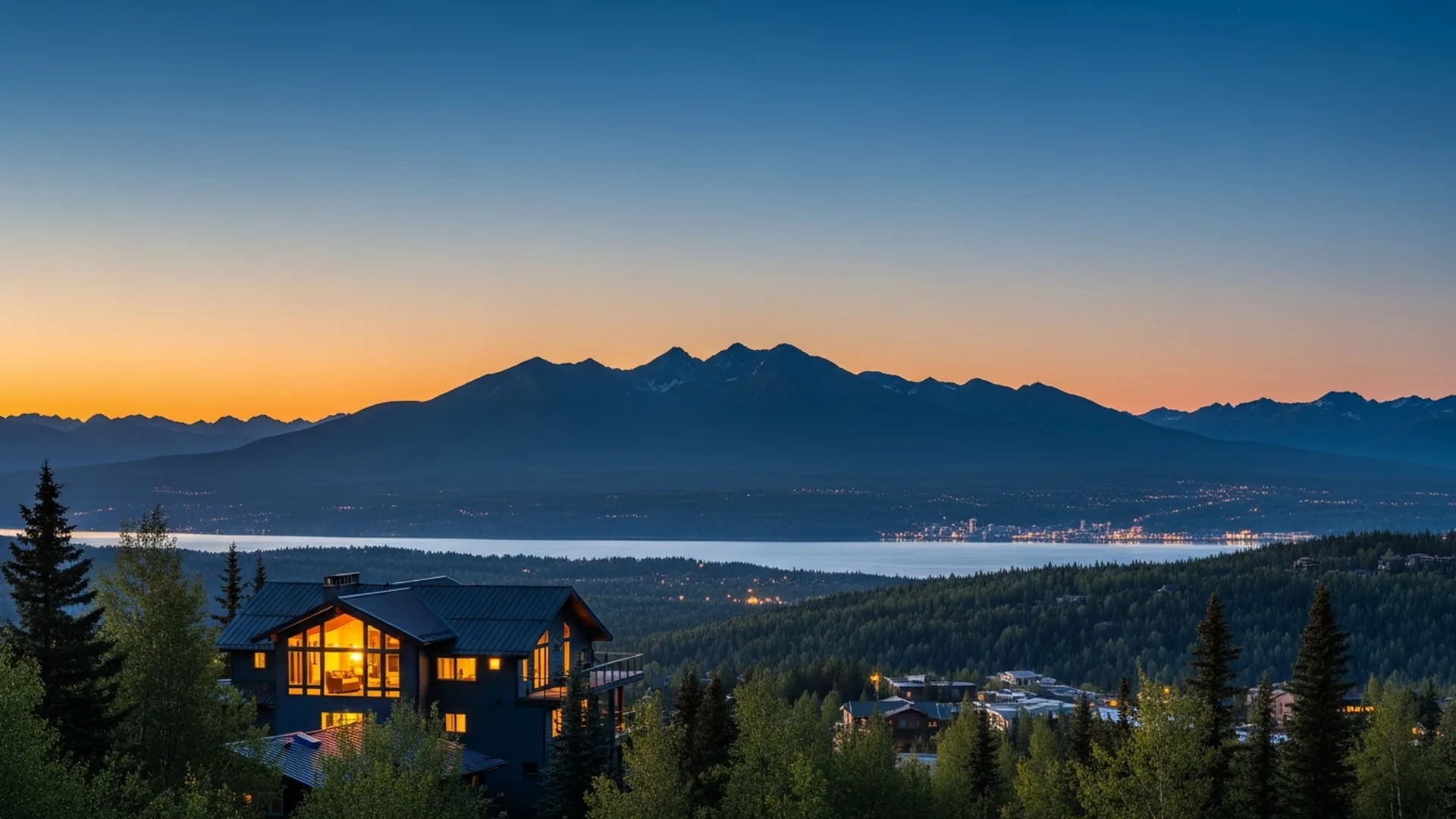
Glen Alps is the highest residential edge of the Anchorage Hillside, tucked against Chugach State Park at the end of Toilsome Road, where the trailhead itself sits near 2,200 feet at tree line. Homes here are custom, on larger wooded lots, and their defining asset is orientation: west and southwest-facing parcels look out over the Anchorage Bowl, Cook Inlet, Sleeping Lady, and the Alaska Range, while the Chugach front and Flattop rise directly behind. Because the neighborhood is above the municipal water and sewer boundary, homes run on private wells and on-site septic, which means a Certificate of On-Site Systems Approval (COSA) at sale. Roads at the top of the Hillside are privately or service-area maintained rather than plowed by the city’s main crews, and at Anchorage’s 61°-north latitude the low winter sun makes a clear west-facing sightline genuinely valuable, not just scenic.
I’ve lived in Anchorage for forty years, and Glen Alps is one of those addresses that people who don’t live here picture when they imagine the Hillside: high, wooded, quiet, and hanging over one of the great city-and-water views in the country. It takes its name from the Glen Alps Trailhead, the most popular gateway into Chugach State Park and the jumping-off point for Flattop Mountain — the most-climbed peak in Alaska. Living up here means the park is quite literally at the end of your street.
But the same qualities that make Glen Alps spectacular — the elevation, the slope, the position above the city’s utility grid — are exactly what a buyer needs to read carefully. The view is the easy part. What separates a great Glen Alps purchase from a frustrating one is understanding the orientation, the well and septic picture, and how the road gets plowed in February. This page walks through all of it.
- Glen Alps sits at the top of the Anchorage Hillside at the end of Toilsome Road, off Upper Huffman off Hillside Drive; the trailhead is near 2,200 feet at tree line, about 20–25 minutes from downtown.
- West and southwest-facing lots capture the Anchorage Bowl, Cook Inlet, Mount Susitna (Sleeping Lady), Fire Island, and — on clear days — the Alaska Range and Denali; the Chugach front and Flattop rise to the east behind the homes.
- The area is above the Anchorage Water & Wastewater Utility boundary, so homes use private wells and on-site septic; roughly 7,000 southeast Anchorage lots are on well and septic.
- Since a 1998 Municipal ordinance, selling a well/septic home requires a Certificate of On-Site Systems Approval (COSA) from the Municipality of Anchorage, based on engineer testing; the MOA review fee is commonly cited around $600.
- Most top-of-Hillside roads are privately maintained or fall under a Limited Road Service Area (LRSA), where neighbors fund their own plowing, sanding, and grading; driveways are always the owner’s responsibility.
- At about 61° north, Anchorage gets roughly 5.5 hours of daylight on the December solstice with the midday sun near 5° above the horizon — so an open west/southwest sightline is a functional value driver, not just a nicety.
- Toilsome Road, the access to Glen Alps, has a switchback and steep grades and can require four-wheel-drive or winter tires — a good preview of the driveway-grade realities on nearby lots.
Where Exactly Is Glen Alps on the Anchorage Hillside?
Glen Alps is at the eastern, uphill limit of Anchorage’s Hillside — the point where custom homes give way to Chugach State Park. From the Seward Highway you take O’Malley Road toward the mountains, follow it to Hillside Drive, turn south, then climb Upper Huffman Road; about a half mile up, the road forks, and Toilsome Road carries you to the Glen Alps parking area at the top. Alaska State Parks describes the trailhead as roughly a 20-minute drive from downtown, and Visit Anchorage puts it closer to 25 — either way, it’s remarkably close to the city for how wild it feels.
The Glen Alps Trailhead itself sits at about 2,200 feet, right at tree line, which tells you a lot about the homes nearby: they’re high, they’re on sloping ground, and they’re surrounded by the mountain hemlock and open tundra that define the upper Hillside. This is a small, custom-home setting rather than a dense subdivision — a place people build to capture a specific view and a specific kind of seclusion. Unlike the lower Hillside, where lots are smaller and closer to services, up here privacy and elevation are the whole point.
| Feature | Glen Alps reality |
|---|---|
| Position on Hillside | Top / uphill edge, adjacent to Chugach State Park |
| Trailhead elevation | ~2,200 ft, at tree line |
| Best view orientation | West / southwest (Cook Inlet, Sleeping Lady, Alaska Range) |
| Mountains behind (east) | Chugach front & Flattop Mountain (3,510 ft) |
| Water & sewer | Private well & on-site septic (above MOA utility boundary) |
| Road maintenance | Private / Limited Road Service Area (not main city crews) |
| Drive to downtown | ~20–25 minutes |
Which Glen Alps Lots Get the Cook Inlet View — and Which Get the Chugach?
This is the question that decides value up here, and it’s the one buyers most often get backwards. Glen Alps sits on the western flank of the Chugach front, so the big postcard view — the Anchorage Bowl, Cook Inlet, Mount Susitna (Sleeping Lady), Fire Island, and the distant Alaska Range and Denali — opens to the west and southwest, downhill toward the city. The Glen Alps overlook is famous for exactly this panorama, and area listings routinely describe unobstructed views of the inlet, Susitna, Denali, and the Alaska Range from west-facing parcels.
Turn around, and the Chugach peaks — including 3,510-foot Flattop, the most-climbed mountain in Alaska — rise directly behind the homes to the east. Some lots are prized for that dramatic mountain backdrop; others are built to face the inlet. A few exceptional homesites capture both. What matters is that the view you’re paying for is genuinely captured by the home’s siting and window walls, not just theoretically present on the lot — and that trees or a rising neighbor’s roofline won’t erase it in five years.
Do Glen Alps Homes Have City Water and Sewer, or Well and Septic?
Well and septic. This is one of the most important facts about buying at the top of the Hillside, and it’s not optional knowledge. The Anchorage Water & Wastewater Utility (AWWU) serves the lower Hillside, but the Anchorage Assembly set a fixed upper boundary for municipal water and sewer when it adopted the Hillside District Plan — and Glen Alps is above that line. AWWU notes that nearly 7,000 residential lots in southeast Anchorage are without municipal water and sewer, most of them larger than an acre, relying on on-site wells for drinking water and septic systems for wastewater.
That’s not a drawback — it’s simply the reality of large-lot mountain living, and it comes bundled with the privacy and acreage buyers want up here. But it does change your due diligence. You’re inheriting a private water source and a private wastewater system, and both need to be understood before you write an offer, not after.
Because these systems are on-site, the Municipality of Anchorage’s On-Site Water & Wastewater Section keeps searchable records of permitted wells and septic systems. Pulling those records early — the as-built survey, prior test results, the well log — is one of the smartest moves a Glen Alps buyer can make.
What Is a COSA, and What Does Well-and-Septic Due Diligence Look Like Here?
Per the Municipality of Anchorage, since an August 1998 ordinance, transferring title on any Anchorage property served by a well or septic system requires a Certificate of On-Site Systems Approval (COSA). The COSA confirms that a licensed civil engineer has inspected and tested the systems and found them in compliance. In practice, that means the engineer flow-tests the well, pulls a water sample for arsenic, nitrate, and bacteria, runs a septic adequacy test sized to the number of bedrooms, and verifies the code separation distances between the well and the septic field. The MOA charges a fee — commonly cited around $600 — to review the package and issue the certificate.
The timing details matter. Engineering firms note that a well flow test and septic adequacy test generally must be within about two years, the tank must have been pumped within the past year, and water-sample lab results have short shelf lives — bacteria and nitrate results are typically valid for only about 90 days, and the lab turnaround can run 10 business days. The unglamorous but crucial point: septic testing needs unfrozen, workable ground. A late-fall or deep-winter closing on a Glen Alps home can bump straight into that constraint, which is why experienced sellers here test early rather than scrambling under a contract deadline.
What buyers gain up here
- Big west/southwest Cook Inlet and Alaska Range views
- Larger, wooded, more private lots
- Chugach State Park and Flattop at the doorstep
- Custom homes, not tract product
- City-lights and aurora views on clear winter nights
What buyers must plan for
- Private well & septic (COSA required at sale)
- Private or service-area road plowing & grading
- Steep driveway grades; 4WD/winter tires realities
- Longer commute than lower-Hillside addresses
- View sightlines that must be verified, not assumed
How Do Roads Get Plowed in Glen Alps in Winter?
Differently than most of Anchorage — and this surprises newcomers every year. The Municipality’s own Snow & Ice Control Plan states plainly that on the Hillside, in Girdwood, and in Eagle River, most streets are privately maintained, either by a Road Service Area or a private association. Many top-of-Hillside neighborhoods fall inside the Limited Road Service Area (LRSA), where, as the Anchorage Daily News has reported, far-flung neighborhoods essentially tax themselves through a locally elected board of supervisors to fund plowing, sanding, ditch clearing, and grading. The main city crews that plow the Anchorage Bowl don’t handle these streets on the same schedule.
For a buyer, this means asking specific questions before you fall in love with a home: Is this street inside the LRSA, maintained by a private association, or an entirely private drive where the owners “pass the hat”? What are the annual road-maintenance costs? And — because the driveway is always the owner’s responsibility — how steep is it, and does it need professional snow-blowing? The access road to the Glen Alps Trailhead itself, Toilsome Road, is described by Alaska State Parks as having a switchback and steep grades that may require four-wheel-drive or winter tires; treat that as a fair preview of what winter access can look like near the top.
Why Does the Winter Sun Matter So Much at This Elevation?
Because Anchorage is far enough north that light is a real design variable. The Alaska Climate Research Center and NOAA-grade sun data put Anchorage at about 61° north, where the December solstice delivers only around 5½ hours of daylight — sunrise near 10:15 a.m., sunset near 3:40 p.m. More important than the length is the angle: at solstice the midday sun peaks at just over 5° above the horizon, so it rakes low across the land all day and light has a permanently golden, long-shadowed quality.
At that sun angle, terrain and trees do real work. A ridge to the southwest, a dense stand of mountain hemlock, or simply the wrong slope can shadow a home for much of a short winter day. That’s the un-glamorous reason a west or southwest orientation with an open sightline is worth paying for in Glen Alps — it’s not just the sunset view, it’s whether direct light reaches your great room in the darkest weeks. This is where I lean on a design background: reading how a home’s window walls, roof lines, and siting will actually behave in December is a different skill than admiring them in June.
Thinking of Selling in Glen Alps? What Drives Value Here
If you own a home near the top of the Hillside, a handful of things move your number more than square footage alone. The first is the view corridor: a cleared, protected west/southwest sightline to the inlet and Alaska Range is the single most valuable attribute up here, and sellers on view lots routinely underestimate how much a genuinely open sightline moves the price versus a partially screened one. The second is a clean, documented well-and-septic history — testing early, pulling your MOA On-Site records, and lining up your COSA before you list removes the biggest deal-killer on the Hillside and keeps a late-season closing from stalling on frozen ground.
The third is how the home presents its light and finishes for the season it’s shown in. With a background in interior design and furnishings, I stage and market Hillside homes to show how they live in both the midnight-sun summer and the low-sun winter — because buyers at this level are imagining January as much as July. If you’d like a specific read on your home, start with a Hillside home value estimate and we’ll build from there.
- Alaska State Parks / DNR — Glen Alps Trailhead location, access via Toilsome Road, switchback and steep grades (dnr.alaska.gov).
- ALASKA.ORG & Visit Anchorage — trailhead elevation (~2,200 ft, at tree line), drive time from downtown, and the panorama of Cook Inlet, Mount Susitna, and Denali.
- Wikipedia / USGS GNIS — Flattop Mountain elevation (3,510 ft), most-climbed peak in Alaska.
- Anchorage Water & Wastewater Utility (AWWU) — Hillside water/sewer boundary and ~7,000 southeast-Anchorage lots on well and septic.
- Municipality of Anchorage, On-Site Water & Wastewater Section — COSA requirement (1998 ordinance), engineer testing process, records; AMC 15.55 / 15.65.
- Independent Anchorage civil-engineering firms — COSA test timelines, water-sample lab turnaround, and the commonly cited MOA review fee (~$600).
- Municipality of Anchorage Snow & Ice Control Plan; Anchorage Daily News — Hillside roads privately/service-area maintained; the Limited Road Service Area (LRSA) model.
- Alaska Climate Research Center & NOAA-grade sun data — Anchorage ~61°N, ~5.5 hours of daylight and ~5° midday sun elevation at the December solstice.
Considering a Glen Alps home?
Let’s read the view corridor, the well-and-septic picture, and the winter access before you write an offer. Call Bill at 907-560-4090.
Frequently Asked Questions
Glen Alps is at the very top of the Anchorage Hillside, on the eastern edge of the city where the residential neighborhoods meet Chugach State Park. You reach it from the Seward Highway via O’Malley Road to Hillside Drive, then up Upper Huffman Road to Toilsome Road. The Glen Alps Trailhead sits at about 2,200 feet, right at tree line, roughly a 20 to 25 minute drive from downtown Anchorage.
West and southwest-facing Glen Alps lots look out over the Anchorage Bowl, Cook Inlet, Mount Susitna (Sleeping Lady), Fire Island, and, on clear days, the Alaska Range and Denali. Because the neighborhood climbs the western flank of the Chugach front, homes oriented downhill toward the inlet capture the sunset and city-lights view, while the Chugach peaks and Flattop rise directly behind to the east.
No. Homes at the top of the Hillside near Glen Alps are outside the Anchorage Water & Wastewater Utility service area and rely on private wells for drinking water and on-site septic systems for wastewater. The Anchorage Assembly set a fixed upper boundary for municipal water and sewer in the Hillside District Plan, and roughly 7,000 lots in southeast Anchorage sit above it on wells and septic.
A COSA is a Certificate of On-Site Systems Approval issued by the Municipality of Anchorage. Since a 1998 ordinance, a COSA is required to transfer title on any Anchorage property served by a well or septic system. A licensed civil engineer flow-tests the well, samples the water for arsenic, nitrate and bacteria, runs a septic adequacy test, and confirms separation distances; the MOA charges a fee (widely cited around $600) to review and issue the certificate.
Most streets at the top of the Hillside, including the Glen Alps area, are privately maintained rather than plowed by the city’s main Anchorage Bowl crews. Many fall under a Limited Road Service Area, where neighbors essentially tax themselves through a locally elected board to fund plowing, sanding and grading, and some smaller roads are maintained by private associations or by the homeowners themselves. Driveways are always the property owner’s responsibility.
Anchorage sits at about 61 degrees north, so on the December solstice the city gets only around 5.5 hours of daylight and the midday sun peaks at just over 5 degrees above the horizon. At that low angle, a ridge, a stand of mountain hemlock, or the slope itself can put a home in shadow for much of a short winter day. That is why a west or southwest orientation with an open sightline matters more here than in almost any Lower-48 market.
For buyers who value big views, privacy, larger wooded lots and immediate trail access, the top of the Hillside near Glen Alps is one of the most distinctive settings in Anchorage. The trade-offs are real: private well and septic, private or service-area road maintenance, steep driveway grades, and a longer commute than lower Hillside addresses. The right fit depends on how much a buyer values view and seclusion versus convenience and lower carrying costs.