

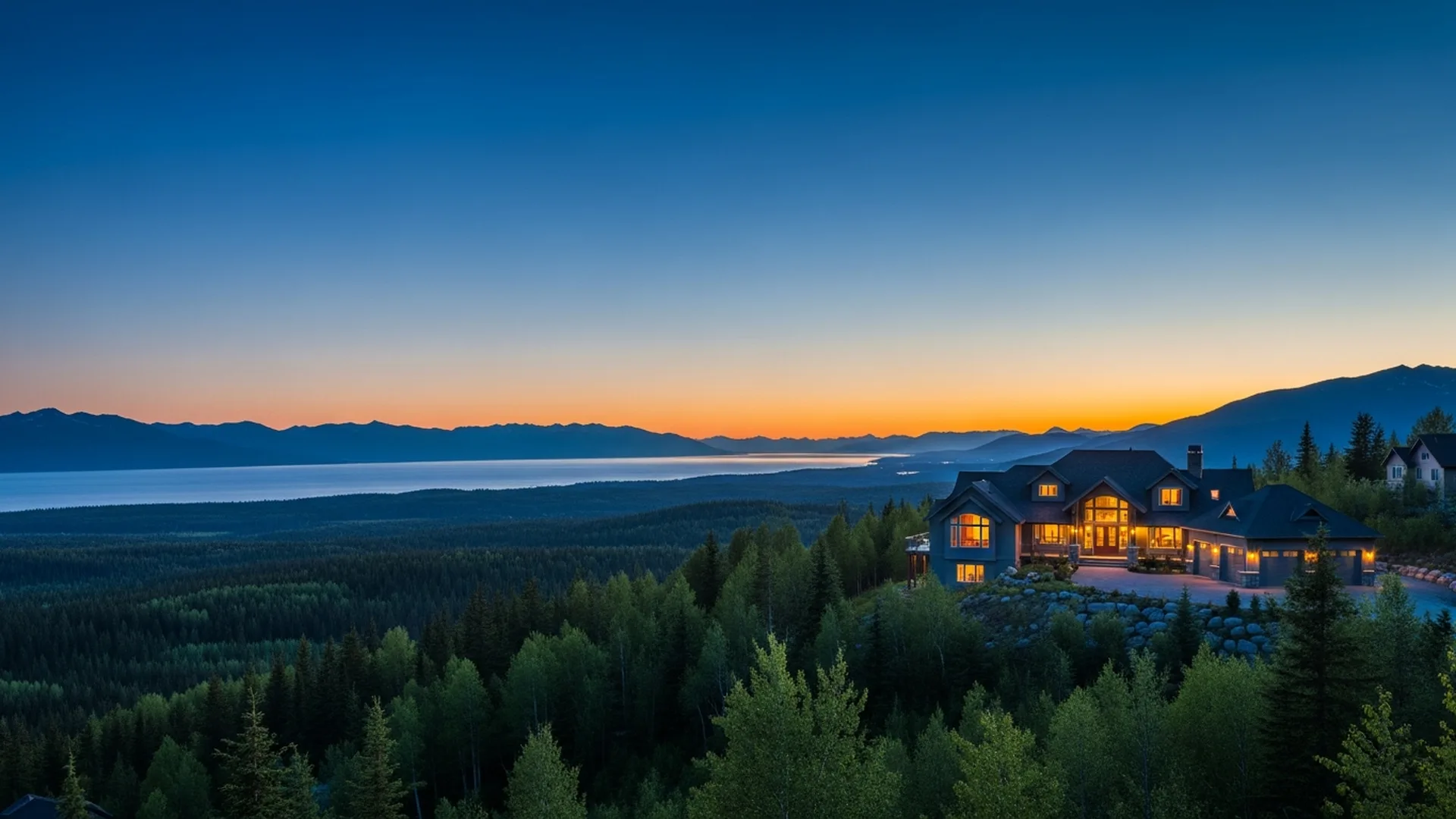
Rabbit Creek is a hillside residential area in southeast Anchorage, east of the Seward Highway, that climbs from Potter Marsh toward Chugach State Park and overlooks Cook Inlet and Turnagain Arm. It is one of the Hillside’s premier luxury pockets: large lots — many over an acre — view-facing custom homes, and a mix of public-utility subdivisions like Goldenview alongside parcels on private well and septic. The value story here is orientation and land: west and southwest lots hold the water view, south-facing lots hold the scarce winter sun, and buyers weigh well-and-septic due diligence and winter road access as carefully as square footage. Because much of Rabbit Creek uses on-site systems, a Certificate of On-Site Systems Approval (COSA) from the Municipality of Anchorage is part of most transactions here.
I’ve watched the Anchorage Hillside grow for four decades, and Rabbit Creek is where the two things Hillside buyers chase — a big-water view and real land — come together most reliably. The neighborhood sits southeast of Huffman–O’Malley and southwest of Mid-Hillside, and as its winding roads switchback uphill the view of Cook Inlet and the city opens up, ridge by ridge. It is a genuine luxury market, but it is also a market where the details underneath the view — the well, the septic, the driveway grade, the direction the lot faces — decide whether a home holds value or quietly frustrates its owner every winter.
This guide is written the way I’d walk a client through the area in person: the geography first, then the buyer diligence that actually matters here, then a straight seller section. Prices below are stated as verifiable ranges from public sources; I don’t invent numbers, and where a specific varies by parcel I say so.
- Rabbit Creek lies east of the Seward Highway in southeast Anchorage, rising from Potter Marsh toward Chugach State Park, with much of the neighborhood overlooking Cook Inlet.
- Lots are large — many exceed one acre — and a substantial share rely on private wells and on-site septic rather than city water and sewer.
- Some subdivisions (notably Goldenview and Potter Creek) do have public water and sewer, which is relatively unusual for Hillside properties.
- For well-and-septic homes, the Municipality of Anchorage requires a COSA at title transfer; the MOA review fee has recently been cited at $600, on top of engineer testing costs.
- West/southwest lots capture the water view; south-facing exposure captures scarce winter sun — on the December solstice the Anchorage sun peaks only ~5° above the horizon.
- Many Hillside roads sit in Limited Road Service Areas under Anchorage Municipal Code Title 27, so winter snow removal is arranged locally, not by the main city plow system.
- Area Anchorage School District schools by name include Rabbit Creek Elementary, Bear Valley Elementary, Goldenview Middle School, and South Anchorage High School (verify boundaries per address).
Where Is Rabbit Creek, and What Makes It a Luxury Address?
Rabbit Creek takes its name from the 15-mile stream that runs from the Chugach Mountains — its headwaters at alpine Rabbit Lake, around 3,150 feet — down through residential hillside and out under the Seward Highway into Turnagain Arm at Potter Marsh, per the USGS and public geographic records. The neighborhood spans that descent: lower parcels near Potter Marsh and the highway, and upper parcels that climb toward the Glen Alps and Chugach State Park trailheads. As the reporting on the area puts it plainly, with each switchback the views of Anchorage below get better.
That vertical geography is the entire luxury thesis. Unlike a flat subdivision where every lot is roughly equal, in Rabbit Creek elevation and orientation create real, permanent differences in value between neighbors. Higher, west-facing lots see Cook Inlet, Turnagain Arm, and on clear days the Alaska Range across the water; east-facing lots trade the water view for the immediate wall of the Chugach. Both are desirable — but they are not interchangeable, and pricing them as if they were is the most common mistake I see out-of-town buyers make.
Sources: USGS/public geography; Alaska Climate Research Center & NWS daylight data; Anchorage Water & Wastewater Utility.
| Lot orientation | Primary view | Winter-sun note |
|---|---|---|
| West / Southwest | Cook Inlet & Turnagain Arm water; Alaska Range on clear days | Good afternoon light; confirm no ridge shadow to the south |
| South | Open sky / partial water depending on elevation | Best winter daylight — sun stays in the southern sky |
| East | Chugach Mountains & state park frontage | Mountains to the east can delay morning sun clearing the crest |
How Do Cook Inlet Views and Winter Sun Actually Work in Rabbit Creek?
This is the moat topic for the whole Hillside, and it is where a low price on a “view lot” can be a warning rather than a bargain. Anchorage sits near 61° north latitude. On the summer solstice the city gets roughly 19 hours of daylight and the midday sun climbs to about 52°. On the winter solstice, daylight drops to about 5.5 hours and the midday sun — even at solar noon around 1 p.m. — peaks at only about 5° above the horizon, per the Alaska Climate Research Center and National Weather Service data.
What that means on the ground: in December the sun barely skims the southern sky, and shadows are enormous. A local climatologist has noted that on the Hillside the sun can take nearly an hour after “official” sunrise just to clear the crest of the Chugach to the east. So an east-facing lot tucked against the mountains loses morning light, and a lot with a ridge or a dense stand of spruce to the south can sit in shade for much of a short winter day. Buyers tour in summer, fall in love with the evening view, and never think to ask where the sun will be in January. The ones who know this place check the winter sightline first — unlike the view alone, winter light is the factor you cannot renovate your way out of.
What Should You Check on a Well-and-Septic Property in Rabbit Creek?
Much of Rabbit Creek is not on city utilities. Per the Anchorage Water & Wastewater Utility, nearly 7,000 residential lots in southeast Anchorage lack municipal water and sewer, and most are larger than one acre, relying on private wells for drinking water and on-site septic for wastewater. Some newer subdivisions are exceptions — Goldenview and Potter Creek are documented as having public utilities — which is genuinely unusual for the Hillside and worth confirming per address.
For any well-and-septic home, the transaction runs through a COSA — a Certificate of On-Site Systems Approval. Per the Municipality of Anchorage, an August 1998 Assembly ordinance requires a COSA at title transfer for any property served by a well and/or septic system. A licensed civil engineer inspects and tests the system, and the MOA charges a review fee — recently cited at $600 — to issue the certificate. Here is what that process actually verifies, drawn from the MOA On-Site program and Anchorage-area engineering firms:
What a COSA confirms
- Septic absorption-field adequacy test within the last two years (or field built within two years)
- Septic tank pumped within the previous year (pumping receipt required)
- Well flow/yield test within two years; MOA advisory issued if sustained production is under ~150 gallons/day per bedroom
- Water quality sampling — bacteria and nitrate results under 90 days old; arsenic under one year
- Required separation distances between the well and septic verified against an as-built survey
Where deals get complicated
- A failed field can mean a new engineered system — costly and time-consuming
- Winter timing: frozen ground can prevent testing/construction, so the MOA may issue a conditional COSA with an escrow (often 1.5× the highest bid)
- Undocumented or unpermitted systems must be documented before approval
- Common repairs: standpipe caps, sanitary seal, baffle failure — smaller, but they hold up closing
The practical rule I give sellers: test early. An engineer told the local market it well — testing the well and septic early in the selling process reduces the risk of delaying or losing a sale to a failed system. On the Hillside, where reporting has noted a large share of Anchorage’s well-and-septic home sales occur, this is not a formality — it is often the pivot point of the whole deal.
COSA validity is time-limited: the well and septic tests are generally good for two years, but bacteria and nitrate water samples are only valid for 90 days and arsenic for one year, per Anchorage engineering firms and MOA code. That means a COSA pulled too early in a slow listing can expire before closing — timing matters.
Is Winter Road Access a Real Concern in Rabbit Creek?
Yes — and it’s a genuine Hillside-specific issue, not marketing color. Many hillside roads are not on the main municipal plow rotation. They sit in Limited Road Service Areas (LRSAs), established by the Anchorage Assembly under Anchorage Municipal Code Title 27; there are twenty-one such service areas on the Hillside, each with a locally elected board that contracts its own summer grading, snow removal, and ice control through private contractors. So two homes a mile apart can have very different winter-maintenance realities depending on which service area — or the main municipal system — covers the road.
Layer on the terrain. Rabbit Creek’s roads are winding and hilly, and driveways can be steep. In a heavy winter, even the municipal system prioritizes arterials and collectors first, aiming to reach residential streets within a target window after a plow-out is declared — and snow removal from private driveways is always the owner’s responsibility, per Municipal Street Maintenance. The buyers who are happiest here ask three questions before they offer: who maintains this road, how steep is the driveway grade, and what does the owner actually pay each winter to stay dug out.
How Does Anchorage’s Building Code Affect Buying or Building Here?
Southcentral Alaska is seismically active, and the November 30, 2018 magnitude 7.1 Anchorage earthquake is the relevant reference point. The useful fact for a Rabbit Creek buyer: the Municipality of Anchorage enforces its building code for residential construction, and post-quake analysis found that structures built and inspected to code in the Anchorage Bowl performed markedly better. The Alaska Seismic Hazards Safety Commission noted that of 40 buildings in the Municipality that suffered severe damage, 38 were in areas without code enforcement — and much of the outlying damage was tied to geotechnical (soils/fill) failures rather than the structures themselves.
For a custom build or an older-home purchase in Rabbit Creek, that translates to two diligence items: confirm the home was permitted and inspected under MOA code, and pay attention to the site’s soils and any fill, since ground conditions drove a lot of the 2018 damage. This is exactly where a designer’s eye and a builder’s questions overlap — and where my background reading finishes and specs earns its keep.
Thinking of Selling in Rabbit Creek? What Drives Value Here
If you’re selling a Rabbit Creek home, the value levers are specific to this neighborhood, and they’re not the same ones that move a flat midtown lot:
- The winter sightline, not just the view. A cleared, protected south/southwest view corridor is a durable premium. If a sightline can be responsibly opened, it can move the number meaningfully — sellers on view lots routinely underestimate how much a clean view moves the price.
- A clean, current COSA. A tested, documented well-and-septic system removes the single biggest source of buyer hesitation. Pull it early, and time it so the 90-day water samples don’t expire before closing.
- Finish quality that reads as intentional. This is where my design background is genuinely useful. I read light, flow, and finishes the way a buyer’s eye does — and I’ll tell you which staging and finish choices earn their cost through an Alaska winter and which don’t. Bill has spent his career in sales and design; today he helps Anchorage buyers and sellers navigate the luxury market.
- Access story. Documenting road maintenance and driveway snow handling reassures buyers who’ve heard Hillside winter-road stories.
For a specific figure on your home, start with a real valuation for the area — get your Hillside home value and I’ll build the number from comparable view lots, not a generic algorithm.
- Municipality of Anchorage — On-Site Water & Wastewater Section: Certificate of On-Site Systems Approval (COSA) requirement, testing, and code (AMC 15.55 / 15.65).
- Anchorage Water & Wastewater Utility (AWWU) — Water & Sewer Service on Anchorage’s Hillside (nearly 7,000 SE Anchorage lots on well/septic; Hillside District Plan service boundary).
- Anchorage-area civil engineering firms (COSA process, MOA $600 review fee, sample validity windows) — corroborating the MOA requirements.
- Hillside Community Council / Anchorage Municipal Code Title 27 — Limited Road Service Areas (21 Hillside service areas); MOA Street Maintenance (winter plowing priorities).
- Alaska Climate Research Center & U.S. National Weather Service — Anchorage solstice daylight and sun-angle data (~5° winter midday; ~19h summer).
- USGS / public geographic records — Rabbit Creek course, Rabbit Lake headwaters (~3,150 ft), Potter Marsh outlet.
- Alaska Seismic Hazards Safety Commission / peer-reviewed reconnaissance — 2018 M7.1 Anchorage earthquake and MOA code-enforcement performance.
- Anchorage School District — area school names (Rabbit Creek Elementary, Bear Valley Elementary, Goldenview Middle School, South Anchorage High School); verify attendance boundaries per address.
Explore Rabbit Creek & the Anchorage Hillside With Bill
Forty years of local knowledge, a designer’s eye for finishes, and the diligence to read a view lot right. Call Bill at 907-560-4090.
Frequently Asked Questions
Rabbit Creek prices reflect its Hillside setting: large lots, elevation, and Cook Inlet and Chugach views drive value. Much of the area sits on parcels larger than an acre with private wells and septic, and the higher, view-facing lots command the strongest premiums. Reporting on the neighborhood has cited an average listing price above roughly $632,000, with custom and view-lot homes ranging well higher.
It depends on the parcel. Some newer subdivisions such as Goldenview have public water and sewer, which is relatively unusual for the Hillside. But much of Rabbit Creek relies on private wells and on-site septic. Per the Anchorage Water & Wastewater Utility, nearly 7,000 residential lots in southeast Anchorage are without municipal water and sewer, and most are larger than one acre. Always confirm which system a specific property uses before writing an offer.
A COSA is a Certificate of On-Site Systems Approval. Per the Municipality of Anchorage, since a 1998 ordinance a COSA is required at title transfer for any property served by a well and/or septic system. A licensed civil engineer inspects and tests the system, and the MOA charges a review fee (recently cited at $600) to issue the certificate. If a Rabbit Creek home is on well and septic, a COSA is part of the transaction.
West and southwest-facing lots capture the Cook Inlet and Turnagain Arm water views, while east-facing exposure looks up into the Chugach Mountains. For winter light, south-facing lots matter most: on the December solstice the Anchorage sun peaks only about 5 degrees above the horizon around 1 p.m., so a low ridge or tall spruce stand to the south can put a house in shadow for much of a short winter day.
Not all of them. Many Hillside roads sit in Limited Road Service Areas (LRSAs) established under Anchorage Municipal Code Title 27, where a locally elected board contracts snow removal separately from the main municipal plow system. There are twenty-one such service areas on the Hillside. Before buying, confirm whether the road is municipally maintained or served by an LRSA, and how the driveway grade handles winter.
The Rabbit Creek area is served by the Anchorage School District. By name and factual reference, area schools include Rabbit Creek Elementary and Bear Valley Elementary, Goldenview Middle School (located in the neighborhood), and South Anchorage High School. Attendance boundaries change, so verify the assigned schools for any specific address directly with the Anchorage School District.
It is one of the Hillside’s most active custom-build areas, with large treed view parcels and both traditional and contemporary homes. The key due diligence is site-specific: septic feasibility and soils, well yield, driveway grade and winter access, and view-corridor orientation. Because the Municipality of Anchorage enforces its building code for residential construction, homes built to code in the Anchorage Bowl generally performed well in the 2018 magnitude 7.1 earthquake.