

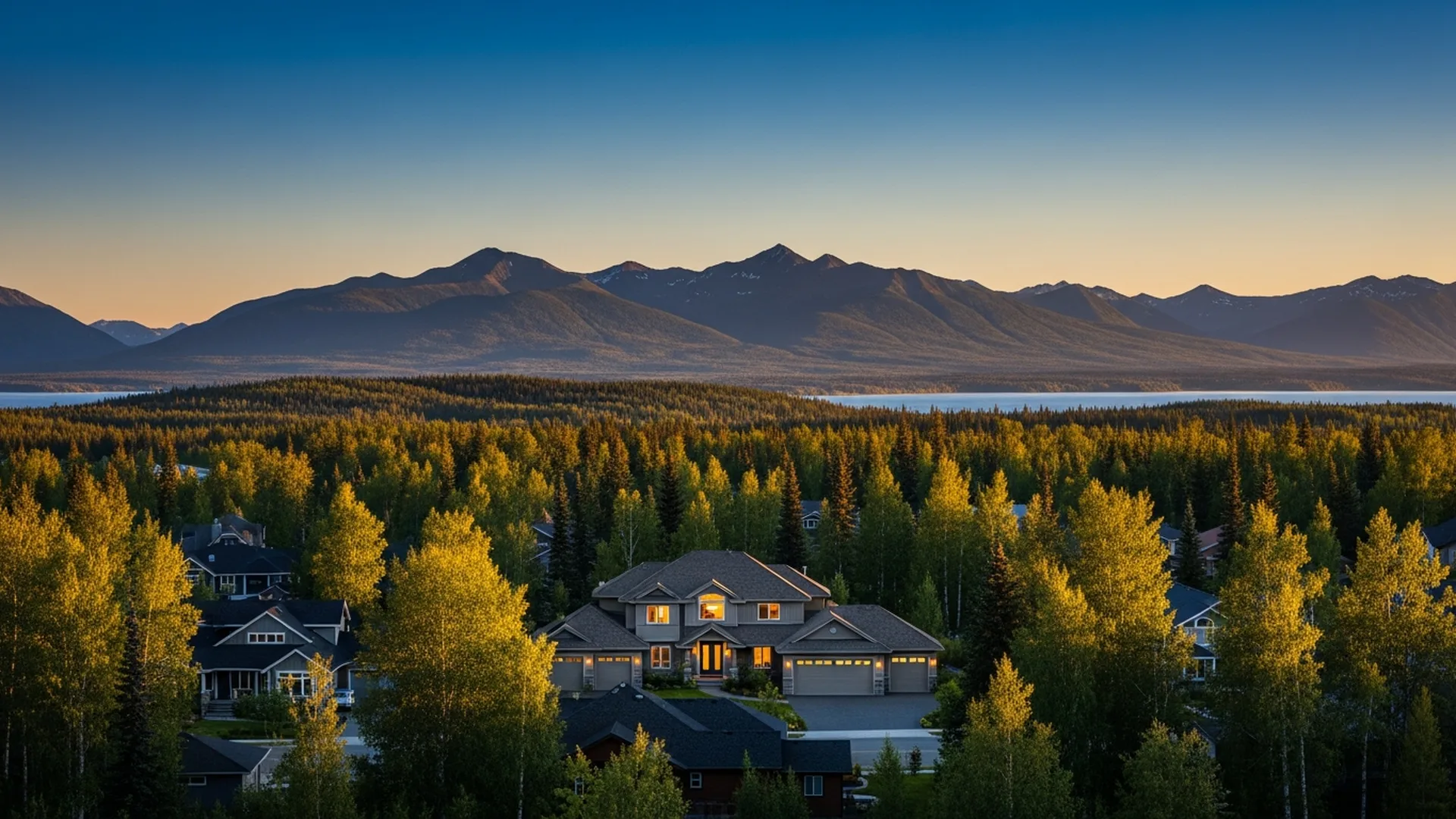
Huffman-O’Malley is a large residential neighborhood on the lower-to-mid slopes of South Anchorage’s Hillside, running roughly from O’Malley Road south to DeArmoun Road, and from the New Seward Highway east toward the Chugach foothills. It’s the closest Hillside area to Seward Highway shopping and commuting, with a mix of established subdivisions and newer custom builds priced above the Anchorage median. Because the Hillside slope climbs to the east, the long views here face west and southwest toward Cook Inlet, downtown, and the Alaska Range. Two local realities shape most transactions: many homes are on private well and septic, which triggers a Municipality of Anchorage Certificate of On-Site Systems Approval (COSA) at sale, and Anchorage’s short winter days make a home’s sun exposure as important as its view.
Huffman-O’Malley is where a lot of Anchorage buyers first realize the Hillside isn’t one single thing. It’s the transition zone — low enough to be minutes from the New Seward Highway, high enough to catch the west-facing Cook Inlet and downtown views the Hillside is known for. Having watched this corridor grow for four decades as an Anchorage local, I’ve found the same handful of factors separate the homes that hold value here from the ones that struggle: which direction the view and the winter sun actually point, whether the property is on public utilities or well and septic, and how the driveway and street handle a real Anchorage winter.
This guide walks through each of those, grounded in Municipality of Anchorage rules and documented Anchorage geography rather than generic real-estate talk. Where a figure varies parcel to parcel — and in Huffman-O’Malley, water and utilities genuinely do — I’ll say so plainly rather than pretend a neighborhood-wide answer exists.
- Huffman-O’Malley runs roughly from O’Malley Road (north) to DeArmoun Road (south), and from the New Seward Highway (west) toward the Chugach foothills (east) — the closest Hillside neighborhood to Seward Highway shopping and commuting.
- Because the Hillside climbs eastward, long views face west and southwest toward Cook Inlet, downtown Anchorage, and the Alaska Range.
- Recent third-party portal data placed Huffman-O’Malley’s typical sale price in roughly the $610,000–$675,000 range — above the Anchorage citywide median — though exact figures vary by source and date and are not a substitute for a current market analysis.
- Many Hillside homes are on private well and septic; the Municipality of Anchorage has required a Certificate of On-Site Systems Approval (COSA) for such title transfers since August 1998.
- The Municipality’s COSA review fee is $600, on top of engineering testing costs; the certificate is generally valid for two years, with water-sample results expiring sooner.
- Anchorage gets about 5 hours 28 minutes of daylight on the December solstice, with the midday sun only about 5° above the horizon — making winter sun exposure a real value factor.
- The area is served by the Anchorage School District, including Huffman and Rabbit Creek elementary schools and South Anchorage High School (attendance boundaries should be verified per address).
Where exactly is Huffman-O’Malley, and how is it laid out?
Huffman-O’Malley occupies the lower and middle slopes of South Anchorage’s Hillside. In practical terms, the neighborhood runs from around O’Malley Road on the north down to DeArmoun Road on the south, and from the New Seward Highway on the west uphill toward the Chugach foothills on the east. It’s one of the city’s largest neighborhoods by area, and it has its own Municipality of Anchorage community council whose members describe the surrounding zone as the “Southeast Hillside” — a low-density, semi-rural character its residents actively work to preserve.
What sets it apart from neighborhoods higher up is access. Unlike Glen Alps or the upper reaches of Hillside East, Huffman-O’Malley is close to Seward Highway retail, restaurants, and the on-ramps that make a downtown commute quick. You get Hillside trees, elevation, and views without committing to the longest, steepest approach roads. The result is a broad mix of housing: 1980s–90s custom homes on wooded lots, established subdivisions, and a steady trickle of new construction on the remaining infill parcels.
| Factor | Huffman-O’Malley |
|---|---|
| Position | Lower-to-mid South Anchorage Hillside |
| Boundaries (approx.) | O’Malley Rd (N), DeArmoun Rd (S), New Seward Hwy (W), Chugach foothills (E) |
| View orientation | West & southwest — Cook Inlet, downtown, Alaska Range |
| Typical sale price* | ~$610,000–$675,000 (varies by source/date) |
| Water & wastewater | Mixed — public utilities lower, well & septic higher |
| School district | Anchorage School District (verify boundaries by address) |
*Price figures are drawn from third-party real-estate portals and represent approximate, point-in-time snapshots, not a current comparative market analysis. Ranges differ meaningfully between sources.
Which way do the views face, and why does winter sun matter more than the view?
Here’s the piece of Hillside geography that trips up newcomers. Because Huffman-O’Malley climbs eastward into the Chugach Mountains, the open, long-distance views look west and southwest — out over Cook Inlet, the downtown skyline, and, on clear days, the Alaska Range. That’s the postcard. The mountains themselves are behind you as you look at the view.
The catch is the sun. Anchorage sits at about 61°N latitude, and on the December solstice it receives only about 5 hours and 28 minutes of daylight, with the midday sun peaking at roughly 5 degrees above the horizon — barely clearing it. In deep winter the sun tracks low across the southern sky and sets to the southwest. So a lot can have a spectacular west-facing view and still sit in shadow for much of a January day if trees, the slope, or a neighboring ridge block that low southern arc. Conversely, a home with genuine south and southwest exposure gets what little winter light there is, right where the living spaces usually face.
The difference between Anchorage’s longest and shortest day is nearly 14 hours (about 19.5 hours of daylight in June versus 5.5 in December, per timeanddate and sunrise-sunset data). On the Hillside, that seasonal swing is exactly why two homes with the same “view” can feel completely different in winter.
Are Huffman-O’Malley homes on well and septic, and what is a COSA?
This is the single most important due-diligence question in this neighborhood, and the honest answer is: it depends on the specific parcel. Lower, closer-in portions of Huffman-O’Malley are more likely to be connected to public water and sewer, while properties farther up the Hillside frequently rely on a private well and an on-site septic system. It genuinely changes street to street and by elevation, so you can’t assume from a neighborhood name — you verify it for the individual home.
When a home is on well and septic, Alaska’s largest municipal rule kicks in. Per the Municipality of Anchorage, an August 1998 ordinance requires a Certificate of On-Site Systems Approval (COSA) for almost every title transfer of a property served by a well and/or septic system (limited exceptions include transfers between spouses or to a family trust). A registered professional engineer inspects and tests the systems and certifies to the Municipality — and to the buyer’s lender — that they meet the code standards in place when they were installed and don’t create a health hazard.
What the COSA process actually involves
The engineer runs a well-flow test and takes water samples (the Municipality requires testing for bacteria, nitrate, and arsenic), and performs an absorption-field adequacy test on the septic, adding water sized to the home’s bedroom count and confirming it’s absorbed over roughly a 24-hour period. Per the Municipality of Anchorage, the MOA charges $600 to review the paperwork and issue the COSA — that’s on top of the engineering firm’s testing fees. A COSA is generally valid for two years, but the water-quality sample results expire sooner (bacteria and nitrate results are only good for about 90 days), so timing matters.
Why well & septic isn’t a dealbreaker
- Common and well-understood on the Hillside — many buyers here expect it
- A passing COSA gives the buyer documented confidence in water quality and quantity
- Testing early (before listing) lets a seller fix small issues on their own timeline
Where it bites the unprepared
- A failed absorption field can mean a costly new system — sometimes tens of thousands
- The septic is approved for a set number of bedrooms; a finished lower level can outrun that approval
- Winter ground can complicate testing; a conditional COSA may be needed to close
One nuance I always flag: the Municipality of Anchorage codes size septic systems by the number of bedrooms. If a home was built with, say, three bedrooms and later finished a lower level into a four- or five-bedroom layout, the septic may only be approved for the original count — something that surfaces at the COSA, not during a happy afternoon showing. Buyers touring Hillside homes on septic consistently discover this the hard way when they check after the offer rather than before.
What do homes and lots cost in Huffman-O’Malley?
Huffman-O’Malley prices sit comfortably above the Anchorage citywide median. Third-party portals in recent periods have reported typical sale prices in roughly the $610,000 to $675,000 range, with view-oriented and luxury listings pushing higher — one aggregator pegged the median list price of view homes in the neighborhood around $690,000. Those numbers come from consumer real-estate sites, not the Alaska MLS directly, so treat them as approximate and dated; they move, and different sources disagree.
Lot size scales with elevation. Nearer the highway, quarter-acre lots are common; higher on the Hillside, acre-plus parcels and treed “estate” lots appear, some with room for a shop or a second structure. That range is part of the neighborhood’s appeal — it spans genuinely different lifestyles within one community council boundary. For a current, address-specific read, a comparative market analysis beats any portal estimate.
*Approximate, from third-party portals; varies by source and date. Not a substitute for a current market analysis.
How does winter access work on these streets?
Two things decide how a Hillside home lives in winter: the driveway and the street. Driveway grade is the one buyers underestimate — a steep approach that’s charming in July becomes a daily project in an icy February, and it affects everything from delivery access to resale. Look at the pitch, the exposure (a south-facing drive sheds ice faster than a shaded one), and whether there’s room to push snow.
Street maintenance varies too. Some Hillside roads are maintained by the Municipality of Anchorage; others fall to a limited road service area or a homeowners’ arrangement, which affects plowing frequency and who pays. On the lower Hillside, Huffman-O’Malley generally fares better here than the highest neighborhoods simply because it’s closer in and more built-out — but it still varies by street, and it’s worth confirming for any specific address before you commit.
Thinking of selling in Huffman-O’Malley? What drives value here
If you’re selling here, the value levers are specific. First, get ahead of the COSA. If your home is on well and septic, order the engineering testing early — a failed field discovered mid-escrow can delay or kill a sale, while an early pass becomes a negotiating asset you can hand a buyer. Confirm your septic’s approved bedroom count matches how the house is marketed.
Second, present the view and the light honestly and well. Because I hold a degree in Interior Design and spent a career in furnishings and design, I look hard at how a home’s finishes and layout capture Anchorage’s low winter light — which window walls to feature, which paint and flooring tones read warm at 5 degrees of sun angle, and how to stage the west-facing rooms that carry this neighborhood’s appeal. On the Hillside, the seller who understands the light sells the house; the one who just lists it competes on price. When you’re ready for a specific number, start with a Huffman-O’Malley home value analysis.
- Municipality of Anchorage — Development Services, Wells & Septic: Certificate of On-Site Systems Approval (COSA) requirement, 1998 ordinance, engineer testing, bedroom-based septic sizing.
- Municipality of Anchorage — COSA Guidelines and On-Site Systems Maintenance Guide (title-transfer requirement, exceptions, validity periods, well casing standards); COSA review fee ($600) confirmed via MOA-certified engineering providers.
- timeanddate.com & sunrise-sunset.org — Anchorage daylight length (December solstice ~5h 28m; June ~19h 30m) and low midwinter solar altitude (~5°).
- Federation of Community Councils & Huffman/O’Malley Community Council — neighborhood identity, Southeast Hillside character, Anchorage School District attendance (Huffman Elementary, 12000 Lorraine Ave).
- Chugach State Park / Alaska DNR & Alaska.org — Hillside geography, Glen Alps/Flattop orientation, Cook Inlet and Alaska Range view relationships.
- Third-party real-estate portals (Zillow, Redfin, Homes.com) — approximate, point-in-time neighborhood price and lot figures; used as directional context only, not MLS data.
Looking at Huffman-O’Malley homes?
Let’s find the ones with the right view, the right sun, and a clean well & septic story. Call Bill at 907-560-4090.
Frequently Asked Questions
Huffman-O’Malley sits on the lower-to-mid slopes of South Anchorage’s Hillside, bounded roughly by O’Malley Road to the north, DeArmoun Road to the south, the New Seward Highway to the west, and the Chugach foothills to the east. It’s one of Anchorage’s largest neighborhoods and the closest Hillside area to Seward Highway shopping and commuting.
On the Hillside, the long views face west and southwest toward Cook Inlet, downtown Anchorage, and the Alaska Range, because the slope itself climbs to the east up into the Chugach Mountains. That west-facing orientation is why a home’s sightline and its winter sun exposure can point in slightly different directions — a distinction worth checking before you buy.
It varies by street and elevation. Lower, closer-in parts of Huffman-O’Malley are more likely to be on public utilities, while properties farther up the Hillside are commonly served by a private well and on-site septic system. Because it’s inconsistent parcel to parcel, always confirm a specific home’s water and wastewater before writing an offer.
A COSA is a Certificate of On-Site Systems Approval. Since an August 1998 ordinance, the Municipality of Anchorage requires one for nearly every title transfer of a property served by a well and/or septic system, certifying that a professional engineer tested the systems and found them compliant. If your Huffman-O’Malley home is on well and septic, you’ll almost certainly need a COSA to close.
Anchorage gets about 5 hours 28 minutes of daylight on the December solstice, versus more than 19 hours on the June solstice. At midwinter the midday sun peaks only around 5 degrees above the horizon, so it stays low and southern all day. That’s why winter sun exposure, not just the view, matters so much when choosing a Hillside home.
Huffman-O’Malley trades some of the upper Hillside’s dramatic elevation for practicality: it’s the closest Hillside area to Seward Highway shopping, restaurants, and commuting, with a mix of established subdivisions and newer custom builds. Buyers who want Hillside character, trees, and views without the longest, steepest winter driveways often land here.
Confirm whether the home is on public water/sewer or well and septic, and if it’s on-site, order the COSA testing early. Check the direction of both the view and the winter sun, look at the driveway grade and how the street is plowed and maintained in winter, and verify the septic’s approved bedroom count against how the house is actually being used.