

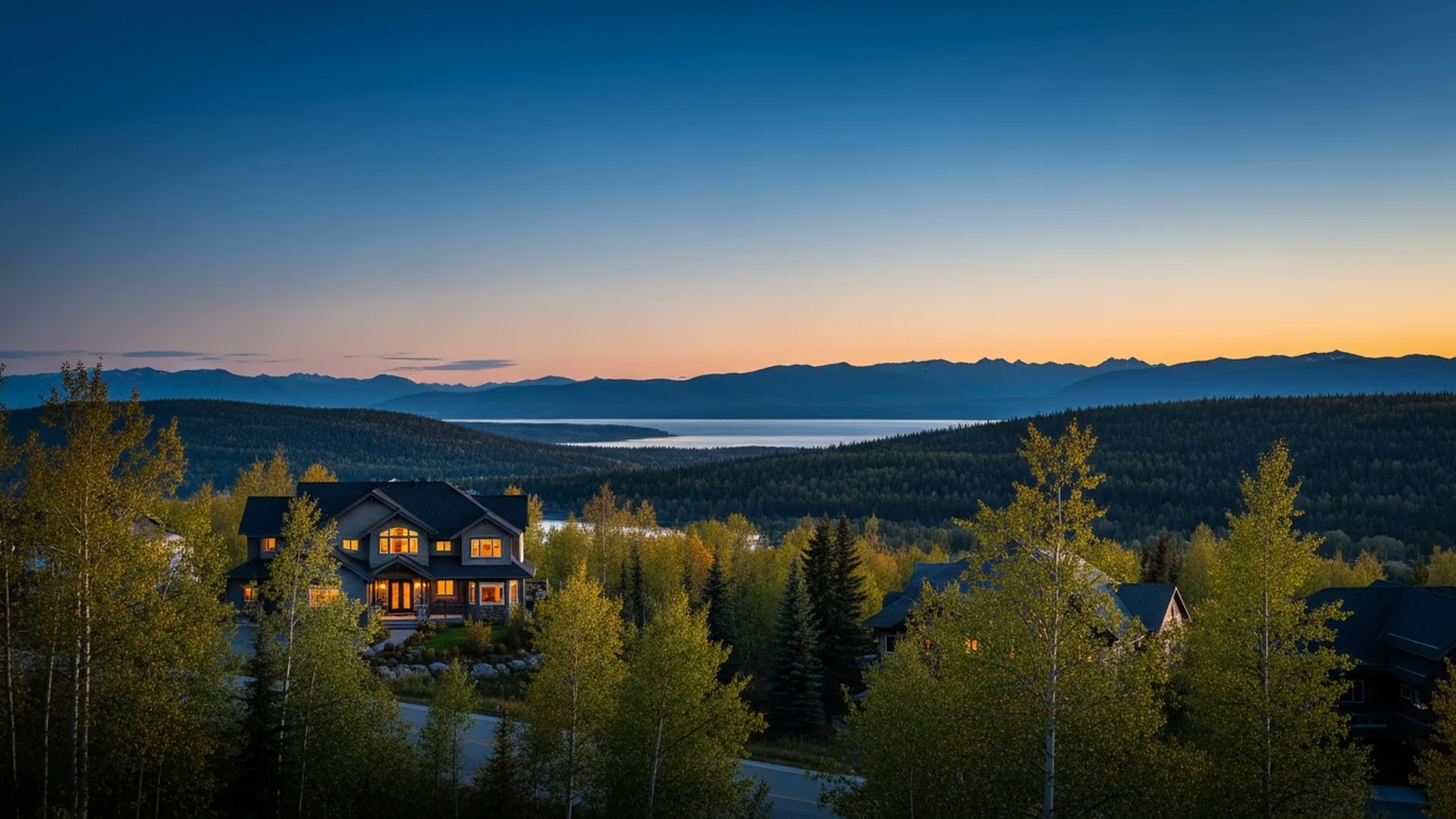
Mid-Hillside sits on the mid-slopes of the Anchorage Hillside in southeast Anchorage, between the lower Anchorage Bowl and the upper Hillside beneath the Chugach Mountains. It filled with custom homes on large wooded lots through the 1980s and 1990s, and its defining assets are west- and northwest-facing views over Cook Inlet and the Alaska Range plus quick access to Chugach State Park trailheads. Because Anchorage receives only about 5.5 hours of daylight at the winter solstice with a sun that barely clears the horizon, a lot’s orientation and cleared sightline drive both view and winter light. Many Mid-Hillside properties are on private wells and on-site septic rather than municipal service, so a Certificate of On-Site Systems Approval (COSA) is required to transfer title, and roads are often maintained through neighborhood Limited Road Service Areas.
Mid-Hillside is one of the Anchorage Hillside’s established addresses — the band of the slope that sits, as the name suggests, between the flatter Anchorage Bowl below and the steeper upper Hillside that runs up to the tree line and Chugach State Park. I’ve watched this part of town fill in over four decades of living in Anchorage, and the pattern is consistent: subdivided lots gave way to a wave of custom homes through the 1980s and 1990s along roads like Upper O’Malley, Birch Road and Snow View Drive, most of them oriented to capture the long view west over the city and inlet.
What separates a genuinely great Mid-Hillside home from an ordinary one is rarely the finish level a buyer notices on the first walk-through. It’s the fundamentals that are hard to change: which way the lot faces, whether it holds winter sun, whether it’s on municipal service or a well and septic, and how the road gets plowed. This guide walks each of those, grounded in Municipality of Anchorage and Alaska data rather than generic listing copy.
- Mid-Hillside occupies the mid-slope of southeast Anchorage’s Hillside, between the Anchorage Bowl and the upper Hillside beneath the Chugach Mountains.
- The premium views — Cook Inlet, the Alaska Range, and Denali on clear days — open to the west and northwest, while the Chugach rises to the east and southeast.
- Anchorage gets about 5.5 hours of daylight at the winter solstice, with the midday sun peaking near 5 degrees above the horizon, so orientation and a cleared sightline matter enormously.
- AWWU reports roughly 7,000 southeast Anchorage lots have no municipal water/sewer and use private wells and septic systems, most on lots over an acre.
- A Certificate of On-Site Systems Approval (COSA) is required to transfer title on any Anchorage property served by a well or septic; the Municipality’s review fee is $600.
- Many Hillside roads are maintained by neighborhood Limited Road Service Areas (LRSAs); there are 21 of them under Anchorage Municipal Code Title 27.
- Mid-Hillside is within the Anchorage School District, with Service High School (opened 1971 on Abbott Road) as a longtime area landmark.
Where exactly is Mid-Hillside, and how is it laid out?
Mid-Hillside is the middle tier of the Anchorage Hillside, the aspirational belt of southeast Anchorage that climbs the foothills of the Chugach Mountains. The neighborhood name itself describes the geography — it’s the reach of the slope between the lower rolling lands of the Anchorage Bowl and the upper Hillside. Most homes here went in through the 1980s and 1990s as larger parcels were subdivided into custom-home lots, and roads such as Upper O’Malley, Birch Road and Snow View Drive became go-to view addresses.
Unlike the flat, gridded neighborhoods of west and midtown Anchorage, Mid-Hillside is wooded, curving and terrain-driven. Lots are generally larger, homes are set back among birch and spruce, and moose along neighborhood roads are a normal part of life. That semi-rural feel inside the Municipality is a big part of the appeal — and it’s also why the practical details below behave differently than they do lower in the Bowl.
| Direction | What’s there | Why it matters |
|---|---|---|
| West / Northwest (downhill) | Anchorage Bowl, Cook Inlet, Alaska Range, Denali on clear days | The premium view corridor and the direction of afternoon and low winter sun |
| East / Southeast (uphill) | Chugach Mountains, Chugach State Park, trailheads | Backdrop, trail access, and morning shading from the mountains |
| South | Low winter-sun path | South-facing exposure captures the most of a short winter day |
Which way do the views — and the winter sun — actually face?
This is the question I wish more buyers asked first. On the Hillside the marquee views open downhill to the west and northwest: the Anchorage Bowl, Cook Inlet, the Alaska Range and, on clear days, Denali. The Chugach Mountains rise behind you to the east and southeast. So a lot “with a view” almost always means a west-facing sightline.
Here’s where local knowledge separates a good buy from a disappointing one. Anchorage sits at about 61 degrees north latitude, and at the winter solstice the city receives only around 5 hours and 28 minutes of daylight, with the midday sun peaking at roughly 5.4 degrees above the horizon — per timeanddate.com and consistent with the Alaska Climate Research Center. At that angle the sun tracks low across the southern sky and shadows are long all day. A west- and south-facing Mid-Hillside lot with a cleared sightline keeps the view and the light; a lot tucked behind a ridge or a dense spruce stand to its south and west can sit in shadow through much of a short winter afternoon. Buyers chase the summer view; the ones who know this place check the December sun.
Is Mid-Hillside on city water and sewer, or well and septic?
It depends on the specific lot, and this is not a detail to assume. The Anchorage Water & Wastewater Utility (AWWU) reports that nearly 7,000 residential lots in southeast Anchorage have no municipal water and sewer service and instead rely on private wells for drinking water and on-site septic systems for wastewater — most of them on lots larger than one acre. AWWU also notes that with the 2010 Hillside District Plan, the Assembly set a fixed boundary for how far municipal service will extend up the Hillside.
As a practical rule, lower Mid-Hillside is more likely to have municipal service, and higher up the slope you’re increasingly into well-and-septic territory. Some homes are even served by small community water systems permitted by the Alaska Department of Environmental Conservation. The takeaway: verify the water and wastewater situation for the exact address, because it changes the due diligence, the closing timeline, and sometimes the price.
Well & septic: a private drilled well supplying drinking water and an on-site septic system (tank plus a subsurface disposal field) handling wastewater, in place of municipal utility connections. Common on larger Hillside lots outside AWWU’s service boundary.
What is a COSA, and how does it affect buying or selling on the Hillside?
If a Mid-Hillside home is served by a well or septic system, a Certificate of On-Site Systems Approval (COSA) is central to the transaction. Under an ordinance the Municipal Assembly passed in August 1998, transferring title on any Anchorage property served by a well or septic requires a COSA — a written confirmation, signed by a licensed civil engineer and the Municipality, that the systems are functional and meet applicable standards, per the Municipality of Anchorage On-Site Water & Wastewater Section.
In practice the engineer inspects and tests the system, runs a well flow test and a septic adequacy test, and samples the water for coliform bacteria, nitrates and arsenic. The Municipality requires a receipt showing the septic tank was pumped within the past year, and an as-built survey showing the system. Once the package passes, the MOA charges $600 to review the paperwork and issue the COSA. A COSA is generally valid for two years from the adequacy test, though bacteria and nitrate results are only good for 90 days.
Unlike a routine city-water home, a well-and-septic sale can surprise the unprepared. A classic example: an older home originally built with a three-bedroom septic that later gained finished lower-level bedrooms may test as under-sized even though it “worked fine” for the current owner. That’s exactly the kind of thing a seasoned local checks before an offer, not after — and it’s why I steer clients to test early rather than late in the selling process.
Septic adequacy testing needs unfrozen ground. In winter the Municipality can issue a conditional COSA once other requirements are met, but if a new system is required to sell, an escrow of roughly one and a half times the highest bid is typically established until the work can be completed. Plan Hillside well-and-septic timing accordingly.
Who plows the roads, and how steep is driveway access?
Road maintenance is one of the biggest differences between Hillside living and the rest of the Bowl. Many Hillside roads are maintained through a Limited Road Service Area (LRSA). Under Anchorage Municipal Code Title 27 there are 21 individual service areas serving the Hillside, each governed by a locally elected board of supervisors that hires private contractors, through competitive bids, for grading, drainage, snow removal and ice control. Funds come from a portion of residents’ property taxes and are held by the Municipality’s Street Maintenance department for that specific area.
What this means for a buyer is that plowing frequency, road quality and winter reliability can genuinely differ from one street to the next depending on the LRSA and its budget. On top of that, Hillside terrain means steeper driveways than you’ll find lower down; a north-facing, shaded, steep driveway that ices over is a very different daily commitment than a short, sunny, south-facing approach. I always want to know which service area a street sits in, and to see the driveway grade and exposure, before I let a client fall in love with a house.
What buyers love about Mid-Hillside
- Large, wooded, private lots with big west-facing views
- Minutes to Chugach State Park trailheads (Glen Alps, Prospect Heights) and Hilltop Ski Area
- Established custom homes rather than tract construction
- Semi-rural feel while staying inside the Municipality and the Anchorage School District
What to check before you buy
- Well & septic status and a valid COSA path (test early)
- Which LRSA maintains the road, and its winter track record
- Driveway grade and sun exposure for winter ice
- Winter-sun orientation, not just the summer view
Thinking of Selling in Mid-Hillside? What Drives Value Here
When I evaluate a Mid-Hillside home to sell, I start with the things buyers here reward most: a genuine, cleared west- or northwest-facing view, winter light, a manageable driveway, and clean, documented well-and-septic records. Sellers on view lots routinely underestimate how much a maintained sightline moves the number — overgrown spruce that blocks the inlet is a fixable value problem worth addressing before listing.
The other lever is presentation, and this is where my background matters. I pair a degree in Interior Design with a career in furnishings, design and real estate, so I read how finishes, flow and light photograph and show in a high-latitude home where interior lighting carries half the year. Staging a Hillside home to feel bright through the dark months is a specific skill, not a generic one. On the systems side, getting the septic pumped and the COSA process started early keeps a sale from stalling. For a data-driven estimate of your home’s value, start with our Anchorage home value tool and I’ll follow up with a custom Hillside market analysis.
- Municipality of Anchorage, On-Site Water & Wastewater Section — Certificate of On-Site Systems Approval (COSA) requirements, 1998 title-transfer ordinance, and inspection/testing standards (muni.org).
- Municipality of Anchorage / engineering firms — COSA process detail, $600 MOA review fee, water sampling for bacteria/nitrates/arsenic, two-year validity and conditional/winter COSA and escrow practice.
- Anchorage Water & Wastewater Utility (AWWU) — approximately 7,000 southeast Anchorage lots without municipal water/sewer on wells and septic; Hillside District Plan (2010) service boundary.
- Municipality of Anchorage, Street Maintenance — Limited Road Service Areas (LRSA) under AMC Title 27; 21 Hillside service areas with locally elected boards (muni.org; community councils).
- timeanddate.com, Alaska Climate Research Center, and Alaska Center for Climate Assessment and Preparedness (ACCAP) — Anchorage winter-solstice daylight (~5.5 hours) and low midday solar altitude (~5 degrees); latitude ~61°N.
- Alaska DEC (18 AAC 80) — permitting authority for some small community water/wastewater systems on the Hillside.
- Anchorage School District — Service High School (opened 1971, Abbott Road) and area school assignment; confirm boundaries for any specific address.
Explore Mid-Hillside & the Anchorage Hillside with a 40-year local
Know a home’s view, winter sun, well & septic, and road access before you fall for it. That’s where I come in.
Frequently Asked Questions
Mid-Hillside sits on the mid-slopes of the Anchorage Hillside in southeast Anchorage, between the lower Anchorage Bowl and the upper Hillside beneath the Chugach Mountains. Its name reflects that geographic perch. Established addresses cluster around roads such as Upper O’Malley, Birch Road and Snow View Drive, with Service High School on Abbott Road as a longtime landmark.
On the Hillside the big city, Cook Inlet, Alaska Range and Denali views generally open to the west and northwest, out over the Anchorage Bowl. The Chugach Mountains rise behind you to the east and southeast. Because the terrain slopes down to the west, a west-facing Mid-Hillside lot with a cleared sightline captures both the daytime view and the low winter sun, which is why orientation matters as much as elevation here.
Anchorage gets only about five and a half hours of daylight at the winter solstice, and the midday sun peaks at roughly 5 degrees above the horizon, per timeanddate.com and the Alaska Climate Research Center. At that low angle a ridge, tall spruce stand, or north-facing slope can put a home in shadow for much of a short winter day, while a south- and west-facing lot on the Hillside stays bright. That difference in winter light is one of the most overlooked value factors on the Hillside.
Many do. AWWU reports that roughly 7,000 residential lots in southeast Anchorage have no municipal water and sewer service and rely on private wells and on-site septic systems, most on lots larger than an acre. Lower Mid-Hillside is more likely to have municipal service and upper areas are more likely to be on well and septic, so it must be verified lot by lot.
A COSA is a Certificate of On-Site Systems Approval. Under a 1998 Municipal ordinance, any Anchorage property served by a well or septic system requires a COSA to transfer title. A licensed civil engineer inspects and tests the well and septic, water is sampled for coliform bacteria, nitrates and arsenic, and the tank must show a pumping receipt within the past year. The Municipality charges $600 to review the paperwork and issue the COSA.
Many Hillside roads are maintained through a Limited Road Service Area, or LRSA. Under Anchorage Municipal Code Title 27 there are twenty-one LRSAs serving the Hillside, each run by a locally elected board that hires private contractors for grading, snow removal and ice control. Service can vary road to road, so buyers should confirm which service area a specific street falls in and how a steep private driveway is handled.
For buyers who want space, wooded privacy, big views and quick access to Chugach State Park trailheads while staying inside the Municipality, Mid-Hillside is one of Anchorage’s most sought-after areas. The 1980s and 1990s saw subdivided lots fill with custom homes, so much of the inventory is larger view-oriented houses. The trade-offs are well and septic due diligence, LRSA road realities and steeper driveway grades, which is exactly where local guidance pays off.
Mid-Hillside is within the Anchorage School District. Service High School on Abbott Road, opened in 1971, is the longtime area high school, and Bear Valley and Campbell elementary schools serve parts of the area. Attendance boundaries change over time, so confirm the assigned schools for a specific address directly with the Anchorage School District.