

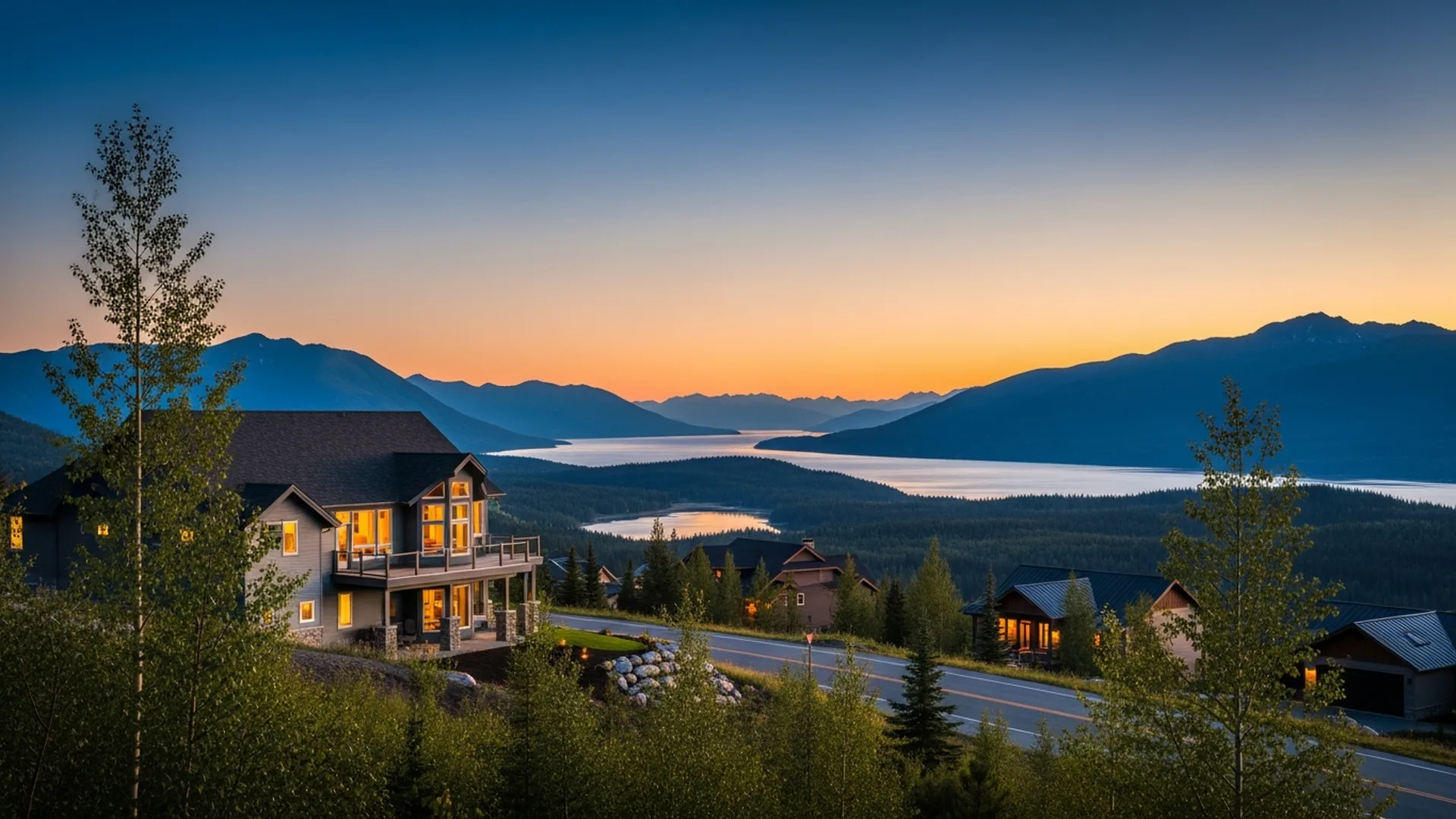
Bear Valley is a rural, heavily forested neighborhood high on the south Anchorage Hillside, tucked between the Rabbit Creek and Glen Alps areas and bordering Chugach State Park — within roughly 20 miles of downtown yet distinctly remote. Homes here sit on larger, wooded parcels served by private well and septic, so a Certificate of On-Site Systems Approval (COSA) from the Municipality of Anchorage is required at sale. Value is driven by view orientation and elevation: west and southwest sites capture Cook Inlet, city lights, and the Alaska Range, while the best-planned homes also secure the low winter sun. Roads are maintained through a Limited Road Service Area, and many are unpaved, so access and driveway grade matter as much as the view. Recent aggregator data drawn from the Alaska MLS put the trailing 12-month median sale price near $697,500, with view estates running well higher.
Some Anchorage neighborhoods are subdivisions; Bear Valley is more of a landscape you happen to live inside. It sits high on the south Hillside, between Rabbit Creek and Glen Alps, south of Rabbit Creek Road, where narrow — and often unpaved — roads climb through hemlock forest to homes spread far enough apart that privacy is the default, not an amenity. In forty years of watching the Hillside grow, I’ve seen buyers fall hard for a summer view here and then discover the parts nobody photographs: where the well sits, which way the winter sun tracks, and who plows the road. This page is about all of it.
What you get in return is genuinely rare inside a city: at the edge of Bear Valley, you’re not looking at the Chugach — you’re living at the base of it, with Chugach State Park’s trailheads out the back and the Anchorage Bowl, Cook Inlet, and on clear days the Alaska Range spread out below. The homes range from 1970s A-frames and contemporary chalets to newly built custom estates, so the diligence, not the postcard, is what separates a smart Bear Valley purchase from an expensive lesson.
- Bear Valley is a rural south-Hillside neighborhood between Rabbit Creek and Glen Alps, bordering Chugach State Park, within about 20 miles of downtown Anchorage but distinctly remote.
- Homes are on private well and septic; the Municipality of Anchorage requires a Certificate of On-Site Systems Approval (COSA) at title transfer, with engineer testing of well flow, septic adequacy, and well-to-septic separation.
- West/southwest orientation captures Cook Inlet, city lights, and the Alaska Range; east faces the Chugach. With Anchorage at ~5h 28m of daylight at the December solstice, sun exposure — not just the view — drives livability.
- Roads are maintained by a Limited Road Service Area (LRSA) under Anchorage Municipal Code Title 27; a local board directs a private contractor, and many streets are unpaved.
- Recent aggregator data (Alaska MLS-derived) show a trailing-12-month median sale price near $697,500 and an average around 83 days on market — longer than the national norm.
- Many parcels are unrestricted (no HOA/CCRs), while some sit in small associations; restrictions vary lot by lot, so verify title and covenants early.
- Larger lots (often a half-acre and up, some multi-acre) support building custom, but soils, percolation, and buildable-site siting govern what a lot can actually carry.
Where Is Bear Valley, and What Makes It Different From the Rest of the Hillside?
Bear Valley sits at the upper, southern end of the Anchorage Hillside, wedged between the Rabbit Creek and Glen Alps neighborhoods, south of Rabbit Creek Road. Unlike the mid-Hillside subdivisions closer to Huffman and O’Malley, Bear Valley reads as rural: tall trees, spread-out lots, and sloping streets — many of them unpaved — that wind through rugged terrain. Residents typically get at least a half-acre, and many parcels run to several acres, with the forest itself providing the privacy that buyers elsewhere pay to engineer.
The defining feature is the border with Chugach State Park. Trailheads sit within or just outside the neighborhood — the Golden View Trailhead reaches toward 4,311-foot McHugh Peak, and the nearby Rabbit Creek Trailhead runs roughly four miles to Rabbit Lake — and the surrounding park stretches across hundreds of thousands of acres of public land. Practically, that means wildlife (moose and bears are regular visitors), direct backcountry access, and a hard edge to development that protects the setting. Everyday errands run downhill to the Old Seward–Huffman corridor rather than downtown; the Dimond Center is roughly ten miles away.
How Do View Corridors and Winter Sun Work in Bear Valley?
This is the single most misunderstood factor in a Hillside purchase, and it’s where I spend the most time with Bear Valley buyers. The neighborhood offers panoramic views in multiple directions — but the direction your home opens to determines both what you see and, more importantly, what winter is like inside.
West and southwest exposures look out over Cook Inlet, the Anchorage Bowl, city lights, and — on clear days — the Alaska Range and Denali. East-facing sites look up into the Chugach front. Both are beautiful. But Anchorage sits at latitude 61.15°N, and at the December solstice the city drops to roughly 5 hours 28 minutes of daylight with the sun tracing a very low arc across the southern sky. A home oriented purely for an east or north Chugach view can be stunning in July and dim and cold from November through February. The homes that hold value through every market are the ones where the glass, the great room, and the deck face south and west — capturing the view and the low winter sun.
Slope reinforces this. A downsloping, west-facing lot pushes the view out below the treeline and pulls afternoon light into a walkout lower level; a home tucked below its own hillside to the south can lose the sun entirely by early afternoon in December. When you read a listing that lists “south and west facing exposure” as a headline feature, that’s not marketing filler on the Hillside — it’s the value.
| Orientation | What you see | Winter-sun reality |
|---|---|---|
| West / Southwest | Cook Inlet, Anchorage Bowl, city lights, Alaska Range / Denali on clear days | Best — captures the low southern winter arc; strongest value hold |
| South | Turnagain Arm direction, open sky | Strong for light; view depends on slope and treeline |
| East | Chugach front, McHugh Peak | Dramatic but dim in deep winter; check afternoon shadow |
| North | Filtered forest / distant bowl | Weakest winter light; scrutinize before buying |
What Should You Check on a Well-and-Septic Property in Bear Valley?
Bear Valley has no public water or sewer — every home runs on a private well and an on-site septic system. That’s normal for the Hillside, but it changes the diligence completely, and Anchorage regulates these systems more tightly than most of Alaska. Per the Alaska Department of Environmental Conservation, the Municipality of Anchorage is one of only two local governments in the state that regulate and set standards for private water wells, and DEC’s minimum separation-distance rules for private water systems live at 18 AAC 72.100.
The pivotal document is the COSA — Certificate of On-Site Systems Approval. Per the Municipality of Anchorage On-Site Water and Wastewater Section, a COSA is required at the time of title transfer for a single-family home or duplex served by well and septic. It’s a report attesting that the systems are adequate, legal, and safe. To grant it, a licensed civil engineer performs a field inspection, checks whether the well and septic were tested within the past two years, and if not runs a well-flow test and a septic disposal-field adequacy test. The engineer also verifies code-required separation distances between the well and septic — and the Municipality is explicit that a separation problem may only surface during the sale, when the COSA is pulled. On a new build or a system upgrade, a registered civil engineer must design the septic and the Municipality must issue a permit before work begins.
Your Bear Valley well & septic checklist
- Ask for the most recent COSA and any well-flow / septic-adequacy test results (valid within two years).
- Confirm required well-to-septic separation distances are met — or that a waiver was properly granted.
- Review the well log for depth, yield, and water quality; private-well testing is the owner’s responsibility, not the state’s.
- On vacant land, confirm soils and percolation support a conventional system, and ask whether a septic design is already approved (an approved 4-bedroom design can save tens of thousands).
- Because ground must be unfrozen for many tests, build seasonal timing into a purchase — a fall or winter closing can complicate COSA testing.
Well and septic rules, COSA requirements, and separation distances are set by the Municipality of Anchorage and Alaska DEC and change over time. This is general educational information, not engineering or legal advice — always rely on a current COSA and a licensed civil engineer for a specific property.
How Are Bear Valley’s Roads Maintained — Especially in Winter?
This is where rural Hillside living gets concrete. Bear Valley’s roads are not maintained the way a city arterial is. The neighborhood sits in a Limited Road Service Area (LRSA), one of about 21 LRSAs the Municipality established on the Hillside under Anchorage Municipal Code Title 27. Instead of the city plowing directly, an elected local road board — your neighbors — directs a private contractor for grading, pothole repair, drainage, dust control, snow removal, and ice control, funded by a dedicated road-service tax. The Bear Valley LRSA’s own site notes a road-maintenance levy of 1.5 mills, compared with 2.46 mills in much of the Municipality.
Practically, that means service levels and plow timing are set locally, many streets are unpaved, and only the LRSA board can request service from the contractor. For a buyer, three things matter: how steep is the driveway and its approach (a north-facing, shaded, steep drive can ice badly), how the specific road is prioritized after a storm, and whether shared or private-road maintenance agreements exist. The state’s Department of Transportation and the Municipality’s Street Maintenance division handle the major roads below, but the last stretch to a Bear Valley home is an LRSA matter.
What buyers love about Bear Valley
- Genuine privacy on large, forested lots
- Panoramic inlet, city-light, and mountain views
- Chugach State Park trailheads at the doorstep
- Room to build custom on acreage
- Many unrestricted parcels (no HOA/CCRs)
- Lower road-service mill levy than much of the Muni
What to weigh before buying
- Well & septic diligence and COSA at sale
- Unpaved, sloping roads; LRSA (not city) plowing
- Winter sun depends heavily on orientation/slope
- Longer average days on market (~83)
- Errands and services are a drive downhill
- Wildlife (moose, bears) is a genuine consideration
What Do Homes in Bear Valley Cost, and How Does the Market Behave?
Bear Valley isn’t a single price point — it’s a spectrum, from older chalets and view lots to newly built custom estates approaching and exceeding 8,000 square feet. Aggregator data drawn from the Alaska Multiple Listing Service put the trailing-12-month median sale price near $697,500, with a reported softening of roughly 7% over that window; view-home listings frequently carry higher asking prices. Because these figures come from third-party portals summarizing MLS data and shift with inventory and season, treat them as a directional snapshot, not a fixed valuation — and never as a substitute for a current comparative market analysis on a specific home.
The behavioral signal matters more than the median. Aggregators report Bear Valley homes averaging around 83 days on market — well above typical national timelines. That’s not weakness; it’s the nature of rural, individualized inventory. Every lot, view, build quality, and access situation is different, so pricing and presentation do more work here than in a subdivision of comparable floor plans. A well-priced, well-presented Bear Valley home with a clean COSA and a genuine south-west view still moves; a mispriced one waits.
Thinking of Selling in Bear Valley? What Drives Value Here
Selling on the upper Hillside rewards preparation more than almost anywhere in Anchorage, and it plays directly to how I read a home. My background is in design — I hold a degree in Interior Design and spent years in furnishings and design before real estate — and in Bear Valley that lens goes straight to value: which finishes read as custom versus dated, how to stage a great room so the west-facing view and winter light do the selling, and where a modest, targeted update returns more than a full renovation.
Sellers here routinely underestimate three things. First, the COSA timeline: getting the well and septic tested and approved ahead of listing removes the single most common closing snag on a rural property. Second, the view story: a cleared sightline and a deck staged toward Cook Inlet and the city lights measurably move the number, and buyers who tour view lots consistently pay for a sightline they can actually picture living in. Third, seasonality: unlike a downtown condo, a Bear Valley home shows its access, sun, and setting completely differently in January than in July — and timing the listing to your home’s strengths is a lever most sellers leave unused. If you want a specific read on your property, start with a Bear Valley home value estimate.
- Municipality of Anchorage — On-Site Water and Wastewater Section: well and septic permitting, and the COSA (Certificate of On-Site Systems Approval) required at title transfer, including engineer field inspection, well-flow and septic-adequacy testing, and separation-distance verification (On-Site Systems Maintenance Guide; muni.org).
- Alaska Department of Environmental Conservation — Private Drinking Water Wells & Systems: the Municipality of Anchorage as one of two Alaska local governments regulating private wells; minimum separation-distance requirements at 18 AAC 80 (dec.alaska.gov).
- Bear Valley Limited Road Service Area (BVLRSA) and Municipality of Anchorage Street Maintenance: LRSA structure under Anchorage Municipal Code Title 27, elected road board, private-contractor maintenance, and the cited 1.5-mill road levy (bearvalleylrsa site; muni.org).
- Alaska Climate Research Center / timeanddate.com / Anchorage Daily News: Anchorage December-solstice daylight of about 5 hours 28 minutes and low winter sun angle at latitude 61.15°N.
- Neighborhood character, trailheads, schools-by-name, and market snapshot (median sale price and days on market) drawn from Alaska MLS–derived listing data via public real-estate portals; figures are trailing-window snapshots and move with the market.
Explore Bear Valley & the Anchorage Hillside With a 40-Year Local
Views, well & septic, road access, acreage — I’ll help you read the parts nobody photographs.
Frequently Asked Questions
Bear Valley is a rural neighborhood high on the south Anchorage Hillside, tucked between the Rabbit Creek and Glen Alps areas, south of Rabbit Creek Road and bordering Chugach State Park. It sits within roughly 20 miles of downtown Anchorage but feels remote, with sloping, often unpaved roads winding through forested terrain.
Yes. Bear Valley properties are served by private wells and on-site septic systems rather than public water and sewer. Because the Municipality of Anchorage regulates these systems, a Certificate of On-Site Systems Approval (COSA) is required at the time of title transfer, and a licensed civil engineer inspects and tests the well and septic before that certificate can be issued.
A COSA is a Certificate of On-Site Systems Approval issued by the Municipality of Anchorage. It is required at title transfer for homes on well and septic and attests the systems are adequate, legal, and safe. A licensed engineer performs a field inspection, a well flow test and a septic adequacy test, and verifies required separation distances between the well and septic — issues that can otherwise surface only during a sale.
West and southwest orientations capture Cook Inlet, the Anchorage Bowl, city lights and, on clear days, the Alaska Range and Denali; east-facing sites look into the Chugach. Because Anchorage drops to about 5 hours 28 minutes of daylight at the December solstice with the sun on a very low southern arc, south and southwest exposure is what actually delivers usable winter light — not just the summer view.
Bear Valley is served by a Limited Road Service Area (LRSA) under Anchorage Municipal Code Title 27, one of about 21 LRSAs on the Hillside. An elected local road board directs a private contractor for grading, snow removal and ice control, funded by a road-service mill levy — the LRSA site cites 1.5 mills versus 2.46 in much of the Muni. Many streets are unpaved, so driveway grade and plowing arrangements matter.
Bear Valley spans a wide range, from cabins and view lots to multi-million-dollar custom estates. Aggregator data drawn from the Alaska MLS put the recent median sale price near $697,500 over a trailing 12-month window, with view-home listings often higher. Prices move with inventory and season, so treat any single figure as a snapshot rather than a fixed value.
Homes in Bear Valley tend to sit on the market longer than typical national timelines — aggregator data reports an average around 83 days, well above the national figure. Rural view properties are more individualized in design, lot, and access, so pricing and presentation carry more weight here than in tract subdivisions.
Many Bear Valley and Hillside parcels are unrestricted, with no HOA or recorded CCRs, while some pockets sit within associations that share grounds or access. Restrictions vary lot by lot, so review the title, any recorded covenants, and lot survey before you write an offer — this is one of the first things to confirm on a rural Hillside property.