

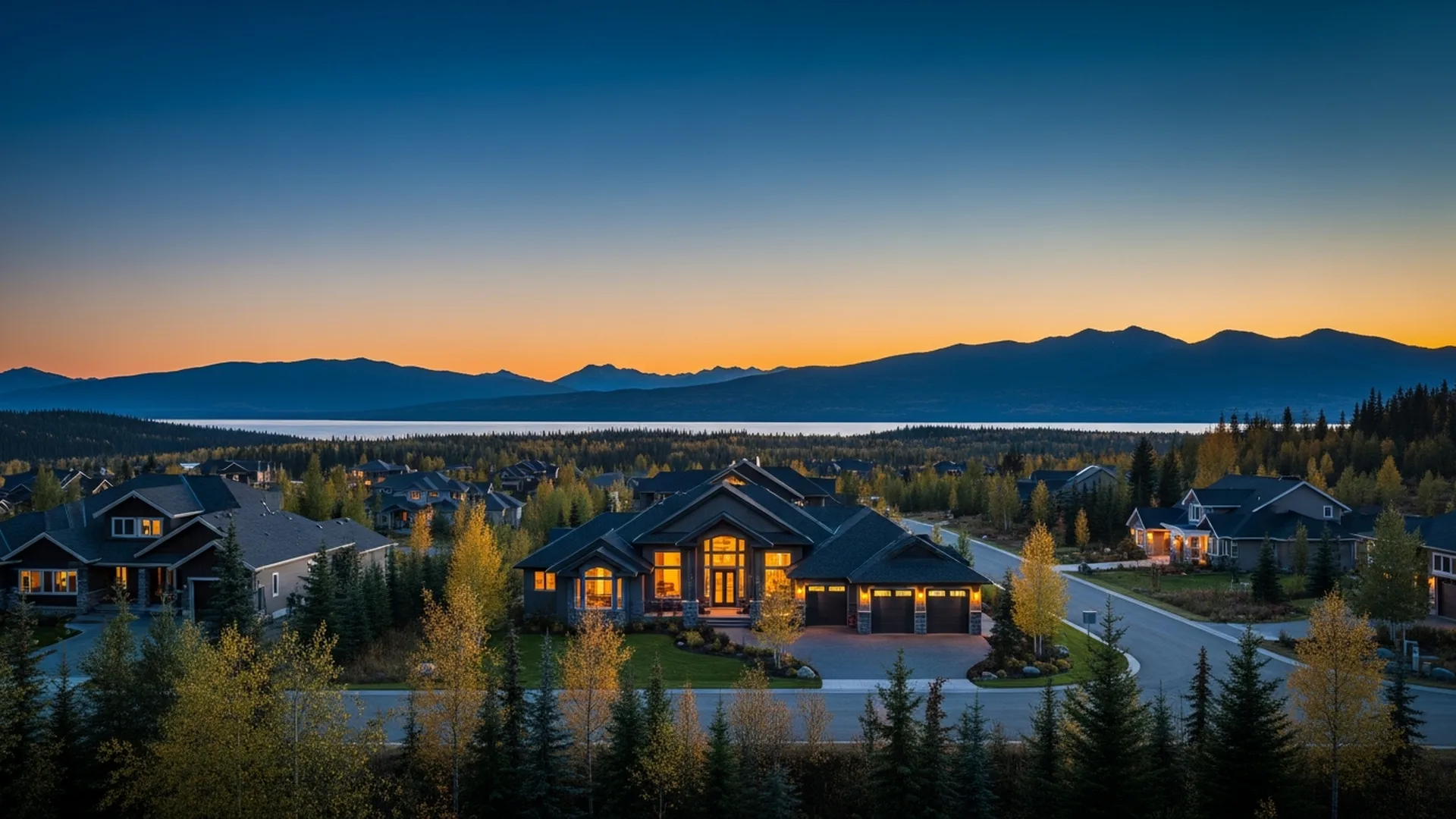
Sahalee is a residential neighborhood on the lower Anchorage Hillside, within the Abbott Loop area of South Anchorage and adjacent to Far North Bicentennial Park — Anchorage’s largest park, with more than 100 miles of trails. Its streets include Sahalee Drive, Snowy Owl Circle, Blue Heron Drive, Egret Rock Circle, and Cormorant Cove Circle. Homes here range from established residences to newer custom builds, with premium homes generally starting around $500,000 and larger executive homes reaching into the seven figures. Because the neighborhood sits on sloped, wooded terrain at roughly 200 meters of elevation, the two factors that most affect a home’s comfort and value are its winter-sun orientation and whether it is served by public utilities or by a private well and septic system, which triggers a Municipality of Anchorage inspection at sale.
Sahalee is one of those Anchorage names that quietly signals a specific kind of Hillside living: wooded, tucked onto short cul-de-sac streets, and close enough to Far North Bicentennial Park that a trailhead is essentially at the end of the block. In four decades living in this city, I’ve learned that neighborhoods like this reward the buyer who reads the lot, not just the listing photos — because on the Hillside, two houses on the same street can live completely differently in December.
This profile is built to give you what actually matters here: where Sahalee sits, how its terrain shapes views and light, what the well-and-septic question means for both buyers and sellers, and how a design-trained eye reads value in this part of South Anchorage. Where a specific figure varies parcel-by-parcel, I’ll say so plainly rather than paper over it.
- Sahalee sits on the lower Anchorage Hillside within the Abbott Loop area, next to Abbott Loop Community Park and Far North Bicentennial Park, at roughly 200 meters (about 650 feet) elevation.
- Named streets include Sahalee Drive, Snowy Owl Circle, Blue Heron Drive, Egret Rock Circle, and Cormorant Cove Circle.
- Premium homes generally start around $500,000; larger executive homes on bigger lots have carried public value estimates into and above $1 million.
- At Anchorage’s latitude (~61.15°N), the December-solstice midday sun peaks at only about 5.4° above the horizon, with roughly 5.5 hours of daylight — making a lot’s south/southwest exposure a genuine value factor.
- West- and southwest-facing Hillside lots look toward Cook Inlet and the Alaska Range volcanoes; east-facing lots look up into the Chugach — but Sahalee’s wooded, lower-Hillside setting means sightlines must be confirmed lot-by-lot.
- Some parcels are served by private well and septic; when such a home sells within the Municipality of Anchorage, a Certificate of On-Site Systems Approval (COSA) is required at title transfer, with a $600 Municipality review fee.
- HOA/CCR status varies by section — Sahalee appears in the Municipality-area HOA directory, yet many nearby Hillside lots are advertised with no HOA or CCRs; confirm the recorded documents for any lot.
Where Is Sahalee, and What Kind of Neighborhood Is It?
Sahalee is a residential neighborhood on the lower Anchorage Hillside, generally described as part of the larger Abbott Loop area of South Anchorage. Public neighborhood references (such as akhomeshow.com and the Great Alaskan Homes subdivision directory) place it within Abbott Loop, with named streets including Sahalee Drive, Snowy Owl Circle, Blue Heron Drive, Egret Rock Circle, and Cormorant Cove Circle — the bird-themed street names are a giveaway that you’re in one cohesive pocket rather than a sprawling district.
What sets the location apart is what it backs up to. Sahalee sits beside Abbott Loop Community Park, which opens directly into Far North Bicentennial Park — the largest park in Anchorage, drawing over a million visitors a year and containing the Hilltop Ski Area, the Alaska Botanical Garden, more than 100 miles of multi-use trails, and access into the 495,000-acre Chugach State Park. For a buyer who wants a home in the city but a trail network out the back door, that adjacency is the whole point.
The housing stock leans toward what local brokerages describe as executive-style single-family homes — wide-open floor plans, fireplaces, large windows, spacious primary suites, and heated garages — typically offering three to six bedrooms and sited on generously landscaped lots. Unlike the upper Hillside’s big-view estates, Sahalee’s appeal is more about a wooded, park-edge setting than a wall-to-wall Cook Inlet panorama.
Sahalee is a small, tightly held pocket rather than a large subdivision with constant turnover, so at any given moment there may be only a handful of active listings — or none. That scarcity is exactly why pricing here should be confirmed against current Alaska MLS data for the specific street, not estimated from a neighborhood average.
| Direction from Sahalee | What’s there | Relevance to a home |
|---|---|---|
| West / Southwest | Downtown Anchorage, Seward Hwy, Cook Inlet, Alaska Range volcanoes | The classic Hillside view & the most winter sun |
| East (uphill) | Far North Bicentennial Park → Chugach Mountains & State Park | Mountain backdrop; trail access; potential afternoon shading |
| Immediately adjacent | Abbott Loop Community Park | Ballfields, playground, trail connections at the doorstep |
| Elevation | ~200 m / ~650 ft on sloped, wooded terrain | Grade affects driveway access & snow management |
Do Sahalee Homes Have Cook Inlet or Chugach Views?
Here is where I slow buyers down. On the Anchorage Hillside, “view” is a directional fact, not a marketing word. West- and southwest-facing lots look down over the city and out to Cook Inlet, with the volcanoes of the Alaska Range — Spurr, Redoubt, Iliamna — on the far horizon. East-facing lots turn their back on the water and look up into the Chugach front range. Both are beautiful; they are not the same product, and they don’t hold value the same way.
Sahalee’s specific character matters here. Because it sits on the lower Hillside in a wooded, park-edge setting, many parcels emphasize privacy and trees over the wide-open Inlet panorama you’d find higher up on the upper Hillside or in a view-dedicated subdivision. Some Sahalee-area listings do describe inlet or mountain and city sightlines; others are firmly “nestled among the trees.” Unlike an upper-Hillside estate lot where the view is the whole thesis, in Sahalee the sightline is something you verify by standing on the actual building pad — ideally in winter, when the leaves are down and the true exposure is honest.
Why Does Winter Sun Matter More Than the Summer View?
This is the un-fakeable Anchorage fact that separates locals from newcomers. Anchorage sits at about 61.15°N latitude. On the December solstice, the midday sun climbs to only about 5.4° above the horizon — it barely clears the treeline — and the city sees roughly 5.5 hours of daylight (about 5 hours 28 minutes), per solar data for Anchorage. Shadows stay long all day and the light has a permanently low, golden quality.
On a flat lot in a subdivision, that’s a seasonal curiosity. On a sloped, wooded Hillside lot like many in Sahalee, it’s a design constraint with real dollar consequences. A rise to the south, a dense stand of the mountain hemlock and spruce that blanket this part of the Hillside, or a north-facing building aspect can put a home in shadow through the short winter day — while a well-sited south- or southwest-facing home two lots away bathes in what little sun there is. That difference shows up in how a home feels in January, in heating behavior, and ultimately in resale.
How Slope and Access Play Out in Winter
Grade cuts two ways on the Hillside. A gentle south-facing slope is ideal — it catches sun and sheds water. A steep driveway on a shaded aspect, though, is the thing buyers underestimate: it’s the surface that ices first and clears last. Sahalee’s lower-Hillside position is generally more forgiving than the upper Hillside’s steeper grades, and several Sahalee-area lots are described as relatively level, but driveway pitch, orientation, and how a street is maintained after snowfall are worth confirming for any specific property.
What Should You Check on a Well-and-Septic Property in Sahalee?
Parts of the Hillside are served by public water and sewer, and parts rely on private wells and on-site septic systems — and this varies parcel by parcel, so it must be verified for each home rather than assumed for the neighborhood. Where a Sahalee home is on well and septic, Alaska’s most important local rule applies.
Per the Municipality of Anchorage, since a 1998 Assembly ordinance, transferring title on any single-family or duplex property served by a well or septic system requires a Certificate of On-Site Systems Approval (COSA). A licensed civil engineer must field-inspect and test the system, verify code-required separation distances between the well and septic, and confirm water quality and quantity. The Municipality charges a review fee of $600 to issue the COSA (an engineering firm’s testing cost is separate and additional).
What a COSA confirms
Well flow is adequate; water samples pass for bacteria, nitrates, and arsenic; the septic absorption field passes an adequacy test; the tank has been pumped within the past year; and required well-to-septic separation distances are met. A COSA is generally valid for two years, though bacteria/nitrate samples are only good for about 90 days.
Where surprises hide
Undocumented or cut-off standpipes, a failing absorption field, a missing as-built survey, or a separation-distance shortfall discovered only at sale. A failed system can mean an engineered redesign and installation costing well into five figures — and in winter, when the ground is frozen, testing and repairs can be delayed or require an escrow arrangement.
The practical takeaway, whether you’re buying or selling: don’t wait until you’re under contract. Sellers who test their well and septic early in the process reduce the risk of delaying — or losing — a sale to a failed system. Buyers should read the COSA and the engineer’s recommendations, not just the pass/fail line.
Thinking of Selling in Sahalee? What Drives Value Here
Sellers in Sahalee are competing on a short list of things that genuinely move the number on the lower Hillside, and my design background shapes how I read them. First is light and orientation — a home that captures winter sun and frames a real sightline (Chugach or Inlet) presents better in every season and photographs honestly. Second is finish coherence: buyers at this level notice when materials, lighting, and flow were chosen with intent rather than assembled piecemeal, and a design-trained walkthrough often finds low-cost, high-impact staging moves that lift perceived value.
Third is the underground story: if you’re on well and septic, a clean, current COSA and a documented as-built remove the single biggest source of buyer hesitation before it ever becomes a negotiation. And fourth is simply scarcity done right — because so few Sahalee homes list at once, correct pricing against live comparables, not a stale neighborhood average, is what captures the limited pool of qualified move-up buyers. When you’re ready, I can prepare a specific, current value analysis for your street.
Who Is Sahalee Right For?
Sahalee tends to suit a buyer who wants an established, low-turnover pocket with trails and parkland at the doorstep, is comfortable with a wooded setting rather than a billboard view, and values a quieter cul-de-sac street within easy reach of the Seward Highway and South Anchorage amenities. If your priority is a dramatic, unobstructed Cook Inlet panorama, the upper Hillside or a view-dedicated subdivision may fit better — and I’m happy to point you there honestly. If your priority is a comfortable, park-adjacent home on a sensible lot, Sahalee is a strong candidate worth touring in person, ideally on a low-sun winter afternoon.
- Municipality of Anchorage, On-Site Water & Wastewater Section — Certificate of On-Site Systems Approval (COSA): title-transfer requirement, engineer testing, separation distances (muni.org).
- Municipality of Anchorage — COSA review/issuance fee of $600 (as reported by Anchorage COSA engineering providers); Anchorage Municipal Code Ch. 15.65 (wastewater disposal) and 15.55 (wells).
- Solar & daylight data for Anchorage (latitude ~61.15°N; Dec. solstice midday sun altitude ~5.4°; ~5h28m daylight) — timeanddate.com, sunrise-sunset.org, and Anchorage Daily News reporting.
- Chugach State Park & Anchorage Hillside geography, elevation, and trail/view context — Alaska Dept. of Natural Resources (dnr.alaska.gov) and alaska.org (Glen Alps Overlook).
- Sahalee location, streets, and neighborhood character — akhomeshow.com, greatalaskanhomes.com subdivision/HOA directory; Far North Bicentennial Park & Abbott Loop Community Park (Anchorage Park Foundation, trailsofanchorage.com).
- School attendance — Anchorage School District (verify specific attendance area by address).
Explore Sahalee & the Anchorage Hillside With a 40-Year Local
Let’s tour the right lots — and read the winter light, grade, and well/septic story before you make an offer.
Frequently Asked Questions
Sahalee is a residential neighborhood on the lower Anchorage Hillside, within the Abbott Loop area of South Anchorage and near Far North Bicentennial Park. Its streets include Sahalee Drive, Snowy Owl Circle, Blue Heron Drive, Egret Rock Circle, and Cormorant Cove Circle. It sits east of the Seward Highway corridor and west of Chugach State Park, at roughly 200 meters (about 650 feet) of elevation.
Sahalee’s premium homes generally start around $500,000, and larger executive homes on bigger lots have carried values into and above the $1 million range in recent public estimates. Prices vary widely by lot size, view, finish level, and whether a home is served by public utilities or well and septic. Because inventory here is limited, current pricing is best confirmed against active Alaska MLS listings for the specific street and lot.
It depends on the lot’s orientation and elevation. On the Anchorage Hillside, west- and southwest-facing lots look out over the city toward Cook Inlet and the volcanoes of the Alaska Range, while east-facing lots look up into the Chugach Mountains. Because Sahalee sits on the lower Hillside near Far North Bicentennial Park, many parcels emphasize a wooded park setting rather than a wide-open Inlet panorama, so confirming the actual sightline lot-by-lot is essential.
At Anchorage’s latitude of about 61 degrees north, the midday sun on the December solstice peaks at only about 5.4 degrees above the horizon, with roughly five and a half hours of daylight. On a sloped Hillside lot, a rise, a dense stand of spruce and hemlock, or a north-facing aspect can put a house in shadow for much of a short winter day. South- and southwest-facing lots capture the most of that low, brief winter light, which is why experienced buyers check daylight, not just the summer view.
Some Hillside-area homes near Sahalee are served by private well and septic systems rather than public water and sewer, but service varies parcel by parcel and should be verified for each property. When a home served by a well or septic system is sold within the Municipality of Anchorage, a Certificate of On-Site Systems Approval (COSA) is required at title transfer. That process involves engineer testing of the well and septic and a Municipality review fee of $600.
Sahalee appears in the Municipality-area homeowners association directory, so parts of the neighborhood may carry covenants, conditions, and restrictions (CCRs) or an association. At the same time, many Hillside-area parcels around Sahalee are advertised with no HOA or CCRs. Because this varies from one section to another, buyers should confirm the specific recorded documents for any lot before making an offer.
Sahalee sits beside Abbott Loop Community Park, which opens into Far North Bicentennial Park — Anchorage’s largest park, with more than 100 miles of multi-use trails, the Hilltop Ski Area, and the Alaska Botanical Garden, plus direct trail access toward Chugach State Park. The Abbott Loop area falls within the Anchorage School District; families should verify the specific attendance schools for a given address directly with the district.