

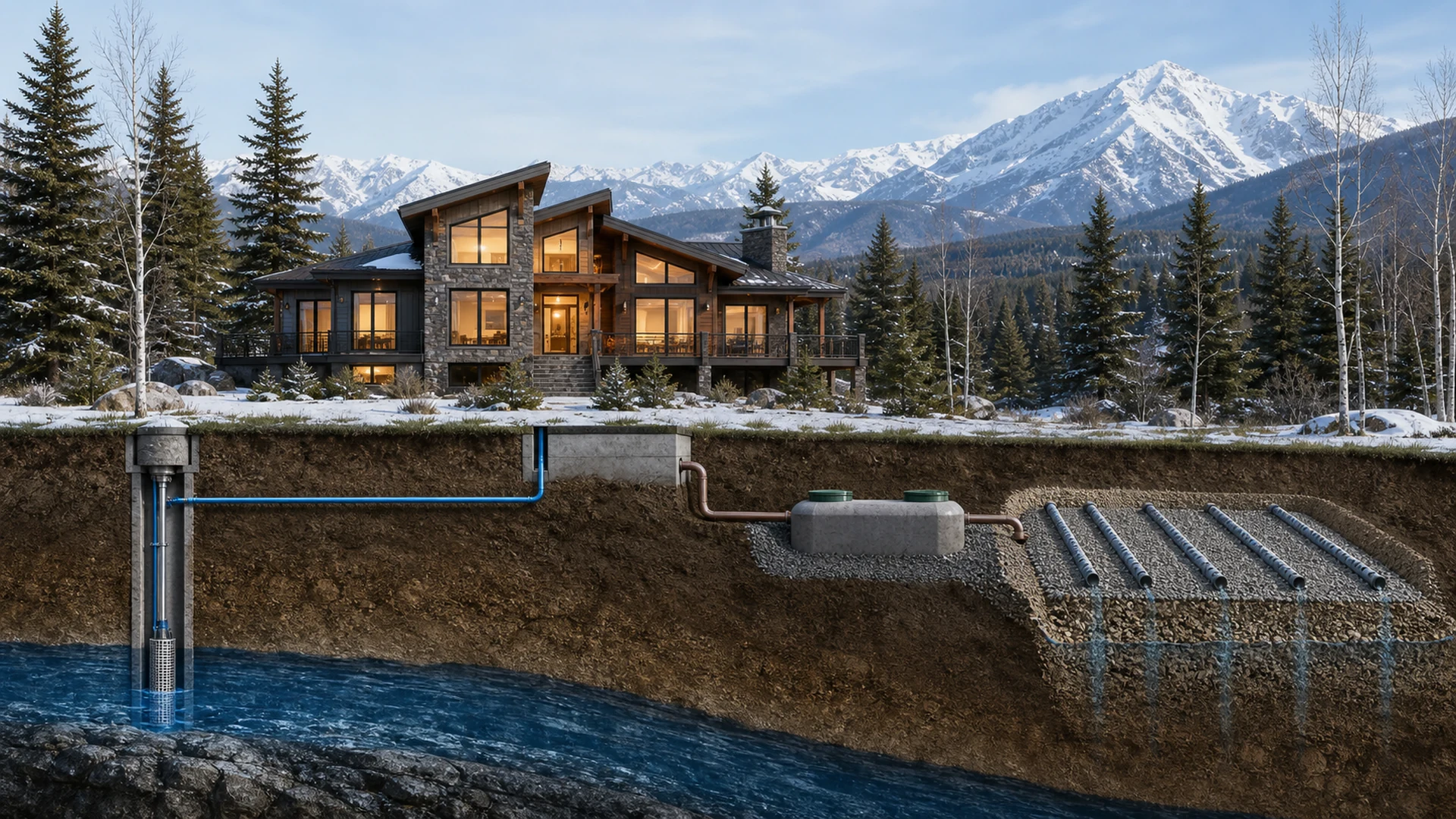
In Alaska, a well-and-septic property is a home that is not connected to public water and sewer. Its drinking water is drawn from a private well drilled on the parcel, and its wastewater is treated on the lot in a septic system — a buried tank and a soil-absorption (leach) field — regulated by the Alaska Department of Environmental Conservation under 18 AAC 72. Within the Municipality of Anchorage, an August 1998 ordinance requires a Certificate of On-Site Systems Approval (COSA) before title can transfer on any property served by a well or septic system, confirming an engineer has inspected and tested the systems. This setup is common on the larger-lot and view parcels of the Hillside, Eagle River, and outlying luxury corridor, which is why understanding well and septic is central to buying an upscale Anchorage home.
If you’ve owned homes in cities Outside, you may have never once thought about where your water came from or where your wastewater went — a utility handled both. In much of the Greater Anchorage luxury corridor, that isn’t the case. The most desirable large-lot, view, and acreage homes often sit beyond the reach of public water and sewer, so they run on a private well and an on-site septic system that the homeowner owns and maintains. Understanding what that means — and what the paperwork requires — is one of the first conversations I have with buyers relocating into these neighborhoods.
- A well-and-septic property gets its drinking water from a private well and treats its wastewater on the lot — no public utility connection.
- On-site septic systems statewide are regulated by Alaska DEC under 18 AAC 72; updated regulations took effect October 1, 2023.
- Within the Municipality of Anchorage, a COSA (Certificate of On-Site Systems Approval) has been required for title transfer on well/septic properties since a 1998 ordinance.
- A registered civil or environmental engineer must inspect and test the systems; the MOA charges a review fee (recently $600) to issue the COSA.
- COSA well-water testing covers coliform bacteria, nitrates, and arsenic — arsenic occurs naturally in pockets around Southcentral Alaska.
- Most Alaska boroughs, including the Mat-Su Borough, have no COSA equivalent; the requirement is unique to Anchorage.
- Well and septic systems are common on the Hillside and in Eagle River, where large view lots sit outside utility service.
Well and septic property — a home served by a private drinking-water well and an on-site septic (wastewater) system rather than by public water and sewer utilities. In Alaska these on-site systems are governed by the Alaska Department of Environmental Conservation under 18 AAC 72; in Anchorage, a Certificate of On-Site Systems Approval (COSA) is required to transfer the property’s title.
What Does “Well and Septic” Actually Mean?
Two independent systems are bundled into that phrase. The well is a bored or drilled hole on the parcel that pumps groundwater into the home for drinking, cooking, and bathing. The septic system is the disposal side: a watertight septic tank that separates solids, followed by a soil-absorption field (the “leach field”) where treated liquid slowly percolates back into the ground. Alaska DEC notes that these on-site disposal systems — often shortened to OSDS — are widely used across the state, and that keeping them properly installed and maintained is essential to protecting both the household’s health and Alaska’s environment.
Because there’s no city utility in the loop, the homeowner is responsible for the well’s water quality and the septic system’s function — which is exactly why Alaska and the Municipality of Anchorage built inspection rules around them.
Why Does Well and Septic Matter When You Buy in Anchorage?
Here’s the reason this definition earns its own page rather than a one-line glossary entry: in Anchorage, a well-and-septic property carries a mandatory point-of-sale hurdle that a home on public utilities does not. Per the Municipality of Anchorage, the Municipal Assembly passed an ordinance in August 1998 requiring that, in order to transfer title on any property served by a well or septic system, a Certificate of On-Site Systems Approval (COSA) must be obtained. The COSA is the municipality’s confirmation that a professional engineer has inspected and tested the systems and found them in compliance with applicable standards.
To earn one, a registered civil or environmental engineer verifies the systems against the records on file, tests the septic field’s absorption capacity and the well’s yield, and pulls water samples. According to Anchorage-area engineering firms that perform this work, the MOA charges a review fee — recently listed at $600 — to process the paperwork and issue the certificate. That fee is separate from the engineer’s testing cost, the required septic-tank pumping, and any repairs.
Alaska ground freezes, and a failed septic system generally can’t be replaced in the dead of winter. In that situation the MOA can issue a conditional COSA and require an escrow — commonly set at one and a half times the highest repair bid — so the sale can close and the work can be finished once the ground thaws. This is why seasonality is really a logistics question for well/septic buyers and sellers, not just a market one.
What Does the COSA Actually Test?
The certificate looks at both systems on defined windows. For the well, water is sampled for coliform bacteria, nitrates, and arsenic. Local engineers and MOA guidance indicate bacteria and nitrate results are typically accepted only when less than 90 days old, while arsenic results hold for roughly a year and well/septic adequacy tests are generally good for about two years. Arsenic is on the list for a specific Alaska reason: it’s a naturally occurring contaminant found in geologic pockets around Southcentral, including areas near Anchorage and Wasilla, so testing for it is not optional here.
| COSA element | What is checked | Typical validity window |
|---|---|---|
| Septic absorption (leach) field | Adequacy / flow test by engineer | ~2 years |
| Well yield | Sustained production (flow) test | ~2 years |
| Septic tank | Pumped & maintenance verified | Within prior 12 months |
| Arsenic (water sample) | Laboratory analysis | ~1 year |
| Bacteria & nitrates (water sample) | Laboratory analysis | < 90 days |
Windows above reflect commonly published Anchorage-area COSA practice; confirm current requirements with the MOA On-Site Water & Wastewater Section and your engineer, since standards are updated periodically.
Is Well and Septic the Same Everywhere in Alaska?
No — and this trips up buyers who assume Anchorage rules apply statewide. The COSA requirement is specific to the Municipality of Anchorage, which holds delegated authority from Alaska DEC to regulate on-site systems serving up to two dwelling units. As the Anchorage Daily News has reported, most other towns and boroughs in Alaska have no such point-of-sale requirement. Move a purchase out to the Matanuska-Susitna Borough and you generally won’t face a COSA at all — though the underlying state rules of 18 AAC 72 still govern how any on-site system must be designed, installed, and maintained. That single difference is one of the practical trade-offs between buying inside Anchorage versus out in the Valley.
- Alaska Department of Environmental Conservation — Wastewater Treatment & Disposal, 18 AAC 72 (on-site disposal systems widely used in Alaska; updated regulations effective October 1, 2023; separation-distance standards).
- Municipality of Anchorage, Development Services — Certificate of On-Site Systems Approval (COSA) page & COSA Guidelines (1998 ordinance; engineer inspection; water testing for bacteria, nitrates, arsenic; MOA delegated authority up to two dwelling units).
- Anchorage Municipal Code (AMC) 15.55 Water Wells & 15.65 Wastewater Disposal (COSA required before title transfer; conditional COSA provisions).
- Anchorage-area engineering firms performing COSAs — current MOA review fee (recently $600), sample validity windows, and conditional-COSA/escrow practice.
- Anchorage Daily News — on COSA being an Anchorage-specific requirement and arsenic occurring naturally in Southcentral Alaska pockets.
Considering a Well & Septic Home in Anchorage?
I walk buyers and sellers through COSA timing and due diligence before it becomes a closing-week scramble.
Frequently Asked Questions
It means the home is not on public water and sewer. Its drinking water is pumped from a private well drilled on the property, and its wastewater is treated on the lot in a septic system — a buried septic tank plus a soil-absorption (leach) field. The homeowner owns and maintains both systems rather than a city utility.
Yes. Since a 1998 Municipal Assembly ordinance, the Municipality of Anchorage requires a Certificate of On-Site Systems Approval (COSA) before title can transfer on any property served by a private well or septic system. A registered civil or environmental engineer inspects and tests the systems, and the MOA charges a fee (recently $600) to review the paperwork and issue the COSA. Transfers between spouses are excepted.
For a COSA, water samples from a private well are tested for coliform bacteria, nitrates, and arsenic. Bacteria and nitrate results are generally accepted only if less than 90 days old, while arsenic results are good for about a year. Arsenic is a naturally occurring contaminant that shows up in pockets around Southcentral Alaska, which is why it is part of the required panel.
Yes. Many larger-lot and view properties on the Anchorage Hillside and in areas like Eagle River sit outside public water and sewer service, so they rely on a private well and an on-site septic system. This is common on the acreage and custom-home parcels that dominate the luxury corridor, which is why COSA due diligence is a routine part of those transactions.
No. The COSA requirement is specific to the Municipality of Anchorage. Well and septic systems there are regulated under the MOA’s delegated authority for systems serving up to two dwelling units, while most other Alaska boroughs — including the Matanuska-Susitna Borough — have no equivalent point-of-sale certificate. Statewide, on-site systems are still governed by Alaska DEC under 18 AAC 72.
If a system does not pass, a replacement must be designed by an engineer, permitted, and installed — which can be costly and time-consuming. Because Alaska ground freezes, construction may not be possible in winter; in that case the MOA can issue a conditional COSA and require an escrow, often set at one and a half times the highest repair bid, so the sale can close and the work can be completed once the ground thaws.