

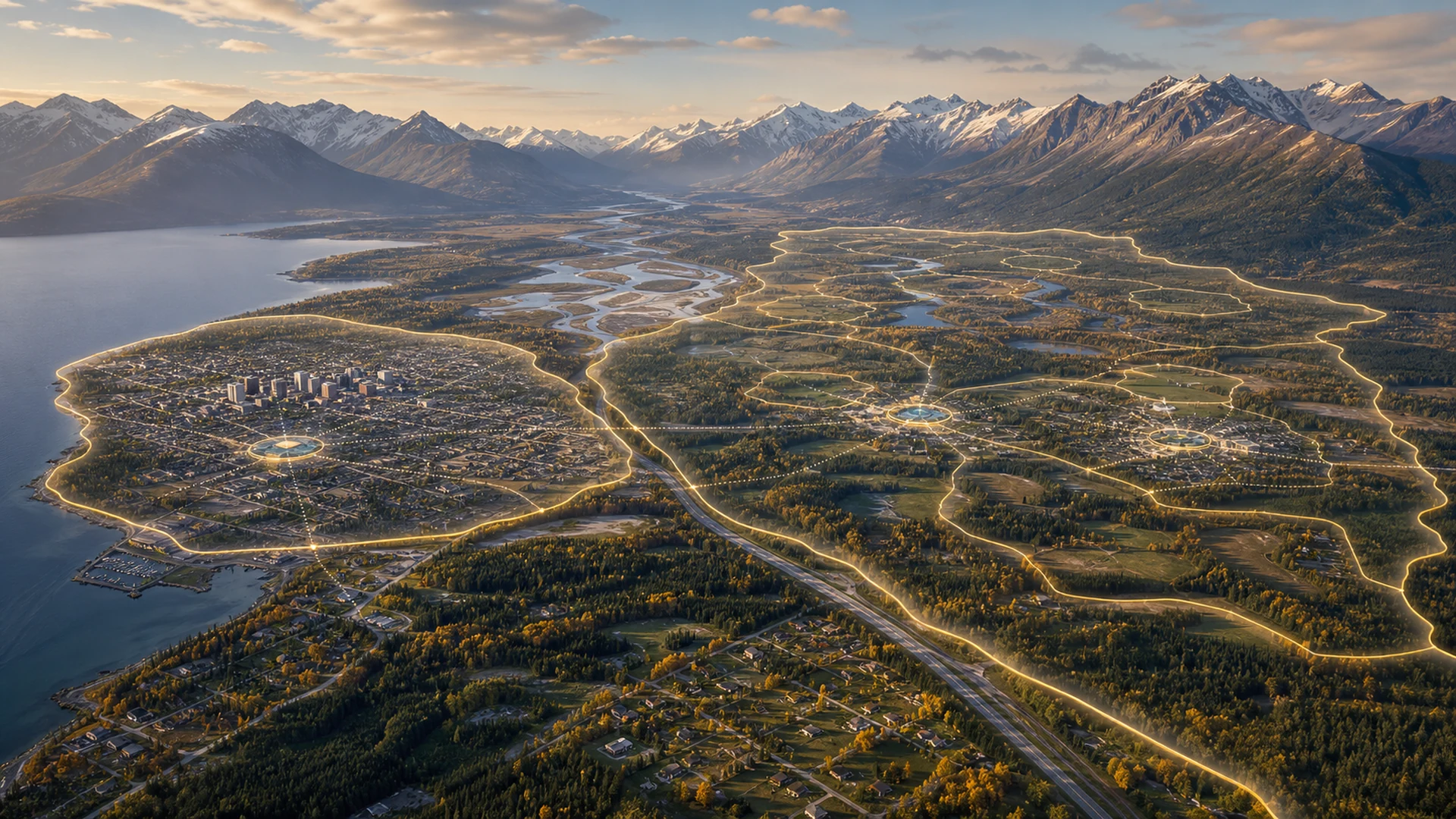
In Alaska, local government comes in exactly two forms — cities and boroughs — and a “municipality” is a legal umbrella that means either a city or a borough, not a separate third type. A borough is Alaska’s version of a county: a larger, regional government, because Alaska is the only state with no counties. Anchorage is a special case: in 1975 the City of Anchorage and the Greater Anchorage Area Borough merged into the Municipality of Anchorage, a “unified home-rule” city-borough governed by one Assembly and one Mayor. About half of Alaska sits in 19 organized boroughs; the rest is the Unorganized Borough, run directly by the state. For a homebuyer, the distinction is practical — permits, building-code enforcement, zoning, and property assessment all run through the borough or municipality, and those rules differ sharply from one to the next.
People moving to Southcentral Alaska almost always ask some version of the same question: “What county is Anchorage in?” The honest answer — none — tends to raise more questions than it settles. Alaska simply built its local government on a different chassis than the other 49 states, and once you understand the borough-versus-municipality distinction, a lot of the friction of buying here (which office issues the permit, whether a building code was ever enforced, who assesses your taxes) suddenly makes sense.
- Alaska has no counties. The state constitution divides Alaska into boroughs, which serve as the county-equivalent — the only such system in the U.S.
- A “municipality” is either a city or a borough — not a third kind of government. A city is community-based; a borough is regional.
- Anchorage is a unified home-rule city-borough. The City of Anchorage and the Greater Anchorage Area Borough merged into the Municipality of Anchorage on September 15, 1975.
- The Municipality spans roughly 1,961 square miles and includes the Anchorage Bowl, Eagle River, Chugiak, and Girdwood under one government.
- 19 organized boroughs cover about half the state; the remainder is the Unorganized Borough, governed by the Alaska State Legislature.
- Building code and zoning are local, not statewide. Anchorage enforces a robust building code; the Matanuska-Susitna Borough has historically not enforced a residential building code.
Borough vs. Municipality (Alaska). Under Alaska law, the two forms of local government are cities and boroughs, and a municipality is the umbrella term for either one — not a separate third form. A borough is Alaska’s county-equivalent, a regionally-based government. A unified municipality, such as the Municipality of Anchorage, is an organized home-rule borough in which a former city and borough have been consolidated into a single government.
What Is the Difference Between a Borough and a Municipality in Alaska?
Here is the piece that trips up most newcomers, and it’s worth stating cleanly. According to the Alaska Local Boundary Commission’s guidance, Alaska has two kinds of municipal government — cities and boroughs — and a municipality is either a borough or a city, not a third type of local government. So “municipality” is the category; “city” and “borough” are the two members of it.
The functional split is one of scale. Per the Alaska Division of Community and Regional Affairs, a city generally exercises its powers within a boundary that normally encompasses a single community, while a borough is an intermediate-sized, regional government — the county-equivalent. A city is also part of the borough in which it sits, and an organized borough can deliver services three ways: areawide (throughout the borough), non-areawide (the part outside cities), and through service areas of varying size. That service-area flexibility is exactly how a single borough government can, for example, fund road maintenance or fire protection in one subdivision but not another.
Why Doesn’t Alaska Have Counties?
Delegates to Alaska’s constitutional convention deliberately avoided the traditional county model and instead created their own system with different classes of boroughs that vary in powers and duties. The constitution requires that the whole state be divided into boroughs, but — unlike county-equivalents in the other 49 states — Alaska’s organized boroughs do not cover the entire land area. As the Division of Community and Regional Affairs explains, the state has 19 organized boroughs covering roughly half the state, and everything outside those boundaries is the Unorganized Borough, whose governing body is the Alaska State Legislature.
The U.S. Census Bureau divides that unorganized area into 11 census areas for statistical reporting, bringing Alaska to 30 county-equivalents on paper — but those census areas have no government of their own; they exist solely for data. The distinction that matters to a homebuyer is simple: in an organized borough, a local government assesses property, runs planning, and may enforce codes; in the Unorganized Borough, most of that either comes from the state or doesn’t exist at all.
| Term | What it is | Local example |
|---|---|---|
| City | Community-based municipality covering a single community | Palmer, Wasilla (within Mat-Su Borough) |
| Borough | Regional, county-equivalent government; 19 organized statewide | Matanuska-Susitna Borough; Kenai Peninsula Borough |
| Unified municipality | Home-rule borough where a former city + borough are merged into one government | Municipality of Anchorage (1975) |
| Unorganized Borough | Area outside all organized boroughs; no local government, run by the state | Split into 11 statistical census areas |
Why Is Anchorage a “Municipality” and Not Just a City?
Before 1975, the Anchorage area had two overlapping local governments: the City of Anchorage, incorporated in 1920, which handled police, fire, and zoning in the urban core; and the Greater Anchorage Area Borough (GAAB), created in 1964, which oversaw regional services outside city limits. That overlap produced exactly the kind of confusion you’d expect — the Municipality’s own history notes that a homeowner might have borough garbage service, city fire protection, and inconsistent law enforcement depending on their address.
In a September 1975 special election, voters approved unification, and on September 15, 1975 the two merged into the Municipality of Anchorage — a unified home-rule city-borough governed by one Assembly and one Mayor under a local charter. Legally its name is “Municipality of Anchorage,” but under state law it is treated as a consolidated city-borough, and per its charter it has all the powers of a home-rule borough. Today the Municipality spans nearly 1,961 square miles and is home to roughly 40% of Alaska’s population.
Why Does Borough vs. Municipality Matter When You Buy a Home?
This is where the civics lesson turns into money. Because Alaska has no statewide residential building code for structures of three units or fewer, code enforcement exists only where a local government created it — and that authority lives at the borough or municipal level. The practical contrast in this corridor is stark:
- Municipality of Anchorage operates the state’s most active building-code program through its Building Safety Division, applying the IBC and IRC with local amendments for Alaska’s conditions — including Seismic Design Category D2 (the highest risk tier) and frost-depth foundation requirements of roughly 42–48 inches in most areas. It also enforces zoning. A single MOA permit covers the Anchorage Bowl, Eagle River, Chugiak, and Girdwood.
- Matanuska-Susitna Borough (Wasilla, Palmer, and the Valley) has historically not enforced a residential building code, though land-use and zoning rules can still apply in specific areas. The same shed or garage that requires a permit in Anchorage may need none just north in the Valley.
That difference isn’t academic. A University of Alaska Anchorage study cited widely after the 2018 magnitude-7.1 earthquake found that buildings in areas without code enforcement suffered damage at roughly 18–20 times the rate of code-enforced areas — and note that some outlying communities within the Municipality of Anchorage’s own boundaries historically operated without the same level of residential enforcement as the Bowl. So “it’s inside the Municipality” is not, by itself, a guarantee that a given home was built to an enforced code. On a luxury purchase, that’s a due-diligence question, not a footnote.
Property assessment is also a borough/municipal function. The Municipality of Anchorage appraises and taxes property through its own office; the Mat-Su Borough does the same through its myProperty and assessment system. When you compare a Hillside home to a Valley acreage, you’re comparing two different assessing authorities, two different permit histories, and two different code realities — not just two price tags.
How Do You Find Out Which Rules Apply to a Specific Property?
Start with the property’s address and the governing body over it. If it’s inside the Municipality of Anchorage, the MOA’s permit and property-appraisal records tell you what was permitted and assessed; if it’s in the Mat-Su Borough, the Borough’s planning and property tools do the same, and you verify whether any building code or zoning ever applied. On any custom or older luxury home, I treat the permit-and-inspection history — not the finish level — as the first thing to confirm. Beautiful work over an unpermitted, uninspected structure is a very different asset than the same work over a code-enforced one.
- Alaska Division of Community and Regional Affairs (DCCED) — “Municipal Government Structure in Alaska” (city vs. borough, areawide/non-areawide/service-area powers, organized vs. Unorganized Borough).
- Alaska Local Boundary Commission / DCCED — “Borough Incorporation in Alaska” and “Home Rule Charters” (municipality = city or borough; unified municipality = organized home-rule borough).
- Legislative Research Services & Legislative Finance Division — “Local Government in Alaska” (LRS Report 21.028) (home-rule vs. first/second class boroughs; property-tax mill limits).
- Municipality of Anchorage — “Unification Explained” and “A Brief Overview” (1975 merger of the City of Anchorage and Greater Anchorage Area Borough; ~1,961 sq mi; home-rule charter).
- Municipality of Anchorage Development Services / Building Safety Division — building code adoption (IBC/IRC), Seismic Design Category D2, frost-depth requirements.
- Matanuska-Susitna Borough (matsugov.us) — planning, land use, and myProperty / assessment resources.
- U.S. Census Bureau — Alaska geography reference (boroughs and census areas as county-equivalents; census areas are statistical, not governmental).
- University of Alaska Anchorage — 2021 study on 2018 M7.1 earthquake damage rates in code-enforced vs. non-enforced areas (as reported).
Not Sure Which Rules Apply to a Home You’re Considering?
I’ll help you read the permit history, code reality, and assessment behind any Anchorage-area property — before you write the offer.
Frequently Asked Questions
No. Alaska is the only U.S. state that does not use counties. Its constitution divides the state into boroughs, which act as the county-equivalent. About half the state falls into 19 organized boroughs, and the remaining land is the Unorganized Borough, which has no borough-level government and is administered by the Alaska State Legislature.
Because in 1975 voters merged the City of Anchorage and the Greater Anchorage Area Borough into one unified home-rule city-borough, legally named the Municipality of Anchorage. The city and borough governments were consolidated into a single Assembly and Mayor, so there is no separate city hall and separate borough office. The Municipality spans roughly 1,961 square miles.
Under Alaska law a municipality is either a city or a borough — not a separate third type of government. A city is community-based and covers a single community, while a borough is a larger, regional government that serves as the county-equivalent. A unified municipality, like Anchorage, is an organized home-rule borough that merged its city and borough into one government.
Because permitting, building-code enforcement, zoning, and property assessment are handled at the borough or municipal level, not by the state. The Municipality of Anchorage enforces a building code with seismic and frost-depth requirements plus zoning, while the Matanuska-Susitna Borough has historically not enforced a residential building code. That directly changes what inspections, permits, and land-use rules apply to a property you’re considering.
Yes. Eagle River, Chugiak, and Girdwood all sit within the boundaries of the Municipality of Anchorage, which is why a single MOA permit office covers them. Historically, some outlying communities inside the municipality did not receive the same level of residential building-code enforcement as the Anchorage Bowl, so it is worth verifying exactly what applied to a specific address and when it was built.
The Unorganized Borough is the part of Alaska not inside any of the 19 organized boroughs, covering more than half the state’s land area. It has no local borough government; the Alaska State Legislature serves as its governing body. For census purposes it is divided into 11 census areas, but those areas are purely statistical divisions, not governments.