

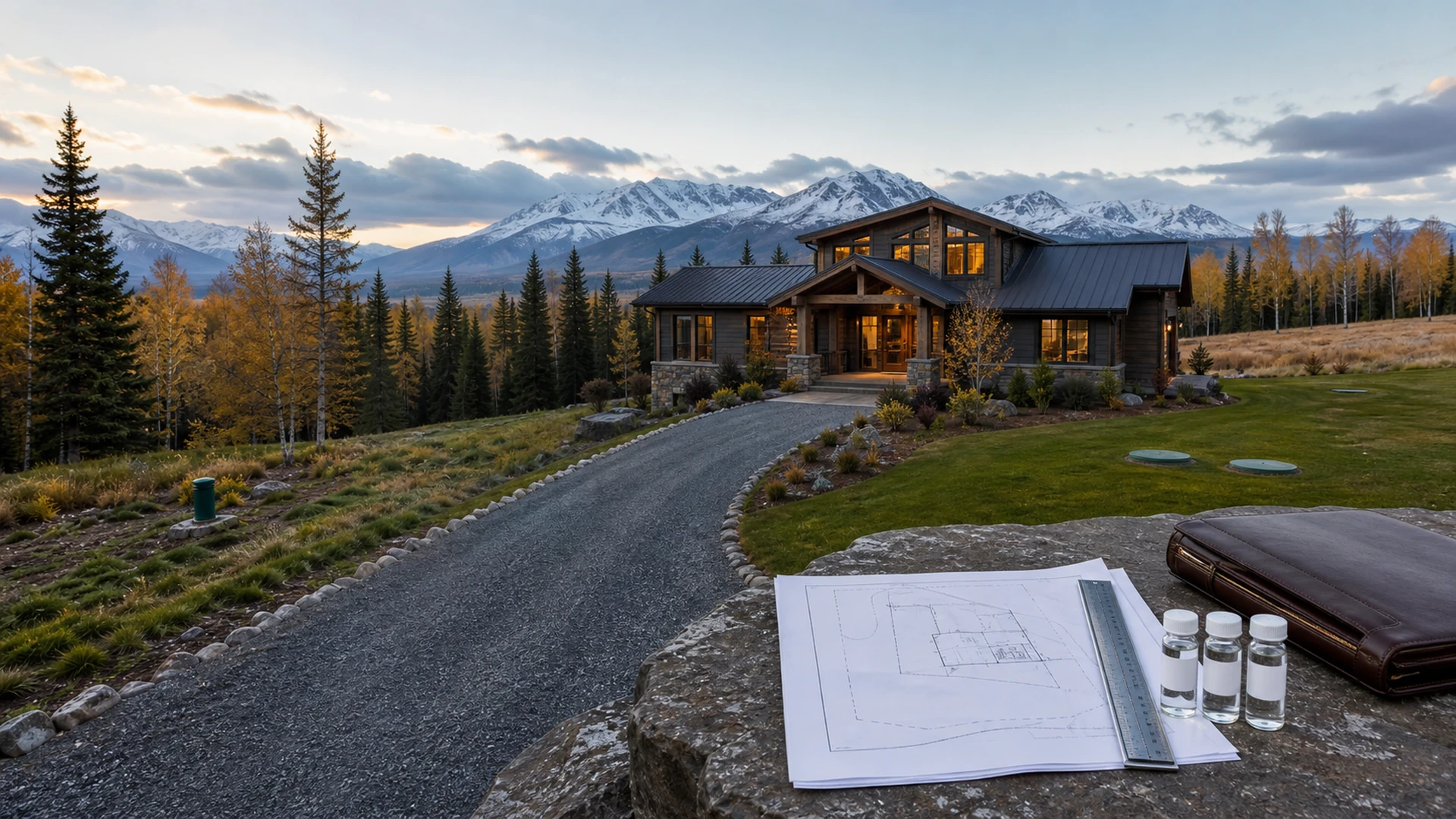
A well-and-septic Alaska home draws its water from a private well and treats its wastewater in an on-site septic system rather than public utilities. Inside the Municipality of Anchorage — which includes Eagle River and Chugiak — a 1998 ordinance requires a Certificate of On-Site Systems Approval (COSA) before title can transfer on any single-family or duplex home served by a private well or septic. The COSA is issued by the Municipality after a registered engineer confirms the system matches its records, meets separation distances, and passes water and adequacy testing. Statewide, Alaska DEC regulation 18 AAC 72 sets the minimum separation distances — notably 100 feet between a well and a septic system — and Alaska Statute 34.70 requires the seller to disclose known well and septic conditions before you make a written offer. The Matanuska-Susitna Borough has no equivalent municipal COSA, so due diligence there falls to the buyer, the lender, and a private inspection.
Some of the finest properties in the Anchorage corridor — the acreage parcels on the upper Hillside, the wooded lots through Eagle River and Chugiak, and much of the premium land in the Mat-Su Valley — are not connected to public water and sewer. They run on a private well and an on-site septic system. That is not a defect; it is simply how large-lot Alaska living works. But it changes your due diligence in ways buyers relocating from a city-utility market rarely anticipate.
The single most useful thing I tell buyers touring well-and-septic homes is this: in Anchorage, the system is inspected and certified by the government before you can close, and that process quietly protects you. The catch is that it operates on the calendar and on the ground — and in a climate where the ground is frozen for months, timing is everything. Here is how the whole thing works, drawn from the actual rules the Municipality and the state enforce.
- Inside the Municipality of Anchorage, a Certificate of On-Site Systems Approval (COSA) has been required to transfer title on any well- or septic-served single-family or duplex home since a 1998 Municipal ordinance.
- A COSA can only be submitted by a State of Alaska registered civil or environmental engineer, who confirms the system matches municipal records and verifies every separation distance in the field.
- Alaska DEC regulation 18 AAC 72.100 requires a private well to sit at least 100 horizontal feet from a septic tank or absorption field, and at least 100 feet from lakes, rivers, and other surface water.
- COSA water testing covers coliform bacteria, nitrates, and arsenic; arsenic is a naturally occurring contaminant found in pockets across Southcentral Alaska.
- A COSA is generally valid for two years, but nitrate and bacteria samples typically expire in about 90 days — so the tests are timed to the closing.
- Eagle River and Chugiak are inside the Municipality and follow the COSA rule; the Matanuska-Susitna Borough does not run an equivalent program, so Valley buyers rely on private inspection and DEC records.
- Under Alaska Statute 34.70, a seller must disclose known well and septic conditions in writing before you make an offer, and a willful violation can carry up to three times the actual damages.
What Is a Well and Septic Alaska Home, and How Common Are They?
A well-and-septic home has no municipal water or sewer connection. Drinking water comes from a drilled private well on the parcel, and wastewater flows to an on-site septic system — typically a watertight septic tank followed by a soil absorption field (a drainfield) that returns treated effluent to the ground. In some low-lying or tight-soil lots you’ll instead see a lift station, a pump vault, or an advanced treatment system doing the work.
These systems are the norm on Alaska’s larger and more rural luxury parcels precisely because those lots sit beyond the reach of utility mains. That’s the trade a buyer is really making: the privacy, acreage, and views that come with being off the grid, in exchange for owning and maintaining the water and waste infrastructure yourself. Unlike a city-lot buyer who never thinks about it, a well-and-septic buyer becomes the utility.
Well-and-septic homes are common enough in the Anchorage market that the Municipality processes them routinely — a long-published account of the local process noted a couple hundred such Anchorage home sales in a single year, concentrated on the Hillside. Treat that as illustrative of scale, not a current annual figure; the point is that this is an established, well-worn process here, not an exotic one.
Do You Need a COSA to Sell a Well or Septic Home in Anchorage?
Yes — and this is the rule that surprises out-of-state buyers most. According to the Municipality of Anchorage, in August 1998 the Municipal Assembly passed an ordinance requiring that, in order to transfer title on any property served by a well or septic system, a Certificate of On-Site Systems Approval (COSA) must be obtained. The Municipality describes the COSA as confirmation that the well and/or septic serving a single-family or duplex dwelling has been inspected and tested by a professional engineer and found to comply with applicable standards. The stated intent is public health — ensuring septic systems are functional and that well water is safe to drink and sufficient in quantity for the household.
The governing municipal code is Anchorage Municipal Code Chapters 15.55 (water wells) and 15.65 (wastewater disposal), administered by the Municipality’s On-Site Water and Wastewater Section. Two practical limits are worth knowing: the requirement covers single-family and duplex homes (systems serving more than two dwelling units fall under state jurisdiction), and transfers between spouses are exempt. Wastewater tanks are defined as watertight receptacles, and a tank that has structurally deteriorated to the point that it is no longer watertight is treated as a malfunction that must be corrected.
| Step | What happens | Who / rule |
|---|---|---|
| 1. Records | Confirm documented, approved well & septic exist | MOA On-Site document search (AMC 15.55 / 15.65) |
| 2. Engineer | Engaged to inspect & certify the system | AK-registered civil / environmental engineer |
| 3. Testing | Water (coliform, nitrate, arsenic); tank pumped; field adequacy test | Engineer + certified lab |
| 4. Waiver / repair | Short separation → waiver; correct minor defects | DEC 18 AAC 72 / MOA |
| 5. Issue COSA | MOA reviews paperwork, issues COSA; title can transfer | MOA On-Site · $600 review fee (as published) |
What Does the COSA Actually Test on the Well and Septic?
The engineer’s job is verification, not rubber-stamping. The Municipality’s process starts by comparing the septic system shown in municipal records against what is actually installed on the ground, locating the standpipes, and reviewing the as-built survey. Then comes the testing.
For the well, water samples are taken and tested for coliform bacteria, nitrates, and arsenic. Arsenic matters more here than newcomers expect: the Anchorage Daily News has reported that arsenic is a naturally occurring, highly toxic contaminant tied to local geology, and that pockets of elevated arsenic have been documented in and around Anchorage, Wasilla, and other parts of Southcentral. For the septic, the tank must have been pumped (with a pumping receipt required by the Municipality within the prior year), lift stations and pump vaults must show recent maintenance, and the absorption field must pass an adequacy test.
Older systems carry their own quirks. Long-published local guidance notes practical requirements such as no depression over a tank, air-tight cleanout caps, tanks installed after 1980 having two cleanouts, and no driveways or heavy-equipment traffic over the absorption field unless an engineer documents the system’s integrity. If a horizontal separation distance falls short of the code in force when the system was approved, the engineer must obtain a waiver before the COSA issues.
What a clean COSA gives a buyer
Independent engineer verification that the well and septic function and comply; documented water safety on bacteria, nitrates, and arsenic; confirmation the system matches municipal records; and a paper trail your lender will want anyway.
What can slow it down
Undocumented systems that must be documented first; expired water samples; a tank that fails; short separation distances needing a waiver; and frozen ground in winter that pushes repair work — and its escrow — past closing.
How Far Does a Well Have to Be From Septic in Alaska?
This is where the state, not the Municipality, sets the floor. Alaska Department of Environmental Conservation regulations at 18 AAC 72 establish the minimum separation distances for on-site systems statewide. Under 18 AAC 72.100, a private drinking-water well must maintain at least 100 horizontal feet — measured nearest edge to nearest edge — from a septic tank, soil absorption field, holding tank, lift station, sewer line, or other potential source of contamination, unless DEC has approved a lesser distance.
Other DEC distances shape where a system can even go on a lot. There is a 100-foot separation between a septic tank or absorption field and the high-water level of a lake, river, stream, or tidally influenced coastal water; a 50-foot horizontal separation between an absorption field and a steep slope (over 25 percent with more than a 10-foot drop); and a required vertical separation between the bottom of the drainfield media and bedrock, clay, or permafrost. These are exactly the constraints that make lakefront, bluff, and tight-soil luxury lots more complicated than they look — and why a knowledgeable read of the as-built matters before you fall for the view.
| DEC separation (18 AAC 72) | Minimum distance |
|---|---|
| Private well → septic tank / absorption field / lift station | 100 horizontal feet |
| Septic tank or absorption field → lake, river, stream, coastal water | 100 horizontal feet |
| Absorption field → steep slope (>25%, >10 ft drop) | 50 horizontal feet |
| Well → fuel storage tank or line (non-propane) | 100 horizontal feet |
| Septic tank → absorption field | 5 horizontal feet |
What If the Septic Fails — and Why Does Winter Matter?
If a system fails the COSA testing, a replacement must be designed, permitted, and installed, and that is genuinely expensive and slow. A widely cited local walkthrough of the process described new-system costs varying broadly — roughly $10,000 to $30,000 depending on the design — alongside separate engineering-design and permit fees. Treat those numbers as older, order-of-magnitude guidance rather than a current quote; the honest answer is that a replacement cost depends entirely on soils, lot, and design, and should be bid by an engineer for the specific property.
Winter is the recurring complication. Because Alaska ground freezes for months, excavation and drainfield work often can’t happen in the dead of winter. The Municipality’s long-standing solution is a conditional COSA: it can approve the paperwork and allow the physical repair later, but selling a home that needs a new system typically requires an escrow holdback of about one and a half times the highest installation bid, so the money is guaranteed to be there when the ground thaws. This is why timing a well-and-septic transaction — and getting the tests started early — is a real strategic lever, not a formality.
Do Eagle River, Chugiak, and the Mat-Su Valley Follow the Same Rules?
Not identically. Eagle River and Chugiak sit inside the Municipality of Anchorage, so the COSA title-transfer requirement applies to well-and-septic homes there just as it does on the Hillside. The Matanuska-Susitna Borough is a different animal: it does not run an equivalent municipal COSA program. In the Valley, septic permitting is handled through the borough’s building department in coordination with Alaska DEC, and roughly 93 percent of borough households are on private septic systems, per the borough’s own regional wastewater study. That density is exactly why Valley buyers should not assume “no COSA” means “no diligence.”
Because Southcentral Alaska’s regulation is a patchwork — the Anchorage Daily News has noted that most towns and boroughs outside the Municipality have no COSA-style requirement — the practical burden simply shifts to the buyer. In the Valley, lenders and buyers commonly still order a private septic inspection, and an as-built drawing on file with the borough is often expected. The rule of thumb I give buyers: in Anchorage the government checks the system for you; in the Valley, you check it for yourself.
What Must an Alaska Seller Disclose About Well and Septic?
Independent of any COSA, Alaska’s disclosure statute applies statewide. Under Alaska Statute 34.70, before a buyer makes a written offer on residential real property, the seller must deliver a completed written Residential Real Property Transfer Disclosure Statement. The seller must disclose known defects and conditions — including well and septic issues — in good faith, and Alaska’s form is unusually detailed, even asking sellers to estimate monthly utility costs like water and sewer.
The teeth are real. A seller who negligently fails to comply is liable to the buyer for actual damages; one who willfully violates the statute can be liable for up to three times the actual damages, plus court costs and attorney fees. And timing gives the buyer leverage: if the disclosure or a material amendment arrives after you’ve made a written offer, you can terminate that offer — within three days if delivered in person, or six days if delivered by mail. One narrow exception: the first sale of a never-occupied home is exempt from the seller disclosure requirement.
This information is general and educational, not legal, engineering, or financial advice, and rules and fees change. Confirm current requirements with the Municipality of Anchorage On-Site Water and Wastewater Section, Alaska DEC, and a State of Alaska registered engineer, and consult a licensed professional about your specific property.
- Municipality of Anchorage, On-Site Water and Wastewater Section — Certificate of On-Site Systems Approval (COSA): 1998 title-transfer ordinance, purpose, testing (nitrates, arsenic, coliform), pumping and adequacy requirements, records/document search.
- Anchorage Municipal Code Chapter 15.55 (Water Wells) and Chapter 15.65 (Wastewater Disposal) — COSA definitions, single-family/duplex scope, watertight-tank malfunction, waivers, conditional certificates.
- Alaska Department of Environmental Conservation, 18 AAC 72 (Wastewater Treatment and Disposal), incl. 18 AAC 72.100 and 18 AAC 72.520 — minimum separation distances (100 ft well-to-septic; 100 ft to surface water; slope and vertical separations) and waivers.
- Alaska Statutes, Title 34, Chapter 70 (AS 34.70.010–.200) — residential disclosure timing, good-faith duty, first-sale exemption, termination windows, and up to treble damages for willful violation.
- Matanuska-Susitna Borough — Regional Wastewater and Septage Study (share of households on private septic); borough building department / DEC septic permitting jurisdiction.
- Anchorage Daily News — reporting on private-well water testing and naturally occurring arsenic in Southcentral Alaska; note that most areas outside the Municipality lack a COSA-style requirement.
Touring acreage or view homes on well and septic?
I’ll help you read the as-built, time the COSA, and know what the numbers really mean before you write.
Frequently Asked Questions
Yes. Since a 1998 Municipal ordinance, transferring title on any Anchorage property served by a private well or septic system requires a Certificate of On-Site Systems Approval (COSA). The Municipality of Anchorage issues it based on an engineer’s inspection and testing, and it applies to single-family and duplex homes. Transfers between spouses are exempt.
Under Alaska DEC regulation 18 AAC 72.100, a private drinking-water well must be at least 100 horizontal feet from a septic tank, soil absorption field, holding tank, lift station, or similar source of contamination, measured nearest edge to nearest edge. There is also a 100-foot separation from a lake, river, or other surface water. A lesser distance requires a DEC-approved waiver.
The engineer confirms the system matches the municipal records, verifies separation distances in the field, and runs adequacy tests on the well and septic. Well water is sampled for coliform bacteria, nitrates, and arsenic. The septic tank must have been pumped within the prior 12 months, and the absorption field must pass an adequacy test.
A COSA is generally valid for two years from the date of the absorption-field adequacy test or construction, as long as the water samples stay current. Nitrate and bacteria results are typically only good for about 90 days, and arsenic for about one year, so the tests are timed to the closing. Confirm the current validity windows with the Municipality, since program details can change.
Eagle River and Chugiak are inside the Municipality of Anchorage, so the COSA title-transfer requirement applies there too. The Matanuska-Susitna Borough does not have an equivalent municipal COSA program; septic permitting there runs through the borough’s building department in coordination with Alaska DEC. Lenders and buyers in the Valley commonly still order a private inspection and expect an as-built on file.
If the system fails, a new one must be designed, permitted, and installed, which is costly and time-consuming. In winter, when the ground is frozen, the Municipality may issue a conditional COSA and allow the work to happen after thaw — but selling then typically requires an escrow holdback of about one and a half times the highest installation bid, so the funds are guaranteed for the repair.
Yes. Under Alaska Statute 34.70, a seller must deliver a completed written Residential Real Property Transfer Disclosure Statement before the buyer makes a written offer, disclosing known defects in good faith — including well and septic conditions. A seller who willfully violates the disclosure law can be liable to the buyer for up to three times the actual damages, plus costs and attorney fees.
Private well water in Southcentral Alaska is generally usable, but it should be tested rather than assumed. The COSA process samples for coliform bacteria, nitrates, and arsenic; arsenic is a naturally occurring contaminant found in geologic pockets around Anchorage, Wasilla, and other parts of the region, per the Anchorage Daily News. If a contaminant exceeds a limit, treatment such as filtration is often available, and results should always come from a certified lab.