

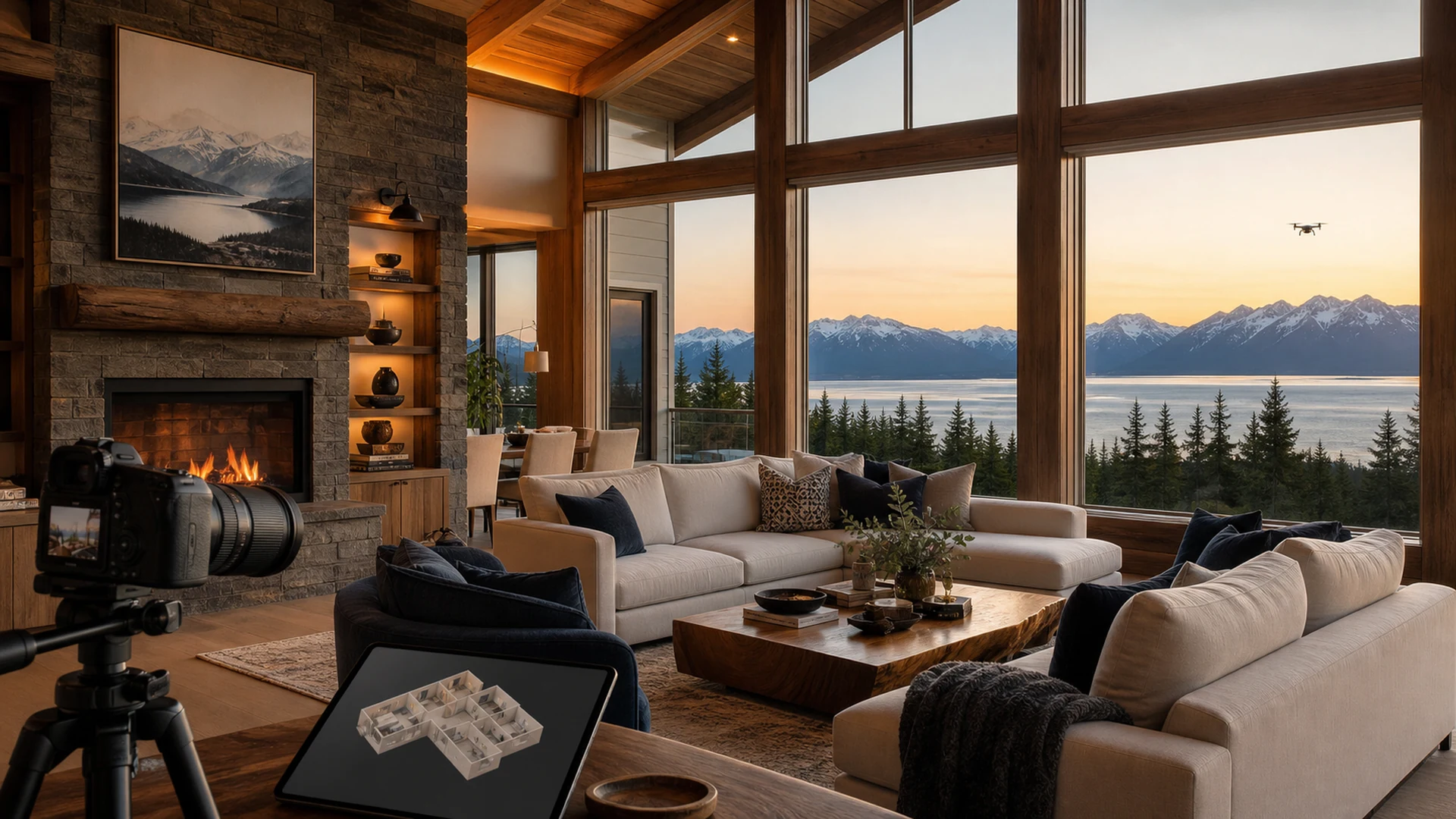
Marketing a luxury home in Anchorage rests on three things: preparing the property for the cold-climate items inspectors scrutinize, staging and photographing it professionally before it hits the market, and timing the listing to Alaska’s extreme light. National data consistently shows staged, professionally photographed homes sell faster and for a premium, and the effect is strongest at the high end, where buyers evaluate lifestyle and scale rather than square footage alone. Anchorage adds a variable most markets don’t: roughly 19.5 hours of daylight near the June solstice versus about 5.5 hours near December, so when a home is shot and listed materially changes how it presents. Drone and 3D-tour media are especially valuable here for conveying Cook Inlet and Chugach view corridors that ground-level photos miss. The through-line is honest, high-quality presentation that lets a buyer understand how the home actually lives.
A luxury home sells on perception before it sells on paper. In today’s market the vast majority of buyers begin their search online, which means a property’s first showing happens on a screen, not in the driveway. For a high-end Anchorage home, that first impression has to do double duty: it has to communicate caliber, and it has to communicate the one thing buyers move here for — light, view, and setting. Get the presentation right and a listing pre-qualifies its own buyers; get it wrong and even a beautiful home gets scrolled past.
Having spent my career in sales and design, I approach marketing a listing the way a designer approaches a room: what does the eye see first, where does it rest, and what makes someone want to step inside? Below is a researched, source-backed walk through staging, media, preparation, and the piece unique to this market — timing a luxury listing to Anchorage’s light.
- Staged homes generally sell faster and for a premium; the Real Estate Staging Association’s Q1 2025 tracking of 84 sold homes reported an average return of about $23.34 for every $1 invested in professional staging (industry benchmark, not a guarantee).
- Staging cost commonly runs about 1–3% of asking price, and it works best as a pre-listing strategy — research indicates homes staged after roughly 30 days on market rarely recover full pricing power.
- In the 2025 NAR Profile of Home Staging, about 29% of agents reported staging led to a 1–10% increase in the dollar value offered; the effect tends to be more pronounced in premium price ranges.
- Professional photography, a floor plan, an interactive 3D tour, and drone imagery are now baseline expectations, not luxury add-ons; NAR reports the overwhelming majority of buyers start their search online.
- Anchorage receives about 19.5 hours of daylight near the June solstice and only about 5.5 hours near the December solstice, with a winter solar-noon sun angle of roughly 5.5 degrees (National Weather Service / sun-position data).
- Buyer activity and household mobility surge in late spring and summer, driven by school calendars and JBER relocations; winter typically brings less competing inventory but fewer buyers.
- Cold-climate prep — crawl-space moisture, roof and ice-dam condition, snow-load drainage, and heating systems — protects your negotiating position because a buyer’s inspector will look.
Is Staging a Luxury Home Worth the Investment?
The data on staging is unusually consistent. In the 2025 National Association of REALTORS® Profile of Home Staging, roughly 29% of agents reported that staging led to a 1–10% increase in the dollar value buyers offered, and buyer’s agents widely report that a staged home makes it easier for a buyer to picture themselves living there. The Real Estate Staging Association’s Q1 2025 Market Insights — which tracked 84 homes actually staged and sold by its members — reported an average return of about $23.34 for every $1 invested in professional staging. Those are real-transaction figures rather than projections, but they are industry benchmarks and should be read as directional, not as a promise for your specific home.
At the luxury level the mechanism sharpens. Luxury buyers are not simply counting bedrooms; they are evaluating lifestyle, scale, and the emotional experience of a space. A vacant high-end home can be surprisingly hard to interpret — buyers admire the finishes but struggle to understand how the home actually lives. Staging supplies that context: it establishes scale, guides the eye to architectural detail, and lets a buyer step in emotionally. Unlike a modest home where staging mostly de-clutters, a luxury stage is about aspiration and flow, which is exactly why the return tends to be more pronounced in premium price ranges.
Staging is a pre-listing strategy, not a rescue. Research reported by staging-industry sources indicates each week of delay in staging can shave sale price on average, and that homes staged after roughly 30 days on market rarely recover full pricing power. Buyer perceptions formed in the first two weeks of a listing carry disproportionate weight in the final negotiation.
How Much Does Staging and Presentation Cost — and Where Should the Dollars Go?
Staging cost varies with service level and whether the home is occupied or vacant, but a common industry rule of thumb puts it at roughly 1–3% of asking price, with vacant-home staging at the higher end because it requires bringing in a full furniture package. The reason the math tends to favor staging is leverage: a modest, front-loaded investment influences a much larger number — the sale price — and it does so precisely when buyer impressions are being formed. The infographic below lays out where presentation dollars typically go and why each element earns its place, drawn from national real-estate media and staging data.
| Presentation element | Why it earns its place | Source basis |
|---|---|---|
| Professional staging | Establishes scale, flow, and emotional connection; strongest effect at the luxury level | NAR 2025 Profile of Home Staging; RESA Q1 2025 |
| Professional photography | First impression happens online; well-photographed homes tend to sell faster and attract more views | Redfin / NAR-reported industry data |
| Floor plan | Buyers want to understand how a home works, not just how it looks | Zillow consumer-trends reporting |
| 3D / virtual tour | Immersive media holds attention and pre-qualifies buyers; strong seller preference for agents who offer it | NAR technology surveys; industry reporting |
| Drone / aerial | Conveys view corridors, lot context, and setting that ground-level shots miss | Industry aerial-imagery reporting |
What Photography and Media Does a Luxury Anchorage Listing Actually Need?
Photography is not a line item — it is the listing. With nearly all buyers starting online, a home’s images decide whether it makes the shortlist. Industry research from Redfin associates professionally photographed homes with faster sales and stronger buyer interest, and a complete, well-sequenced gallery gives buyers the confidence to schedule a showing. For a luxury property the baseline package is broader than a set of stills: it includes a floor plan (buyers increasingly expect to understand the layout), an interactive 3D tour, and aerial/drone imagery.
The 3D tour matters because immersive media both holds attention longer and filters the buyer pool — someone who has virtually walked the home arrives at a showing already qualified. Seller preference bears this out: NAR-cited surveys show the large majority of sellers would favor an agent who offers 3D tours. Drone imagery, meanwhile, does something uniquely important in this market: it tells the location story. Aerial shots communicate how a lot sits, where the view corridors face, and the home’s relationship to Cook Inlet, Turnagain Arm, or the Chugach front — context flat photos simply cannot convey. Used honestly — consistent altitude, no misleading wide sweeps that imply more acreage than exists — drone media answers buyer questions before they’re asked.
Media that pulls its weight
- Professional stills, sequenced to tell a story
- A floor plan for layout clarity
- An interactive 3D tour that pre-qualifies buyers
- Drone imagery for view corridors and lot context
- Twilight exteriors that showcase architectural lighting
Where honesty guards the sale
- Label any virtual/digital staging as such
- Keep aerial framing accurate about lot size
- Disclose the season a photo was taken
- Present measurements as approximate unless verified
- Never imply a view or amenity the home doesn’t have
How Does Anchorage’s Daylight Change How You Market a Home?
This is the variable that makes Anchorage marketing genuinely different from the Lower 48. Near the June solstice the city gets roughly 19.5 hours of daylight, with the sun barely dipping below the horizon and a long, low golden hour that can last past midnight. Near the December solstice it gets only about 5.5 hours, and — per National Weather Service data — the solar-noon sun angle drops to about 5.5 degrees above the horizon. That’s roughly a 14-hour swing in daylight across the year. A home’s exterior, its view, and its landscaping look like entirely different properties depending on when the camera comes out.
The practical implications are concrete. Exterior and view photography captured in summer’s long, raking light presents at its best; the same home shot in a five-hour December window with the sun skimming the horizon reads flat and dim. If a home is going to market in winter, the professional playbook is to lean on warm, well-lit interiors, use twilight exteriors to showcase architectural lighting, and — critically — be transparent about seasonal photos rather than passing off a summer shoot as current. On the flip side, that low summer sun angle is a photographer’s gift: hours of soft, warm light instead of a brief golden hour.
When Should You List a Luxury Home in Anchorage?
Timing follows the light and the calendar together. Late spring through summer brings the most buyers and the fastest timelines, and Anchorage sees a genuine summer surge in household mobility — families move around the school year, and Joint Base Elmendorf-Richardson (JBER) relocations concentrate demand in the warm months. Homes generally sell faster in summer because touring is easier and daylight is abundant. Exterior-dependent prep that needs unfrozen ground — landscaping, exterior paint, certain inspections — is also best scheduled late spring through summer.
That doesn’t make winter a dead zone. Fewer sellers list in winter, which means less competing inventory and often more motivated, serious buyers — relocation buyers frequently start their search in late January to close before the next school year. A well-prepared winter listing that leans into warm interiors and easy, cleared access can stand out precisely because the field is thinner. The right answer depends on your property, price point, and goals, not the month alone.
What Should You Fix Before a Luxury Home Goes to Market?
In this climate, preparation is marketing. Anchorage buyers — and, more to the point, their inspectors — check things that rarely come up in warmer markets. Crawl spaces are a known trouble spot; a meaningful share of Anchorage crawl spaces take on water in spring, and an inspector will go down there even if the buyer won’t. Roof condition, ice damming, and snow-load management matter, as does drainage that carries spring melt away from the foundation. Heating systems — especially in-floor radiant heat, which takes longer to warm a home for showings — are part of the story.
Front-loading these fixes protects your number. A problem discovered during inspection almost always costs more in buyer credits and lost leverage than it would have cost to resolve before listing. And basic winter access — a cleared driveway, walkways, and even the back deck — isn’t just courtesy; it’s the difference between a showing that happens and one that gets rescheduled. This is also where my design background does quiet work: knowing which finishes and light-handling choices hold value through an Alaska winter helps me direct staging and prep toward the things buyers here actually reward.
The cost ranges, ROI figures, and market data on this page are general industry and regional benchmarks for educational purposes — not a guarantee of results, and not legal, tax, or financial advice. Staging returns and listing outcomes vary by property, price point, and market conditions. Consult the appropriate licensed professional about your specific situation.
- National Association of REALTORS® — 2025 Profile of Home Staging (share of agents reporting a 1–10% value increase; buyer-visualization findings).
- Real Estate Staging Association (RESA) — Q1 2025 Home Staging Market Insights (84 tracked homes; ~$23.34 return per $1 invested).
- Redfin / NAR-reported industry data — professional photography and time-on-market / online-search behavior.
- NAR technology surveys and industry reporting — 3D-tour seller preference and immersive-media engagement; drone/aerial imagery for lot and view context.
- U.S. National Weather Service (Anchorage) & sun-position data — ~19.5 hours June-solstice daylight vs. ~5.5 hours December-solstice; ~5.5° December solar-noon sun angle; ~52° June solar-noon sun angle.
- Visit Anchorage / Alaska daylight references — corroborating seasonal daylight figures.
- Municipality of Anchorage (Development Services) — local building safety guidance on roof snow loads, foundation drainage, and meltwater management.
Thinking About Selling Your Anchorage Home?
Start with a clear-eyed sense of value, then build a presentation strategy around it. Call Bill at 907-560-4090.
Frequently Asked Questions
For most luxury listings, yes. National staging data consistently shows staged homes sell faster and for a premium, and the effect tends to be more pronounced at the high end because luxury buyers evaluate lifestyle and scale, not just finishes. A vacant luxury home can be hard to interpret, even when the architecture is excellent. The right question is not whether to invest in presentation but how much, and where the dollars move the number for your specific property.
Staging cost varies widely by service level and whether the home is occupied or vacant, and industry figures commonly land in the range of roughly 1% to 3% of asking price. The Real Estate Staging Association’s Q1 2025 tracking of 84 sold homes reported an average return of about $23.34 for every $1 invested in professional staging, though results vary by market and property. Treat these as industry benchmarks, not guarantees for any one home.
Dramatically. Anchorage receives about 19.5 hours of daylight near the June solstice and only about 5.5 hours near the December solstice, per National Weather Service and sun-position data. The winter solar-noon sun angle is only about 5.5 degrees above the horizon, so exterior and view photography captured in December looks very different from a June shoot. Timing your photo capture, and being honest about seasonal photos, matters more here than in most markets.
Buyer activity and daylight both peak in late spring and summer, and Anchorage sees a summer surge in household mobility tied to school calendars and JBER relocations. Homes generally sell faster with more daylight and easier access. That said, winter can mean less competing inventory and more motivated buyers, so the best window depends on your property, price point, and goals rather than the calendar alone.
For the right property, yes. With the vast majority of buyers starting their search online, immersive media holds attention and pre-qualifies buyers before a showing. Industry reporting associates aerial imagery with faster sales and shows strong seller preference for agents who offer 3D tours. Drone imagery is especially valuable in Anchorage for conveying Cook Inlet and Chugach view corridors and lot context that ground-level photos cannot capture, as long as the framing is honest and any digital staging is labeled.
Prioritize the cold-climate items a buyer’s inspector will scrutinize: crawl-space moisture, roof and ice-dam condition, snow-load and drainage away from the foundation, and heating systems such as in-floor radiant heat. Ensure safe, cleared access to the driveway, walkways, and decks in winter. Resolving these before listing protects your negotiating position, because problems discovered during inspection cost more in credits than they would have cost to fix up front.
Bill pairs a degree in Interior Design with a career in furnishings, design, and real estate, which shapes how he reads finishes, light, and flow when preparing a home for market. That designer’s eye informs staging direction and how a listing is presented, from which rooms to feature to how a home photographs in Alaska’s high-latitude light. It is applied to marketing strategy, not offered as a separate design service.