

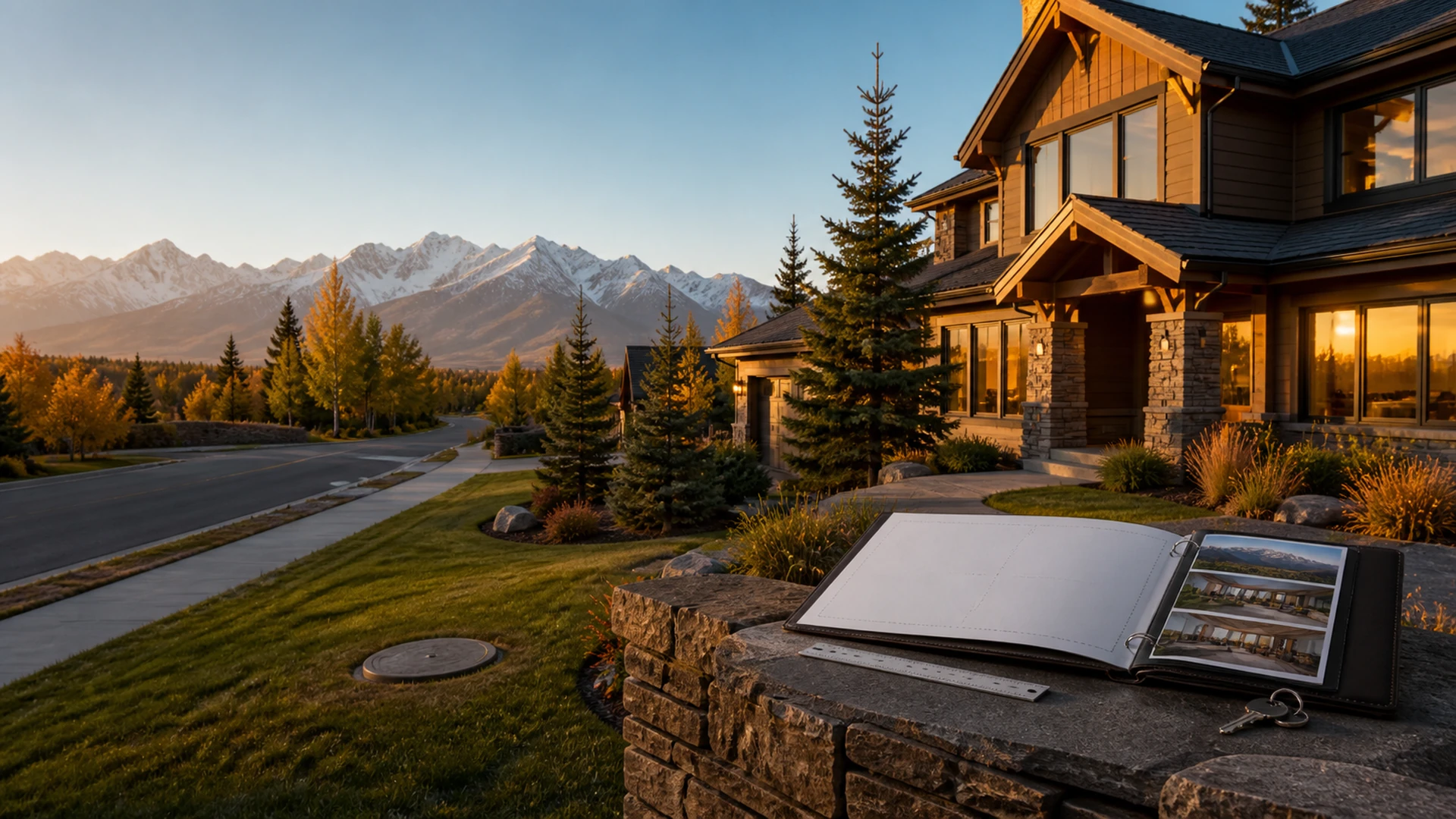
The most accurate answer to “what is my South Anchorage home worth” comes from a comparative market analysis on your specific street, because value here swings widely by view, lot size, and well/septic status even within a single subdivision. In recent listings data, reported medians across the Huffman-O’Malley and Hillside areas have run in the mid-$500,000s to mid-$600,000s, with view estate homes reaching well past $1 million. Two big factors set South Anchorage apart from an online estimate: unobstructed Cook Inlet or Chugach views, and whether the home is on public utilities or private well and septic. Because the Municipality of Anchorage requires a Certificate of On-Site Systems Approval (COSA) to transfer title on a well/septic property, that status affects both your price and your timeline. A local valuation weighs all of this; an algorithm does not.
South Anchorage — the rising ground from the New Seward Highway up through Huffman-O’Malley, the Hillside, Rabbit Creek, and Bear Valley toward the Chugach foothills — is one of the hardest submarkets in the state to value from a spreadsheet. I’ve watched this corridor grow for forty years as an Anchorage resident, and the pattern is consistent: the homes that surprise sellers on the high side almost always win on view and daylight, and the ones that stall usually carry a well-or-septic question that never got answered early. This page walks through what genuinely drives your number, grounded in the rules and sources that actually govern a South Anchorage sale.
- Reported neighborhood medians in the Huffman-O’Malley and Hillside areas have run in the mid-$500,000s to mid-$600,000s in recent listings data, while view and acreage estate homes reach past $1 million — range, not a single number.
- Cook Inlet and Chugach views are among the largest value drivers, and a sightline that stays open through winter is worth more than a partial or seasonally screened one.
- Many upper South Anchorage homes are on private well and septic; the Municipality of Anchorage requires a Certificate of On-Site Systems Approval (COSA) to transfer title on those properties.
- A COSA involves an engineer testing well water for nitrates, arsenic, and coliform bacteria and running a septic adequacy test — and the septic test needs unfrozen ground, so timing matters.
- Alaska has no state income tax and no state capital-gains tax; the federal IRS Section 121 exclusion can shelter up to $250,000 of gain (single) or $500,000 (married filing jointly) on a qualifying primary residence.
- Your Municipality of Anchorage assessed value is set for taxation, not for pricing a sale; the assessor is only required to visit a property once every six years, so it can lag the market.
What Actually Drives Your South Anchorage Home Value?
No single number describes “South Anchorage” because the corridor holds everything from lower-Hillside subdivisions near shopping to multi-acre view estates in the foothills. Recent listings data illustrates the spread: portals have reported 12-month medians for the Huffman-O’Malley area in the mid-$500,000s to mid-$600,000s, with luxury inventory listing higher and estate homes well into seven figures. Treat those as ranges from aggregator data, not as your home’s value — the point is that the corridor is wide, and where your property sits within it is what a real valuation resolves.
Unlike a flat national estimator that leans on square footage and bed/bath counts, a South Anchorage valuation has to weigh factors that don’t travel well: which direction the view faces, how big and buildable the lot is, and whether the home is on public utilities or a private system. Those are the levers that move the number here, and they’re exactly what the matrix below breaks down.
| Value factor | Relative impact | Why it matters in South Anchorage |
|---|---|---|
| View corridor (Inlet / Chugach) | High | An unobstructed, winter-holding sightline commands the largest premium; partial or screened views add far less. |
| Lot size & buildability | High | Multi-acre and estate-sized Hillside parcels carry a premium over smaller lower-Hillside lots. |
| Well & septic status (COSA) | High | A clean, current COSA protects price and timeline; a failing system forces repairs or a concession. |
| Finish quality & design | Med–High | Cold-climate-appropriate finishes and daylight-capturing layouts support higher offers. |
| Home size & condition | Medium | Baseline driver, but rarely the tiebreaker between two comparable South Anchorage homes. |
| Neighborhood & school area | Medium | Attendance areas and subdivision character factor in, described by name and fact only. |
| Property-tax assessed value | Low | Set for taxation as of January 1; can lag the market and understate improvements. |
How Much Does a View Add to a South Anchorage Home?
Views are the value driver buyers chase hardest and price most emotionally, and South Anchorage’s topography — homes stepping up the Hillside toward the Chugach, facing west and southwest across Cook Inlet — is why. The premium is real, but it’s not uniform. A genuinely unobstructed view that holds its sightline through winter, when the light is low and neighboring trees are bare, is worth substantially more than a partial view or one that closes up seasonally. When I walk a listing, I’m reading not just what the view is today but whether it’s protected — a vacant downhill lot or maturing spruce can quietly cost a seller real money at appraisal.
How Does Well and Septic Affect Value When You Sell?
This is the factor that catches South Anchorage sellers most often. Much of the upper Hillside and outlying South Anchorage runs on private well and septic rather than public utilities. Per the Municipality of Anchorage, a 1998 Assembly ordinance requires a Certificate of On-Site Systems Approval (COSA) before title can transfer on any property served by a well or septic system — and the Municipality reports this has been rigorously enforced ever since. A COSA is signed off by a State-registered civil or environmental engineer who inspects the system, tests the well water for nitrates, arsenic, and coliform bacteria, and runs a septic adequacy test.
Two practical points drive value. First, timing: septic adequacy testing needs unfrozen ground, and water-sample lab results have tight windows, so a system tested at the last minute can delay a closing. Second, condition: a clean, current COSA reassures buyers and lenders and protects your number, while a failing or undocumented system can force a repair, an escrow holdback, or a price concession — and a full replacement is a five-figure cost. Because of that, I advise South Anchorage sellers on well/septic to have the system checked early in the process, not at closing. It’s the single most overlooked step in pricing an upper-Hillside home confidently.
Anchorage residential property is assessed by the Municipality as of January 1 each year, and the assessor is only required to physically visit a property once every six years. Single-family assessed values rose about 6% in the most recent cycle reported by the municipality. Because assessment lags the market and misses recent improvements, your green-card value is a tax figure — not a reliable list price.
Thinking of Selling in South Anchorage? What Costs and Taxes to Expect
Your net proceeds — not just your sale price — are what a valuation should help you plan around. A few Alaska-specific facts work in your favor. Alaska has no state income tax and therefore no state-level capital-gains tax on a home sale. At the federal level, IRS Section 121 lets qualifying sellers exclude up to $250,000 of gain (single) or $500,000 (married filing jointly) if the home was a primary residence for at least two of the last five years. On the disclosure side, Alaska Statute AS 34.70 requires you to deliver a completed Residential Real Property Transfer Disclosure Statement before the buyer makes a written offer; a seller who willfully fails that duty can be liable to the buyer for up to three times actual damages, which is exactly why thorough, honest disclosure protects you. My role as a designer-trained agent is to read your finishes and light the way a buyer will, price accordingly, and keep the well/septic and disclosure work ahead of schedule so nothing surprises your number at the table.
This information is general and educational, not legal, tax, or financial advice. Confirm your specific situation with a licensed tax professional or attorney.
- Municipality of Anchorage, On-Site Water & Wastewater Section — Certificate of On-Site Systems Approval (COSA) — title-transfer requirement, licensed civil-engineer inspection/testing, water-quality testing, and septic-system adequacy requirements. (muni.org)
- Municipality of Anchorage, Property Appraisal & Treasury — assessed value set as of January 1, property-appraisal cycle, mill rates, and residential property-tax exemption. (muni.org; Anchorage Daily News assessment reporting)
- Alaska Statutes AS 34.70.010–34.70.200 — Residential Real Property Transfer Disclosure Statement; deliver-before-offer requirement; up to 3× actual damages for willful violation; State of Alaska Real Estate Commission disclosure forms.
- IRS — Section 121 primary-residence capital-gains exclusion ($250,000 single / $500,000 married filing jointly); IRS Publication 523, Selling Your Home.
- State of Alaska, Department of Revenue — Alaska has no individual state income tax and therefore does not impose a separate individual state capital-gains income tax.
- Alaska Multiple Listing Service / public listing aggregators — Redfin — Huffman-O’Malley, Homes.com — Huffman-O’Malley, and related Hillside market pages — illustrative neighborhood median and days-on-market ranges for the Huffman-O’Malley and Hillside areas (treated as ranges, not authoritative valuations).
What’s Your South Anchorage Home Really Worth?
Get a free, expert valuation from a 40-year Anchorage local — not an algorithm’s guess. I’ll weigh your view, lot, and well/septic status the way the market actually does.
Frequently Asked Questions
The most accurate answer comes from a comparative market analysis on your specific street, because South Anchorage value swings widely by view, lot size, and well/septic status even within one subdivision. Reported neighborhood medians in the Huffman-O’Malley and Hillside areas have run in the mid-$500,000s to mid-$600,000s in recent listings data, with view estate homes reaching well past $1 million. Online estimates miss the view corridor and acreage premiums that matter most here, so a local valuation is the reliable path to a real number.
Yes, and they are one of the largest single value drivers in South Anchorage. Cook Inlet and Chugach Mountain sightlines command a meaningful premium, and a genuinely unobstructed, south- or west-facing view that holds through winter is worth more than a partial or seasonally screened one. Two otherwise identical homes a block apart can differ substantially in price based only on what the windows actually see.
Many Hillside and upper South Anchorage homes are on private well and septic rather than public utilities, and the Municipality of Anchorage requires a Certificate of On-Site Systems Approval (COSA) to transfer title on those properties. A clean, current COSA protects your value and timeline; a failing or undocumented system can force repairs, an escrow holdback, or a price concession. Because septic adequacy testing needs unfrozen ground, timing the test matters, so I advise sellers to have the well and septic checked early rather than at closing.
Alaska has no state income tax and therefore no state-level capital gains tax on a home sale. At the federal level, under IRS Section 121, if the home was your primary residence for at least two of the last five years, you can generally exclude up to $250,000 of gain if single or up to $500,000 if married filing jointly. This is general information, not tax advice, so confirm your situation with a tax professional.
Not reliably. The Municipality of Anchorage assessed value is set for taxation as of January 1, and the assessor is only required to physically visit a property once every six years, so it can lag the market or miss recent improvements. Market value is what a willing buyer will actually pay today, which is usually different from the green-card assessment, so use a current comparative market analysis rather than your tax figure to price a sale.