

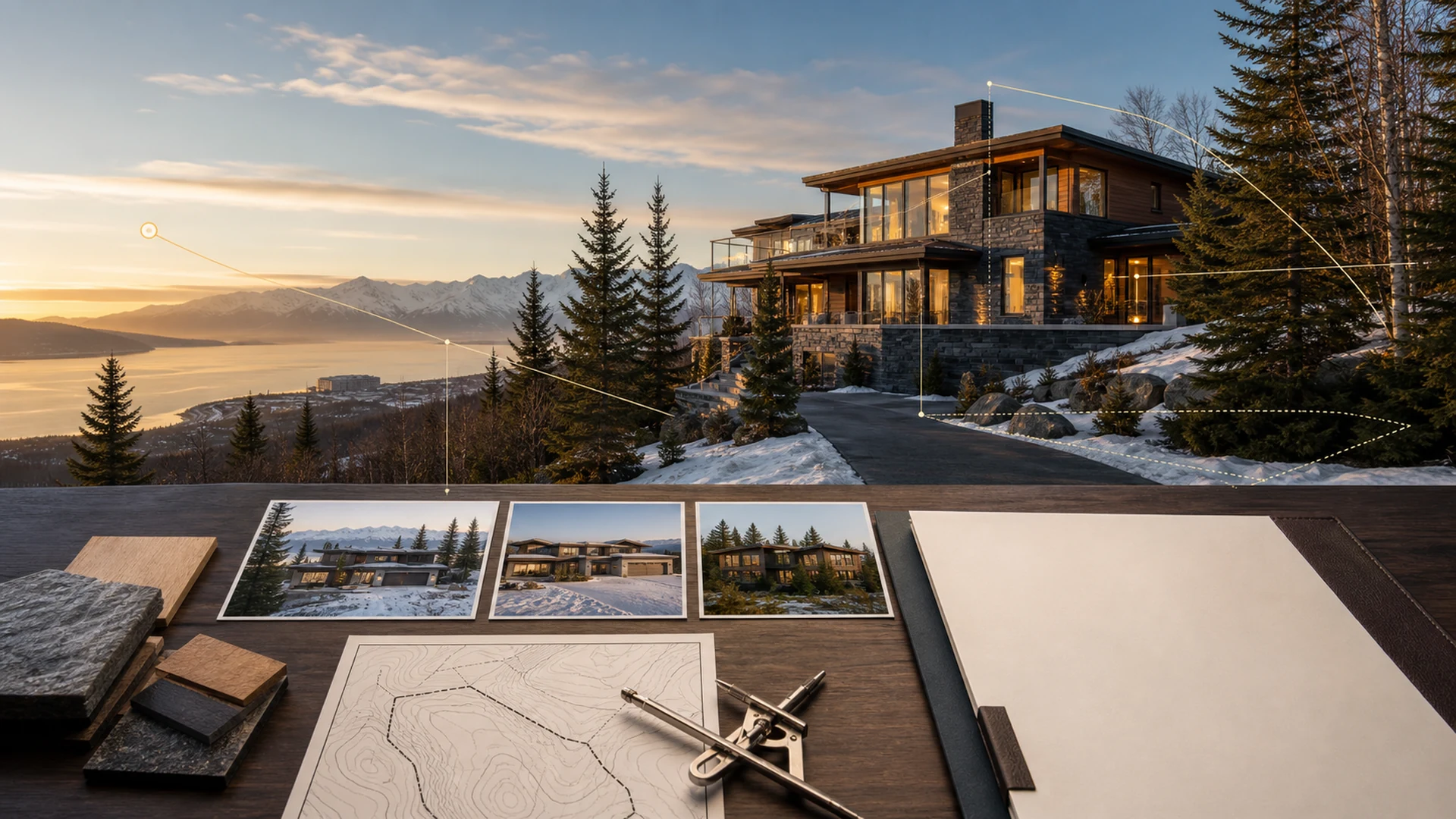
Pricing a luxury home in Anchorage means working from only a handful of true comparable sales, then adjusting for the features that carry value here — a genuine Cook Inlet or Chugach view, winter sun exposure, lot size, and finish quality. Unlike a mid-market home appraised from fifteen or twenty near-identical sales, a high-end Anchorage home is typically priced from three to five comps, often pulled from other subdivisions or further back in time. The Municipality of Anchorage’s assessed value is set for taxation and should not be confused with market price; in 2026 overall single-family assessments rose about 4%, but roughly 10% of properties saw far larger swings. Because well-priced Anchorage homes in desirable areas have been selling in about 20 to 35 days while overpriced ones sit 60 to 90-plus days, getting the launch number right is the single most important pricing decision a seller makes.
The hardest number in real estate to get right is the first one. In the Anchorage upscale corridor — the Hillside, South Anchorage, West and Coastal Anchorage, Eagle River, and Girdwood — that difficulty is amplified, because the pool of genuinely comparable sales is small and every custom home is a little different from the last. I have watched this corridor since 1982, and the pricing mistakes I see repeat year after year are almost always the same: leaning on the tax assessment, treating “a view” as a flat percentage, and launching high “to leave room.”
This guide walks through how luxury pricing actually works in Anchorage, grounded in current market data, Alaska’s disclosure law, and the way the Municipality assesses property. My background is in sales and design — I hold a degree in Interior Design — and that lens is exactly why I read finish quality and light differently than a spreadsheet does. Those two things, finish and light, are where a lot of the price lives at the top of this market.
- High-end Anchorage homes are typically priced from just 3–5 comparable sales rather than 15–20, giving agent and appraiser judgment far more weight than in the mid-market.
- The Municipality of Anchorage assessed value is a mass-appraisal figure for taxes, not a market price; 2026 single-family assessments rose about 4% overall, but roughly 10% of properties saw much larger swings after a methodology change.
- A genuine, protected view (Cook Inlet, the Chugach, the Alaska Range, city lights) is one of the biggest luxury price drivers on the Hillside — but the premium is parcel-specific, not a flat rate.
- Winter sun exposure and finish quality are chronically underpriced by generic tools that only count square footage.
- Alaska law (AS 34.70) requires the seller to deliver a written Residential Real Property Transfer Disclosure Statement before the buyer’s written offer; willful violations expose the seller to up to three times actual damages.
- Well-priced homes in desirable Anchorage areas have moved in roughly 20–35 days in 2026, while overpriced or work-needed homes sit 60–90+ days and require reductions.
- Spring (April–June) brings the most inventory and buyers; Alaska’s snow-free window also matters for appraiser access, photography, and any well/septic or view-clearing prep.
Why Is Pricing a Luxury Home in Anchorage So Different From a Mid-Market Home?
The whole method changes at the top of the market. For a typical Anchorage home, valuation is close to arithmetic: pull recent sales of similar homes in the same subdivision and make small adjustments. High-end appraisers and agents describe the opposite situation — luxury properties lack identical comparable sales, and bespoke features that a standard grid simply cannot quantify. Industry guidance is blunt about the math: luxury homes above roughly $2 million are commonly priced from three to five comparable sales rather than fifteen to twenty, which gives professional judgment disproportionate weight.
In Anchorage the problem is geographic as much as numeric. The upscale corridor breaks into distinct micro-markets — the way appraisers treat separate high-end enclaves in other cities as their own worlds applies cleanly here. A custom home on the upper Hillside is not automatically comparable to one in Eagle River or Goldenview even at the same square footage, because lot, elevation, view, and access differ. When there are no clean matches, appraisers are allowed to reach further — back 12 to 24 months, or into a competing enclave — as long as they document why those sales are the best available indicators of value. The upshot: on a luxury Anchorage home, the price is only as strong as the story behind the comps.
| Step | What you do | Anchorage-specific reality |
|---|---|---|
| 1. Find comps | Identify 3–5 true comparables | Often pulled from other subdivisions or 12–24 months back |
| 2. Adjust | Value the differentiators | Protected view, winter sun, lot/privacy, finish quality |
| 3. Cross-check | Compare to assessment | MOA value is for tax; +4% avg in 2026, ~10% with larger swings |
| 4. Set price | Price to sell in the normal window | Well-priced ~20–35 days; overpriced 60–90+ days |
| 5. Appraisal | Document comps in advance | Low appraisal answered by reconsideration of value |
What Actually Drives the Price of a High-End Anchorage Home?
Square footage is the floor of the conversation, not the answer. At the top of this market, four things move the number more than size does — and generic online estimators are weakest on exactly these.
A genuine, protected view
View is the headline value driver on the Hillside, and it is priced by sightline, not by adjective. Local luxury listings lead with panoramic Cook Inlet, Chugach Mountain, and city-light views, and Hillside East recently showed a median around $932,000 with homes running from the mid-$500,000s to over $2 million. The distinction that a spreadsheet misses: an unobstructed, protected view of the Inlet or the Alaska Range commands a real premium, while a partial or tree-blocked view of the same direction does not. On the Hillside, homeowners even describe sunsets from southwest-facing decks as a selling feature — that is the view and the light working together.
Winter sun and orientation
This is the most overlooked pricing factor in Anchorage, and it is where local knowledge separates a good price from a guess. At high latitude, December daylight is short and the sun sits low; south- and southwest-facing lots that hold genuine winter light live very differently than a north-facing parcel that stays in shadow. Buyers chase the summer view; the ones who know this place check the winter sun. A home that is bright and warm-feeling in January defends its price in a way a dark one cannot.
Lot, privacy, and access
Hillside luxury is defined by larger wooded lots and privacy at the base of the Chugach, with close trail access — and the trade-off is real winter driving. Local descriptions of the Hillside are candid that the sloping approach can be windy and slick, so studded tires and all-wheel drive are the norm. That access reality is a legitimate pricing input: an easy, plowed, south-facing approach is worth more than a steep, shaded, hard-to-maintain one.
Finish and construction quality
This is where my design background earns its keep. Two homes of equal size can differ dramatically in value based on design, craftsmanship, and cohesion — and appraisal grids have no line item for a truly well-executed kitchen, cold-climate-appropriate materials, or a floor plan that flows. In Anchorage the finish conversation is also a durability conversation: newer construction post-1980 in the Hillside, South Anchorage, and Eagle River uses more modern siding and systems, and buyers here are increasingly sophisticated about heating costs, energy ratings, and deferred maintenance. Quality that reads on paper and holds up to a subarctic winter is quality that prices.
Why Isn’t My Assessed Value the Same as My Sale Price?
This confuses more Anchorage sellers than anything else on this page, and 2026 made it worse. The Municipality of Anchorage assessed value is a mass-appraisal number produced for taxation, covering roughly 98,000 parcels — it is not a listing price. Per the Municipality’s own reporting, overall estimated single-family values rose about 4% for 2026, a more modest bump than prior years. But the headline was the exceptions: after the assessor’s office simplified how it grades construction quality and consolidated its market areas (from roughly 400 down to fewer than 20), about 10% of residential properties saw much larger swings, with some owners reporting 20–40% increases and one Eagle River homeowner citing a jump from $781,000 to over $1 million.
Two practical takeaways for pricing. First, never anchor your list price to the green assessment card — in a reassessment year like this one, it can be well above or below true market value. Second, the assessment appeal window is real and tight: for 2026, appeals were generally due in early February, so a homeowner who believes the Municipality overshot needs a market-based value (a comparative market analysis or appraisal) in hand quickly. That same market analysis is exactly what you use to set a defensible list price.
Anchorage funds services heavily through property tax and, unlike neighboring Palmer and Wasilla, has no municipal sales tax — one reason assessment swings draw so much attention here. Assessment questions go to the Municipal Assessor (appeal hotline 907-343-6500); pricing questions belong to a market analysis. They answer different things.
What Does the Current Anchorage Market Say About Pricing?
Pricing is set inside a market, so here is the 2026 backdrop from multiple sources — treated as ranges, because reporting methods differ. Anchorage overall has been a modest seller’s market: reported metro median sale prices in the first half of 2026 ranged from roughly $410,000 to $449,000 depending on source and window, with inventory below historical norms and price-per-square-foot figures around the mid-$250s per square foot on sold data. The luxury tiers sit well above that: South Anchorage and the Hillside are widely described as the premium market, generally $450,000 to $700,000-plus for standard homes and reaching into seven figures for estates, with Hillside East’s recent median near $932,000.
The behavioral lesson is consistent across every source: pricing is everything, and buyers in 2026 are not chasing aspirational numbers the way they did in 2021–2022. Homes priced at fair market value sell in the normal window — roughly 20 to 35 days in desirable neighborhoods — while homes priced above market sit 60 to 90-plus days and end up cutting. In a corridor this small and lightly contested, an overpriced luxury listing doesn’t just wait; it burns its best weeks of attention and signals a problem to the exact buyers you want.
Priced at market
- Sells in the normal 20–35 day window in strong areas
- Draws competing, serious buyers early
- Appraises cleanly with documented comps
Priced aspirationally
- Sits 60–90+ days; usually requires reductions
- Spends its freshest attention at the wrong number
- Higher risk of an appraisal gap on financed buyers
How Do Alaska’s Disclosure Rules Affect Pricing and the Sale?
Disclosure is not a pricing factor in the arithmetic sense, but it shapes how a price survives contract to close, so a seller pricing a home should understand it up front. Under Alaska Statute AS 34.70, before the buyer makes a written offer, the seller must deliver a completed written Residential Real Property Transfer Disclosure Statement — the state form covers known defects and the condition of systems like the roof, foundation, heating, electrical and plumbing. It does not require a public-records search or a professional inspection; it requires good-faith disclosure of what the seller knows.
Two mechanics matter to sellers. First, timing gives the buyer an out: if the disclosure or a material amendment is delivered after a written offer, the buyer may terminate within three days (delivered in person) or six days (by mail). Second, the penalties are real — a negligent violation makes the seller liable for the buyer’s actual damages, and a willful violation exposes the seller to up to three times actual damages, plus possible court costs and attorney fees. The pricing connection is simple: a clean, complete, early disclosure protects the number you negotiated. Surprises discovered mid-transaction are where prices get renegotiated downward.
This information is general and educational, not legal, tax, or financial advice. Alaska’s disclosure and tax rules have specific requirements and exceptions; consult a licensed attorney, tax professional, or your agent about your particular situation before relying on it.
When Should You List to Get the Best Price?
Seasonality in Anchorage is both a demand story and a logistics story. On demand, spring — roughly April through June — brings the most inventory and the most active buyers, which is the classic window for maximizing competition; listing in November drops a home into a slower, more negotiation-driven market. On logistics, Alaska adds constraints the Lower 48 doesn’t: appraiser and buyer access is easier on snow-free ground, professional photography shows the property and its views at their best in the long-daylight months, and any prep that touches the outside — a well or septic check on an unrestricted-lot property, view-clearing, exterior paint (a repaint here runs well above national averages because of freight, a small contractor pool, and a compressed summer work window) — wants unfrozen ground and warm weather.
The practical sequence I see work: prepare over winter, price against fresh spring comps, and list into the April–June window with photography and disclosures ready. That timing captures the most buyers and presents the home at its strongest — both of which support the top of your price range.
What Happens If the Appraisal Comes In Low?
On a financed luxury sale this is the pricing risk that bites at the end. Jumbo lenders require an appraisal, and the lender funds based on the lower of the contract price or the appraised value — so a low appraisal creates a gap the buyer must cover in cash or the parties must renegotiate. Because luxury appraisals rest on so few comps, two qualified appraisers can land meaningfully apart on the same high-end home. The most effective response is a documented reconsideration of value: comparable sales, adjustments, and recent market data the appraiser may have missed. This is precisely where a local agent’s comp knowledge is the critical input — and it’s another argument for pricing the home defensibly at launch, so the contract price and the appraisal are never far apart in the first place.
- Municipality of Anchorage, Property Appraisal Division — 2026 assessment scope (~98,000 parcels), appeal deadline, assessor contact. muni.org
- Anchorage Daily News & Alaska’s News Source (Jan–Feb 2026) — ~4% average single-family assessment increase, methodology change (market areas reduced from ~400 to <20), ~10% of properties with larger swings, Eagle River example.
- State of Alaska Residential Real Property Transfer Disclosure Statement & AS 34.70 (Alaska Statutes) — delivery-before-offer requirement, 3-day/6-day termination, damages including up to 3× for willful violation.
- Alaska Home HQ, Anchorage Housing Market Forecast 2026 — luxury price bands (South Anchorage/Hillside), days-on-market by pricing, seasonality, JBER demand.
- Homes.com (Hillside East) & Redfin / Movoto / FRED (Realtor.com) — median prices, price-per-square-foot, days-on-market ranges for Anchorage, mid-2026.
- Luxury-appraisal industry sources (Own Luxury Homes, ASREB, JP Findley Group) — thin-comp methodology, 3–5 comps, reconsideration-of-value process, appraisal variability.
Want a Real Number for Your Anchorage Home?
Get a market-based valuation built from true comps — not a tax card or an online guess.
Frequently Asked Questions
You widen the search and lean on judgment instead of a tidy grid. High-end Anchorage homes are appraised and priced from only three to five comparable sales rather than fifteen to twenty, so an appraiser and a good agent expand the search area, look back further in time (often 12 to 24 months on truly unique properties), and make larger, well-documented adjustments for lot, view, size and finish. On the Hillside or in Eagle River, the closest true comp may be in a different subdivision, so the strength of the price depends on documenting why each chosen sale supports it.
The Municipality of Anchorage assessment is a mass-appraisal figure set for taxation, not a market listing price, so the two often diverge — especially on unique high-end homes. For 2026 the Municipality maintains records for roughly 98,000 parcels and estimated single-family values rose about 4% overall, but roughly 10% of residential properties saw much larger swings after a methodology change, and one Eagle River owner reported a jump from $781,000 to over $1 million. Price your home from current market comps, not the green assessment card.
A genuine, unobstructed view is one of the biggest price drivers on the Hillside, but the premium is specific to the sightline, not a flat percentage. Listings describe panoramic Cook Inlet, Chugach and city-light views as a headline feature, and Hillside East recently showed a median around $932,000 with homes from the mid-$500,000s to over $2 million. The key is that a cleared, protected view of the Inlet or Alaska Range holds value where a partial or tree-blocked view does not, so the premium has to be judged parcel by parcel.
Under Alaska Statute 34.70, before a buyer makes a written offer the seller must deliver a completed Residential Real Property Transfer Disclosure Statement covering known defects and the condition of systems like the roof, foundation, heating and plumbing. If it is delivered after a written offer, the buyer can terminate within three days (in person) or six days (by mail). A negligent violation exposes the seller to the buyer’s actual damages, and a willful violation to up to three times actual damages plus possible costs and fees.
Spring, roughly April through June, brings the most inventory and the most active buyers, so it is the classic window to maximize competition on a high-end home. Listing in late fall or November puts a home into a slower, more price-negotiation market. Timing is also logistical in Alaska: appraiser access, photography and any well, septic or view-clearing work all go easier before snow, so serious sellers often prepare over winter to list in spring.
Because the 2026 Anchorage market rewards accurate pricing and punishes aspirational pricing. Well-priced homes in desirable areas like South Anchorage, the Hillside and Eagle River have been moving in roughly 20 to 35 days, while homes priced above market or needing work sit 60 to 90-plus days and usually require reductions. A high starting price also spends the freshest weeks of buyer attention, so the eventual sale often lands below what a correctly priced launch would have produced.
Yes. On homes financed with a jumbo loan, the lender funds based on the lower of the contract price or the appraised value, so a low appraisal creates a financing gap the buyer must cover in cash, or the parties renegotiate. Because luxury appraisals rest on so few comps, two appraisers can differ meaningfully on the same high-end home. The most effective response is a documented reconsideration of value — comparable sales and market data the appraiser may have missed — which is where a local agent’s comp knowledge matters most.