

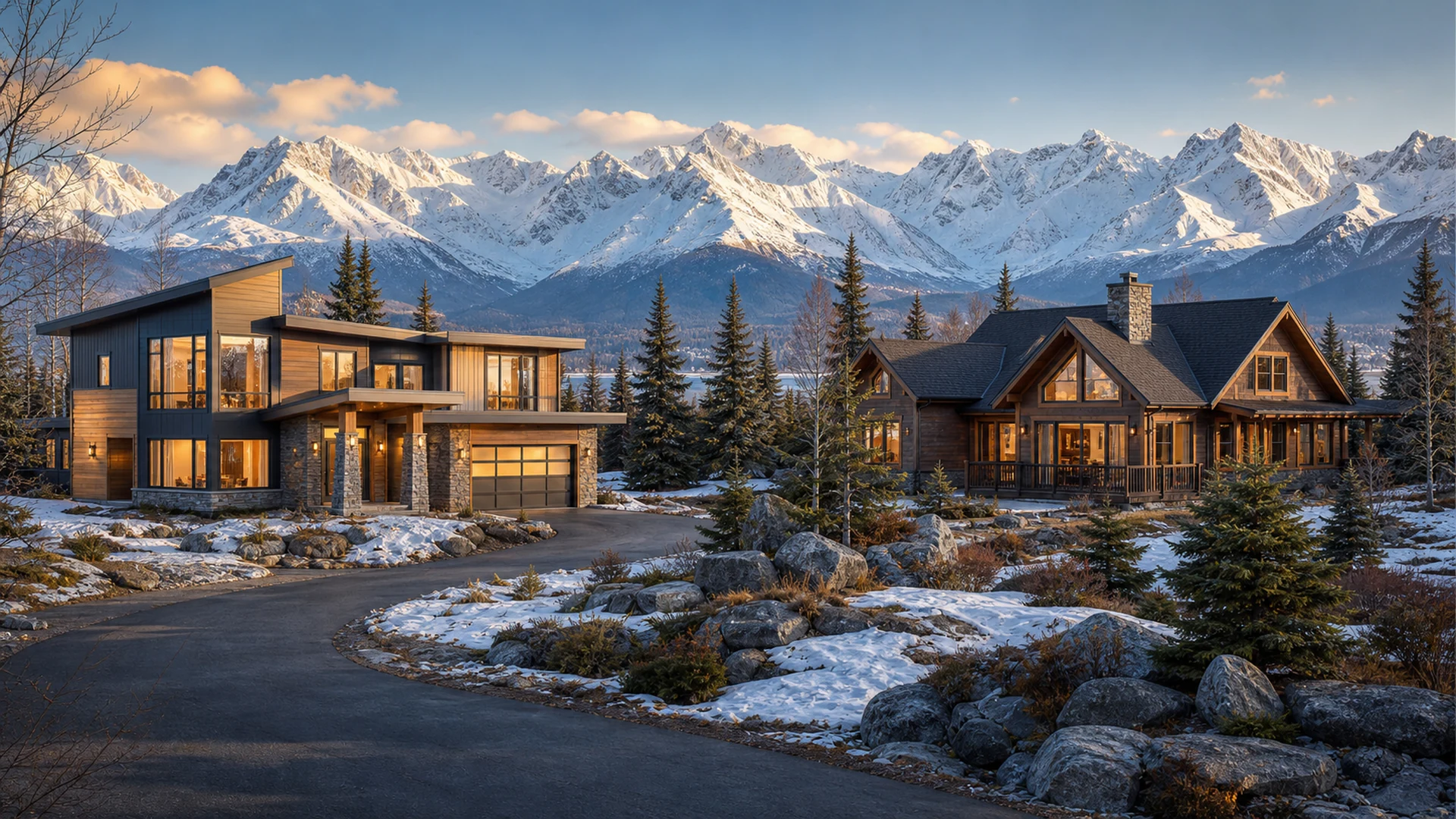
In the Anchorage market, new construction and resale homes trade different advantages. New builds typically list higher — around a $475,000 median in early 2026 versus a roughly $428,000 resale median — but they offer modern layouts, current energy efficiency, and possible eligibility for AHFC's $10,000 New Home Construction Rebate for homes meeting a 5-Star Plus energy rating with a foundation completed on or after January 2, 2025. Resale homes offer established neighborhoods, mature view lots, faster move-in, and often more room to negotiate, but come with an older systems profile and an Alaska seller disclosure (AS 34.70) to review — a form a never-occupied new home is exempt from. Both benefit from the Municipality of Anchorage's stringent seismic building code. The better choice usually comes down to timing, location, and how much finish work you want to choose versus inherit.
One of the first forks a buyer hits in this market is whether to buy something brand-new or something with a little history. It is a genuinely different decision in Anchorage than it is in a sprawling Lower 48 suburb, because our supply picture, our climate, and our seismic setting all bend the math. Buyers who tour both sides in the same week almost always come away realizing the choice is less about “new is better” and more about which set of trade-offs fits their situation.
Below is the comparison table first — the fastest way to see where each option wins — followed by the detail behind each row, drawn from the Municipality of Anchorage code, Alaska statute, and AHFC's own program rules.
- New construction in Anchorage listed at roughly a $475,000 median in early 2026; the resale market's median sale price ran closer to $428,000 over the three months ending May 2026 (Redfin/AKMLS data).
- A local builder described about $500,000–$550,000 as near the floor for building a new single-family home in Anchorage, and said new builds struggle to compete on price with resale.
- AHFC's New Home Construction Rebate pays $10,000 to eligible owner-occupied buyers of new homes with a foundation completed/inspected on or after January 2, 2025 that meet a 5-Star Plus energy rating — resale homes do not qualify for it.
- Under AS 34.70.010, a resale seller must deliver a written disclosure statement before the buyer makes a written offer; a never-occupied new home is exempt from that requirement under AS 34.70.120.
- A willful disclosure violation can expose a seller to up to three times the buyer's actual damages under Alaska law.
- The Municipality of Anchorage enforces the International Building Code with local amendments (soil analysis, reinforced connections); structures built to current code generally fared better in the November 30, 2018 magnitude 7.1 earthquake.
- Chugiak–Eagle River sits outside the Anchorage Building Safety Service Area and does not require the same code-compliance inspections — a real due-diligence difference by location.
New Construction vs. Resale in Alaska: The Side-by-Side Comparison
Here is the head-to-head. Every figure below is tied to a specific source in the References section, and market prices carry their date because they move — treat the structural differences (energy rules, disclosure law, seismic code) as the durable part and the dollar figures as a dated snapshot.
| Factor | New Construction | Resale (Existing) |
|---|---|---|
| Typical price | Higher — ~$475K median list (early 2026); ~$500K–$550K near the build floor for a new single-family home | Lower — ~$428K median sale price (3 months ending May 2026) |
| $10,000 AHFC rebate | Possible — if 5-Star Plus rated and foundation completed on/after Jan 2, 2025, owner-occupied | Not eligible for the New Home Construction Rebate |
| Energy efficiency | Built to current standards; many list a 5-Star Plus / high AkWarm rating | Varies with build era; may need upgrades to raise the rating |
| Seller disclosure | Never-occupied first sale is exempt (AS 34.70.120) | AS 34.70 disclosure required before your written offer |
| Seismic code | Built to latest adopted IBC + Anchorage amendments (in MOA service area) | Reflects code of its build year; quality varies |
| Neighborhood & lot | Newer subdivisions; smaller or premium view lots; some infill | Established areas, mature landscaping, prime view parcels |
| Move-in timing | Immediate if complete; months if built to order | Typically faster to close and occupy |
| Inventory | Limited — land-constrained; ~50 new-build listings noted in early 2026 | Also tight, but the larger share of the market |
How Much Do New Builds Cost Compared to Resale Homes in Anchorage?
Price is where the two paths diverge most clearly, and the direction is consistent: new tends to cost more. Redfin, drawing on Alaska MLS data, showed roughly 52 new homes for sale in Anchorage at a median listing price near $475,000 in early 2026, while the broader market's median sale price was about $428,000 over the three months ending May 2026, up around 3% year over year. On the build side, an Anchorage homebuilder told Alaska Business Magazine that a 1,500–2,000-square-foot new home in the $500,000–$550,000 range is about as affordable as you can currently build single-family in the city — and candidly noted those homes are slow to sell because they have a hard time competing with resale.
The reason is not mysterious. New-build costs have been squeezed by construction inflation, and Anchorage is hemmed in by military land, Chugach State Park, wetlands, and municipal reserves, so there is far less open ground to build on than a typical Lower 48 metro. Unlike a market that can push new subdivisions endlessly outward, Anchorage's limited buildable land keeps new supply scarce and priced accordingly. At the top of the market, though, the picture shifts — developers have reported new-construction million-dollar homes selling briskly, which tells you demand at the luxury end is real even when the entry-level new-build math is tight.
Does New Construction in Alaska Qualify for the $10,000 AHFC Rebate?
This is the single most concrete financial reason a new build can pencil out despite the higher sticker. According to AHFC, the New Home Construction Rebate pays a flat $10,000 to eligible owner-occupied buyers of newly built homes. The rules are specific: the foundation must be completed and inspected on or after January 2, 2025; the home must achieve a minimum 5-Star Plus energy rating (Alaska uses AkWarm modeling for its ratings); and it must be a single-family residence through a fourplex where the owner occupies one unit. Developers, investment properties, and non-residential buildings are excluded, there are no income limits, and it is funded first-come, first-served from a state appropriation until the money runs out.
That is why you will see so many Anchorage new-build listings advertising a “5 Star Plus” rating — it is the threshold that unlocks the rebate. A resale home cannot access this program, though AHFC separately offers an energy-efficiency interest-rate reduction on financing for energy-efficient homes (new or existing) and for buyers who make qualifying energy improvements, applied to the first $250,000 of the loan for commitments issued on or after October 1, 2024. In other words, energy efficiency is rewarded on both sides — but the $10,000 cash rebate is a new-construction advantage.
What Are the Disclosure Differences Between New and Resale Homes in Alaska?
Here the law draws a bright line. Under AS 34.70.010, before a buyer makes a written offer on residential real property, the seller must deliver a completed written Residential Real Property Transfer Disclosure Statement — the form the Alaska Real Estate Commission establishes under AS 34.70.050. If that statement (or a material amendment) is delivered after the buyer has already made a written offer, the buyer may terminate within three days of in-person delivery or six days of mailed delivery. The teeth are real: AS 34.70.090 makes a negligent violator liable for actual damages, and a willful violation can expose the seller to up to three times the actual damages, plus possible costs and attorney fees.
New construction is treated differently. Under AS 34.70.120, the first transfer of residential real property that has never been occupied is exempt from the seller-disclosure requirement. Practically, that means a brand-new home usually arrives without the AS 34.70 form that a resale seller must provide. Some buyers read that as “less to worry about” — I read it the opposite way. With no disclosure form and no prior owner's lived-in knowledge, an independent inspection on a new build earns its keep, because you are relying on the builder's work and the municipal inspection record rather than a seller's written account of what has gone wrong.
The Alaska disclosure form is a good-faith statement of the seller's knowledge (AS 34.70.060); it is not an inspection or a public-records search. On either a new or resale purchase, an independent inspection remains the buyer's own due diligence — the disclosure regime supplements it, it does not replace it.
Are Newer Anchorage Homes Built to Withstand Earthquakes Better?
Southcentral Alaska is one of the most seismically active places in the country — the state averages tens of thousands of quakes a year. The Municipality of Anchorage enforces the International Building Code with local amendments that require in-depth soil analysis and reinforced connections between structural beams and columns, standards rooted in lessons from the magnitude 9.2 Great Alaska Earthquake of 1964. When the magnitude 7.1 earthquake struck about seven miles north of Anchorage on November 30, 2018, engineers and officials widely credited those codes: there were no building collapses and no loss of life, and structures built to current code generally performed better.
Two honest caveats keep this from being a blanket “new is safer” claim. First, a UAA-led study warned that 2018 was not a full test — the shaking reached only about half the level the design standard is meant to absorb, so surviving 2018 doesn't prove a home would ride out a larger quake. Second, and this is a genuine Anchorage-area distinction: the Chugiak–Eagle River area sits outside the Anchorage Building Safety Service Area and does not require the same code-compliance inspections. So on a resale home there, and even on some new builds outside the service area, the “built to current code and inspected” assumption doesn't automatically hold — making construction documentation and an engineer's eye more important, not less.
So Which Should You Buy — New or Resale?
There is no universal winner; there is a fit. Weigh what each side actually gives you:
New construction leans better when…
- You want current layouts, finishes, and a high energy rating in a cold climate
- The 5-Star Plus / $10,000 AHFC rebate math fits your purchase
- You value building to current code inside the MOA service area
- You can wait on a build-to-order timeline (or find a completed spec home)
Resale leans better when…
- Location and a mature view lot matter more than newness
- You want to move in faster and possibly negotiate more on price
- You want the AS 34.70 seller disclosure as one more information source
- You’re comfortable budgeting for updates over time
In a constrained, limited-inventory market like Anchorage's, the decision often gets made for you by what's actually available in the neighborhood and view corridor you want. That is exactly where a local read pays off — matching the right trade-off to the right street, at the right time of year.
- Alaska Housing Finance Corporation (AHFC) — New Home Construction Rebate rules ($10,000; 5-Star Plus rating; foundation on/after Jan 2, 2025; owner-occupied 1–4 unit; first-come/first-served) and the Energy Efficiency Rate Reduction (first $250,000 of loan; commitments on/after 10/1/24).
- Alaska Statutes, AS 34.70.010–.200 (via akleg.gov / Alaska DCCED disclosure form) — residential transfer disclosure requirement, termination windows (3/6 days), damages including up to 3× for willful violation (AS 34.70.090), first-sale exemption (AS 34.70.120), Real Estate Commission form (AS 34.70.050).
- Municipality of Anchorage / Alaska Seismic Hazards Safety Commission / ICC / EERI Earthquake Reconnaissance Report — International Building Code with local amendments (soil analysis, reinforced connections); Nov. 30, 2018 M7.1 earthquake performance; Chugiak–Eagle River outside the Anchorage Building Safety Service Area.
- UAA-led seismic study (via Alaska Beacon) / ADN — 2018 shaking reached about half the design-based earthquake level; not a full test of seismic vulnerability.
- Redfin / Alaska MLS (AKMLS) — Anchorage new-home median list (~$475K, early 2026) and market median sale price (~$428K, 3 months ending May 2026).
- Alaska Business Magazine — local builder commentary on new-build cost floor ($500K–$550K), competition with resale, and strong luxury/new-construction demand.
Weighing New vs. Resale in the Anchorage Corridor?
I’ll help you match the right trade-off to the right neighborhood, lot, and timing.
Frequently Asked Questions
Generally yes. As of early 2026, new construction in Anchorage carried a median listing price around $475,000 (Redfin/AKMLS), while the resale market's median sale price sat closer to $428,000 over the three months ending May 2026 (Redfin). One Anchorage builder described roughly $500,000 to $550,000 as about as affordable as you can currently build a new single-family home in the city, and noted new builds have a hard time competing on price with resale. Land constraints and construction inflation are the main drivers.
It can, if it meets the program rules. AHFC's New Home Construction Rebate pays $10,000 to eligible owner-occupied buyers of newly built homes whose foundation was completed and inspected on or after January 2, 2025 and that meet a minimum 5-Star Plus energy rating. It is limited to single-family homes through fourplexes where the owner lives in one unit, excludes developers and investment properties, and is first-come, first-served until funds run out. A resale home does not qualify for this particular rebate.
Yes. Under AS 34.70.010, before a buyer makes a written offer the seller must deliver a completed Residential Real Property Transfer Disclosure Statement. If it is delivered after the buyer has already made a written offer, the buyer can terminate within three days of in-person delivery or six days of mailed delivery. A person who negligently violates the chapter is liable for actual damages, and a willful violation can expose the seller to up to three times the actual damages.
Usually not. Under AS 34.70.120, the first transfer of residential real property that has never been occupied is exempt from the seller disclosure statement requirement. So a never-lived-in new build typically does not come with the AS 34.70 disclosure form a resale home would — which is one reason a thorough independent inspection still matters on new construction, since you're relying on the builder's work and municipal inspection record rather than a prior owner's account.
Often, but it depends on the era and location. The Municipality of Anchorage enforces the International Building Code with local amendments requiring soil analysis and reinforced structural connections, and structures built to current code generally fared better in the magnitude 7.1 earthquake of November 30, 2018. Homes built to the most recent code cycles benefit from those standards, though a well-built newer resale home may perform similarly. Note that the Chugiak-Eagle River area sits outside the Anchorage Building Safety Service Area and does not require the same code-compliance inspections.
It depends on what you value most. New construction offers modern layouts, current energy efficiency, and possible eligibility for the AHFC $10,000 rebate, but usually costs more and takes longer if built to order. Resale offers established neighborhoods, mature lots and views, faster occupancy, and often more price room, but comes with an older systems profile and an AS 34.70 seller disclosure to review. In Anchorage's constrained, limited-inventory market, the right answer usually comes down to timing, location, and how much finish work you want to inherit versus choose.