

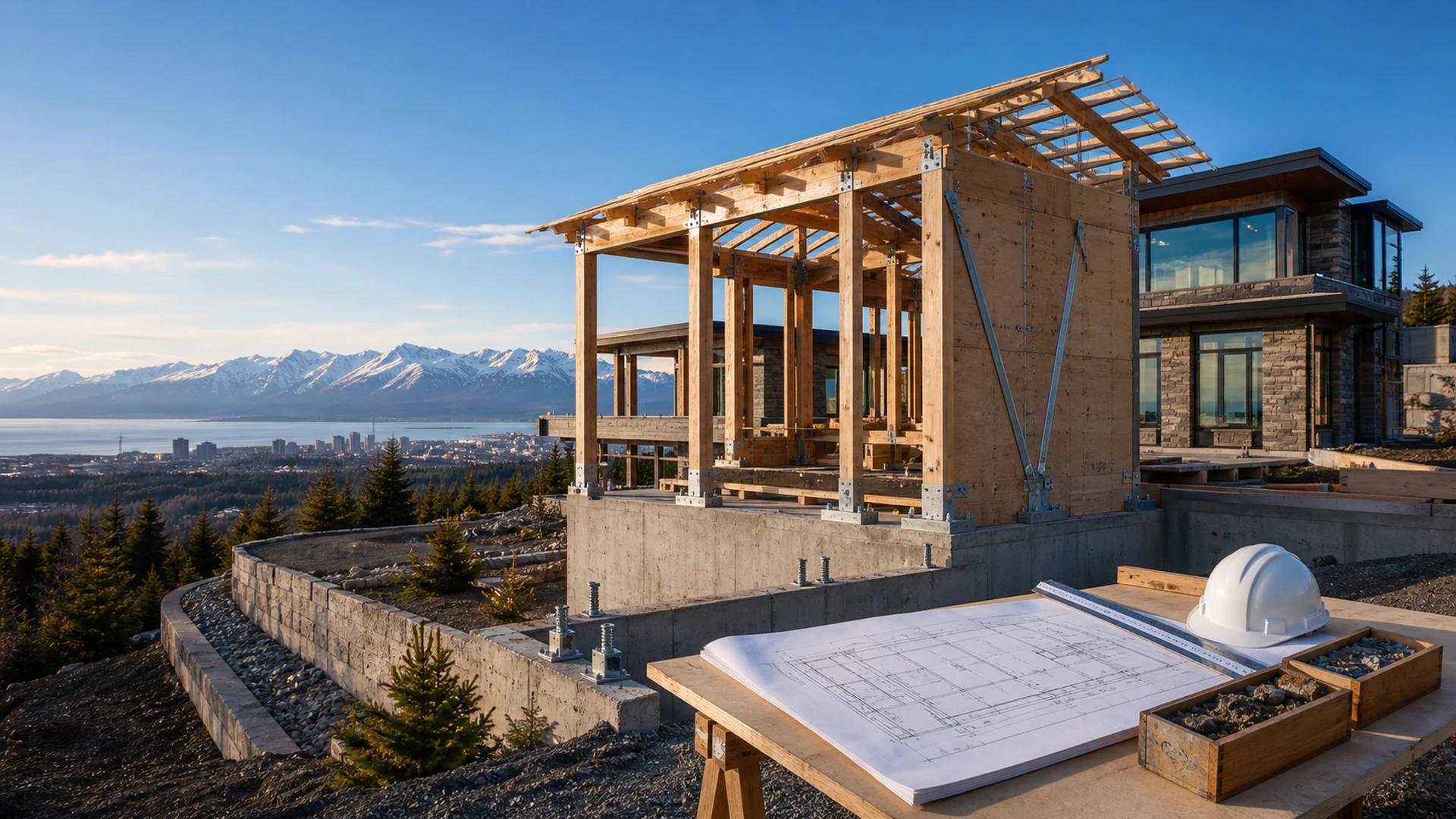
Anchorage homes are built to some of the most demanding seismic standards in the country. The Municipality of Anchorage enforces its own building code under Title 23, based on the International Building and Residential Codes with local amendments, and the area is classified as Seismic Design Category D2. That framework was validated in the November 30, 2018 magnitude 7.1 earthquake: no large buildings collapsed and there was no loss of life, which the U.S. Geological Survey attributed to the quake's depth combined with Anchorage's strict, enforced codes. The bigger variable for a buyer is usually the site, not the structure — sensitive Bootlegger Cove clay under parts of coastal Anchorage drove the destructive 1964 landslides, so soil and slope matter as much as the building itself.
After four decades living in Anchorage, I've come to think of earthquake resilience the way a good builder does: it isn't one thing, it's two things that have to agree with each other. The house has to be built right, and the ground under it has to be right. Buyers touring the Hillside or a coastal bluff almost always lead with the view; the ones who buy well quietly ask what the lot is sitting on.
This guide walks through both halves — how Anchorage regulates seismic construction, what the 1964 and 2018 earthquakes actually taught us, and the specific, checkable things I look at with clients before an offer. Everything here is grounded in Municipality of Anchorage code, U.S. Geological Survey research, and the Alaska Seismic Hazards Safety Commission, cited in full below.
- The Municipality of Anchorage adopts and enforces its own building code under Title 23, based on the IBC and IRC with local amendments; the area is Seismic Design Category D2.
- The November 30, 2018 magnitude 7.1 earthquake (centered near Point MacKenzie, ~29 miles deep) collapsed no large buildings and caused no loss of life — credited to depth plus strict, enforced codes.
- Of 40 severely damaged buildings in the Municipality in 2018, the Alaska Seismic Hazards Safety Commission noted 38 were in areas without enforced codes.
- The 1964 magnitude 9.2 earthquake's worst Anchorage damage came from landslides where soft, sensitive Bootlegger Cove clay lost strength — the Turnagain Heights slide destroyed about 75 homes.
- Site risk (soil, slope, bluffs) often matters more than the structure; the Municipality maps seismic ground-failure hazard zones for this reason.
- Homes in seismic ground-failure hazard zones 4 and 5 require structural design sealed by an Alaska-licensed civil or structural engineer.
- Anchorage foundation footings must extend below the local frost line, and engineered grading on sloped lots can trigger a soils engineering report per IBC Section 1803.
Why is earthquake construction such a big deal in Anchorage?
Alaska is the most seismically active state in the country — it averages roughly 40,000 earthquakes a year, more large quakes than the other 49 states combined, according to the U.S. Geological Survey. Southcentral Alaska sits at the eastern end of the Aleutian Trench, where the Pacific plate is subducting beneath the North American plate and converging at about 57 millimeters per year. Anchorage isn't near earthquake country; it is earthquake country.
That reality is baked into how homes here get built. Unlike a buyer relocating from a low-seismic region, an Anchorage buyer is purchasing a structure that was engineered from the foundation up to move with the ground rather than fight it — provided it was permitted and built to code. The distinction between a permitted, code-compliant home and an older or unpermitted one is one of the first things I help clients understand, because it materially changes the risk profile.
Who sets the building code for Anchorage homes?
This surprises newcomers: Alaska has no statewide residential building code for cities of Anchorage's size, and even where code exists in the state, enforcement is uneven. Anchorage is the exception rather than the rule. Because the City of Anchorage and the Greater Anchorage Area Borough consolidated in 1975 into the unified Municipality of Anchorage, a single MOA Building Safety Division handles permits across the entire municipality — the Anchorage Bowl, Eagle River, Chugiak, and Girdwood alike.
The Municipality adopts its building code under Title 23 of the Anchorage Municipal Code, based on the International Building Code (IBC) and International Residential Code (IRC) with local Anchorage amendments. Those local amendments are the point: engineers who worked here after the 2018 quake described Anchorage's requirements as going beyond the base IBC, requiring in-depth soil analysis and, on sloped sites, demonstrations that the ground will remain stable under a defined level of shaking. Two Alaska governors and an Anchorage mayor publicly credited these codes after 2018 — one governor, who had only minor water damage at his own home, put it simply: building codes mean something.
This page is general educational information about construction and property due diligence — not legal, engineering, tax, or financial advice. Seismic and structural design must be performed or reviewed by a licensed Alaska professional engineer, and permitting requirements change. Always confirm current rules with the Municipality of Anchorage Development Services — Building Safety Division before relying on them.
| Step | What to check | Why it matters |
|---|---|---|
| 1. Hazard zone | MOA seismic ground-failure hazard zone | Zones 4 & 5 require engineer-sealed structural design |
| 2. Soil & slope | Bluff / Bootlegger Cove clay / Hillside slope | Site can matter more than the structure |
| 3. Permit history | Permitted & built under enforced Title 23 | Code-compliant homes performed best in 2018 |
| 4. Inspections | Home + structural/geotechnical review | Confirms as-built condition and site stability |
| 5. Disclosure | Alaska AS 34.70 seller disclosure | Surfaces known damage/repairs to investigate |
What did the 2018 earthquake reveal about Anchorage homes?
The November 30, 2018 magnitude 7.1 earthquake struck at 8:29 a.m., centered near Point MacKenzie about 10 miles north of Anchorage at a depth of roughly 29 miles, and was followed minutes later by a magnitude 5.7 aftershock. Despite hitting a metro area of about 300,000 people, it collapsed no large buildings and caused no loss of life. The U.S. Geological Survey attributed that outcome to a combination of the quake's depth — much of its energy dissipated before reaching the surface — and Anchorage's progressive, enforced building code.
The most instructive detail for a buyer is the pattern of damage. A state geologist who chairs the Alaska Seismic Hazards Safety Commission pointed out that of the 40 buildings severely damaged in the Municipality, 38 were in areas without enforced codes, and structural performance in the code-enforced Anchorage Bowl was markedly better than in some outlying communities. Where homes failed, the cause was more often soil subsidence and ground failure than the structure itself. Roads took the worst of it: the Alaska Department of Transportation counted about 50 damaged sites, eight of them major, with the heaviest damage on highways north of the city.
Why does Anchorage soil matter more than the house?
To understand modern Anchorage code, you have to understand 1964. The magnitude 9.2 Good Friday earthquake — the most powerful ever recorded in the United States — shook Southcentral Alaska for around four and a half minutes. In Anchorage, the truly catastrophic damage wasn't buildings shaking apart; it was landslides. Beneath much of coastal Anchorage lies the Bootlegger Cove clay, a soft, sensitive glacial marine deposit. Under prolonged shaking, sensitive zones within it lost strength and sand layers liquefied, and flat-topped bluffs slid on nearly horizontal surfaces.
The Turnagain Heights landslide ran about 1.5 miles along the bluff fronting Knik Arm, moved over 12 million cubic yards of earth, and destroyed roughly 75 homes — that ground is now Earthquake Park. Similar translatory slides hit the Fourth Avenue and L Street areas downtown and Government Hill. The takeaway that still governs due diligence today: a home's soil and slope conditions can drive risk more than the structure. This is exactly why the Municipality maps seismic ground-failure hazard zones and why a bluff-top parcel deserves closer geotechnical scrutiny than an interior lot.
Lower relative site risk
- Interior lots on stable, well-drained soils
- Level parcels away from bluffs and steep slopes
- Permitted homes built under enforced Title 23 code
- Parcels with existing geotechnical documentation
Warrants closer review
- Bluff-top or coastal parcels over Bootlegger Cove clay
- Steep Hillside lots subject to slope-stability standards
- Parcels mapped in ground-failure hazard zones 4 or 5
- Older or unpermitted structures with unknown history
What construction and permit rules actually apply here?
A few concrete requirements shape how Anchorage homes get built and what you can verify as a buyer:
Seismic Design Category D2. Anchorage falls in one of the most demanding IBC seismic categories, so new structures and most significant structural alterations must demonstrate seismic compliance, and structural work typically requires engineering calculations and stamps.
Engineer-sealed design in high-hazard zones. Under MOA Development Services policy, structural designs for one-, two-, and three-dwelling-unit buildings in seismic ground-failure hazard zones 4 and 5 must be performed and sealed by an Alaska-licensed civil or structural engineer.
Frost-depth foundations. Anchorage's cold climate requires footings below the frost line — reported at roughly 42 to 48 inches for most of the municipality — on top of seismic detailing.
Grading and soils reports. Under Anchorage Municipal Code 23.105 (grading, fill, excavation and landscaping), engineered grading triggers a soils engineering report prepared in accordance with Section 1803 of the IBC, and Hillside-area properties face additional standards for slope stability, drainage, and access. Retaining walls and grading generally require their own permits.
None of this is meant to alarm a buyer — it's meant to reassure. The rules exist because the hazard is real, and a home that cleared them is a home built for this place. The value, from my seat, is knowing which questions to ask so the paperwork actually protects you.
How should this shape what you buy — and how you sell?
For buyers, the practical move is to treat seismic due diligence as part of the offer process, not an afterthought: confirm the hazard zone, understand the soil and slope, verify permit history, and add a structural or geotechnical review on any bluff or steep parcel. For sellers, Alaska's residential real property transfer disclosure statute (AS 34.70) requires disclosing known material defects, which can include known earthquake damage or completed repairs — and documented, professionally completed repairs are often a selling point rather than a liability. Well-kept records of a code-compliant build or a competent post-2018 repair genuinely move buyer confidence.
- U.S. Geological Survey — Effects of the earthquake of March 27, 1964, at Anchorage, Alaska (Bootlegger Cove clay, translatory landslides, Turnagain Heights).
- U.S. Geological Survey / Associated Press coverage — 2018 quake outcome and Alaska seismicity (~40,000 quakes/year; codes credited).
- Alaska Seismic Hazards Safety Commission (via Alaska Beacon / Alaska Public Media) — 38 of 40 severely damaged buildings in unenforced-code areas; statewide code gaps.
- Municipality of Anchorage — Title 23 Anchorage Municipal Code; AMC 23.105 grading/soils report (IBC §1803); Development Services Building Safety policies (seismic ground-failure hazard zones 4 & 5; footing/foundation).
- Municipality of Anchorage building-permit guidance — Seismic Design Category D2 classification; minimum frost-depth footing (42 in. standard warm foundation; 48 in.+ for unheated/exposed structures); MOA consolidation (1975).
- Engineering News-Record / ICC / PBS NewsHour — 2018 magnitude 7.1 event details, depth, epicenter, and code performance commentary.
- Alaska Statutes AS 34.70 (residential real property transfer disclosure). General information only — not legal advice.
- Verify all current site-specific foundation and permitting requirements directly with the Municipality of Anchorage Development Services — Building Safety Division.
Buying in Anchorage? Let’s look at the ground, not just the great room.
I help buyers read the site, the permits, and the structure together — so the view you fall for is one you can stand on.
Frequently Asked Questions
Yes. The Municipality of Anchorage adopts its own building code under Title 23 of the Anchorage Municipal Code, based on the International Building Code and International Residential Code with local amendments, and the Anchorage area is classified as Seismic Design Category D2 — among the most demanding categories. New construction and most significant structural alterations must meet seismic provisions, and structural work generally requires engineering stamped by an Alaska-licensed engineer. In the 2018 magnitude 7.1 earthquake, buildings in the code-enforced Anchorage Bowl performed markedly better than structures in outlying areas without enforced codes.
The November 30, 2018 magnitude 7.1 earthquake, centered near Point MacKenzie about 10 miles north of Anchorage at a depth of roughly 29 miles, caused no collapsed large buildings and no loss of life. Officials and the U.S. Geological Survey credited the quake's depth and Anchorage's strict, enforced building codes. Most severe damage was to roads and to structures on poor soils; of 40 buildings that suffered severe damage in the Municipality, the Alaska Seismic Hazards Safety Commission noted 38 were in areas without code enforcement.
Bootlegger Cove clay is a soft, sensitive glacial marine deposit that underlies much of coastal Anchorage. In the 1964 magnitude 9.2 earthquake, this layer lost strength and caused massive translatory landslides — including the Turnagain Heights slide, which destroyed about 75 homes and is now Earthquake Park. It matters because a home's soil and slope conditions, not just the structure, drive seismic risk. Modern Municipality of Anchorage code responds to this with mapped seismic ground-failure hazard zones and geotechnical requirements.
The Municipality of Anchorage maps areas by their potential for earthquake-triggered ground failure such as landslides and liquefaction. Under MOA Development Services policy, structural designs for one-, two-, and three-dwelling-unit buildings located in seismic ground failure hazard zones 4 and 5 must be performed and sealed by an Alaska-licensed civil or structural engineer. Before buying, you can check a parcel's hazard zone and require appropriate geotechnical and structural review.
Often, yes. Properties in Anchorage's Hillside area are subject to development standards for slope stability, drainage, and access, and footing and foundation design on variable or sloped soils may require geotechnical input. Under Anchorage Municipal Code 23.105 (grading, fill, excavation), engineered grading triggers a soils engineering report prepared per Section 1803 of the International Building Code. Confirm current requirements with the MOA Development Services — Building Safety Division.
Alaska's residential real property transfer disclosure statute (AS 34.70) requires sellers to disclose known material defects, which can include known earthquake damage or repairs. The disclosure is about known conditions, not a substitute for inspection. Buyers should still commission their own inspections and, on higher-risk parcels, a structural or geotechnical review. This is general information, not legal advice — consult a licensed professional about a specific transaction.
Bluff-top and coastal parcels can be beautiful and highly desirable, but the 1964 landslides occurred on flat-topped bluffs underlain by sensitive Bootlegger Cove clay, so soil and slope evaluation matters more here than on interior lots. The prudent approach is to review the parcel's mapped seismic ground-failure hazard zone, understand whether prior geotechnical work exists, and factor a structural or geotechnical review into your due diligence rather than relying on the view alone.
A meaningful share. Much of Anchorage's housing stock is relatively young, and each generation of the International Building and Residential Codes has strengthened seismic detailing such as reinforced beam-and-column connections and anchorage of components. Because the Municipality has enforced codes covering residences for decades — unlike some outlying Alaska communities — newer, permitted, code-compliant Anchorage homes generally reflect stronger seismic design than older or unpermitted structures.