

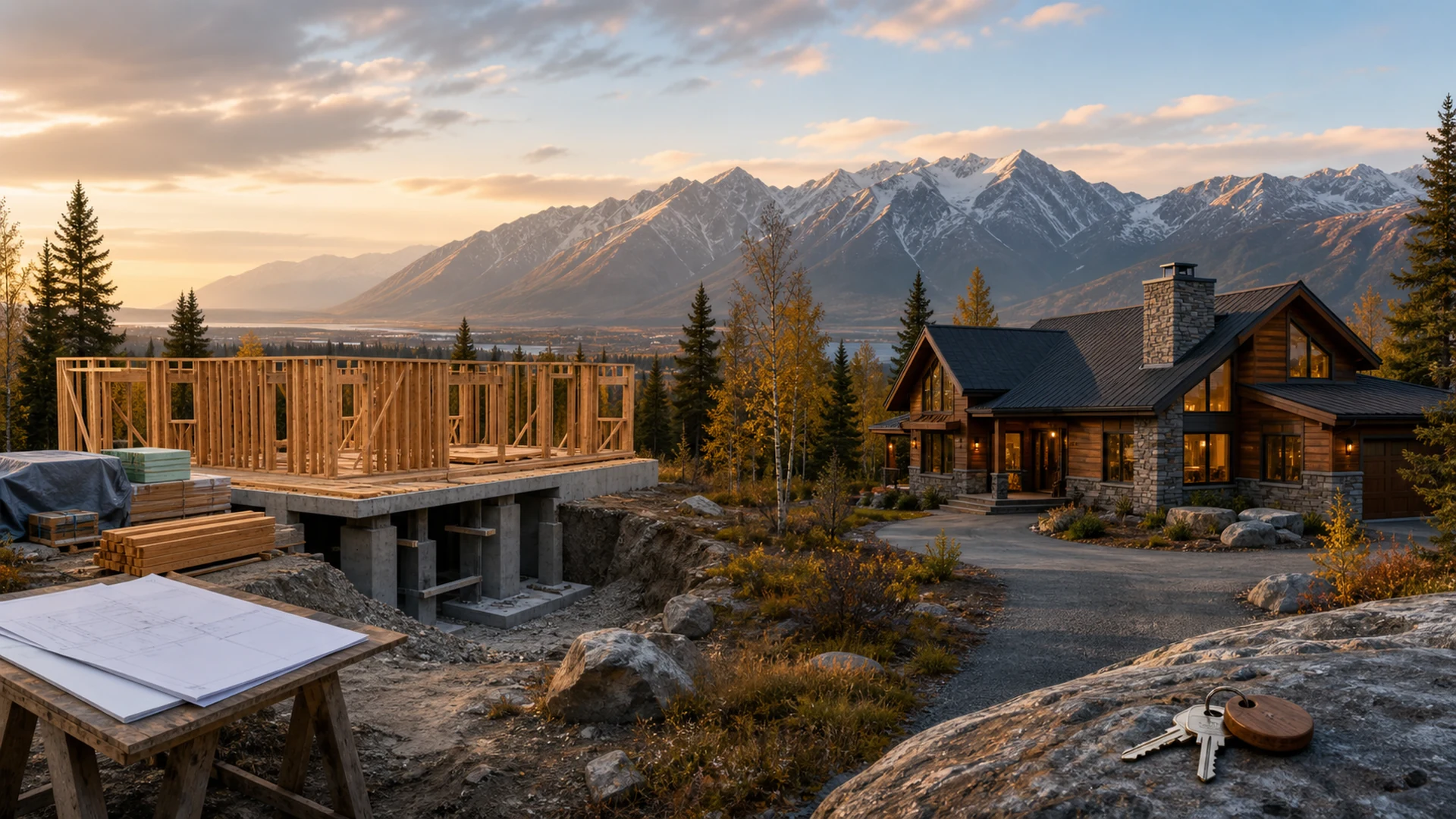
In the Anchorage market, buying an existing home is usually faster and less expensive up front, while building gives you control over the lot, layout, and finishes at a higher cost and a longer timeline. Third-party estimators put local construction roughly in the $150–$350 per square foot range depending on grade, and that excludes land and sitework. Building is also constrained by Alaska’s short season — the municipal construction season runs April 1 through October 31 — so a custom home commonly takes 10 to 14 months. The right choice hinges on whether existing inventory offers the lot, view, and floor plan you want, and on how you weigh certainty against customization.
Whether to build or buy is one of the most consequential decisions a homebuyer makes in Southcentral Alaska — and it’s one where generic, Lower-48 advice quietly misleads people. Anchorage has its own building code, its own seismic and frost realities, its own well-and-septic rules, and a construction calendar that a warm-climate builder would find alarming. After forty years living in this market, I’ve watched buyers fall in love with the idea of “building exactly what I want” without pricing the land, the short season, and the site work that comes before a single wall goes up.
This guide lays out the real comparison — costs, timeline, permits, land, and financing — using Anchorage-specific figures and the actual municipal and state rules, so you can decide with your eyes open rather than on instinct.
- Building in Anchorage is generally more expensive than buying existing; cost estimators put local construction in a roughly $150–$350 per square foot range by grade, before land and sitework.
- Alaska’s municipal construction season runs April 1 through October 31, and frozen ground can push groundbreaking to May — a custom home typically takes 10 to 14 months.
- Within the Municipality of Anchorage Building Safety Service Area, a building permit is required; residential fees run about a flat $175 up to $40,000 of valuation, then roughly 0.9% above that, and permits are valid for 18 months.
- Anchorage is in Seismic Design Category D2 (the highest), and foundation footings must reach frost depth of about 42–48 inches — engineered foundations and stamped calculations are routine.
- A lot without public water and sewer needs permitted well and septic systems; MOA septic designs must be prepared by a registered civil engineer, and a COSA is required at title transfer.
- Construction financing releases funds in draws and converts to a mortgage at completion; one Alaska lender requires 25% down in cash or land equity plus a 10% overrun contingency.
- To qualify for AHFC financing, homes built on or after July 1, 1992 must meet Alaska Minimum Construction Standards and the Building Energy Efficiency Standard (BEES), with rate reductions for high energy ratings.
Is It Cheaper to Build or Buy a Home in Alaska?
For most buyers, buying an existing home costs less up front than building a comparable one — a point even Alaska builders make plainly. One local builder resource notes that while building lets you customize, building a house is generally more expensive than buying an existing home due to Alaska’s high labor costs and material costs. The gap is driven by factors that are specific to the state, not just to a given lot.
The cost-per-square-foot figures you’ll see online vary widely because they measure different things and come from third-party estimators rather than an official source — treat them as directional. For Anchorage specifically, one home-cost estimator puts construction at roughly $130 to $280 per square foot depending on grade, not including sitework or land; another puts mid-range custom builds around $250 to $350 per square foot with luxury higher still. What the numbers agree on is direction: Alaska ranks among the most expensive states for residential construction, and Anchorage reflects that even though it has better labor access than remote parts of the state.
Unlike a resale purchase — where the price you negotiate is essentially the price you pay — a build is a moving target until it’s done. That’s the single most important mental shift: buying is a fixed number; building is a budget with a range around it.
*Per-square-foot figures are ranges from third-party cost estimators and exclude land and sitework; actual cost depends on grade, site, and design. Confirm current pricing with local builders.
How Do the Costs Actually Break Down When You Build?
The sticker figure — dollars per square foot — hides where Alaska money really goes. Three line items behave differently here than almost anywhere in the Lower 48:
Foundation and site work. Because Anchorage sits in one of the most seismically active regions on earth and endures deep frost, foundation work can consume a disproportionate share of the budget. Industry commentary describes foundation work accounting for up to 30% of total project cost on difficult soils, driven by glacial soils, liquefaction zones, and seismic requirements that often call for engineered foundations rather than simple slab-on-grade. Footings must extend to frost depth — the Municipality sets that at roughly 42 to 48 inches for most areas.
Materials and freight. Much of what goes into an Alaska home is shipped in. Analysts note that shipping materials from Seattle by barge adds a freight premium, and that skilled tradespeople command higher wages because the labor pool is small — a structural feature of the market, not a temporary spike.
Energy and insulation. High-latitude homes demand serious envelopes. Local construction guidance describes Anchorage homes needing roughly R-38 to R-60 in ceilings and R-21 to R-40 in walls to meet Alaska’s energy efficiency standards — a real line item, and one that pays back in heating cost over the life of the home.
Then there are the costs buyers routinely forget: permits, geotechnical reports, and engineering, which one estimate places at $15,000 to $30,000 or more on a complex site, plus land, clearing, and utility connections. When you buy existing, someone else already absorbed all of that.
| Factor | Buy Existing | Build Custom |
|---|---|---|
| Upfront cost | Usually lower; fixed at closing | Usually higher; ~$150–$350/sq ft before land* |
| Timeline | Weeks to close | ~10–14 months, season-constrained |
| Customization | Existing layout & finishes | Full control of lot, layout, finishes |
| Season risk | None | April 1–October 31 build window |
| Financing | Standard mortgage | Construction loan → converts to mortgage |
| Known unknowns | Deferred maintenance, older systems | Site/soil, overruns, permit & engineering fees |
*Estimator ranges, land and sitework excluded.
How Long Does It Take to Build — and Why the Season Matters So Much?
Timeline is where Alaska diverges hardest from the Lower 48. A typical custom home here runs about 10 to 14 months from groundbreaking to move-in, with the short season as the primary driver — a project started in May may pause exterior work over winter and finish the following spring. The Anchorage municipal code even defines the construction season as April 1 through October 31, with tighter noise-limited hours the rest of the year.
The practical consequence is scheduling pressure. Because deep cold can leave the ground too hard to break until May, and everything has to fit into the warm months, seasoned builders advise securing a general contractor about a year ahead — the good ones are booked before spring breakup. Unlike a resale purchase you can start today and close in weeks, a build effectively begins the winter before the shovel hits dirt.
What Permits and Inspections Does Building Require in Anchorage?
Because the City of Anchorage and the borough consolidated in 1975, there’s no separate city-versus-borough permit maze — the Municipality of Anchorage (MOA) Building Safety Division handles permits across the entire municipality, including Eagle River, Chugiak, and Girdwood. New construction inside the Building Safety Service Area requires a building permit before work begins.
On fees, published guidance describes residential permits as a flat minimum of about $175 for projects up to $40,000 of valuation, then roughly 0.9% of valuation above that. Permits are valid for 18 months from issuance and can be extended once if work has started. Residential plan review is comparatively quick — one industry summary cites an initial review cycle of only a few days, with correction cycles being the main cause of delay. Trade permits for electrical, plumbing, and mechanical work are filed separately.
The reason Anchorage takes this seriously is physical. The municipality adopts its own code under Title 23 and sits in Seismic Design Category D2 — the highest risk category — a legacy of the 1964 magnitude 9.2 Good Friday earthquake and reinforced by the 2018 magnitude 7.1 event. Licensed-engineer stamps and structural calculations are standard rather than exceptional for new homes, and roofs and frames must be designed for local snow loads.
Building without a required MOA permit isn’t a shortcut — it’s a resale problem waiting to happen. Unpermitted work commonly gets flagged by buyers, lenders, and title companies at sale, and a retroactive permit can cost more than doing it right the first time. If you buy an existing home, unpermitted additions are worth checking during due diligence for the same reason.
What About Land, Wells, and Septic on a Buildable Lot?
Buying a lot and building only pencils out if the land can actually support a home. Where public water and sewer aren’t available, you’re into well-and-septic territory — a genuine Alaska due-diligence layer. In the MOA, a new septic system for a single-family or duplex home requires a permit, and the design must be submitted by a registered civil engineer who evaluates soils and site conditions; a new well requires its own permit through the On-Site Water and Wastewater Section.
Statewide, Alaska DEC (under 18 AAC 72) governs on-site wastewater, though the Municipality of Anchorage holds delegated authority for systems serving up to two dwelling units. A lender-driven point that catches buyers on both sides: private wells and septic systems require health-department approval plus soil and percolation testing, and lenders typically require that documentation before financing. And at the far end, the MOA requires a Certificate of On-Site Systems Approval (COSA) at title transfer — a report by a licensed civil engineer attesting the system is adequate, legal, and safe. When you build, your engineer’s design and completion records become the paper trail a future COSA relies on.
Water quality matters too: MOA code sets potable-water standards including zero total coliform bacteria, so a new well is tested and documented before it serves the home.
How Does Financing a Build Differ From a Mortgage?
Buying uses a familiar single mortgage. Building uses a construction loan — a short-term loan disbursed in stages, or “draws,” as work is completed and inspected, which then converts to permanent mortgage financing at completion. Lenders often inspect the site before releasing each draw.
Alaska lenders build in cushions for the state’s cost volatility. One Alaska bank requires borrowers to provide a minimum of 25% of construction cost in cash or land equity, plus a 10% contingency for overruns — and independent Alaska loan guidance recommends a 10–20% contingency buffer because overruns are common. If costs exceed the approved budget and appraisal, that gap can land on you out of pocket.
There’s also an energy-and-eligibility dimension. By statute, homes built on or after July 1, 1992 must meet Alaska Minimum Construction Standards and the Building Energy Efficiency Standard (BEES) to be eligible for Alaska Housing Finance Corporation (AHFC) financing. AHFC also offers interest-rate reductions for energy-efficient new construction that exceeds the minimum BEES rating — a real reason to build tight and well-insulated in this climate.
This information is general and educational, not legal, tax, or financial advice. Loan programs, rates, eligibility, permit fees, and code requirements change and vary by lender and by parcel. Confirm current details with a licensed mortgage professional, the Municipality of Anchorage Development Services Department, and Alaska DEC before you commit.
The Designer’s-Eye Angle: Where Building Truly Pays Off
Here’s where my background genuinely changes the advice. I hold a degree in Interior Design and spent a career in furnishings and design before real estate, so I read a floor plan and a finish schedule differently than a buyer chasing square footage. Building pays off most when your priorities are things existing inventory simply can’t deliver: a south-facing great room engineered for winter light, a layout that follows how you actually live, and finishes chosen for how they hold up through an Alaska winter rather than how they photograph.
Where buying wins is certainty and value: you see exactly what you’re getting, you avoid the season and overrun risk, and in a market where luxury inventory is scarce, the right existing home on the right view lot is sometimes the rarer find. The decision isn’t “which is better” — it’s “which matches your lot, your timeline, and your tolerance for a moving budget.”
Building may fit you if…
- You want a specific lot, view corridor, or floor plan inventory doesn’t offer
- You can start planning a year ahead and absorb the season
- You value control of finishes and energy performance
- You have 25%+ equity and room for a contingency
Buying may fit you if…
- You want a fixed price and a fast, predictable close
- You’d rather not carry build-season and overrun risk
- An existing home already offers the lot and layout you want
- You prefer to renovate selectively rather than build from zero
- Municipality of Anchorage — Development Services / Building Safety: residential permit requirements, Building Safety Service Area, permit validity, Title 23 code adoption, Seismic Design Category D2, and frost-depth foundations (~42–48 in).
- Municipality of Anchorage — On-Site Water & Wastewater Section: well and septic permits, engineer-prepared septic designs, COSA at title transfer (AMC Chapter 15.55 / Chapter 15.65), and potable-water standards.
- Alaska Department of Environmental Conservation (18 AAC 72): on-site wastewater authority and MOA delegated authority for systems serving up to two dwelling units.
- Alaska Housing Finance Corporation (AHFC): Alaska Minimum Construction Standards, Building Energy Efficiency Standard (BEES), and energy-based rate reductions for new construction.
- Anchorage Municipal Code, Chapter 15.70 (Noise Control): construction season defined as April 1–October 31.
- Cost context (third-party estimators, disclosed as estimates): HomeBlue, Block Renovation, and Alaska Home HQ per-square-foot ranges; Alaska Business Magazine and MOA Street Maintenance on the short building season (AMC 15.70.030 defines the municipal construction season as April 1–October 31); First National Bank Alaska on construction-loan down payment (min. 25%) and contingency structure (10%).
Not sure whether to build or buy in Anchorage?
Talk it through with a 40-year local who reads both the market and the finishes. Call Bill directly at 907-560-4090.
Frequently Asked Questions
In most cases, building is more expensive than buying an existing home in Alaska because of high labor costs, shipped-in materials, and a short building season. Third-party estimators put Anchorage construction roughly in the $150 to $350 per square foot range depending on grade, and that figure excludes land and sitework. Buying an existing home usually costs less up front and closes in weeks rather than months, but you accept the previous owner’s layout, finishes, and any deferred maintenance. Building can still make sense when you want a specific lot, view, or floor plan that existing inventory doesn’t offer.
A typical custom home in Alaska takes roughly 10 to 14 months from groundbreaking to move-in, and often longer for complex sites. The main constraint is the short building season: Anchorage’s municipal construction season runs April 1 through October 31, and frozen ground can delay breaking ground until May. Because so much work has to fit into the warm months, builders recommend securing a general contractor a year ahead — good ones are booked before spring.
Within the Municipality of Anchorage Building Safety Service Area, residential building permit fees are structured as a flat minimum of about $175 for projects up to $40,000, then roughly 0.9% of total valuation above that, based on published fee guidance. Permits are valid for 18 months from issuance. Beyond the permit itself, plan review, geotechnical reports, and engineering can add meaningful cost — one industry estimate puts permits, geotech, and engineering at $15,000 to $30,000 or more on a complex site. Always confirm current fees with MOA Development Services.
Yes, if the lot isn’t on public water and sewer. In the Municipality of Anchorage, a new septic system for a single-family or duplex home requires a permit, and the system must be designed by a registered civil engineer who evaluates the soils and site. A new well also requires a permit through the On-Site Water and Wastewater Section. Statewide, private wells and septic systems require health-department approval plus soil and percolation testing, which lenders typically require before construction financing.
A Certificate of On-Site Systems Approval (COSA) is a report, issued under Anchorage Municipal Code, attesting that a lot’s well and/or septic system operates adequately, legally, and safely. The Municipality of Anchorage requires a COSA at the time of title transfer for properties served by regulated on-site systems. When you buy an existing well-and-septic home, this comes up at sale; when you build, your engineer’s design and completion documentation establish the system record that a future COSA will rely on.
A construction loan is a short-term loan that funds the build in stages, or draws, released as work is completed and inspected, then converts to a permanent mortgage when the home is finished. Alaska lenders commonly ask for a substantial down payment plus a contingency for overruns — one Alaska bank requires a minimum of 25% of construction cost in cash or land equity and a 10% contingency. To be eligible for Alaska Housing Finance Corporation financing, homes built on or after July 1, 1992 must meet Alaska Minimum Construction Standards and the Building Energy Efficiency Standard (BEES). This is general information, not financial advice.
Several Alaska-specific factors stack up. Materials are often shipped by barge from Seattle, adding freight cost; the skilled-trade labor pool is small, which pushes wages up; and the building season is short, compressing work into warm months. Foundations are also costly because Anchorage sits in the highest seismic design category and footings must reach frost depth — roughly 42 to 48 inches — so engineered foundations and seismic detailing are the norm, not the exception. Energy code requiring high insulation levels adds further cost.