

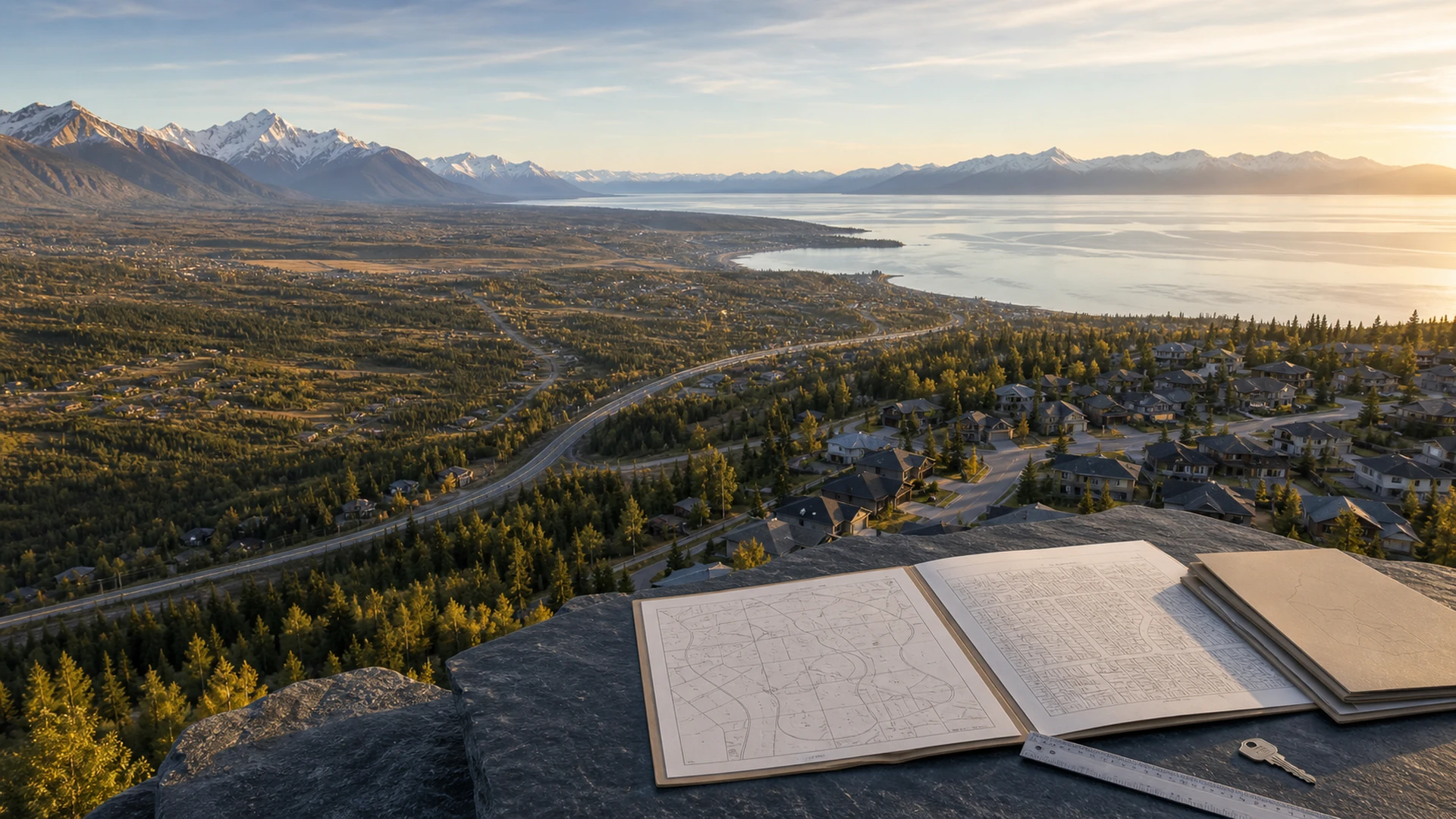
Alaska is the only state with no counties; instead it uses boroughs, which act as regional county-equivalents, and municipalities, the legal umbrella term for an incorporated city or borough. Anchorage is a unified home-rule municipality — a city and borough merged into one government since 1975 — so a single authority runs its taxes, zoning, permits, and the well-and-septic COSA required to close on a home. The neighboring Matanuska-Susitna Borough works differently: it is largely unzoned, does not require building permits for single-family homes, and has no COSA requirement, which trades regulatory certainty for lower typical property taxes and more freedom to build. For a homebuyer, the practical takeaways are that your mill rate, your zoning protections, and your due-diligence checklist all change the moment you cross a borough line.
The first thing that trips up buyers moving to Alaska is a blank on the paperwork: county. There isn’t one. In forty years of living here I’ve watched newcomers assume Anchorage works like a city inside a county the way most of the country does — and then discover, usually at the closing table, that Alaska built something entirely its own. Understanding that structure isn’t academic. It is the difference between a $7,000 and a $3,500 annual tax bill on similar homes, between a lot where zoning protects your view and one where anything can go up next door, and between a straightforward closing and one that stalls on a septic certificate.
This guide explains the borough-versus-municipality distinction in plain English and, more importantly, translates it into the decisions a Greater Anchorage buyer or seller actually faces. The government terminology is genuinely confusing even to lifelong Alaskans, so we’ll ground every point in how it changes what you pay, what you can build, and what you must verify before you sign.
- Alaska has no counties; it divides into 19 organized boroughs and an unorganized borough, and boroughs are treated as county-equivalents by the U.S. Census Bureau.
- A “municipality” is the broad legal term for any incorporated local government — a city or a borough. A “unified municipality” is a merged city-borough with all home-rule powers.
- Anchorage is legally the Municipality of Anchorage, a unified home-rule city-borough formed on September 15, 1975 when the City of Anchorage and the Greater Anchorage Area Borough merged.
- Property tax is set as a local mill rate ($1 per $1,000 of assessed value); the Mat-Su Borough's FY2026 areawide rate was 8.485 mills, well below urban Anchorage's combined rate.
- The Mat-Su Borough does not require building permits for single-family homes and is largely unzoned; Anchorage enforces its own building code (Title 23) and zoning (Title 21).
- Since 1998, Anchorage requires a Certificate of On-Site Systems Approval (COSA) to transfer title on any well-and-septic property; the Mat-Su Borough has no equivalent municipal requirement.
- The unorganized borough — where the state legislature is the governing body — generally levies no local property tax, relevant mostly for remote and recreational property.
What is the difference between a borough and a municipality in Alaska?
Start with the vocabulary, because Alaska uses these words differently than the Lower 48. A borough is the regional government that functions like a county elsewhere — and Alaska’s constitutional convention deliberately chose this model instead of counties, creating boroughs in different classes with varying powers to fit a state of extreme geographic variation. A municipality is the umbrella legal term for an incorporated local government, which can be either a city or a borough. So every borough is a municipality, but not every municipality is a borough.
Under the Alaska Constitution, all of Alaska is divided into boroughs, either organized or unorganized. The organized boroughs cover the populated regions; the rest is the unorganized borough, where the state legislature itself serves as the governing body for services a borough would otherwise provide. There are 19 organized boroughs today, and both the Municipality of Anchorage and the Matanuska-Susitna Borough are among them — which is why local-tax and land-use rules apply across the entire Greater Anchorage corridor.
The wrinkle that confuses even locals is the unified municipality. Alaska law defines a home-rule municipality as a city or borough that has adopted a home-rule charter, giving it all legislative powers not prohibited by law or charter. A unified municipality goes a step further: it is a city and a borough merged into one, and it is treated as a borough in statute. That is exactly what Anchorage is — which is why “the Municipality” and “the borough” mean the same government there.
| Structure | Example | What it means for a buyer |
|---|---|---|
| Unified municipality (city-borough) | Municipality of Anchorage | One government for taxes, zoning (Title 21), building code (Title 23), and a required COSA on well/septic transfers. |
| Organized, non-unified borough | Matanuska-Susitna Borough | Borough handles regional services; cities like Palmer & Wasilla add their own. Largely unzoned, no SFH permit, no COSA. |
| Unorganized borough | Much of rural Alaska | State legislature governs; generally no local property tax. Relevant for remote/recreational property. |
Why is Anchorage called a “municipality” and not a city?
Before 1975, Anchorage had two overlapping local governments: the City of Anchorage, which ran police, fire, and zoning in the urban core, and the Greater Anchorage Area Borough (GAAB), created in 1964, which handled regional services outside city limits. The overlap produced exactly the confusion you’d expect — residents and developers, especially near the boundaries, often didn’t know which entity to call for a permit or a service. In a special election, voters approved a merger, and on September 15, 1975 the two consolidated into the Municipality of Anchorage.
Today that unified municipality spans roughly 1,961 square miles and is home to about 40% of Alaska’s population, encompassing everything from downtown to Eagle River, Chugiak, Girdwood, and large tracts of wilderness. For a buyer, the practical upside is simplicity: there is no separate city permit office and no separate borough permit office. The municipality’s Building Safety Division handles all building permits across the entire municipality, so one set of rules and one records system applies whether you buy in the Anchorage bowl or up a Hillside cul-de-sac.
How does the borough vs. municipality difference change my property taxes?
Alaska has no statewide property tax, no state income tax, and no state sales tax, so organized boroughs and cities fund schools, roads, police, and fire largely through local property tax. That tax is expressed as a mill rate — $1 of tax per $1,000 of assessed value — and state law caps a municipality’s general levy at 30 mills, though rates in the Anchorage corridor sit well below that ceiling.
The structural difference matters because a borough can layer taxes. An organized borough may levy at the areawide level (everywhere), the non-areawide level (outside cities), and through individual service areas for things like roads and fire. In the Mat-Su Borough, the fiscal year 2026 general areawide rate was 8.485 mills plus a 0.371-mill non-areawide rate, and then each road or fire service area adds its own separately-set levy on top. Anchorage combines its areawide and service-area levies into a total that runs materially higher — which is a large part of why a comparable home can carry a substantially bigger annual tax bill inside the Municipality than in the Valley.
Two things soften the raw comparison. Anchorage offers a residential exemption of 40% of assessed value (up to a maximum, historically around $75,000) for owner-occupied primary residences, plus senior and disabled-veteran exemptions of up to $150,000 of assessed value — meaningful relief that a headline mill rate hides. And service-area levies cut both ways: a rural Mat-Su parcel that joins a new road or fire service area can see a levy appear where there wasn’t one before. The lesson is to price the actual parcel, with its exemptions and service areas, rather than trust a borough-wide average.
Mill rates and exemption caps are set annually by the local assembly and change with each budget. Always confirm the current-year figures for a specific parcel with the Municipality of Anchorage Property Appraisal Division or the Mat-Su Borough Assessor before you rely on them — the numbers here are the most recent published rates, not a guarantee for your address.
Does zoning and the right to build change between Anchorage and the Mat-Su Borough?
This is where the two governments diverge most sharply, and where it matters enormously for a luxury or custom buyer. The Municipality of Anchorage divides its land into zoning districts under Anchorage Municipal Code Title 21, which controls allowed uses, lot dimensions, setbacks, density, and height. It also adopts and enforces its own building code under Title 23, based on the International Residential and Building Codes with local amendments for Anchorage’s conditions.
The Mat-Su Borough operates on nearly the opposite philosophy. Large portions of the borough are simply unzoned, and — critically — the borough does not require building permits for single-family homes, even owner-built ones. Because there’s no permit trail, the borough assessor tracks improvements largely through on-site inspections and aerial surveys rather than permit records.
The freedom side (Mat-Su)
Fewer land-use restrictions, no single-family building permit, room for acreage, outbuildings, and custom builds without a municipal review gauntlet — a genuine draw for buyers who want to build on their own terms.
The certainty side (Anchorage)
Zoning and code enforcement mean more protection for what surrounds your investment — you have a clearer idea of what can and can’t be built next door, and every home carries an inspected, documented build history.
Neither is objectively better; they suit different buyers. But the trade-off is real and it’s permanent: the freedom that lets you build what you want in the Valley is the same freedom that lets your neighbor do it too. On a view lot especially, that distinction can affect long-term value.
What does this mean for well, septic, and the COSA at closing?
Many luxury and acreage homes across the corridor — particularly on the Anchorage Hillside and throughout the Mat-Su Valley — are on a private well and septic system rather than public water and sewer. Here the governing structure creates a hard, dollar-and-timeline difference at the closing table.
Inside the Municipality of Anchorage, a 1998 ordinance requires a Certificate of On-Site Systems Approval (COSA) to transfer title on any single-family or duplex property served by a private well and/or septic system, with narrow exceptions such as transfers between spouses or to a family trust. A State-of-Alaska registered civil or environmental engineer must inspect and test the system — pumping the septic tank, flow-testing the well, and sampling water for arsenic, nitrates, and coliform bacteria — and certify it meets municipal standards under Anchorage Municipal Code chapters 15.55 and 15.65 before the sale can close. If a system fails, the fix can range from minor to a full replacement running well into five figures, and winter closings often require an escrow set at one-and-a-half times the highest repair bid.
The Mat-Su Borough has no equivalent municipal COSA requirement. That doesn’t mean Valley well-and-septic homes are risk-free — it means the responsibility for verifying the system shifts squarely onto the buyer’s own inspection and negotiated contingencies. Note too that in both jurisdictions, systems serving more than two dwelling units fall under State of Alaska DEC jurisdiction, not the local government, which is another reason to confirm exactly what governs a given property.
This guide is general education about Alaska’s government structure, not legal, tax, or engineering advice. Requirements, fees, and rates vary by parcel and change over time — verify specifics for your property with the relevant borough or municipality and licensed professionals before relying on them.
How should a Greater Anchorage buyer use all of this?
Boil it down to three questions I walk every buyer through before they fall in love with an address. First: which government does this parcel sit in — the Municipality of Anchorage, the Mat-Su Borough (and inside a city like Palmer or Wasilla, or outside one), or somewhere unorganized? Second: what will the true, exemption-adjusted mill rate and any service-area levies cost annually, not the borough-wide average? Third: is it on well and septic, and if so, does a COSA or a buyer-driven inspection govern the closing?
Answer those three and the confusing government terminology resolves into a clear picture of what you’ll pay, what you can build, and what you must verify. That’s the entire point of understanding borough versus municipality — not to pass a civics quiz, but to buy the right home at the right total cost with no surprises at closing.
- Alaska Dept. of Commerce, Community & Economic Development, Division of Community and Regional Affairs — “Municipal Government Structure in Alaska” (home rule vs. general law; borough service levels; unorganized borough).
- Alaska Statutes AS 29.04.010 (home rule & unified municipality) and AS 29.45.090 (30-mill property tax cap), via akleg.gov / justia.
- Municipality of Anchorage (Unification Explained) — 1975 merger of the City of Anchorage and the Greater Anchorage Area Borough (~1,961 sq mi; ~40% of Alaska population).
- Municipality of Anchorage, On-Site Water & Wastewater Section — COSA Guidelines (2018) and AMC 15.55 / 15.65 (COSA required for well/septic title transfers since 1998; engineer certification; testing).
- Municipality of Anchorage Planning — Zoning Districts and AMC Title 21; Building Safety Division and AMC Title 23 building code.
- Matanuska-Susitna Borough — Transparency: Your Tax Bill (FY2026 areawide 8.485 mills, non-areawide 0.371 mills; service areas) and Development Services (no SFH building permit; land-use review).
- U.S. Census Bureau / Wikipedia summary of Alaska boroughs & census areas (19 organized boroughs; boroughs as county-equivalents; unorganized borough).
- Note: specific figures reflect the most recent published rates and are subject to annual change by the local assembly.
Not sure which side of the line fits you?
Talk it through with a 40-year Anchorage local who reads taxes, zoning, and well-and-septic realities before you make an offer.
Frequently Asked Questions
Anchorage is all three combined. Its legal name is the Municipality of Anchorage, and it is a unified home-rule city-borough, meaning the former City of Anchorage and the Greater Anchorage Area Borough merged into a single government in 1975. There is no separate city and county layer, so one government handles taxes, zoning, permits, and services across the entire municipality, from the Anchorage bowl to Eagle River, Chugiak, and Girdwood.
In Alaska, a borough is the regional government that functions like a county in other states, while a municipality is the broad legal term for an incorporated local government that can be either a city or a borough. Alaska does not use counties. A unified municipality, such as Anchorage, is a borough that has merged with its city into one government under a home-rule charter, so the words municipality and borough describe the same entity there.
Delegates to Alaska’s Constitutional Convention deliberately rejected the traditional county system and created boroughs with different classes and varying powers. The goal was a flexible structure that could fit a state with enormous geographic variation and widely different population densities. Boroughs are treated as county-equivalents by the U.S. Census Bureau, but they have more adaptable authority than a standard county.
Often, but it depends on the exact parcel. Property tax in Alaska is set locally as a mill rate, meaning dollars of tax per $1,000 of assessed value. The Mat-Su Borough’s fiscal year 2026 general areawide rate was 8.485 mills plus a small non-areawide rate, while urban Anchorage combines areawide and service-area levies that push the total notably higher. Because Alaska has no state income or sales tax, boroughs lean heavily on property tax, and service-area levies for roads and fire can vary parcel to parcel.
Generally no, not the same way. The Matanuska-Susitna Borough does not require building permits for single-family homes, even owner-built ones, and large parts of the borough are unzoned. The Municipality of Anchorage, by contrast, adopts its own building code under Title 23 and enforces zoning districts under Title 21. This means a Mat-Su property can offer more freedom to build, but also fewer guarantees about what a neighbor may put up next door.
A COSA, or Certificate of On-Site Systems Approval, is a Municipality of Anchorage requirement for transferring title on any Anchorage property served by a private well and/or septic system, with narrow exceptions such as transfers between spouses. Since a 1998 ordinance, a registered engineer must inspect and test the system and certify it meets municipal standards before closing. The Mat-Su Borough has no equivalent municipal COSA requirement, so well-and-septic due diligence in the Valley falls more heavily on the buyer’s own inspection.
The unorganized borough is the vast area of Alaska not inside any organized borough, where the state legislature acts as the regional governing body. Property in the unorganized borough generally pays no local property tax, because there is no borough to levy one. For most Greater Anchorage buyers this is not a factor, since Anchorage and the Mat-Su Borough are both organized, but it matters for remote and recreational property elsewhere in the state.