

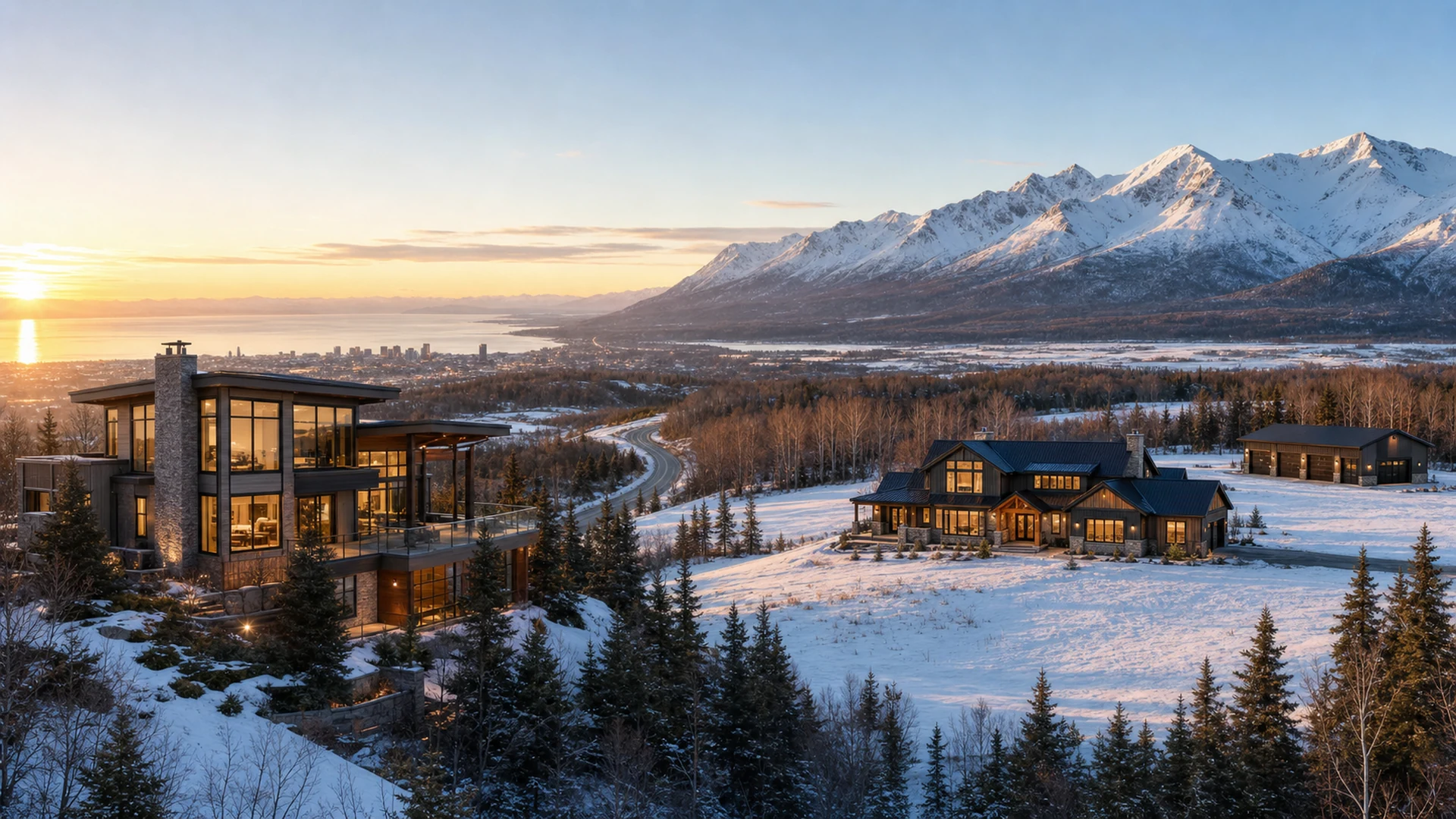
The core trade-off between Anchorage and Mat-Su luxury homes is proximity-and-view versus land-and-value. Anchorage — especially the Hillside — concentrates Cook Inlet and Chugach view lots close to jobs, the airport, and services, at a premium tier that runs roughly $450,000 to $700,000-plus and climbs past $1,000,000 in top new-construction pockets. The Matanuska-Susitna Borough (Palmer and Wasilla) trades a 42- to 44-mile Glenn Highway commute for larger parcels — averaging about an acre — more new construction, and a lower effective property tax rate. One rule that only applies inside Anchorage: a well-or-septic property needs a municipal Certificate of On-Site Systems Approval (COSA) to transfer title, a step the Valley does not require.
Buyers cross-shopping Anchorage and the Mat-Su Valley are really weighing two different definitions of what a luxury home should deliver in Southcentral Alaska. On the Anchorage Hillside, the scarce asset is the view lot with genuine winter sun and a short drive to everything. In the Valley, the scarce asset is space — buildable acreage with a mountain backdrop — at a price per acre Anchorage can no longer match. I’ve watched this corridor shift for forty years, and the buyers who choose well are the ones who decide which of those two things they’re actually buying before they fall for a single listing.
- Anchorage’s Hillside/South Anchorage luxury tier runs roughly $450,000–$700,000+, with new-construction pockets starting near $775,000 and reaching past $1,000,000; Anchorage’s overall median sits in the low-$400,000s.
- The Mat-Su Valley’s overall median is around $435,000; quality one-acre building lots run roughly $80,000–$100,000 per acre — the Valley’s value proposition is land.
- Mat-Su parcels average about an acre; most new Valley homes are stand-alone builds on one-acre lots, whereas Anchorage’s flat, buildable land is nearly gone.
- Effective property tax rate is lower in the Mat-Su Borough (about 0.99–1.10%) than in Anchorage (about 1.22–1.29%), per third-party analyses of Census data — verify any specific parcel with the assessor.
- A Certificate of On-Site Systems Approval (COSA) is required to transfer an Anchorage well/septic property under a 1998 municipal ordinance; the Mat-Su Borough does not impose that step.
- Commute from Palmer (~42 mi) or Wasilla (~43–44 mi) to Anchorage is ~45–55 minutes via the two-lane Glenn Highway, and winter and traffic can extend it well beyond that.
- Alaska has no statewide sales or personal income tax, and sellers statewide must deliver an AS 34.70 disclosure statement before a buyer’s written offer — that part is the same in both markets.
Anchorage vs Mat-Su Luxury Homes at a Glance: The Comparison Table
Start here. The single most useful thing a cross-shopping buyer can do is line the two markets up on the factors that actually move a luxury decision — price structure, land, taxes, the well/septic rules, and the commute — rather than reacting to individual listings. Figures below are drawn from the sources listed at the end of this page; treat market prices as ranges that shift with season and inventory, and always verify parcel-specific taxes with the assessor.
| Factor | Anchorage (Hillside / South Anchorage) | Mat-Su Valley (Palmer / Wasilla) |
|---|---|---|
| Luxury price tier | ~$450K–$700K+; new construction ~$775K to $1M+ | ~$435K overall median; acreage & view homes $750K+ |
| Typical lot size | Smaller, view-premium; flat buildable land nearly gone | Averages ~1 acre; most new builds on one-acre lots |
| Effective property tax rate | ~1.22%–1.29% (third-party est.) | ~0.99%–1.10% (third-party est.) |
| Well/septic title transfer | Municipal COSA required (1998 ordinance) | No municipal COSA requirement |
| Commute to downtown Anchorage | Minutes | ~42–44 mi / ~45–55 min via Glenn Hwy |
| Buyer profile | View, prestige, proximity | Space, acreage, value |
How Do Prices and Value Compare Between Anchorage and the Mat-Su Valley?
The headline difference is what a dollar buys. In Anchorage, the overall single-family median sits in the low-$400,000s, and the luxury tier concentrates on the Hillside and in South Anchorage, generally running $450,000 to $700,000-plus, per current Anchorage market data. Upscale Hillside subdivisions with Cook Inlet or mountain views and new construction start higher — one established Hillside brokerage describes upscale new-build pockets starting around $775,000 and climbing past $1,000,000.
The Mat-Su Valley, by contrast, carries an overall median around $435,000 across Wasilla, Palmer, Houston, and Big Lake, and its luxury and acreage properties commonly reach the $750,000-plus range while delivering far more land. The pattern I see repeatedly: a buyer priced out of a view lot on the Hillside can, in the Valley, buy the same square footage plus several acres and a shop — but they trade the short commute to get it. Neither is “cheaper” in the abstract; they price different things.
Alaska has no statewide sales tax and no personal income tax, so the recurring tax question in both markets is property tax, not income or sales tax. That makes the effective property-tax gap between the borough and the municipality more consequential to a luxury buyer’s annual carrying cost than in most Lower-48 comparisons.
Is Land Really Bigger and Cheaper in the Valley?
Yes — and it’s the Valley’s defining advantage. Matanuska-Susitna Borough property records show an average lot size right around one acre, and industry reporting notes that most new Valley homes are stand-alone builds on one-acre parcels, unlike the compact subdivisions common elsewhere. Quality building lots — good soil, drainage, year-round access, utilities nearby — run roughly $80,000 to $100,000 per acre, and those are the parcels that sell first.
The reason is simple supply: the flat, easily buildable parcels inside Anchorage are nearly gone, which is why the Valley leads the state in new construction. If your luxury vision includes acreage, a heated shop, a garden, room between neighbors, or an airstrip lot, the Valley is where that inventory actually exists. Unlike the Hillside — where you’re paying for a finite view corridor — the Valley lets you buy scale.
What Are the Well, Septic, and COSA Differences?
This is the rule most out-of-area buyers miss, and it only cuts one way. Under a 1998 Municipal Assembly ordinance, transferring title to any Anchorage property served by a well or septic system requires a Certificate of On-Site Systems Approval (COSA) — a document, issued by the Municipality of Anchorage, confirming a professional engineer has inspected and tested the systems and found them compliant with municipal standards. In practice that means recent absorption-field, septic-tank, and well-flow testing, plus current water samples, before closing.
The Mat-Su Borough does not impose that municipal COSA step. But — and this matters — that does not mean Valley well/septic homes are lower-risk. Because city water and sewer reach only the Palmer and Wasilla cores, the vast majority of Valley luxury homes are on private wells and septic. The absence of a mandatory municipal certificate simply shifts more of the burden onto the buyer’s own inspection and testing. On the Hillside, the COSA process forces the issue for you; in the Valley, you have to insist on it.
Which Market Has the Better Views and Setting?
Both are spectacular; they’re just different kinds of spectacular. The Anchorage Hillside is engineered around Cook Inlet and Chugach sightlines, with south-facing view lots commanding the premium — the view is the product. The Valley delivers big, close mountain drama: Pioneer Peak and Lazy Mountain over Palmer, Hatcher Pass to the north, and bluff parcels above the Knik and Matanuska rivers with Chugach and Talkeetna backdrops, frequently on acreage that lets the home sit privately in the landscape.
If your priority is a framed Inlet-and-mountain view minutes from downtown, the Hillside wins. If it’s a wide mountain horizon with land around you and a farmers-market, Hatcher-Pass, State-Fair kind of lifestyle, the Valley wins. That’s a lifestyle choice, not a quality ranking.
How Does the Commute Change the Math?
The Glenn Highway is the whole story. Palmer sits about 42 miles from Anchorage and Wasilla about 43 to 44 road miles, and in normal conditions the drive runs roughly 45 to 55 minutes. But this is a two-lane commuter corridor carrying most of the region’s Mat-Su traffic, and long-time commuters report that rush hour, construction, winter conditions, moose, and the occasional multi-car crash routinely push a “45-minute” drive well past an hour. If an accident closes the Glenn, there isn’t a quick alternate.
For a buyer who works downtown daily, that reliability question is the real cost of the Valley’s land savings. For remote workers, retirees, or those commuting to JBER (which is closer than downtown), it weighs far less. This is exactly why many buyers who need daily Anchorage access but want more space land on Eagle River or Chugiak as the middle ground rather than the full Valley move.
What’s the Same in Both Markets? Taxes and Seller Disclosure
Two things travel with you across the borough line. First, Alaska’s no-statewide-sales-tax, no-personal-income-tax structure applies in both places — the tax you compare is property tax, where the Valley’s lower effective rate is a modest but real annual advantage. Second, seller disclosure is a statewide law: under AS 34.70, before a buyer makes a written offer the seller must deliver a completed written Residential Real Property Transfer Disclosure Statement, and a willful violation can expose the seller to up to three times the buyer’s actual damages. That obligation is identical on the Hillside and in the Valley.
Lean Anchorage (Hillside) if you…
- Want a Cook Inlet / Chugach view lot and short access to jobs, the airport, and services
- Prefer the COSA process to force well/septic verification for you
- Value prestige addresses and proximity over acreage
- Commute to downtown Anchorage daily
Lean Mat-Su Valley if you…
- Want acreage, a shop, privacy, or to build new on a one-acre lot
- Prioritize dollar-per-acre value and a lower effective tax rate
- Work remotely, in the Valley, or commute to JBER rather than downtown
- Are comfortable owning private well/septic and doing your own diligence
- Municipality of Anchorage, On-Site Water & Wastewater Section — Certificate of On-Site Systems Approval (COSA); 1998 ordinance requiring COSA to transfer title on well/septic properties (Anchorage Municipal Code 15.65 / Ch. 15.55).
- Alaska Statutes AS 34.70.010–.200 (via Alaska DCCED and FindLaw) — Residential Real Property Transfer Disclosure Statement: delivery before a written offer; up to 3× actual damages for willful violation; waiver and first-sale exemptions.
- Matanuska-Susitna Borough, Assessment / Transparency portal — borough tax structure, mill rates, and average assessed values; borough property records (average lot ~1 acre).
- Effective property-tax comparisons (SmartAsset; TaxByCounty; Tax-Rates.org) drawn from U.S. Census ACS data — Anchorage ~1.22–1.29% vs. Mat-Su ~0.99–1.10% (estimates; verify parcel-specific figures with the assessor).
- Anchorage market data (Alaska Home HQ 2026 forecast; Redfin; local brokerage neighborhood pages) — Hillside/South Anchorage luxury tier and new-construction ranges; overall Anchorage median.
- Glenn Highway distance/commute context (City of Wasilla; Wikipedia; regional guides) — Palmer ~42 mi, Wasilla ~43–44 mi, ~45–55 min; two-lane commuter corridor.
- Alaska tax structure — no statewide sales tax or personal income tax.
Still deciding between the Hillside and the Valley?
I’ll walk both markets against your actual priorities — view, acreage, commute, and carrying cost — before you tour a single home.
Frequently Asked Questions
For a given amount of land and square footage, the Mat-Su Valley is generally more affordable. Where Anchorage’s Hillside luxury tier runs roughly $450,000 to $700,000-plus and new-construction pockets push past $775,000 toward and above $1,000,000, the Valley’s overall median sits around $435,000 and quality one-acre building lots run roughly $80,000 to $100,000 per acre. The Valley’s discount buys space; Anchorage’s premium buys proximity and increasingly scarce view lots.
Substantially. Matanuska-Susitna Borough records show an average lot of roughly one acre, and most new Valley homes are stand-alone builds on one-acre parcels. Anchorage Hillside luxury lots are typically smaller but view-premium; the flat, easily buildable parcels inside Anchorage are nearly gone, which is a large part of why the Valley leads Alaska in new construction.
No. The Certificate of On-Site Systems Approval (COSA) is a Municipality of Anchorage requirement. Since a 1998 Municipal Assembly ordinance, transferring title to any Anchorage property served by a well or septic system requires a COSA confirming an engineer has inspected and tested the systems. The Mat-Su Borough does not impose that municipal step — but a well-and-septic property anywhere still warrants full inspection and testing as buyer due diligence.
On an effective-rate basis, generally yes. Third-party analyses of Census data put Anchorage’s effective property tax rate around 1.22 to 1.29 percent and the Matanuska-Susitna Borough around 0.99 to 1.10 percent. Your actual bill depends on assessed value, exemptions, and which local service areas apply, so verify a specific parcel with the borough or municipal assessor before relying on any figure. Alaska has no statewide sales or personal income tax in either place.
Palmer is about 42 miles from Anchorage and Wasilla about 43 to 44 road miles, both via the Glenn Highway. In normal conditions the drive is roughly 45 to 55 minutes, but this is a two-lane commuter corridor where rush-hour traffic, winter conditions, moose, and crashes routinely add time. If daily downtown-Anchorage commuting is a priority, that reliability question matters as much as the raw mileage.
It depends on the view you want. The Anchorage Hillside is built around Cook Inlet and Chugach mountain sightlines, with south-facing view lots commanding a premium. The Mat-Su Valley delivers dramatic, close-up mountain scenery — Pioneer Peak, Lazy Mountain, Hatcher Pass, and the Knik and Matanuska river valleys — often on far more acreage. Hillside skews view-and-prestige and proximity; the Valley skews space, mountain backdrop, and value.
The Valley leads Alaska in new construction, largely because buildable land remains available and permitting is simpler than in built-out Anchorage. Most Valley luxury builds are stand-alone homes on one-acre lots relying on wells and septic, since city water and sewer reach only the Palmer and Wasilla cores. Soil quality, drainage, year-round access, and utility proximity drive lot value as much as the view, so vetting the parcel is as important as designing the house.